Xiang Fang

202 posts

Xiang Fang

Xiang Fang

@fang_leon

Assistant Professor of Finance, HKU. (International) Macro-finance. PhD in Economics, University of Pennsylvania.

Hong Kong Katılım Kasım 2013
970 Takip Edilen1.7K Takipçiler
Xiang Fang retweetledi
Central Bank Research Association
Happy Friday / TGIF! 🎉 Reminder to submit your research for the #CEBRA26 Annual Meeting — deadline: 2 March ⏰ 📌#CFP Session 3 highlight: “Monetary Policy in Emerging Markets” Organized by @Banxico Committee: Santiago Bazdresch, @acebreroz 👉 Submit here: cebra-events.org/submitter-dash… Have a great weekend! 📄 #CEBRA #CallForPapers #MonetaryPolicy #EmergingMarkets #AcademicTwitter #EconomicsResearch #TGIF
Central Bank Research Association tweet media
English
0
6
24
1.8K
Xiang Fang retweetledi
Simon Oh
Simon Oh@plausiblyexog·
I've always found seminar preparation to be one of the trickiest parts of academic research. Inspired by @ben_golub and @alexolegimas, I vibe coded Dry Run -- a tool to practice presentations with an AI-powered audience that interrupts you in real-time.
Simon Oh tweet media
English
9
72
435
93.9K
Xiang Fang retweetledi
Dejanir Silva
Dejanir Silva@SilvaDejanir·
If you want to learn more about Machine Learning for Computational Economics, I’m teaching a course on the topic, building on my RFS work. 📘 Lecture notes + Julia implementations: 👉 dejanirsilva.github.io/mlce/
GIF
English
2
56
204
25.4K
Xiang Fang retweetledi
International and Monetary Economics Network
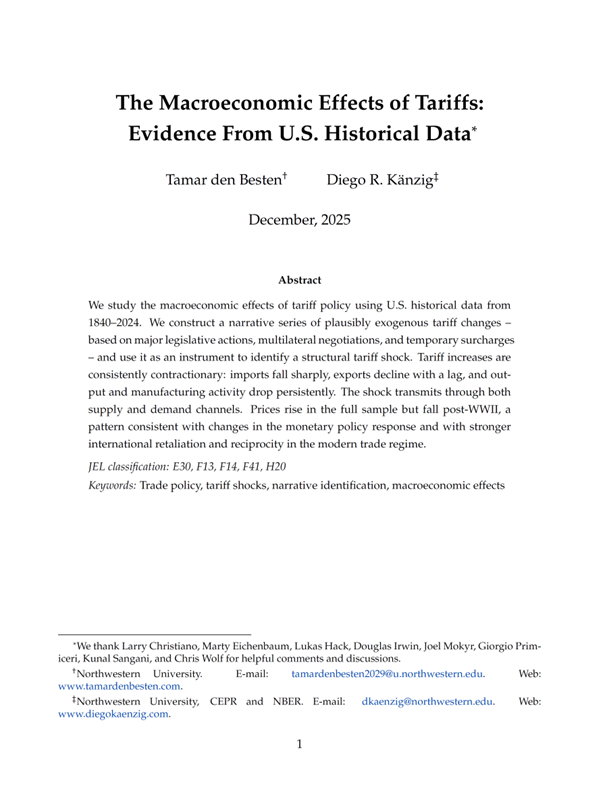
Highly recommended! "The Macroeconomic Effects of Tariffs: Evidence From U.S. Historical Data" by Tamar den Besten and Diego R. Känzig. "We study the macroeconomic effects of tariff policy using U.S. historical data from 1840–2024. We construct a narrative series of plausibly exogenous tariff changes – based on major legislative actions, multilateral negotiations, and temporary surcharges – and use it as an instrument to identify a structural tariff shock. Tariff increases are consistently contractionary: imports fall sharply, exports decline with a lag, and output and manufacturing activity drop persistently. The shock transmits through both supply and demand channels. Prices rise in the full sample but fall post-WWII, a pattern consistent with changes in the monetary policy response and with stronger international retaliation and reciprocity in the modern trade regime." dkaenzig.github.io/diegokaenzig.c…
International and Monetary Economics Network tweet media
English
7
125
550
29.6K
Xiang Fang retweetledi
International and Monetary Economics Network
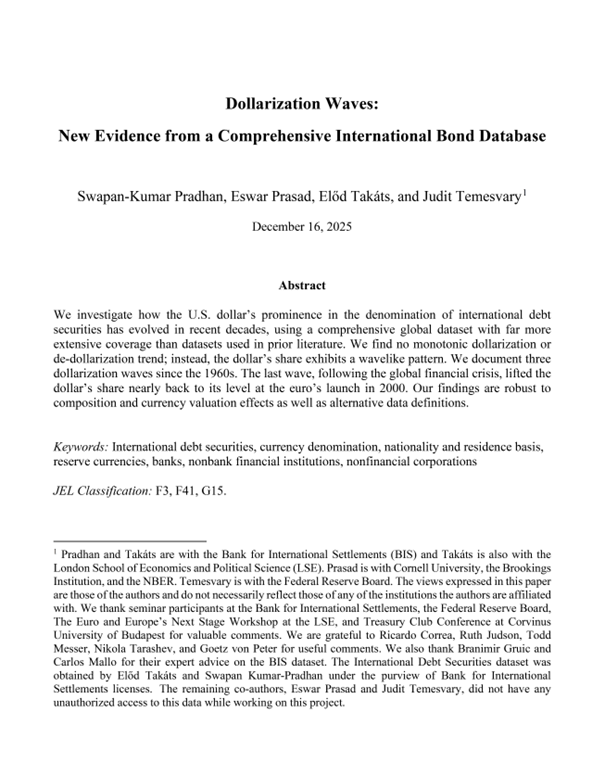
Food for thought! "Dollarization Waves: New Evidence from a Comprehensive International Bond Database" by Swapan-Kumar Pradhan, Eswar Prasad, Előd Takáts, and Judit Temesvar. "We investigate how the U.S. dollar’s prominence in the denomination of international debt securities has evolved in recent decades, using a comprehensive global dataset with far more extensive coverage than datasets used in prior literature. We find no monotonic dollarization or de-dollarization trend; instead, the dollar’s share exhibits a wavelike pattern. We document three dollarization waves since the 1960s. The last wave, following the global financial crisis, lifted the dollar’s share nearly back to its level at the euro’s launch in 2000." federalreserve.gov/econres/ifdp/f…
International and Monetary Economics Network tweet media
English
0
15
57
3.3K
Xiang Fang
Xiang Fang@fang_leon·
@andresfernanm It's a great pleasure to host you and learn from your insightful work! Look forward to the paper and data release.
English
0
0
0
39
Andres Fernandez Martin
Andres Fernandez Martin@andresfernanm·
Many thanks to Wataru Miyamoto and @HKUEcon for the invitation and warm hospitality. It was a real pleasure to present our forthcoming work on capital flow restrictions and AI, and engage in thoughtful discussions. Excellent questions and very valuable feedback, much appreciated.
English
1
0
10
1.2K
Xiang Fang retweetledi
International and Monetary Economics Network
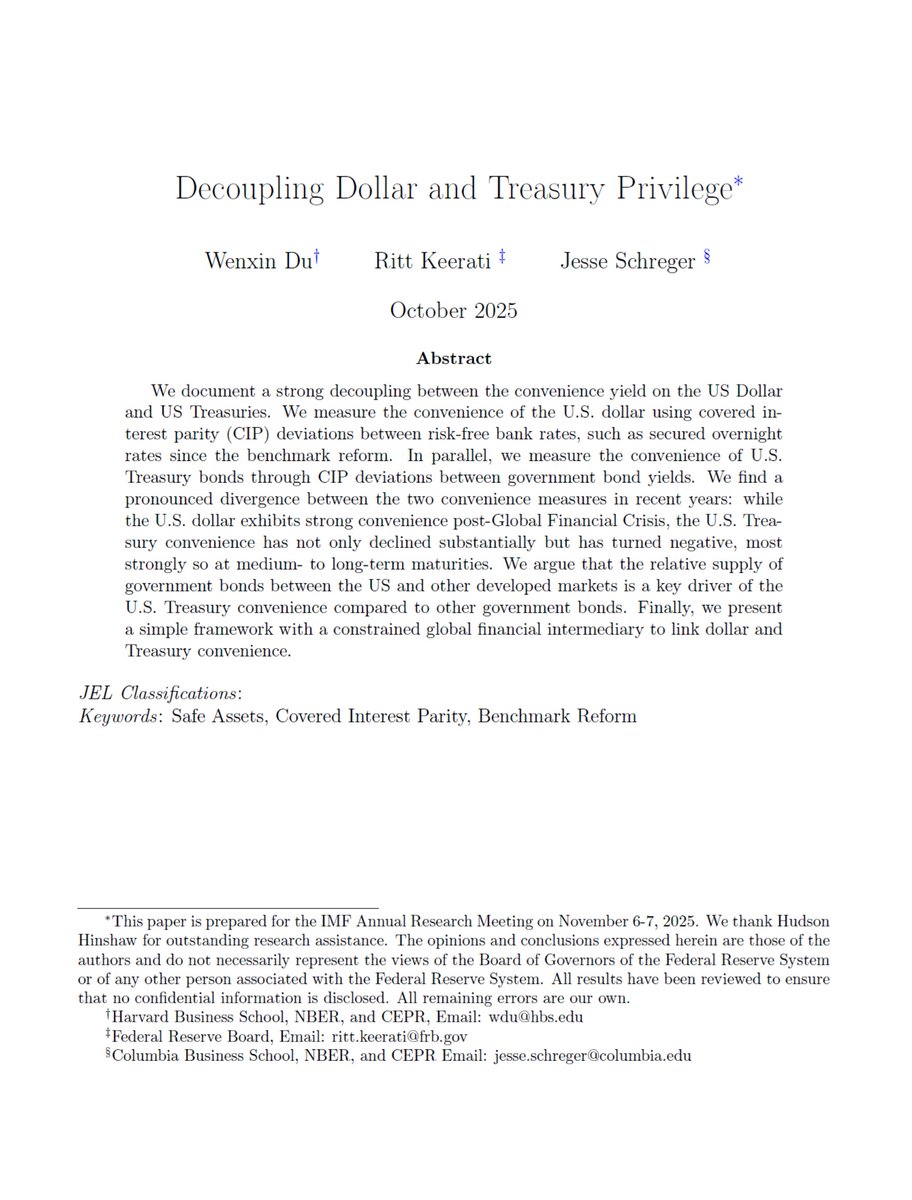
Super interesting! "Decoupling Dollar and Treasury Privilege" by Wenxin Du, Ritt Keerati, and Jesse Schreger. "We document a strong decoupling between the convenience yield on the US Dollar and US Treasuries. We measure the convenience of the U.S. dollar using covered interest parity (CIP) deviations between risk-free bank rates, such as secured overnight rates since the benchmark reform. In parallel, we measure the convenience of U.S. Treasury bonds through CIP deviations between government bond yields. We find a pronounced divergence between the two convenience measures in recent years: while the U.S. dollar exhibits strong convenience post-Global Financial Crisis, the U.S. Treasury convenience has not only declined substantially but has turned negative, most strongly so at medium- to long-term maturities. We argue that the relative supply of government bonds between the US and other developed markets is a key driver of the U.S. Treasury convenience compared to other government bonds." imf.org/en/News/Semina…
International and Monetary Economics Network tweet media
English
2
24
105
14.4K
Xiang Fang retweetledi
Bryan Hardy
Bryan Hardy@BryanHardyEcon·
Great initiative! For macro/finance/international topics, we’ve assembled a number of links to different datasets (as well as code and other resources) here: sites.google.com/view/interconn… The NBER IFM data page is another great resource.
Nicholas Decker@captgouda24

I’ve started an ongoing project to collect all the datasets which economists can use, all in one place, organized by topic. Started with 50, further suggestions are extremely welcome. It will grow considerably.

English
3
36
252
25.2K
Xiang Fang retweetledi
Ivan Werning
Ivan Werning@IvanWerning·
My pick for Monday Econ Nobel. International macro. Calvo, Obstfeld Rogoff. One can dream.
English
22
40
457
57.1K
Xiang Fang retweetledi
Global Capital Allocation Project
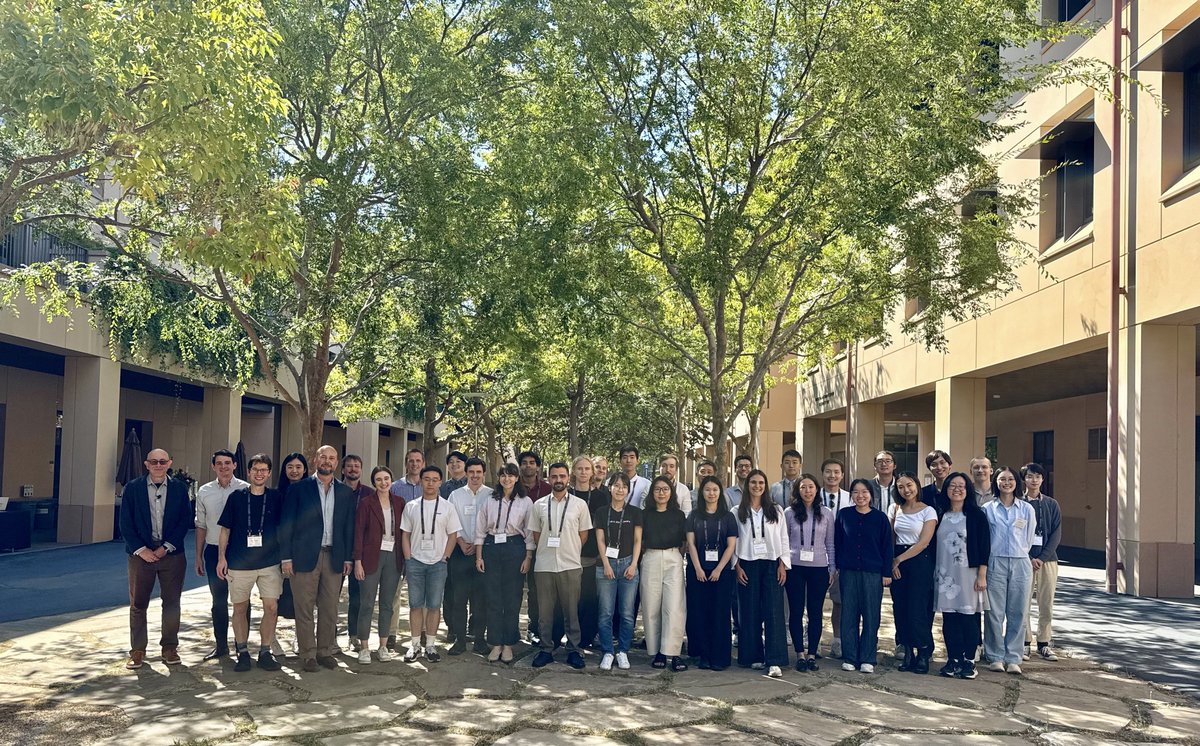
We welcomed 37 PhD students from 22 universities to the 2025 Big-Data Initiative in International Macro-Finance this month. This was the 5️⃣th iteration of an event that is designed to lower barriers to entry to large-scale, data-driven research in the field. All materials are available on the event website: globalcapitalallocation.com/bdi-cover-page.
Global Capital Allocation Project tweet media
English
3
11
96
25.9K
Xiang Fang retweetledi
Jon Hartley
Jon Hartley@Jon_Hartley_·
In honor of Stan Fischer, his classic "Lectures on Macroeconomics" with @ojblanchard1 deserves a re-read
Jon Hartley tweet media
English
8
49
409
52.5K
Xiang Fang retweetledi
NBER
NBER@nberpubs·
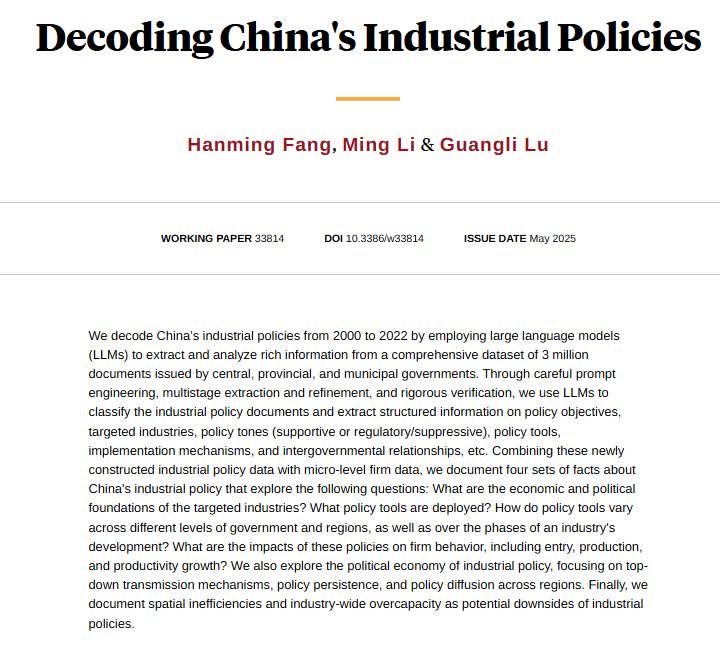
Extracting information from a dataset of 3 million documents issued by Chinese central, provincial, and municipal administrations to assess China's industrial policies over the period 2000 to 2022, from @HanmingF, Ming Li, and Guangli Lu nber.org/papers/w33814
NBER tweet media
English
14
59
197
26.4K