Fearfully Greedy

1.2K posts

Fearfully Greedy banner
Fearfully Greedy

Fearfully Greedy

@fearfullygr33dy

Lokesh is learner of markets, adviser to none. Everything here are just my thoughts, don't hold me against them if they turn out to be garbage.

Katılım Haziran 2011
1.1K Takip Edilen133 Takipçiler
Sabitlenmiş Tweet
Fearfully Greedy
Fearfully Greedy@fearfullygr33dy·
रात भर का है मेहमां अंधेरा, किसके रोके रुका है सवेरा? रात जितनी भी संगीन होगी, सुबह उतनी ही रंगीन होगी, ग़म न कर गर है बादल घनेरा, किसके रोके रुका है सवेरा? लब पे शिकवा न ला अश्क़ पी ले, जिस तरह भी हो कुछ देर जी ले, अब उखड़ने को है ग़म का डेरा, किसके रोके रुका है सवेरा? यूं ही दुनिया में शामें ढली हैं, यूं ही मुश्किल की राहें चली हैं, होगा हर दिल में कल फिर बसेरा, किसके रोके रुका है सवेरा? - साहिर लुधियानवी
हिन्दी

1
0
0
349
Fearfully Greedy
Fearfully Greedy@fearfullygr33dy·
SJ Logistics (India) Ltd Sector: Logistics & Supply Chain Solutions Author: @fearfullygr33dy SJ Logistics (SJL) is pivoting from pure freight forwarding to high-margin Project Cargo and integrated Vessel Operations. Earnings Inflection: 44% PAT growth in FY26. Valuation Gap: Trading at 6.8x PE despite 30% revenue CAGR. Operational Pivot: Expansion into UAE-based vessel chartering to capture higher-margin cargo flows. Things to watch out for: Cash Flow Disconnect: FY26 CFO is only 28% of PAT. Profitability is not translating to cash; it is trapped in receivables. And in most cases this is because of large, repeat institutional customers being extend a larger credit line. And eventually trims bottomline. By 16Cr this year. However, receivable days in the 120–170 day range appears to be an industry-specific for project cargo, freight forwarding, and multimodal logistics in India. Receivables Pressure: Receivables days at 134 days. Revenue growth is technically debt-funded (₹77 Cr increase in borrowings). Rerating aspects: Mainboard Migration: Necessary to attract institutional credit lines. And possibly have peer mainboard valuations. CFO/PAT Conversion: Must improve from 28%. But mgmt says its by choice. UAE Subsidiary: Success in chartering operations will confirm margin expansion thesis. View High-conviction inflection play. Current 6.8x PE offers significant safety, but the working capital cycle is the primary structural bottleneck. Monitor cash conversion ruthlessly. Our Estimates: Revenue | FY26 ₹653.8 Cr | FY27 Est ₹787.5 Cr PAT | FY26 ₹75.8 Cr | FY27 Est ₹91.35 Cr These are very conservative estimates because of 50% execution efficiency caused by capital stuck in receivables vs the real revenue capability of ₹1,575 Cr. SEBI Disclaimer: For research only. SME stocks carry high liquidity risk. Not a SEBI-registered advisor. Consult a pro. #SJLogistics #sme
Fearfully Greedy tweet media
English
0
1
10
888
Fearfully Greedy
Fearfully Greedy@fearfullygr33dy·
How's selling an asset that they built themselves and was planned to be sold (hence all the myriad subsids because it was always planned) is not an operating income? Oriana doesn't just sell solar plants they sell a de-risked cash flow. They secure the land, ppa, build the plant, operationalize it and then sell the shares of the subsids to Actis. Why would one keep a depreciating low pat margin asset with a lot of capital stuck? Wouldn't this liquidity give them fire power to work on ammonia projects? bess projects without diluting a lot or increasing debt?
English
1
0
2
391
Vikash Khandelwal
Vikash Khandelwal@bitcoinMyName·
Disappointing oriana power result Will sell half of them, if price rises a little
English
3
0
1
3K
Fearfully Greedy
Fearfully Greedy@fearfullygr33dy·
Oriana Power Limited: The BESS Inflection 🔋 Author: @fearfullygr33dy Oriana is transitioning from a Solar EPC to an integrated RE Powerhouse. With the BESS (Battery Storage) pipeline now at 20 GWh and a ₹3,135 Cr Green Ammonia deal with SECI, the company is positioning for a 5-year earnings explosion. The missed guidance and margin suppression: In our opinion real margin Story is probably not module prices for the FY26 margin dip, but our forensic audit reveals a different truth: Accounting issue: Past margins were clean at 16%+ (FY25 & H1 FY26). The H2 dip (12.6%) is a pure timing issue on the ₹900 Cr Actis deal. If that's what the management accounted for in their guidance. Heavy H2: Because construction costs were booked in FY26, the deferred Actis premium in Q1 FY27 will be near-100% margin. Expect a profit surge. Overhead Bloat: Employee costs jumped 3.7x in H2, indicating heavy senior hiring ahead of revenue. Mostly hiring is being done for new verticals bess, ccus. And may be effect of labour laws? Revenue & PAT Visibility Our Estimation (Including ACTIS deal) Current Revenue (FY26): ₹1,814 Cr Estimated Revenue (FY27): ₹3,125 Cr Current PAT (FY26): ₹252 Cr Estimated PAT (FY27): ₹450 Cr Key Catalysts Actis Deal Closure: Expected Q1 FY27 (The major re-rating trigger). GWh-Scale BESS Execution: Growing contribution to top line and bottom line from just being orders so far. Green Ammonia Land Bank: Progress on the MP/UP integrated complexes. SEBI Disclaimer: For research only. SME stocks carry high liquidity risk. Not a SEBI-registered advisor. Consult a pro. #orianapower #truere #sme #smeresults #oriana
Fearfully Greedy tweet media
English
0
0
1
993
Fearfully Greedy
Fearfully Greedy@fearfullygr33dy·
Kay Cee Energy and Infra Limited 1. Business Model and Revenue Breakdown KCEIL is an EPC specialist focused on EHV transmission lines (up to 765kV) and substations. It also offers specialized Emergency Restoration Systems (ERS). - EPC (Supply + Services): ~90% of revenue. - O&M Services: ~10% (Stable recurring base). 2. Strategic Roadmap (2025-2030) - Sep 2026: Delayed commissioning of Plant-II (Kota) for backward integration. - 2027+: Expansion into Solar EPC and Railway Electrification. 3. Execution issues and Governance Audit - Cash Flow Misalignment: The business is currently not self-sustaining; growth is funded by debt and constant equity dilution (Rs 25 Cr QIP in 2025). - Capex Delays: Plant-II has been pushed multiple times from its original FY25 target. - Litigation: Current Rs 5 Cr lawsuit against Zee Rajasthan suggests potential reputational friction. 4. Summary Conclusion KCEIL is currently just showing growth. The high order-to-sales ratio (2.9x) is negated by the structural inability to convert profits into cash. SEBI Disclaimer: This report is for informational purposes only and does not constitute investment advice. I'm not a SEBI-registered advisor. Investing in SME stocks involves extrme risk of capital loss. #kaycee #kceil #kayceenenergy
Fearfully Greedy tweet media
English
0
0
0
617
Fearfully Greedy
Fearfully Greedy@fearfullygr33dy·
Purple United Sales Limited (Purple United) has reported strong FY26 results Purple United Sales Ltd (PURPLEUTED) on a Growth Spree! Recent FY26 results, concall highlights & investor presentation paint a vibrant picture for this #KidsFashion brand. Here's the scoop: Financial Highlights (FY26): - Revenue: Up 65% YoY! - EBITDA: Surged 76% YoY! - PAT: Increased 45% YoY! - EBITDA Margin: Strong at 21%. Retail Expansion & Strategy: - Reached 111 EBOs (Exclusive Brand Outlets) by April 2026. - Targeting 200+ stores in FY27! - Retail contribution expected to cross 50% of topline in FY27. - Mature stores seeing ₹9L/month sales (up from ₹4L in FY25!). E-commerce & Omnichannel: - Targeting 12-14% of revenue from e-commerce in FY27. - D2C website revamped, driving 59% Q-o-Q revenue growth online! - Total e-commerce orders: 1,000-1200/day. Key Takeaways: - Strategic shift to high-margin "Control Business" (EBOs + D2C) paying off. - Secured CRISIL BBB-/Stable rating. - No immediate fresh fundraising planned. Watch Outs: - Rapid expansion execution. - Working capital management (inventory levels). Purple United is truly carving out its niche as India's premium kids' fashion leader! #IndianStockMarket #SME #Investment #GrowthStocks #purpleunitedsales #pusl --- Disclaimer: This is not financial advice. I am not a SEBI-registered research analyst or investment advisor. Please consult a qualified financial advisor before making any investment decisions.
Fearfully Greedy tweet media
English
0
0
0
202
Fearfully Greedy
Fearfully Greedy@fearfullygr33dy·
#pngadgil P N Gadgil Jewellers Ltd #PNGJL Q4 Margins🔴 Warranted A 230 bps drop is a fundamental miss; it questions the "high margin" story. Duty/PM News🟡 Overreaction Short-term volume pain is real, but the inventory gain (windfall) is being ignored by the market. Growth (+40%)🟢 Under-appreciated Beating revenue guidance during an expansion phase is rare and positive.
English
1
0
0
1.6K
Fearfully Greedy
Fearfully Greedy@fearfullygr33dy·
@Alchemist1320 Sandeep sir I really miss your wisdom and lay of the land commentary we used to get on the spaces. Last correction/bear market ate up the spaces as well. Please see if we can resume those mustafa, prince et. al. late night(for us) sessions. @mustafa_kach @AI_Feb21
English
2
0
6
393
Sandeep Singh
Sandeep Singh@Alchemist1320·
One will see that people working in certain industries never pick winner stock from same industries while those who know less carry on. Same way employees rarely bet on their own employers. Curse of awareness is a philosophical and psychological concept that describes burden of seeing, knowing or understanding more than average.
English
10
0
63
6K
shiv
shiv@shivrockstar·
Visual representation of a hidden multibagger 💮
shiv tweet media
English
6
1
29
2.2K
Fearfully Greedy retweetledi
Chenthil
Chenthil@jcrajan00·
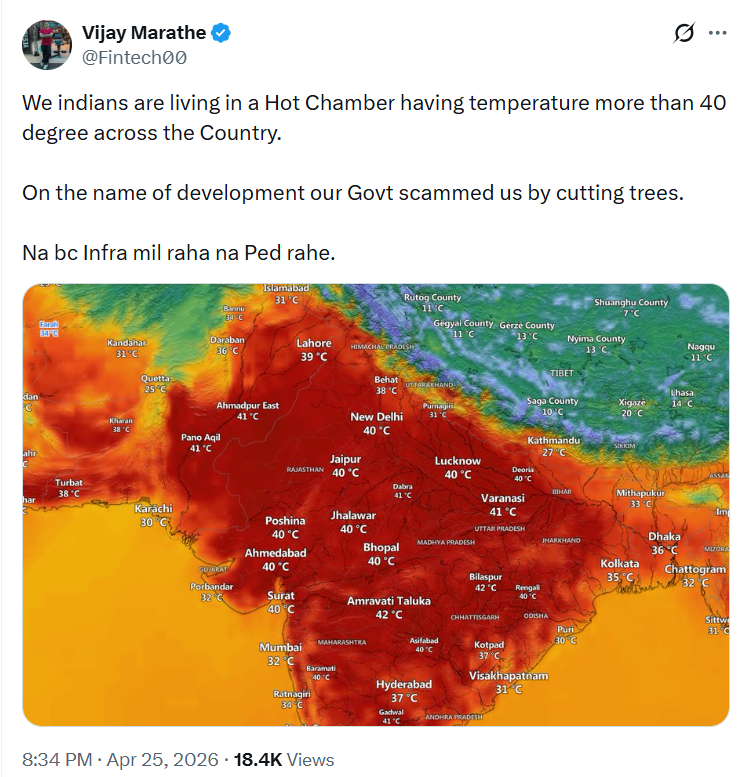
India's power demand hit 260 GW last week. That record lasted 3 days. Yesterday it touched 265 GW. The heatwave is pushing the grid to limits that did not exist in planning scenarios. Solar generation is helping during peak daytime hours — 60 GW of solar capacity pumping out near-maximum between 11 AM and 3 PM. But the problem is the evening ramp. When solar drops at 5 PM, thermal and hydro need to pick up 50 GW in two hours. That ramp rate is what grid operators lose sleep over. India's grid design assumed peak demand of 270 GW by 2030. We hit 265 GW in April 2026 — four years ahead of schedule. The gap between planning and reality is the most important infrastructure story right now. NTPC, Adani Power, Tata Power — every generator running at maximum. Coal stockpiles at several plants fell below 10 days. The grid is holding. But the margins are getting thinner by the week. At 1,255 kWh per capita — one-third the global average — India's electricity demand will compound for decades. The companies building generation and transmission capacity today are building toll roads for the next 20 years of industrialisation.
English
15
68
449
22.6K
Fearfully Greedy retweetledi
Niteen S Dharmawat, CFA
Niteen S Dharmawat, CFA@niteen_india·
I see so many SM posts which appeared to be a coordinated effort to discredit India and the India story while seeding the seeds of doubt, pessimism, and mistrust in our own progress, often by amplifying half-truths and ignoring context. Just a fact of the matter is India has always experienced extreme heat waves 45–49°C temperatures were recorded decades ago too.
Niteen S Dharmawat, CFA tweet media
English
19
22
120
6.2K
Fearfully Greedy retweetledi
Massimo
Massimo@Rainmaker1973·
India is currently the hottest large region on Earth by a huge margin with 95 of the world’s 100 warmest cities right now. Large parts of northern and eastern India are experiencing extreme heat much earlier than usual, with dozens of cities in the 43–47°C range while most of the rest of the world is far cooler.
Massimo tweet media
English
165
667
2.7K
379.4K
Fearfully Greedy retweetledi
Chenthil
Chenthil@jcrajan00·
India's peak power demand hit 260 GW yesterday. New all-time record. During a heatwave with 47°C temperatures across North India. The grid held. No blackouts. That sentence alone is an engineering achievement most people will not appreciate. Five years ago India had chronic power deficits. Load shedding was normal. In 2023, peak demand hit 243 GW and several states struggled. In April 2026, the grid delivered 260 GW without a single major failure. What changed: 26.5 GW of new capacity added in FY26 — largest annual addition in a decade. Solar alone contributed 18 GW. New HVDC transmission corridors connecting surplus regions to deficit ones. Battery storage deployments cushioning peak load. But the margin is razor thin. India's grid is designed for about 270 GW. We just touched 260 GW. That is 96% utilisation during peak hours. One more heatwave spike or an unexpected plant outage and the buffer disappears. This is why every power stock hit 52-week highs. The market sees what the headlines miss — India needs $150 billion in power infrastructure investment over five years just to keep up. Data centres, EVs, semiconductor fabs, industrial expansion — all need reliable 24/7 power. The grid is the bottleneck holding everything else together.
English
152
2.2K
10.9K
472.3K
Fearfully Greedy retweetledi
Aakash Gupta
Aakash Gupta@aakashgupta·
India is the hottest country on Earth right now. Amravati 42°C. Bilaspur 42°C. Delhi 40°C. It is April. Here is the number every India bull is missing. McKinsey projects that lost labor hours from heat will put 2.5% to 4.5% of Indian GDP at risk every year by 2030. That works out to $150 to $250 billion in annual losses. The ILO converts the same effect into 34 million full-time job equivalents lost to heat exposure that physically caps how long humans can work outdoors. The IMF projects India passes Japan to become the 3rd largest economy this decade. Those forecasts assume normal labor productivity. They are not pricing in 167 billion labor hours already lost to heat in India in 2021 (Lancet), or heat-related deaths rising 55% over two decades. Now look at the cooling curve. 8% of Indian households own an AC. The U.S. is at 87%. Chinese urban households average more than one AC per home. China was also at 8% in 1995, and added 200 million ACs over the next 15 years. India is starting the same curve right now, with 110 million units already installed and another 130 to 150 million expected by 2035. Here is where the grid math breaks. Indian peak power demand hit 240 GW in 2024. ACs already account for 40 to 50 GW of that load. UC Berkeley projects room ACs alone will add 180 GW of peak demand by 2035. That is the entire installed electricity capacity of Germany. From cooling. The Central Electricity Authority is already modeling a 26 GW peak shortfall by 2028. The grid is roughly 70% coal-fired generation. Every AC switched on pulls harder from a thermal plant that is itself part of the heating loop. So the rate limiter on India becoming the world's 3rd largest economy is the grid. The country needs roughly 240 million more air conditioners to keep its workforce productive through a six-month summer. The grid can supply maybe a third of that load without rolling blackouts that destroy the same productivity the AC was meant to save. The map at 42°C in April is the GDP forecast getting marked down in real time.
Aakash Gupta tweet media
English
139
374
1.5K
213.1K
Fearfully Greedy retweetledi
Chenthil
Chenthil@jcrajan00·
India approved 139 data centres worth $10 billion in investment in the last 18 months. Total capacity under construction: 2.5 GW. This is not a tech story. This is an energy and real estate story. A single hyperscale data centre consumes as much power as a small city. The 2.5 GW pipeline is equivalent to adding the power demand of three Jaipur-sized cities — just for data centres. Adani, Reliance, Tata, CtrlS, NTT, Equinix — all building simultaneously across Mumbai, Chennai, Hyderabad, and Noida. AWS, Google, and Microsoft have each committed over $5 billion to Indian cloud infrastructure. NVIDIA is backing Indian AI startups at seed stage. Here is the problem nobody is solving fast enough: where does the power come from? India's grid is already at 95% peak utilisation in summer. Adding 2.5 GW of always-on data centre load requires either massive new generation capacity or dedicated renewable installations. This is why the semiconductor and data centre stories are connected. India cannot be an AI power without reliable 24/7 power. The grid infrastructure bottleneck — not talent, not capital — will determine whether India becomes an AI hub or just an AI consumer.
English
69
211
1.3K
368.3K
Fearfully Greedy retweetledi
Alistair Brownlee
Alistair Brownlee@AliBrownleetri·
It is my birthday today, so I allowed myself a completely self‑indulgent data analysis. I have had the “what is the hardest endurance sport” argument in so many changing rooms and cafes that I lost count years ago. Swimming feels psychologically hardest for me. Cycling feels highest risk. Running just feels brutally honest. So this time I tried to answer it with data. I pulled nearly a million sessions across nine endurance sports and looked at what each one does to the cardiovascular system, both per minute and per session. Here is what I found: - Every sport has a distinct heart‑rate “fingerprint”. Running is a tight, right‑shifted bell around 145 bpm. Walking and ski touring sit broader and lower. Downhill skiing is all peaks and troughs. - Running really is hard on the heart. It has the highest session average, peak HR, and sustained intensity ratio. - Walking’s “high” intensity ratio is a statistical trick. Low average, low peak, very flat sessions that only look hard on paper. - Downhill skiing has the biggest swings. Peaks rival outdoor cycling, but average HR sits near walking. That 47 bpm gap matches the feeling of short bursts and a lot of standing around. - Cross‑country skiing behaves like running at the top end and like cycling on average. Huge peaks, long gliding recoveries. - Indoor cycling is the purest steady effort after running. The sustained profile is similar in relative terms, but the absolute load is lower because seated cycling simply costs less than weight‑bearing running. Within the same person, running still wins. Among 1,480 people who both run and ride outside, 93% hit a higher fraction of their personal max HR when they run. Same body, same heart, different biomechanical demand. Then I changed the question. Because intensity is only part of the story and I recently cycled for 35 hours at a low Heart Rate, but it certainly felt pretty hard! Do you want to reward time on feet, or time in the red zone? Full research below.
Alistair Brownlee tweet media
English
30
39
380
94.6K
Fearfully Greedy
Fearfully Greedy@fearfullygr33dy·
@term_investor @Alchemist1320 Its not always about buying, at times its about owning one and trying to find the path down. A capital intensive business with such high growth will soon need much larger capital. And having access to raise equity its always better to be able to dilute less.
English
0
0
0
51
The Long Term Investor
The Long Term Investor@term_investor·
@Alchemist1320 If stock is so good, then you should be buying all in instead of promoting it on twitter which is exactly opposite of what one should do. You all should appreciate good stock staying below fundamentals rather than promoting it on twitter.
English
2
0
5
1K
Sandeep Singh
Sandeep Singh@Alchemist1320·
Rajesh power : company of this size and calibre should have not been listed on SME platform. Segment doesn’t have enough investor depth and profile to appreciate that growing on large bases is not a cake walk. And then raw material volatility and war supply shock must have made execution even more challenging for all companies. Such price volatility and then price crash on result gives very bad feedback to good managements as they are left wondering what exactly is the investor expectation. Management’s best course of action would be to keep on pitching to investors who are active in both mainboard and SME while final redemption will only come once they reach main board.
English
28
19
272
23.5K
Fearfully Greedy
Fearfully Greedy@fearfullygr33dy·
@VTGCapital Blockade has worked. I think here Trump is right. Theyre under severe cash crunch.
English
0
0
0
34
Fearfully Greedy
Fearfully Greedy@fearfullygr33dy·
Rajesh Power Service Limited Concall 1. The Cash Flow Reversal (The "Smoking Gun") The most significant update is the ₹150 crore already received. In the FY26 results, the company had a negative operating cash flow of -₹41.42 crore. If ₹150 crore was collected in April/May 2026 (post-March 31), the negative cash flow caused by back-ended March billing. They can clear receivables in 45–60 days, and the company’s working capital cycle is actually quite healthy for the power T&D sector, where 90–120 days is often the norm. 2. Hypergrowth Sustainability (FY27 Outlook) Management’s guidance of 40% growth for FY27 is aggressive. Visibility: With a ₹3,200 crore pending order book and ₹6,000 crore in the pipeline, the revenue target is mathematically grounded. 3. Margin Defense: "Mix" vs. "Erosion" Supply vs. Service: In EPC, "Supply" components (buying cables/transformers) have lower margins, while "Installation/Testing" has higher margins. If a large chunk of the current billing was for equipment supply, the margin dip is temporary and not a loss of pricing power. Price Escalation Protection: The claim that margins are "protected with price escalation" is vital. It means the company is not absorbing the rising costs of aluminum, copper, or steel, which is the primary killer of EPC businesses. 4. The "Intangibles": Low Attrition The mention of people who are with them from 2002 are still with them and are training new folks is a massive competitive advantage in a labor-strapped sector. Industry low attrition. Execution Risk: The biggest risk in hypergrowth is "execution failure" due to lack of skilled manpower. A stable workforce reduces the risk of project delays or technical errors in complex 400kV GIS projects. #rajeshpower
English
0
1
1
383