Deo Non Fortuna

247 posts

Deo Non Fortuna banner
Deo Non Fortuna

Deo Non Fortuna

@filiusveritatis

I will either find a way or make one. Christian Orthodox, Stock market investor, Philosopher. #RKLB #ASTS

Katılım Temmuz 2015
110 Takip Edilen69 Takipçiler
Deo Non Fortuna
Deo Non Fortuna@filiusveritatis·
@kingtutcap @moninvestor Brother could you sometime show your portfolio and how you have allocated percentage wise in every position? You have give out alpha
English
1
0
0
42
mon
mon@moninvestor·
I know 2027 is a long way off, but I think $OUST is going to be one of the top stocks of 2027.
English
18
8
248
23.2K
Deo Non Fortuna
Deo Non Fortuna@filiusveritatis·
@kingtutcap @moninvestor You in $OUST Tut? I’m balls deep $ASTS but I might allocate 25% somewhere down the line and Ouster is interesting
English
1
0
0
199
Deo Non Fortuna
Deo Non Fortuna@filiusveritatis·
@Yeah_Dave Brother, can you drop a portfolio update? Like I said before you have really good takes and one of the better accounts on X
English
0
0
2
540
YeahDave
YeahDave@Yeah_Dave·
Between the $PENG "crisis" and the frantic 800V / $WOLF / $IFX / $NVTS frenzy, we're hitting peak gerbil energy. Add the now non-stop $NBIS glazing and near-universal derision at any "AI bubble" mention. It's getting a bit one-sided. Worth a reminder to stay sober minded.
English
14
0
120
38.6K
Deo Non Fortuna
Deo Non Fortuna@filiusveritatis·
@BryzonX Do you have a pt on $PENG? What could is possibly reach?
English
0
0
0
227
bryan
bryan@BryzonX·
@filiusveritatis PENG has a better valuation, but MXL has a more diversified business with a much larger TAM I own both
English
1
0
1
547
bryan
bryan@BryzonX·
Currently, $PENG 🐧 is the headliner stock solving the CXL/HBM constraint for the GPU memory wall running AI inference But there is a company quietly rerating in the background applying that exact same concept of data expansion and latency reduction, except they are doing it at the CPU and storage layer for the agentic era That company is MaxLinear $MXL The logic driving $SNDK ‘s astronomical run is fairly simply to understand. Real time AI agents require massive storage pools but with the industry predicting a severe storage capacity wall out to 2028, hyperscalers are forced to find ways to make their CPU’s more efficient since they physically can’t buy more NAND Last year in July at the 2025 Future of Memory & Storage Conference (yes this is a real conference) MXL announced Panther 5, an accelerator that delivers up to a 15:1 data reduction ratio directly into the CPU By compressing and deduplicating data inline at 450Gbps, Panther 5 increases hyperscalers existing flash capacity while completely freeing the host CPU from excess power consumption Management didn't just announce Panther 5x they are already guiding for storage accelerator revenue to at least double in 2026 from 2025, targeting a standalone $5B silicon accelerator market Just like $PENG ‘s MemoryAI KV Cache is expanding existing hyperscalers HBM capacity, $MXL ‘s Panther 5 is expanding existing hyperscalers NAND capacity PENG = GPU Memory Expansion (HBM) MXL = CPU Storage Expansion (NAND) The same core thesis, but a different layer of the AI server rack As of today, the market has widely known MXL for their high speed 800G and 1.6T DSPs, viewing them as a pure play winner in optical interconnect infrastructure With both their 1.6T optical interconnect chips and their Panther 5 AI storage accelerators, MaxLinear is now positioning themselves as a core full stack AI infrastructure play They already have one foot in the door with hyperscalers due to their DSPs… it’s just a matter of time before this becomes the new industry standard
bryan tweet media
English
16
22
219
32.2K
🐧
🐧@pennycheck·
@ParadisLabs Just saying according to last earnings call revenue from kioxia and sandisk will start ramping for $ADEA beginning in q2 !
English
3
3
68
9.9K
Paradis Labs
Paradis Labs@ParadisLabs·
Kioxia (285A) just put out sensational earnings & guidance. Very bullish validation of the NAND supercycle. I'm viewing this dip as a perfect buying opportunity to cost-avg up. Q4 FY25 (Jan-Mar 2026): - Revenue: ¥1,002.9B (QoQ +85%) - OP: ¥599.1B (margin 60%; QoQ +314%) - ASPs >2x'd QoQ; bit shipments down ~10% QoQ as planned for inventory control. - 8th-gen BiCS production now exceeds 5th-gen levels. Cash flow and balance sheet are pristine post-refinancing. Q1 Guidance (Apr-Jun 2026): - Revenue: +75% QoQ - OP: +117% QoQ; margin 74% - NP: +112% QoQ "AI inference servers driving overall NAND demand growth… interest is intensifying." "CY27: Demand anticipated to exceed supply." Memory keeps going up and up with every quarter... Pls DYOR.
Paradis Labs tweet media
English
19
27
265
142.7K
John Galt
John Galt@AtlasShrug1·
Test to see if you folks have been listening. When Uranium is down, what do I do? A. Buy with hands B. Buy with both hands bc there is an incredible supply/demand story emerging C. Buy with both hands because every country in the world will be seeking energy independence after this Iran conflict or D. All of the above
English
3
0
10
1.1K
🐧
🐧@pennycheck·
@filiusveritatis Current top 3 holdings are Adea , peng shmd Not financial advise as always
English
5
1
38
2.7K
bryan
bryan@BryzonX·
$HLIT CFO on the current opportunity ahead of them: ‘COMCAST HAS LED THE WAY, WHAT WE ARE SEEING IS EVERYONE ACROSS THE GLOBE ARE STARTING TO UPGRADE THEIR NETWORK AS THEY NEED TO STAY COMPETITIVE’ ‘THIS IS OPENING UP A LARGE WAVE OF CAPEX OPPORTUNITIES’ ‘WE EXPECT Q2 TO BE A STRONG QUARTER FOR US’
bryan tweet media
English
3
3
45
6.8K
Serenity
Serenity@aleabitoreddit·
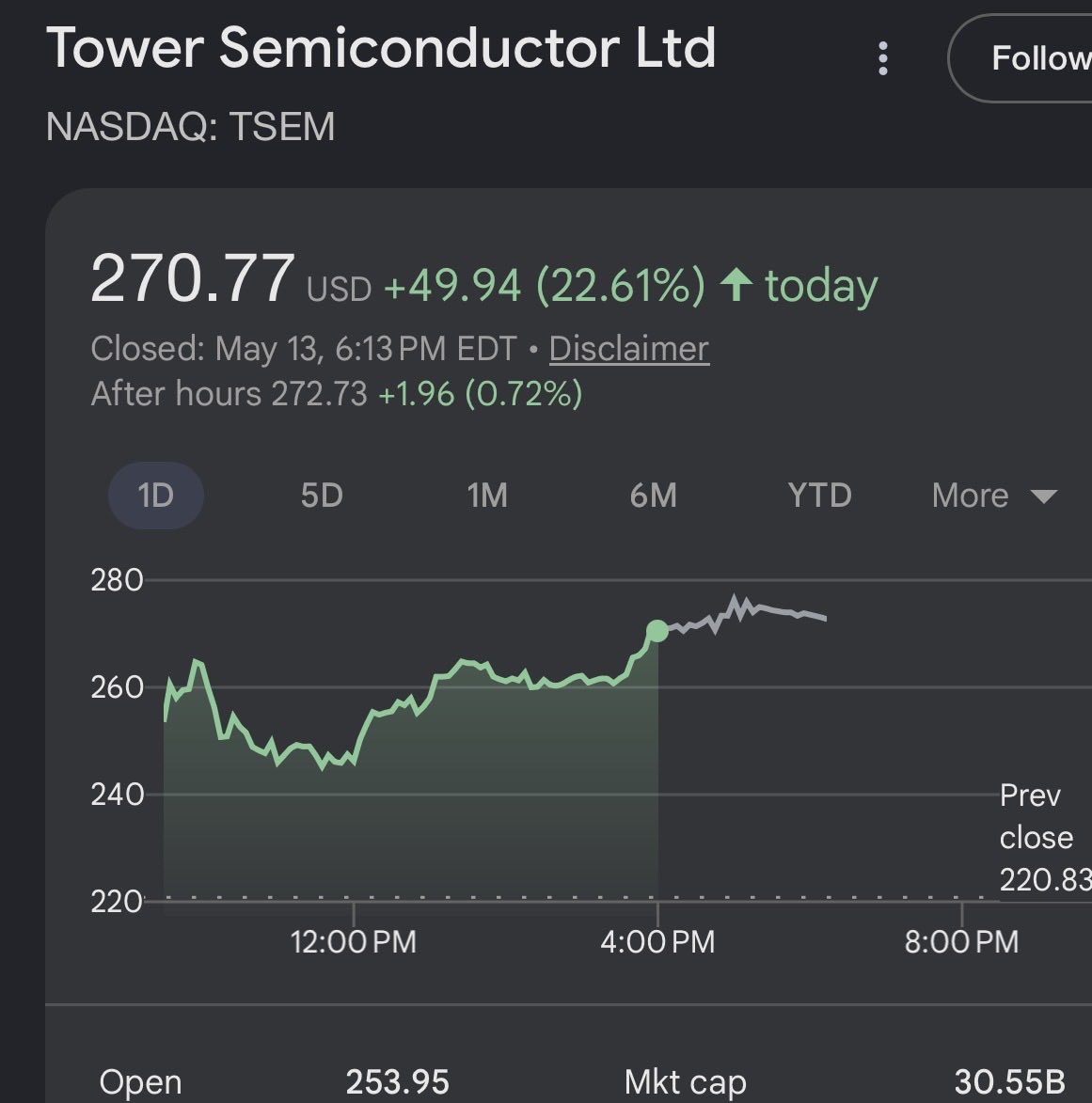
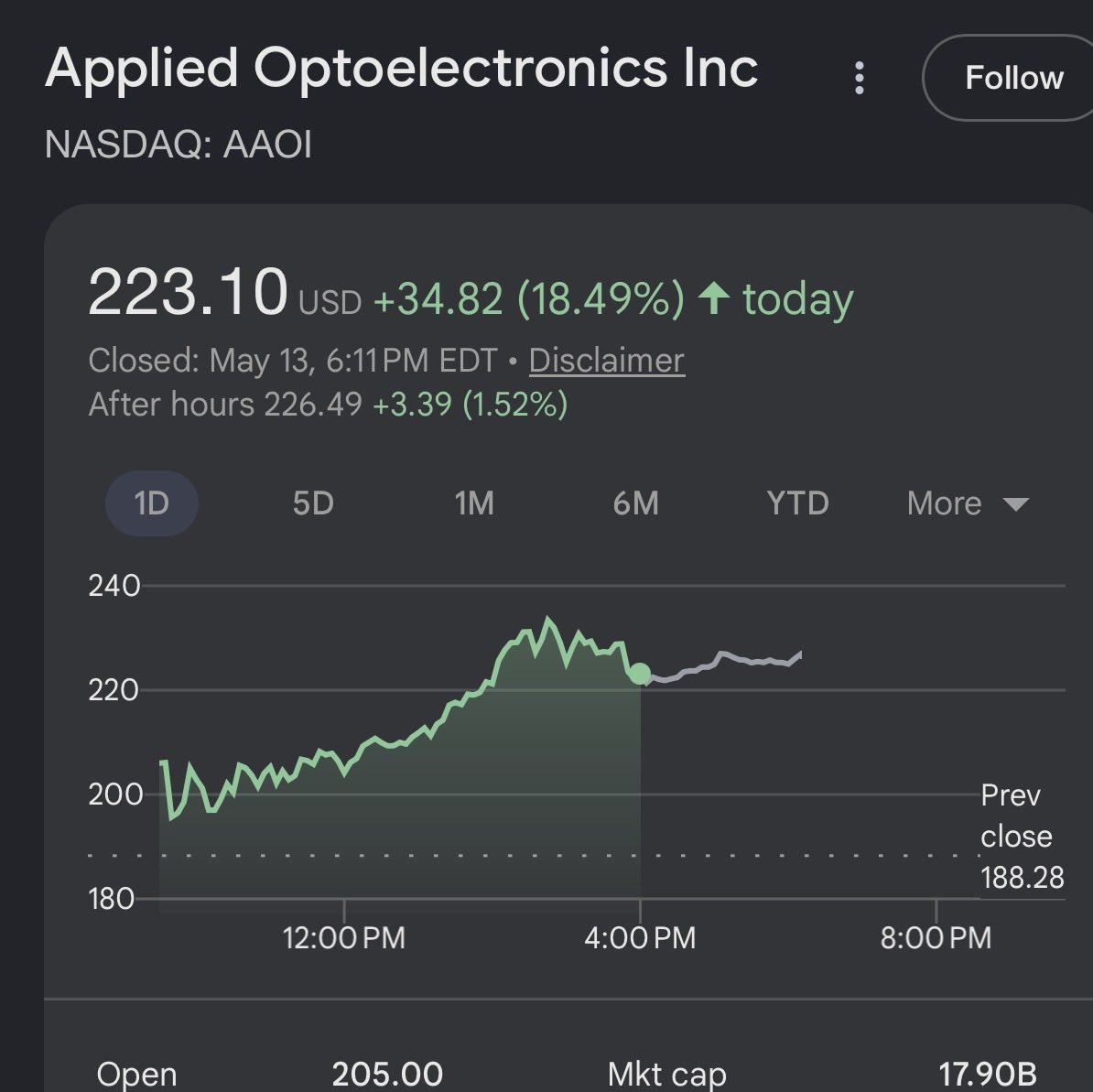
What an insane day for photonics. $SIVE up 31.3% $TSEM up 23.1% $AAOI 20.01%. It feels like a lot… but this just means you’re early to the next supercycle and there’s a lot of room to go. Lot of people on X ask what’s next after $SNDK? Here they are.
Serenity tweet mediaSerenity tweet mediaSerenity tweet media
English
178
212
2.8K
320.2K
Sun Liao
Sun Liao@sunxliao·
Simplifying the memory trade... 🫡 The fastest AI chips in the world are useless if you can't feed them data fast enough, and there are several different types of memory doing that work. Each one is a different business with different economics and different winners. The squeeze starts at the top. Near memory is HBM, the high bandwidth stuff sitting right next to the GPU doing 1-20 terabytes per second. This is the actual bottleneck on every $NVDA system shipping today and $MU is the cleanest American pure play on it. Sk Hynix and Samsung control most of the market globally, but if you trade US listed names, Micron is the trade. Then comes main memory, which is the DDR5 doing long context inference at 100-500 GB per second. Micron again. Same playbook. Expansion memory is where it gets interesting and where most retail isn't paying attention. This is the CXL layer that lets servers pool memory across the rack, and it's a real growth market right now. $MRVL and $MCHP build the controllers that make it work, and $ALAB is the one that nobody had on their radar a year ago and now everyone wishes they did. $RMBS sits in the IP layer collecting royalties. Context memory is the SSD and NAND layer doing session memory at 20-200 GB per second. Micron plays here too... $WDC and $SNDK are the public American pure plays, and this is the layer that benefits most from agentic AI specifically because agents need persistent session memory at scale. And at the bottom you have the data lakes, which is petabyte scale storage for RAG, documents, and training files. $DELL, $NTAP, $HPE, and $IBM are the names selling the actual infrastructure here, with Western Digital underneath them on the drives. I also shared an important position update with Startup.io indicator suite users today too. Now zoom out... like I noted the other day, Jensen said agentic AI needs 1000X more compute. You can't 1000X the compute and leave the memory stack alone... I think all dips are for buying.
Sun Liao@sunxliao

$SNDK this thing isn't done until that weekly gold support breaks IMO... Memory theme continues to stay strong.

English
24
19
220
64.7K
Deo Non Fortuna
Deo Non Fortuna@filiusveritatis·
@Yeah_Dave Why do you have $ASTS as your biggest investment in your portfolio and not $NBIS ? They execute on every front (my largest is also ast but I’m just curious to hear your thoughts.
English
0
0
0
405
bryan
bryan@BryzonX·
Days like this reminds me why I never chase I don't care how great the stock is, I will never buy just because the company is good if it is overextended A great cost basis takes the emotions out of your trading which is the #1 reason most don't succeed
English
6
5
73
4.5K
Deo Non Fortuna
Deo Non Fortuna@filiusveritatis·
@BryzonX How does your portfolio look brother ? Is $HLIT your biggest investment after $PENG? Which one is your highest conviction long?
English
0
0
0
295
Deo Non Fortuna
Deo Non Fortuna@filiusveritatis·
@Yeah_Dave I’m excited about this one as well, looking forward to hear your analysis
English
0
0
1
986
YeahDave
YeahDave@Yeah_Dave·
Doing analysis on the upcoming Cerebras $CBRS IPO Deciding on whether I want to grab a position Specialized AI Inference Chips $NVDA & $AMD competitor Big Chip = Big Good etc. As usual there's a lot of hype nonsense flying around. -2025 "GAAP profitable" was due to a one time event. They ran an operating loss of -$145.9M ($344.9M on opex against $199.1M of gross profit). -Gross margins are 39% which is not great ($NVDA data-center segment is ~75%) -33.4M in OpenAI warrant adds 15.7% in potential dilution An $NVDA killer this is not, but there are some interesting aspects to this that are worth taking a look at.
English
14
7
145
31.3K
Deo Non Fortuna
Deo Non Fortuna@filiusveritatis·
@Defiantclient2 Thanks for your answers brother, I’ve been all in on ast for a while as I can’t see a better opportunity in the market and I’m trying to debunk every bear case I hear about, trying to learn more every day. Your answers helped a lot.
English
1
0
5
103
Kevin Chen
Kevin Chen@Defiantclient2·
@filiusveritatis Yes Consumer beta and start of commercial service will happen with FPGA In a world where AST has ~90 ASIC sats for global comms and ~28 FPGAs, they could switch those FPGA to be dedicated military. I like the point that you raised.
English
1
0
1
137
Kevin Chen
Kevin Chen@Defiantclient2·
$ASTS: ✍️HIGH LEVEL FPGA VS ASIC What are they? + FPGA = Field-Programmable Gate Array + ASIC = Application-Specific Integrated Circuit FPGA is FIELD REPROGRAMMABLE such that it can handle a much wider range of use cases. In AST's case, this makes FPGA satellites very good at being flexible for both communications and non-communications applications. (Bullish for government/military work). ASIC is APPLICATION-SPECIFIC such that it does one job extremely well. In AST's case, this means communications use cases. Examples of non-communications applications Borrowing @HennessyFunds's list: hennessyfunds.com/insights/compa… • Radar – Supporting high-value military radar applications such as synthetic aperture radar (high-resolution imaging using radar signal reflections), ground-moving target indication, and missile tracking. • Assured and Alternative PNT (Position, Navigation, and Timing) – Providing a stronger, jam-resistant signal compared to existing GPS, improving indoor reception and cybersecurity through authentication and encryption. • Blue Force Tracking (BFT) & Identify Friend or Foe (IFF) – Improving situational awareness of troop and asset locations, reducing friendly fire incidents. • UAS/drone control – Enabling remote control of unmanned aerial systems (UAS) in areas lacking terrestrial infrastructure. • Signal Intelligence – Detecting and reading electromagnetic emissions of the enemy. • Signal Jamming – Jamming enemy signals over large geographical areas, such as maritime zones and remote areas, where terrestrial jammers are impractical. Processing Capacity: Block 2 FPGA has 3,000 MHz processing capacity. Block 2 ASIC has 10,000 MHz processing capacity. Divide the capacity by size of MHz channels to get your total number of beams per satellite. For example, for 10 MHz channels, Block 2 FPGA can support 3,000 / 10 = 300 beams each with a 10 MHz channel whereas Block 2 ASIC can support 10,000 / 10 = 1,000 beams each. Download and Upload Speeds: The same, assuming equal bandwidth channels, i.e. a 10 MHz channel being served by Block 2 FPGA and a 10 MHz channel being served by Block 2 ASIC can both hit up to 10 MHz x 3 bits/Hz spectral efficiency = 30 Mbps per beam. However, the difference is in # of simultaneous beams at once as explained above. Power Efficiency: ASICs are much more power-efficient than FPGA since they are very good at doing their one job. See this thread for more details: x.com/jusbar23/statu… How many BlueBirds will be FPGA vs ASIC? The decision to go FPGA or ASIC is made at the micron level. On March 2, 2026, AST said they had microns done up to BB28 and simultaneously said they haven’t started integrating ASICs yet. So I interpret that to mean that at least up to BB28 will all be FPGA. It is not clear whether BB29+ are FPGA or ASIC. They should provide clarity on Monday!
Kevin Chen@Defiantclient2

$ASTS: 🚨ASIC MICRONS IN PRODUCTION At 1:55 you can see that @AST_SpaceMobile has already started producing ASIC microns! But wait... "experts" and "consultants" said it would take another 6 to 12 months for this to happen??


English
9
25
224
35.3K