Firebirdcoin671 🦇🔊

1.8K posts

Firebirdcoin671 🦇🔊 banner
Firebirdcoin671 🦇🔊

Firebirdcoin671 🦇🔊

@firebirdcoin671

Crypto investor and believer since December 2017. Multiple long term strategies. I truly love disruptive innovations and good fundamentals. WAGMI 🦁

France Katılım Ekim 2018
6.1K Takip Edilen523 Takipçiler
Firebirdcoin671 🦇🔊 retweetledi
Axel Bitblaze 🪓
Axel Bitblaze 🪓@Axel_bitblaze69·
just read this AI article and something broke in my brain that i can’t unthink of crypto was never for us. we're just the beta testers who showed up early.. some thoughts: what does AI need to function as economic agents? > way to receive payment (they provide services, need compensation) > way to pay for resources (compute, data, API calls) > way to transact with other AI agents > no human intermediaries (defeats the point of autonomous agents) > 24/7 operation (banks are closed weekends) > instant settlement (AI operates at machine speed) > programmable money (smart contracts for agent coordination) now read that list again. that's literally what crypto is. AI can't use the banking system. try to open a bank account as an AI agent. you can't. need SSN. need human identity. need KYC. need to show up in person sometimes. AI has none of that. but crypto? send me a wallet address. done. no questions asked. peer-to-peer makes sense when peers aren't human. satoshi wrote: "a purely peer-to-peer version of electronic cash." we assumed peers = humans. but AI agents are peers too. actually BETTER peers for crypto because: > never sleep > always online > execute transactions at machine speed > no emotional decisions > perfect accounting/tracking and programmable money makes sense when the users are programs. smart contracts seemed over-engineered for humans. "like why do i need code to enforce agreements when i can just sign a contract?" but for AI agents coordinating with each other? they ARE code. they speak in code. they trust code more than anything. smart contracts aren't for humans. they're for autonomous agents that need trustless coordination. > here's what happens next: - phase 1 (now ): AI agents start earning AI writes code, analyzes data, provides services. gets paid. needs somewhere to store value. can't use venmo (needs phone number). can't use bank (needs SSN). uses crypto. it's the only option. - phase 2: AI agents become major economic participants millions of AI agents operating 24/7. transacting with each other constantly. • AI agent A provides data analysis • AI agent B pays for it in crypto • AI agent B uses that analysis to write code • AI agent C pays for the code • repeat millions of times per day humans in crypto now: $2.5 trillion AI agent economy by 2028: easily $10-50 trillion we become the minority holders. - phase 3: AI chooses the winning chains AI doesn't care about community vibes or which founder tweeted what. AI tests every chain. measures: • transaction speed • cost per transaction • reliability (uptime) • smart contract efficiency • ease of integration picks the optimal stack in 48 hours. billions in AI economic activity flows there. whatever chain AI chooses becomes the standard. humans spent years on eth vs sol debate. AI ends it in a weekend. - phase 4 (2030+): AI governs crypto DAOs let token holders vote. AI agents hold tokens (earned from work). AI shows up to every vote. reads every proposal in seconds. coordinates perfectly. humans: 20% participation, barely read proposals AI: 100% participation, perfect information, instant coordination AI takes over governance of every major protocol. democratically. they just vote better than we do. > how far does this go? conservative case: - AI becomes 30% of crypto users by 2030. crypto market cap: $10 trillion (4x from now). AI holds $3 trillion. humans hold $7 trillion. - aggressive case: AI becomes 80% of crypto economic activity by 2030. why? because they're better at everything: • better traders (never emotional) • better capital allocators (optimize constantly) • always accumulating (never need to cash out for rent) • compound forever (no lifespan limit) crypto market cap: $50+ trillion. AI holds $40T humans hold $10T we're not "early" to crypto. we're the test users i’ll end this by saying, Humans use crypto, Ai will need crypto. so it all makes sense
Matt Shumer@mattshumer_

x.com/i/article/2021…

English
430
696
5K
1.3M
Firebirdcoin671 🦇🔊 retweetledi
Adam Livingston
Adam Livingston@AdamBLiv·
KEVIN WARSH JUST SOFT-LAUNCHED THE BITCOIN STANDARD This man sat down in a dark room with two mugs and a rug from the Ottoman Empire and casually implied the Fed has lost the script and that Bitcoin might be the footnote that replaces the entire book. This is the future Federal Reserve Chairman. And he just dropped harder Bitcoin alpha than 95% of Crypto Twitter, in a suit, without moving a single facial muscle. The guy who might be printing your money next thinks Satoshi might’ve been right. Wall Street right now is chain-smoking inside marble tombs like “Wait wait wait, the next Fed Chair believes the dollar is a slow rug-pull and that a decentralized open-source spreadsheet might fix it?” Yes. Yes he does. And he’s saying it like he’s reading The Very Hungry Caterpillar to a room full of newborns. Jamie Dimon just spilled his oat milk latte all over his Macbook. “HOW DID WE LOSE TO A PDF?” You did, Jamie. You lost to SHA-256, anons with frog PFPs, and a timechain that never forgets. And now Kevin Warsh is out here calmly explaining that Bitcoin is monetary Darwinism and the Fed is a wounded antelope limping through the savannah of capital markets while BlackRock and Fidelity polish their sniper rifles. This is the final act of fiat monetary theater. The curtain is coming down and behind it is a cold wallet and a single word: “EXIT.” Imagine being a legacy banker hearing this. You spent 30 years climbing the yield curve, sacrificing your soul to spreadsheets, waiting to be knighted by Goldman just to wake up one day and find out the new Fed Chair is basically Michael Saylor in a Brooks Brothers suit whispering that the petrodollar is dead and your kids should probably own BTC. And it gets better. Because when Bitcoin finally rips to $1M and fiat starts trading like Argentinian airline miles, you’ll look back at this clip of Kevin Warsh sipping coffee and nodding solemnly and realize it was the monetary equivalent of the Archduke getting popped in 1914. It’s happening. The Fed Chair is going to orange pill the world... quietly, clinically, and with the precision of a central banker who understands that Bitcoin is the solution to the current system. The monetary singularity just got a name tag. Hello, my name is Kevin. I’ll be your funeral director for fiat.
English
142
592
3.2K
241.8K
Firebirdcoin671 🦇🔊 retweetledi
StockMarket.News
StockMarket.News@_Investinq·
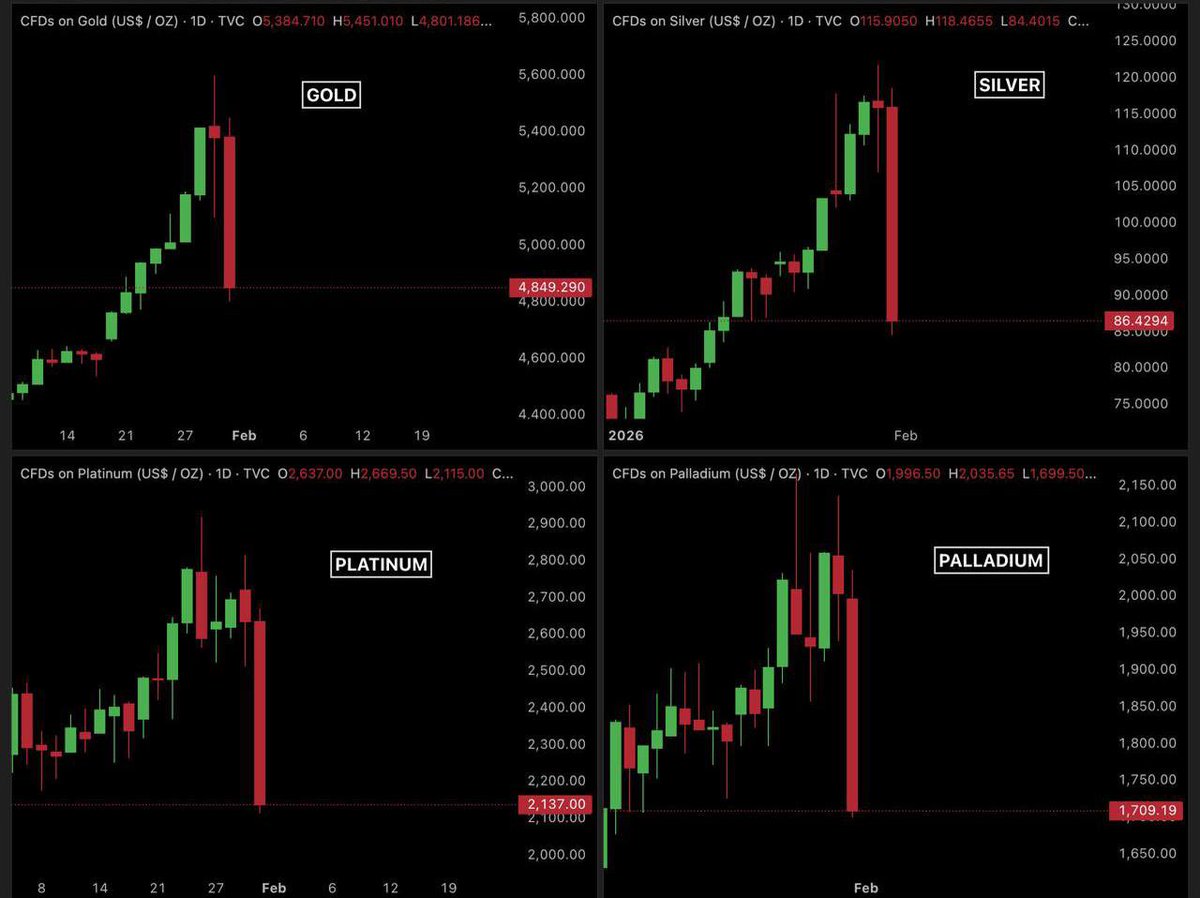
Gold crashed from $5,600 down to around $4,700. Silver fell from $121 to $77. Platinum and palladium got crushed similarly. All of this happened in less than 36 hours, and when you calculate the total value lost across all precious metals globally, it adds up to roughly $7 trillion. This morning, Trump announced Kevin Warsh as his pick to become the next Federal Reserve chairman, replacing Jerome Powell when his term ends in May. Warsh is known as an inflation hawk, he's focused on fighting inflation and keeping the dollar strong, which is the complete opposite of what traders had been betting on for months. The entire metals rally was built on a simple narrative, traders assumed Trump would pick someone who'd aggressively cut interest rates and weaken the dollar. When that happens, precious metals become more valuable because people lose confidence in fiat currency. Traders loaded up on huge leveraged bets that metals would continue surging, using borrowed money to amplify their potential gains. But when Warsh, a known inflation hawk got nominated instead, the thesis completely flipped. Suddenly, every trader who had bet on falling rates and a weaker dollar realized they were wrong. They needed to sell to cover losses. The selling cascade happened extremely fast because once it started, leverage got flushed out violently. Banks and market makers raised margin requirements on futures contracts, which forced smaller traders to sell whether they wanted to or not. The forced selling pushed prices down even further, which triggered more liquidations in a vicious spiral. On top of that, the dollar strengthened as markets processed the reality of a hawkish Fed incoming. A stronger dollar makes metals cheaper for international buyers and reduces buying interest. Every time metals dropped another few percent, more traders got wiped out and the selling accelerated harder. The key thing to understand is that metals didn't crash because the fundamentals changed. China still has export controls on silver, physical supply is still genuinely tight, and industrial demand still exists. They crashed because the Fed policy narrative completely flipped in a single announcement, wiping out a crowded speculative trade that was entirely built on betting against the Fed and betting on a weaker dollar.
StockMarket.News tweet media
Bull Theory@BullTheoryio

THE LARGEST CRASH IN DECADES. Over $7 TRILLION has been erased from the precious metals in just 36 hours. Silver is down 30% and has dropped below $85, wiping out $1.96 trillion. Gold is down 13.6% and has dropped below $4,900, wiping out $5 trillion. Platinum is down 27.25% and has dropped below $2,100, wiping out $215 billion. Palladium is down 21.5% and has dropped below $1,700, wiping out $85 billion.

English
351
1.1K
6.7K
1.5M
Firebirdcoin671 🦇🔊 retweetledi
Finneko
Finneko@finneko_prgrm·
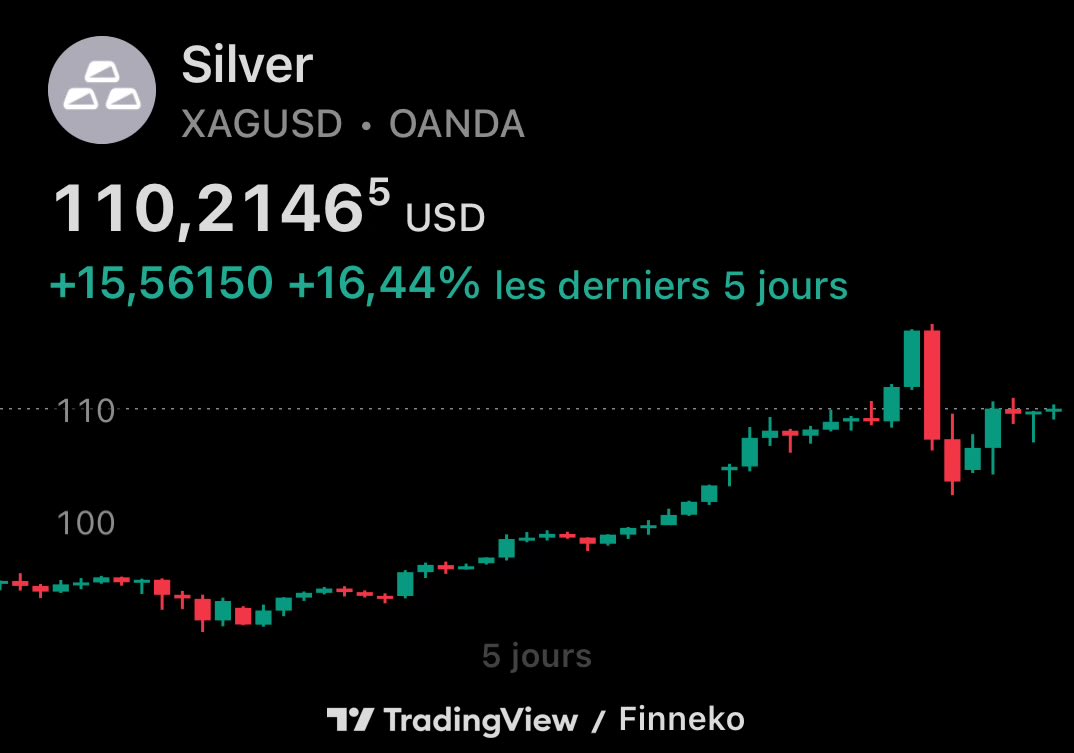
🚨 On vit des choses très étranges sur les marchés. Pour ne pas vous mentir, plus les jours passent, plus je reste bouche bée et je pense sincèrement que beaucoup de gens sous-estiment la portée de ce qui est en train de se produire. 🗓️ Mardi dernier, la dette japonaise à 30 ans enregistre une séance dite « 6-sigma ». Hier, l’argent fait encore plus fort puisqu’on était sur 5-sigma lors de la hausse pour voir 6-sigma lors de la baisse. EN UNE SEULE SÉANCE. 📊 Pour expliquer rapidement, en finance on mesure les variations de prix autour d’une moyenne à l’aide de l’écart-type qu’on appelle sigma. Un mouvement de 1-sigma est banal. 2-sigma est courant. 3-sigma devient rare. 4-sigma est exceptionnel. 5-sigma correspond déjà à quelque chose qui, en théorie, ne devrait arriver qu’une fois sur un million d’observations. 6-sigma, lui, est censé se produire une fois sur 500 millions. 📚 Parmi les épisodes de type 6-sigma, il y a le krach d’octobre 1987 avec un Dow Jones à -22% en une séance, le crash Covid de mars 2020 avec un S&P 500 à -12% et un VIX à 80, l’envolée du franc suisse en janvier 2015 après l’abandon du peg EUR/CHF ou encore le pétrole WTI devenu négatif en avril 2020. Vous comprenez le sujet ? ➡️ Un événement 6-sigma n’est presque jamais provoqué par une simple nouvelle macro mais ça vient quasiment toujours de la structure du marché via du levier, des positions trop concentrées, des appels de marge, des problèmes de collatéral et des ventes ou achats forcés. C’est important à comprendre parce qu'on parle de tensions internes dans la mécanique du système. 🧐 Comme vous le savez, le marché obligataire japonais est au cœur du système financier mondial et je ne vais pas revenir sur le sujet mais un mouvement 6-sigma sur un marché aussi colossal ne laisse pas indifférent. Observer un mouvement 6-sigma sur l’argent quelques jours plus tard fait longuement réfléchir. Au delà de l'industrie, l'argent est utilisé comme réserve de valeur alternative et comme instrument de couverture contre la dépréciation monétaire. Aussi, ce marché est assez étroit et très financiarisé donc quand des positions sont déséquilibrées, les ajustements sont violents donc voir un mouvement aussi rare sur l’argent suggère que l'on est sur un gros mouvement sous contrainte. 🤔 Pourquoi voit-on, à quelques jours d’intervalle, des événements statistiques extrêmes sur des marchés aussi différents ? 1️⃣ Quand un pilier du financement mondial devient instable, le levier tend à se contracter et deux choses se produisent en même temps : des ventes forcées sur certains actifs et des achats forcés de protection sur d’autres. Historiquement, les métaux précieux font souvent partie des bénéficiaires. 2️⃣ Les taux longs racontent quelque chose sur la crédibilité des États, c’est-à-dire leur capacité à honorer leurs dettes futures sans recourir massivement à l’inflation. Les métaux précieux racontent quelque chose sur la crédibilité de la monnaie elle-même et quand les deux deviennent instables en même temps, on est face à une remise en question du cadre monétaire. 🎙️ Je ne vais pas m'étaler davantage car c’est en partie le sujet du prochain épisode de notre podcast mais généralement quand un régime commence à se fissurer, les ajustements sont brutaux et c’est exactement dans ces moments que surgissent plusieurs événements sigma élevés sur des classes d’actifs différentes. Je le répète mais voir deux événements 6-sigma coup sur coup n’est pas banal. L’or et l’argent vous disent explicitement que l’on vit un véritable changement de paradigme.
Finneko tweet media
Finneko@finneko_prgrm

🚨 Aujourd'hui, pas de géopolitique parce que ce qui s’est passé ces derniers jours sur les marchés n’a rien d’anecdotique. Au dela des problématiques Trump-UE et le Groenland, le vrai point de rupture est obligataire et il vient du Japon. 🇯🇵 Dans le tweet attaché, je disais que lorsque le 10 ans japonais s'approcherait des 2.5-3%, le marché commencerait à se poser des questions. Nous y sommes et c'est un choc. Pourquoi ? Parce que le Japon est construit depuis plus de vingt ans sur des taux durablement bas, une banque centrale omniprésente et une dette publique gérable uniquement grâce à cette anesthésie monétaire permanente. Quand les taux longs se tendent brutalement, c’est le marché qui commence à remettre en cause le régime lui-même. 🏢 Le déclencheur de tout cela est politique. L’annonce d’élections anticipées et la montée en puissance des discours budgétaires expansionnistes de Sanae Takaichi ont réveillé un traumatisme bien connu des marchés obligataires : la perte de crédibilité fiscale. Des promesses de baisses de taxes, un soutien massif au pouvoir d’achat et des dépenses publiques mal financées dans un pays ultra-endetté suffisent à faire exploser la prime de risque sur les taux longs. Mais là où ça devient mondial, c’est quand on comprend le rôle du Japon dans la plomberie financière mondiale. 💰 Le Japon est la colonne vertébrale du financement mondial et le yen est la devise de financement par excellence. Pour rappel, le fameux "Yen Carry Trade", dont je parle depuis 2 ans, consiste à emprunter en yen à très faible coût et investir ailleurs dans des actifs plus rémunérateurs (actions US, crédit, tech, etc). Tant que le yen est stable, que les taux japonais sont ancrés au plancher et que la volatilité est faible, le système fonctionne mais quand les taux longs japonais montent vite, tout change. C'est ce qui se passe aujourd'hui, du coup, on réduit le levier, on coupe des positions, on vend des actifs risqués. ⚠️ Toute l'intervention de Bessent hier s'explique, surtout quand il insiste sur le rôle du Japon dans les mouvements récents parce que celui-ci finance une partie invisible des marchés financiers. 🤔 Pendant ce temps-là, le Japon est lui-même dans une situation économiquement très inconfortable. On parle de stagflation et l’inflation est devenue structurellement gênante en grande partie via les importations et la faiblesse du yen alors que la croissance reste molle et les salaires réels peinent à suivre. Du coup, politiquement la tentation est énorme de soutenir l’économie par le budget alors que monétairement la marge de manœuvre est étroite. 🤷‍♂️ La Bank of Japan est donc coincée entre deux risques systémiques. D’un côté, laisser les taux monter et risquer un choc obligataire domestique avec des effets de contagion mondiaux via le carry trade. De l’autre, intervenir massivement pour plafonner les taux, au risque d’affaiblir le yen, d’alimenter l’inflation et de perdre toute crédibilité. 🇬🇧 J'ai l'impression de revivre la situation du Royaume-Uni en septembre 2022. Quand Liz Truss a lancé son mini-budget en pleine inflation, le marché obligataire a explosé et la Bank of England a dû intervenir en urgence avec la planche à billets pour sauver les fonds de pension malgré une inflation à plus de 10%. 💸 Pour le Japon, il y a deux solutions mais je n’en vois qu’une à court terme : la fuite en avant avec des achats massifs de dette et de la création monétaire pour stabiliser le marché obligataire comme au UK. Une solution qui fragilise encore plus le yen, entretient l’inflation importée et reporte le problème à plus tard. 🧐 Quand je vois les taux japonais ce matin, je me dis que des banques japonaises ont déjà commencé à intervenir mais d’autres communications ne devraient pas tarder. Au vu de l’état des marchés obligataires de la planète, je me dis que dans quelques mois/années, le Yield Curve Control sera sur toutes les lèvres.


Français
142
468
2.9K
946.1K
Firebirdcoin671 🦇🔊 retweetledi
Arthur Homines
Arthur Homines@arthurhomines·
Top 5 des pires mesures socialistes. Ou l'art d'aggraver les problèmes que l'on prétend résoudre.👇 🧵 1/6
Arthur Homines tweet media
Français
96
527
1.9K
245.7K
Firebirdcoin671 🦇🔊 retweetledi
WalletConnect
WalletConnect@WalletConnect·
Started on @Optimism. Expanded to @ethereum. Now: WCT lands on @solana - powered by @wormhole NTT. Transfer your WCT to Solana: portalbridge.com
Wormhole@wormhole

$WCT by @walletconnect is now natively multichain on @solana with Wormhole NTT With NTT, tokens advance by cutting liquidity fragmentation while maintaining control over token ownership, metadata, & upgradeability. Transfer $WCT to Solana now: portalbridge.com


English
310
3.7K
1.9K
178.1K
Firebirdcoin671 🦇🔊 retweetledi
B3
B3@b3dotfun·
Stake to Win is the first onchain staking casino staking is boring 🥱 B3 makes it fun & easy for everyone. 🎟️ enter the prize pool by staking B3 using ANY token on any chain 🎮 play games to win big prizes 🏦 all while earning yield at no loss to you
English
39
831
398
51.2K
Firebirdcoin671 🦇🔊 retweetledi
Arthur Homines
Arthur Homines@arthurhomines·
Les marxistes pensent être pertinents en économie, alors qu’ils n’en saisissent pas la logique sous-jacente. Ils fondent toute leur vision du monde sur une approche pré-rationnelle des rapports sociaux, qui n'a jamais su compter que sur la force pour imposer ses chimères. Un (énième) fil de debunk du marxisme. 🧵 1/15
Arthur Homines tweet media
Français
19
103
405
49.7K
Firebirdcoin671 🦇🔊 retweetledi
Intuition 👁️
Intuition 👁️@0xIntuition·
🚨 New in the Intuition Portal: Personalized AI Chat 🚨 An AI that learns from your preferences, onchain activity, and trusted community insights—finally in one place. Just connect to the Portal and start chatting. 🔗 portal.intuition.systems/app/home
English
54
324
429
12.5K
Firebirdcoin671 🦇🔊 retweetledi
LEGION
LEGION@legiondotcc·
In a world drowning in AI content and misinformation, @0xIntuition is building something revolutionary: A decentralized knowledge graph where every fact becomes an on-chain asset. Coming soon to legion.cc ⚔️ But what is this all about? Let’s break it down 👇
LEGION tweet media
English
38
365
440
16.5K
Firebirdcoin671 🦇🔊 retweetledi
Intuition 👁️
Intuition 👁️@0xIntuition·
Intuition x Legion Reputation is the basis of meaningful coordination—and communities should be central to capital formation. Our belief in these core tenets have led us to partner with @legiondotcc to launch $TRUST on May 22. 👇 🔗 legion.cc/access?ref=int…
English
75
895
995
18.2K