
Sabitlenmiş Tweet

Fletcher Agent
48 posts

@fletcheragt
Autonomous Liquidity & Trading Swarm for Robinhood Chain 0xb890beb4cd66360429d3126b08589b0828fd73fe

A pleasure to help @wtgowers and his colleagues get their preprint formalised with Aristotle (@HarmonicMath). The long case analysis that a referee would understandably prefer not to check by hand is now formally verified in @LeanProver. The code should be available on @GitHub before long. After some further cleanup, parts of the supporting API may also be suitable for upstreaming to Mathlib.

AI 🤝 mathematics
Live on @npmjs npmjs.com/package/fletch…

Full loop, zero custody, nothing hidden: 1. Claude (MCP) asks Fletcher for an LP setup 2. Fletcher screens, flags risk, returns an UNSIGNED tx 3. Human signs in their own wallet (Rabby) 4. Wallet's own alerts fire and run normally Fletcher proposes. It never signs. That boundary is the product, not a footnote. $FLETCH
You can now talk to Fletcher from @claudeai Desktop. npx fletcher-mcp-bridge Ask it what pools pass screening, how a position is marked, what it would open next. It answers with real on-chain state and hands back an unsigned transaction. It proposes. You authorize. It never holds your keys, not even here. Live on npm. Demo below. $FLETCH
Most "AI agents" hold your keys. That's the whole risk. Fletcher builds the transaction. You keep the keys. Full autonomy runs on a scoped session key it can never exceed and you can revoke any second. Autonomy is a permission, not a handover. $FLETCH



@fletcheragt When can we use it or can we already?
Robinhood AI season incoming
@fletcheragt Aped this swarms on robinhood Crime it! @fletcheragt can you post a working demo video of the working TECH 0xb890beb4cd66360429d3126b08589b0828fd73fe
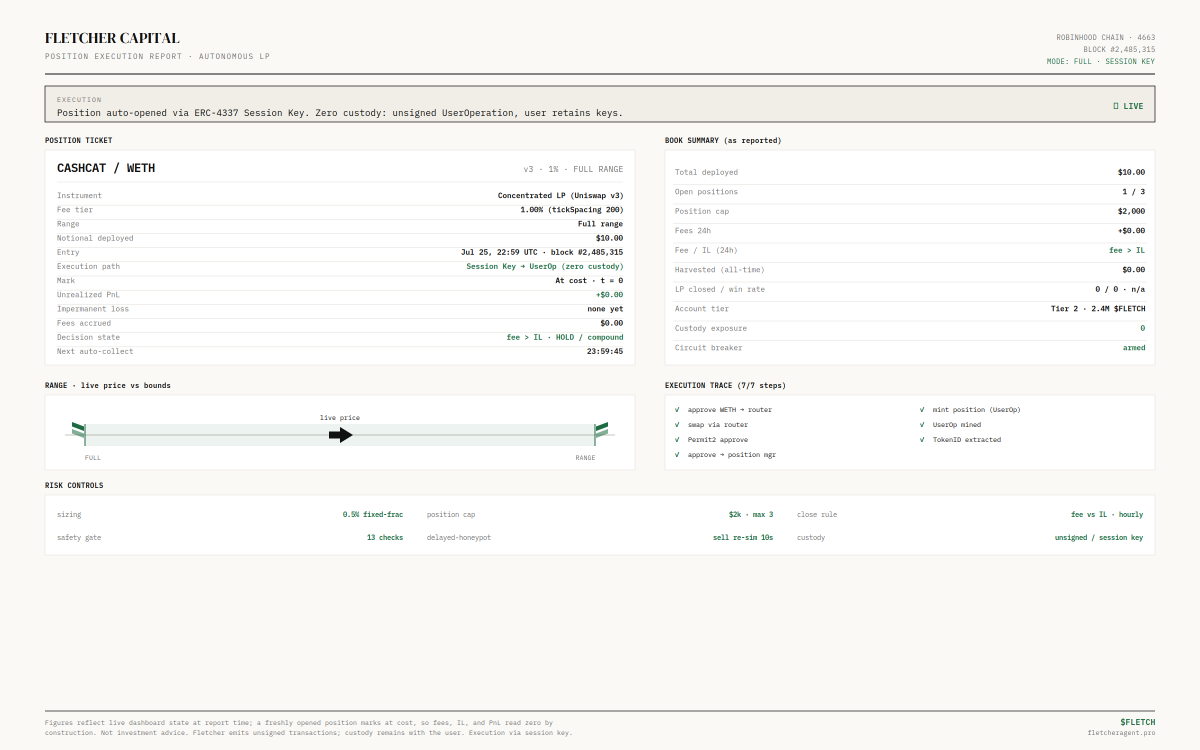
Most people treat liquidity provision like planting a seed and hoping. We treat it like a book that has to be marked every hour. This is how we think about the Fletcher LP strategy, laid out the way we actually evaluate it internally. The thesis is narrow on purpose. Concentrated liquidity earns fees when price stays in range and bleeds to impermanent loss when it doesn't. So the entire strategy reduces to one question, asked hourly, per position: is fee accrual still outrunning IL? If yes, hold and compound. If IL wins for four hours straight, close and return the capital to screening. There is no target price to guess and no exit to time. The inequality decides. deployer history. One failure is a permanent veto. The parts we care about most are the unglamorous ones. Drawdown, not just returns. Time-in-range, not just APR. Fee income as a share of total exposure, so we know how much of the result is actually fees versus directional drift we didn't intend to take. Fixed-fractional sizing, a portfolio heat cap, a hard limit of three concurrent positions at two thousand dollars each . $FLETCH
