

Frederico Batista
1.5K posts

Tree-based gradient boosting is an ensemble method that builds a powerful prediction model by sequentially adding weak learners (often decision tree stumps). 🌲📈
To help my students really get it, I built a #Python @matplotlib interactive dashboard 🚀🐍
Step through each stump and watch the model update as the residuals and error evolve in real time! 🔥🎯
#MachineLearning #DataScience #AI #Python
GIF
English

One reason I love Lovecraft is how he combines science & older horror. I find this really effective.
There is plenty of horror about curses or abominations of science, but Lovecraft combines these effectively.
Cthulhu for instance isn’t an occult god. He’s the priest-king of an extrasolar civilization that plunges from world to world through space, ravaging planets. He has bizarre powers because he’s from a part of the universe so remote he follows different natural laws.
Science + horror really brings horror to gruesome reality in games or tales.
1/2

English
Frederico Batista retweetledi


Frederico Batista retweetledi

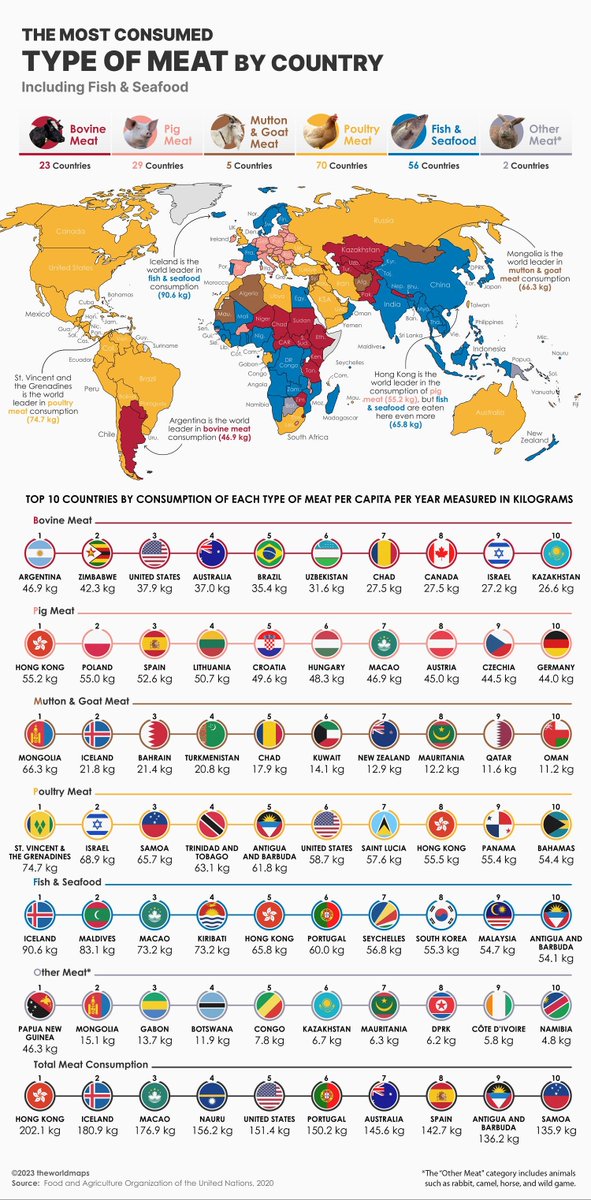
This map shows global meat consumption patterns. Source: visualcapitalist.com/cp/mapped-meat…
English
@roderix1966 É um equilíbrio difícil de alcançar. 😬 Muitas das suas histórias ilustram isso de alguma maneira mas é uma luta fazer o bem e se proteger no processo
Português

Meu pai fez colegial na EPCar, da FAB. 1959. E me criou assim: filho vc pode ser o cara mais gente boa mas chega uma hora que vc tem que colocar um limite! Senão abusam de vc! Seja chefe, esposa, sogra, sogro, filho, hater. Nunca esqueci disso.
Português
Recomendo o livro
Jon Schwabish@jschwabish
‼️‼️Updated data visualization catalog‼️‼️ With help from Claude, I've updated my workflow to bring in more graphs and charts faster than ever. If you work with data, research, journalism, policy, or just love a good chart, check it out: policyviz.com/resources/poli…
Português
Português

@MrsCharlotteYo1 @pfnery imagina mandar o Pedro prestar concurso kkk
Português

STF desfez décadas de reformas da previdência ontem.
Esse bônus de 35% para juízes aposentados é injustificável. Não contribuíram!

Português


@steipete @chrisalbon @indexsy Please don't be. New tools make old tools and old ways obsolete. I haven't tried openclaw yet but I've been following with interest. You moved us all forward. Let old things rest in peace and new things flourish and bear fruit
English

@indexsy When I read stuff like that, I sometimes regret making openclaw.
English

We scaled this to 400 accounts by the way
0.5% ban rate so far
Jacky Chou (buying online businesses up to $1m)@indexsy
Have ClawdBot farm up 50 Reddit accounts at a time Each one running on ARM chips in the cloud Have ClawdBot use Qwen3 for commenting + stupid tasks to save on usage Everyone is cooked, you are all cooked
English
In Paranoia the roleplaying game, they had "computer-assisted sights" which you could put on your gun. You didn't find out what it was like till after it was installed.
Then you discovered you had to ask the computer to shoot and designate a target. The computer would then ask, "Are you sure?"
"Yes yes I'm sure SHOOT SHOOT."
"Maybe we should open a dialogue? Or I could shoot the guy in red next to you. He seems angry."
"He's on MY SIDE, he's angry because we're getting overrun. SHOOT"
"Well, let's check ammo first."
Petr Baudis@xpasky
[wife] maybe more than 1984 or Brave New World, we are living in The Hitchhikers Guide To The Galaxy
English
@SandyofCthulhu This is a sore point for me in the movies. Merry and Pippin did stuff but after their return home, they are responsible for saving the shire. The journey tested and forged them into heros. Both far and close to home
English
When I read Tolkien in college, I quickly realized Sam wasn't a "side character" which was part of the genius of Tolkien.
Look at the Fellowship of the Ring - an elf, dwarf, and two humans each of noble blood; then a wizard, followed up by 4 hobbits, whom you would expect to leave behind in Rivendell. But the story doesn't follow the noble heroes - it follows the hobbits.
Then we have the side quest of Frodo and Sam and Gollum. Frodo is the "gentleman" class hobbit, while Sam is clearly a man of the people. Yet it's Sam who drives the quest forward and enables its success. Frodo's only job is to hold onto the ring.
And it's the side characters who carry the day. Merry & Pippin bring down the Entish wrath on Saruman. Merry helps kill the Witch-king. Sam literally carries Frodo to Mount Doom, and Gollum has a pretty important role too.
The whole saga is focused on what seem to be the "wrong" people and that's what makes it great. Think how dull and conventional the Lord of the Rings would have been if it had followed Aragorn, as a lesser writer would have done.
Trad West@trad_west_
We love Tolkien don't we folks
English
Frederico Batista retweetledi

A few random notes from claude coding quite a bit last few weeks.
Coding workflow. Given the latest lift in LLM coding capability, like many others I rapidly went from about 80% manual+autocomplete coding and 20% agents in November to 80% agent coding and 20% edits+touchups in December. i.e. I really am mostly programming in English now, a bit sheepishly telling the LLM what code to write... in words. It hurts the ego a bit but the power to operate over software in large "code actions" is just too net useful, especially once you adapt to it, configure it, learn to use it, and wrap your head around what it can and cannot do. This is easily the biggest change to my basic coding workflow in ~2 decades of programming and it happened over the course of a few weeks. I'd expect something similar to be happening to well into double digit percent of engineers out there, while the awareness of it in the general population feels well into low single digit percent.
IDEs/agent swarms/fallability. Both the "no need for IDE anymore" hype and the "agent swarm" hype is imo too much for right now. The models definitely still make mistakes and if you have any code you actually care about I would watch them like a hawk, in a nice large IDE on the side. The mistakes have changed a lot - they are not simple syntax errors anymore, they are subtle conceptual errors that a slightly sloppy, hasty junior dev might do. The most common category is that the models make wrong assumptions on your behalf and just run along with them without checking. They also don't manage their confusion, they don't seek clarifications, they don't surface inconsistencies, they don't present tradeoffs, they don't push back when they should, and they are still a little too sycophantic. Things get better in plan mode, but there is some need for a lightweight inline plan mode. They also really like to overcomplicate code and APIs, they bloat abstractions, they don't clean up dead code after themselves, etc. They will implement an inefficient, bloated, brittle construction over 1000 lines of code and it's up to you to be like "umm couldn't you just do this instead?" and they will be like "of course!" and immediately cut it down to 100 lines. They still sometimes change/remove comments and code they don't like or don't sufficiently understand as side effects, even if it is orthogonal to the task at hand. All of this happens despite a few simple attempts to fix it via instructions in CLAUDE . md. Despite all these issues, it is still a net huge improvement and it's very difficult to imagine going back to manual coding. TLDR everyone has their developing flow, my current is a small few CC sessions on the left in ghostty windows/tabs and an IDE on the right for viewing the code + manual edits.
Tenacity. It's so interesting to watch an agent relentlessly work at something. They never get tired, they never get demoralized, they just keep going and trying things where a person would have given up long ago to fight another day. It's a "feel the AGI" moment to watch it struggle with something for a long time just to come out victorious 30 minutes later. You realize that stamina is a core bottleneck to work and that with LLMs in hand it has been dramatically increased.
Speedups. It's not clear how to measure the "speedup" of LLM assistance. Certainly I feel net way faster at what I was going to do, but the main effect is that I do a lot more than I was going to do because 1) I can code up all kinds of things that just wouldn't have been worth coding before and 2) I can approach code that I couldn't work on before because of knowledge/skill issue. So certainly it's speedup, but it's possibly a lot more an expansion.
Leverage. LLMs are exceptionally good at looping until they meet specific goals and this is where most of the "feel the AGI" magic is to be found. Don't tell it what to do, give it success criteria and watch it go. Get it to write tests first and then pass them. Put it in the loop with a browser MCP. Write the naive algorithm that is very likely correct first, then ask it to optimize it while preserving correctness. Change your approach from imperative to declarative to get the agents looping longer and gain leverage.
Fun. I didn't anticipate that with agents programming feels *more* fun because a lot of the fill in the blanks drudgery is removed and what remains is the creative part. I also feel less blocked/stuck (which is not fun) and I experience a lot more courage because there's almost always a way to work hand in hand with it to make some positive progress. I have seen the opposite sentiment from other people too; LLM coding will split up engineers based on those who primarily liked coding and those who primarily liked building.
Atrophy. I've already noticed that I am slowly starting to atrophy my ability to write code manually. Generation (writing code) and discrimination (reading code) are different capabilities in the brain. Largely due to all the little mostly syntactic details involved in programming, you can review code just fine even if you struggle to write it.
Slopacolypse. I am bracing for 2026 as the year of the slopacolypse across all of github, substack, arxiv, X/instagram, and generally all digital media. We're also going to see a lot more AI hype productivity theater (is that even possible?), on the side of actual, real improvements.
Questions. A few of the questions on my mind:
- What happens to the "10X engineer" - the ratio of productivity between the mean and the max engineer? It's quite possible that this grows *a lot*.
- Armed with LLMs, do generalists increasingly outperform specialists? LLMs are a lot better at fill in the blanks (the micro) than grand strategy (the macro).
- What does LLM coding feel like in the future? Is it like playing StarCraft? Playing Factorio? Playing music?
- How much of society is bottlenecked by digital knowledge work?
TLDR Where does this leave us? LLM agent capabilities (Claude & Codex especially) have crossed some kind of threshold of coherence around December 2025 and caused a phase shift in software engineering and closely related. The intelligence part suddenly feels quite a bit ahead of all the rest of it - integrations (tools, knowledge), the necessity for new organizational workflows, processes, diffusion more generally. 2026 is going to be a high energy year as the industry metabolizes the new capability.
English
Frederico Batista retweetledi

@roderix1966 Pessoalmente, considero essa afirmação naive. Coloca uma perspectiva limitada em uma ponderação sobre os limites do ilimitado. Bom assunto pro boteco
Português
Vcs conhecem uma pergunta filosófica que intriga pessoas há anos? Deus consegue criar uma rocha tão pesada que não consiga carregar?
Português

tá rolando alguma coisa na 408 norte, tem bombeiro, ambulância, polícia, gente saindo de maca. @correio @Metropoles alguém sabe?
Português
@goescarlos @ben_golub @alexolegimas Sim, eu entendi. É brutal mesmo. Vale a pena passar 1 mês com cada pra comparar
Português

@fredfb @ben_golub @alexolegimas É GitHub copilot nao MS Copilot. Da acesso a outros modelos. A questão é mais integração com o editor
Português
Hi #econtwitter and overall vibecodes. How much better is paying for Cursor compared to VSCode + GitHub Copilot (premium)? I have yet to hit the constraint for premium requests on Copilot. c/c @ben_golub @alexolegimas
English
@WeiseFranklin Não sei, F. Me parece que a Meta tinha uma boa ideia e que foi mal executada. Acho que valeu a mudança na equipe. Se a escolha nova foi a melhor, é difícil dizer. Só sei que eu gostei e torço pro LeCun fazer uma coisa nova do lado dele e a meta fazer um catch-up. Ganha ganha.
Português