Gapingvoid Culture Design Group

11.2K posts

Gapingvoid Culture Design Group banner
Gapingvoid Culture Design Group

Gapingvoid Culture Design Group

@gapingvoid

We deliver a real, human, emotional, immersive connection to work, by designing a more meaningful culture.

Miami Beach, FL Katılım Eylül 2009
14.9K Takip Edilen69.8K Takipçiler
Gapingvoid Culture Design Group
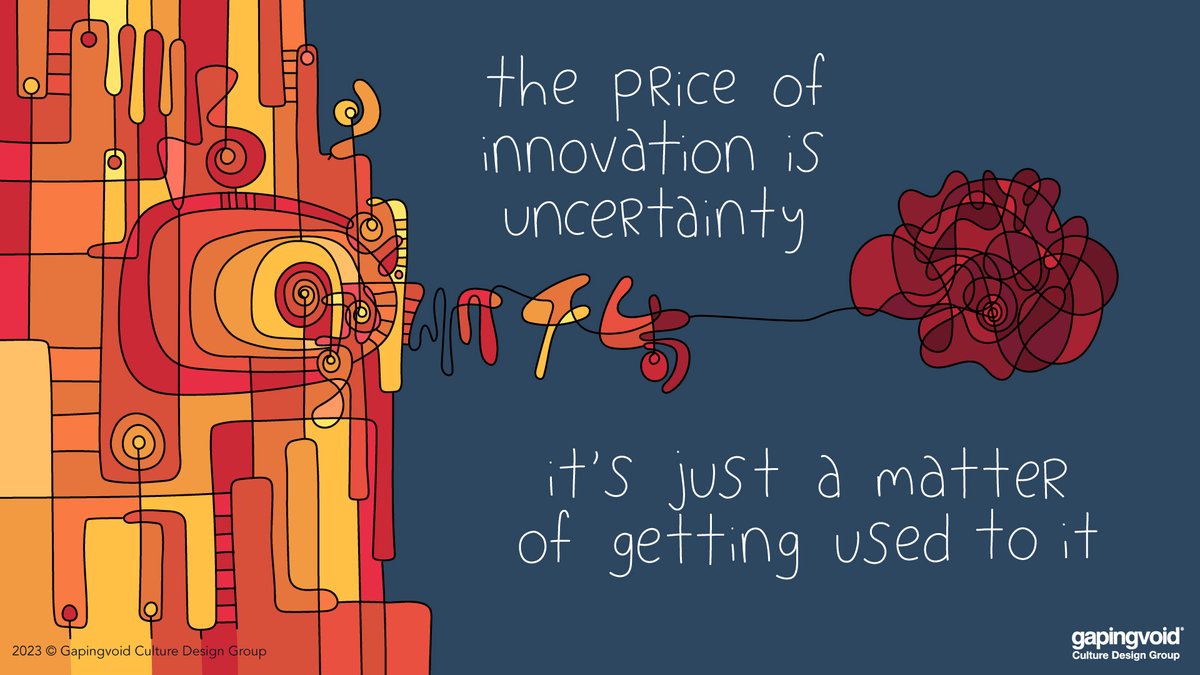
Marcus Aurelius. Charlemagne. Suliman The Magnificent. Muhammed. Elizabeth I. Quin Shi Huang. Peter The Great. Maria Theresa of Austria. Great historical leaders, sure, but what else do they all have in common? As good at their jobs as they were, in the end, they all ultimately failed. Read on: gapingvoid.com/how-to-survive…
Gapingvoid Culture Design Group tweet media
English
0
1
2
251
Blake Burge
Blake Burge@blakeaburge·
Underrated life advice: You can literally start to turn your whole life around by winning the next 24 hours. One clean day becomes evidence. Evidence becomes momentum. Momentum becomes a new life.
English
63
425
3.5K
87.9K
Tim Denning
Tim Denning@Tim_Denning·
The day you accept uncertainty as a forever thing is the day you stop delaying decisions and just take action knowing you’ll figure it out along the way.
English
64
101
626
16K
Jay Yang
Jay Yang@Jayyanginspires·
The quickest way to improve your life is to put yourself in an environment where you feel like you don't belong and force yourself to level up.
English
38
105
964
18.7K
Blake Burge
Blake Burge@blakeaburge·
Major life cheat code: Become comfortable being misunderstood. The moment you choose a real path, someone will think you’re too much, too little, too serious, too strange. Do you. A life designed for universal approval becomes a life that belongs to nobody.
English
63
218
1.4K
38.9K
Nir Eyal
Nir Eyal@nireyal·
Never underestimate a person who practices self-education. Formal education ends. Self-education doesn't. The person reading on the train, working through a textbook at night, watching lectures on the weekend — they're compounding something the credentialed often stop building the day they graduate. What I've noticed about self-educators: They ask better questions. Not because they're smarter, but because they've read across fields the rest of us assume don't connect. They're harder to bluff. They've gone to the primary sources. They know what the study actually says, not just what the headline claimed it said. They update faster. No identity tied to a degree, no tribe to defend — just the next book, the next paper, the next conversation. And they tend to be quiet about it. The loudest people in the room are rarely the ones who've spent the most time alone with a book. The credential gets you in the door. What you read after — every week, every year, for the rest of your life — is what decides where you end up.
Nir Eyal tweet media
English
4
16
85
4K
Gapingvoid Culture Design Group
Idealistic people with good intentions like Brutus enter the halls of power wanting to do good, but because of the greed, envy, and ambition that surrounds them, they end up being used like a rag. Unfortunately, kids, when you grow up and enter the working world, you will find lots of people like Cassius and Mark Antony. And the higher up the food chain you go, the more of them you’ll find. This is why we still read Shakespeare. If you want to be a strong leader, you must learn to recognize these characters before history repeats itself. Full synopsis: bit.ly/4wz0AaR
English
0
0
2
295
Andrew Yeung
Andrew Yeung@andruyeung·
Catan is the most accurate personality trait ever invented. You can learn a lot about someone in one game of Catan. e.g. - The hoarder who stockpiles resources and never trades is the person IRL who splits every check. - The revenge player who spends the entire game trying to get back at someone for robbing them has a massive chip on their shoulder and holds grudges. - The kingmaker who never wins but is the loudest person at the table is the planner of the friend group. - The quiet person who says nothing, barely trades, and wins out of nowhere is the most dangerous person in any room.
Andrew Yeung tweet media
English
16
8
98
18.2K
Mark Manson
Mark Manson@Markmanson·
Resentment is the compound interest on conversations you were too afraid to have.
English
61
244
1.7K
57.8K
Jessica Amir
Jessica Amir@JessicaDAmir·
What if you didn’t trust all of your thoughts? And slowed down. And reflected. I can guarantee that if you did this with: Your investments. Your opinions of others. Your most important relationships. Life would be easier. And you would be a lot richer in every sense.
Jessica Amir tweet media
English
9
0
63
3.9K
Leila Hormozi
Leila Hormozi@LeilaHormozi·
5 reasons you should go for it: • Nobody is thinking about your life as much as you are. • Playing it safe is still a risk. • You can always change direction. You can’t get back lost time. • The worst-case scenario is usually survivable. • The best-case scenario could change your life.
English
140
583
3.9K
88.3K
Tim Ferriss
Tim Ferriss@tferriss·
Ninety-nine percent of people in the world are convinced they are incapable of achieving great things, so they aim for the mediocre. The level of competition is thus fiercest for “realistic” goals, paradoxically making them the most time- and energy-consuming. If you are insecure, guess what? The rest of the world is, too. Do not overestimate the competition and underestimate yourself. You are better than you think. Unreasonable and unrealistic goals are easier to achieve for yet another reason. Having an unusually large goal is an adrenaline infusion that provides the endurance to overcome the inevitable trials and tribulations that go along with any goal. Realistic goals, goals restricted to the average ambition level, are uninspiring and will only fuel you through the first or second problem, at which point you throw in the towel. If the potential payoff is mediocre or average, so is your effort. The fishing is best where the fewest go, and the collective insecurity of the world makes it easy for people to hit home runs while everyone else is aiming for base hits. There is just less competition for bigger goals.
English
272
1.1K
9.3K
694.5K
Gapingvoid Culture Design Group
Let's evaluate fireworks objectively for a moment. They're expensive. They last about fifteen minutes. They literally go up in smoke. They wake the baby. They terrify the dog. We spend more time setting them up than we do enjoying them. And every year, thousands of people accidentally light their own shoes on fire. On paper, fireworks are a disaster. And yet Americans spend billions of dollars on them every Fourth of July. Why? bit.ly/4wj0TGs
English
0
0
1
341
Gapingvoid Culture Design Group
If you want extraordinary performance, give people an extraordinary reason. Nobody climbs for a KPI.
Gapingvoid Culture Design Group tweet media
English
0
1
3
378
Gapingvoid Culture Design Group
Most people choose to pass the buck. The ones who don’t? The ones who take extreme ownership even if it makes them look bad? Those are the leaders people will dutifully follow into battle. bit.ly/4p3jBj1
English
0
1
2
294
How To Prompt
How To Prompt@HowToPrompt__·
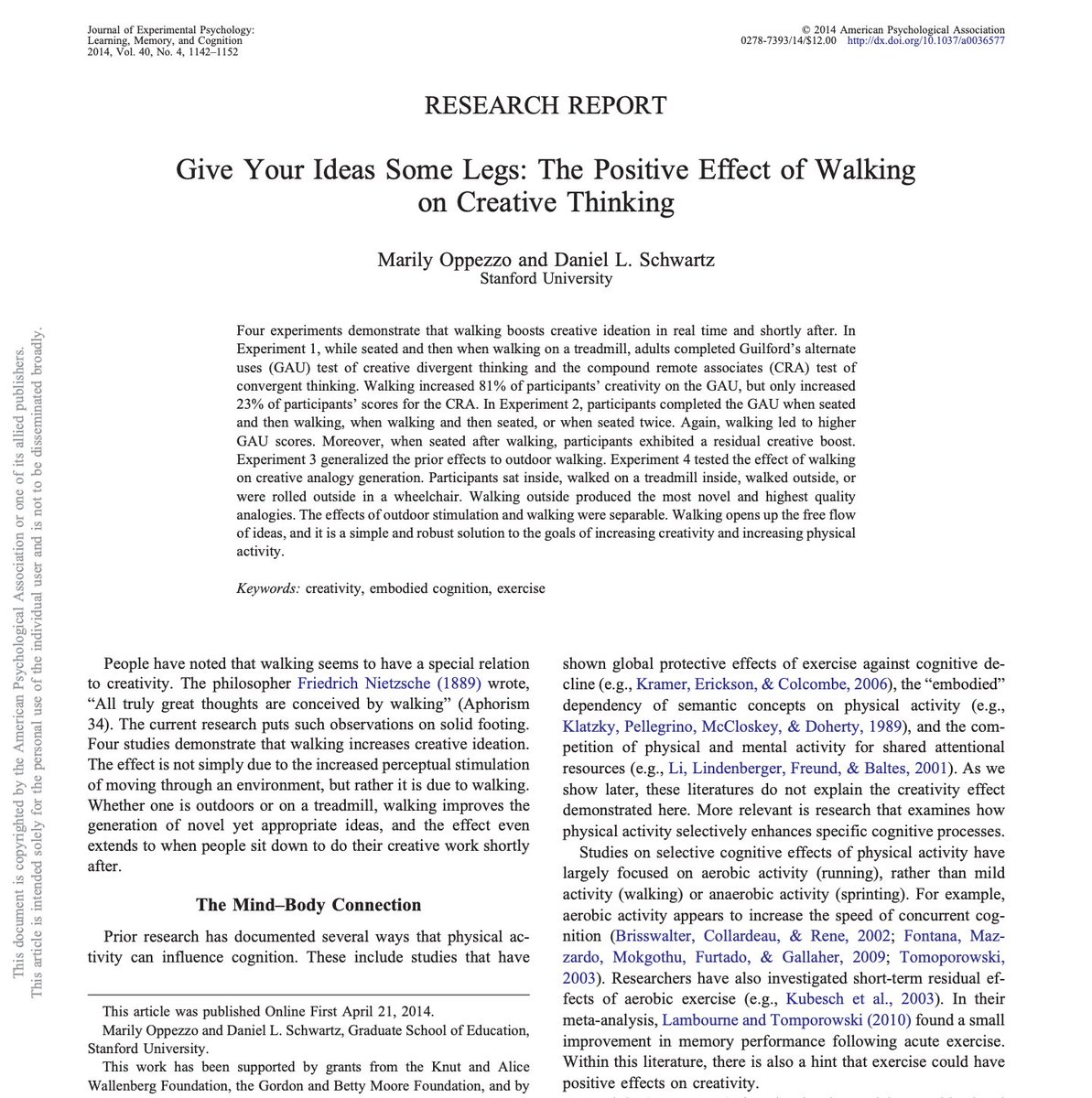
You are killing your own creativity every time you sit down to work. And Stanford has the data to prove it. They found that the simple act of walking generates 60% more creative ideas than sitting. But they didn't just find a loose correlation. They designed a brutal experiment to kill every single alternative explanation. They tested people sitting inside. They tested people walking outside in nature. They tested people being rolled outside in a wheelchair. And they tested people walking on a treadmill inside, staring at a blank, windowless wall. The results were undeniable. It wasn't the environment. It wasn't the fresh air. Being rolled outside in a wheelchair did absolutely nothing. But walking on a treadmill facing a blank wall? Creative output exploded. The cognitive upgrade came directly from the physical mechanics of walking. 100% of the participants who walked outside generated at least one novel, high-quality analogy compared to only 50% of those seated inside. Across the board, 81% of participants saw their creative output surge the moment their legs started moving. And here is the best part. The effect is residual. When participants sat back down after a walk, the creativity boost carried over into their seated work. Every time you sit perfectly still at a desk trying to force a breakthrough, you are fighting your own biology. The human brain wasn't designed to innovate in a chair. We built an entire corporate culture around sitting at a screen for 8 hours a day. And it is literally paralyzing our best ideas.
How To Prompt tweet media
English
3
10
36
3.3K