Garry Haraveth (he/him) retweetledi
Garry Haraveth (he/him)
1.8K posts

Garry Haraveth (he/him)
@gharaveth
Father. Educator. Lifelong Learner. Relentless Pursuer of Truth. EdTech, Blended Learning. Family/School Engagement. Coach. ***My posts, my views.***
Cortland, NY Katılım Ekim 2011
2.3K Takip Edilen579 Takipçiler

@SpeakerJohnson Lies, again. Straight to Hell for your lying ass.
English
Garry Haraveth (he/him) retweetledi

A community college professor taught the same study skills lecture for 30 years, and the video quietly became one of the most watched educational recordings on the internet.
His name is Marty Lobdell. He spent his career as a psychology professor watching students fail not because they were lazy, but because nobody had ever taught them how their brain actually works under the pressure of learning something hard.
The lecture is called "Study Less Study Smart." Over 10 million views. Passed around in Reddit threads, Discord servers, and university study groups for over a decade. And the core insight buried inside it has been sitting in cognitive psychology research for years, waiting for someone to explain it in plain language.
Here is the framework that completely changed how I think about effort.
Your brain does not sustain focus the way you think it does. Studies tracking real students found that the average learner hits a wall somewhere between 25 and 30 minutes.
After that, efficiency doesn't just decline. It collapses. You're still sitting at your desk, still looking at the page, but almost nothing is going in.
Lobdell illustrated this with a student he knew personally. She set a goal of studying 6 hours a night, 5 nights a week, to pull herself out of academic probation. Thirty hours of studying per week. She failed every single class that quarter.
She wasn't failing because she lacked effort. She was failing because she had confused time spent near books with time spent actually learning. The 25-minute crash hit her at 6:30pm every night. She spent the next five and a half hours sitting in the wreckage of her own focus and calling it studying.
The fix sounds almost too simple. The moment you feel the slide, stop. Take five minutes. Do something that actually gives you a small reward. Then go back. That five-minute reset returns you to near full efficiency. Across a six-hour window, the difference is not marginal. It is the difference between thirty minutes of real learning and five and a half hours of it.
The second thing he taught destroyed something I had believed about how memory actually works.
Highlighting feels productive. Going back over your notes and recognizing everything feels like knowing. But recognition and recollection are two completely different cognitive processes, and your brain is very good at making you confuse them.
You can see something you've read before and feel completely certain you understand it, even when you couldn't reconstruct a single sentence from memory if the page were blank.
He proved this live in the room. He read 13 random letters to his audience. Almost nobody could recall them. Then he rearranged the same 13 letters into two words: Happy Thursday. The whole room got all 13 without effort.
Same letters. Same count. The only thing that changed was meaning.
The brain stores meaning. Not repetition. The moment new information connects to something you already understand, the retention changes entirely.
This is what the cognitive psychology literature calls elaborative encoding, and it is the mechanism underneath every effective study technique.
The third principle was the one that hit me hardest, and the one almost nobody applies.
Lobdell cited research showing that 80 percent of your study time should be spent in active recitation, not passive reading. Close the material. Say it back in your own words.
Teach it to someone else, or to an empty chair if no one is around. The struggle of retrieval is where the actual learning happens. Reading your notes again is watching someone else do the work.
His parting line has stayed with me longer than almost anything else I have read about learning.
He told the room that if what he shared didn't change their behavior, they hadn't actually learned it. It would just live in their heads as something they had heard once and felt good about.
He was right. And most people leave every lecture exactly like that.
The students who remember everything aren't putting in more hours.
They stopped confusing the feeling of studying with the fact of it.
English
Garry Haraveth (he/him) retweetledi

🚨 In 2013, Ben Polak gave a Yale lecture that quietly changed how smart people make decisions.
Most people have never seen it.
And instead of teaching theory, he showed how decisions actually play out in real life.
One hour that can completely shift how you think.
He broke down game theory into something practical. Not equations, but thinking patterns. Like dominance where the best move becomes obvious once you remove weak options. Or backward induction starting from the end and reasoning your way back to the present to make smarter choices.
And then there’s something subtle but powerful: proactive bias. Most people wait, react, and adjust. The best decision-makers move first, shape the game, and force better outcomes.
What makes this lecture different is how usable it is. It’s not about being “right” it’s about thinking ahead, understanding incentives, and making moves with clarity.
Because in negotiations, business, and even everyday life…
Better decisions don’t come from more information.
They come from better thinking.
English
Garry Haraveth (he/him) retweetledi

En 2019, el profesor del MIT Patrick Winston dio una conferencia legendaria de 1 hora llamada “How to Speak”.
Tiene más de 18 millones de visualizaciones por una razón.
Sus frameworks:
· Tus ideas son como tus hijos
· La regla de los 5 minutos para presentaciones de trabajo
· Por qué los chistes fallan al principio
15 lecciones sobre comunicación:
Español
Garry Haraveth (he/him) retweetledi

I'm 27.
I've made $3 million selling ebooks online.
• No writing.
• No audience.
• No fancy sales funnel.
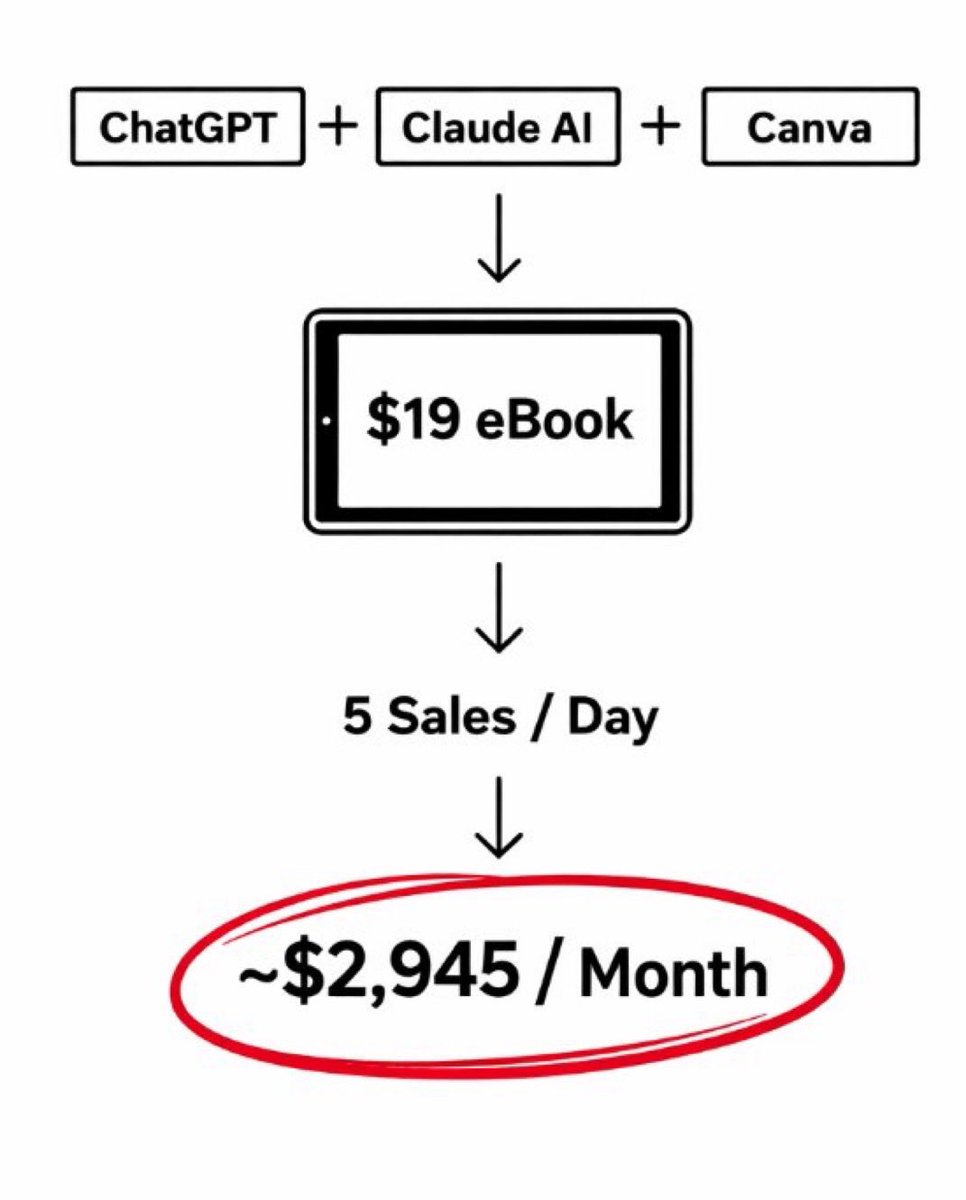
Here's the boring system that can make you at least $2,945 in the next 72 hours:
1. Find an unsexy, urgent problem
Go on Reddit. People complain there all day.
You're not looking for trends, you're looking for pain.
Example: "How to stop your husband from snoring at night"
That's your niche.
2. Build the outline with ChatGPT
Prompt it to outline 10 chapters around that problem.
Each chapter should stand alone, because Amazon shows samples, and samples sell books.
3. Write the book with Claude
Feed Claude your outline, your tone, your style.
Ask it to write 1,000 words per chapter.
Target: 80–150 pages. Done in an afternoon.
4. Design the cover in Canva
Most people skip this. Don't.
Your cover is your ad.
Great design = more clicks = more sales.
5. Publish on Amazon KDP
Upload. Done.
- No inventory.
- No sales page.
- No personal brand.
Amazon handles the rest.
Publish 3–5 books this way.
See what sells. Scale the winners.
Total cost to start: nearly $0.
Though I'd recommend investing $800–$1,500 in tools and freelancers once you're ready to treat it like a real business.
Want the full system?
My tools, my AI prompts, the exact process?
I recorded 5+ hours of tutorials covering all of it.
Like + comment "Need"
I'll DM you and Free for 24 hours.
(Follow first, otherwise I can't reach your DMs.)

English
Garry Haraveth (he/him) retweetledi


@Scavino47 @WhiteHouse I’m really surprised they didn’t all burst into flames.
English

Garry Haraveth (he/him) retweetledi

🚨BREAKING: Democrats are in panic mode after DEVASTATING new poll finds Americans trust the Republican Party on the ECONOMY and INFLATION by +6 points, tariffs by +2 points, immigration by +11 points and border security by +28 points.
Donald Trump is crushing it! 🇺🇸🇺🇸
Simple poll. Please be honest! As of today, how much do you still trust and support this man?
A. 100%
B. 50%
C. 25%
D. 0%
MAKE THIS GO VIRAL ON 𝕏. LET’S GO 👏
English

SEC DOD Pete Hegseth: “Under the previous administration, we looked like fools. Not anymore.” @Acyn (2025)
English
Garry Haraveth (he/him) retweetledi

83M views later, I’m thinking about what to write next.
If you read my article and have questions you still want answered, what are they?
Matt Shumer@mattshumer_
English