Alex👾

1.6K posts

Alex👾 banner
Alex👾

Alex👾

@ghost_trader94

Froganas|MyPetHooligan |Nifty Portal Holder

Katılım Temmuz 2021
483 Takip Edilen158 Takipçiler
Alex👾 retweetledi
Jonny Paradox
Jonny Paradox@GoldenPixelArt·
BREAKING: Bitpoin Puppets being analyzed at length by renowned german art historian Steven Reiss. 🖼🎨👀 Not that we are trying to be art anyhow. Else we would just get stolen out of Louvre one day. 🌍☮️
Jonny Paradox tweet media
Steven Reiss@stenreiss

Over the last few days I’ve had a couple of DMs from people who felt a bit offended when I categorized projects in the Ordinals space differently: sometimes as art, sometimes “only” as design or as a tech demo or as a collectible. I understand why that’s sensitive. A lot of people have put time, money and emotion into these things. At the same time, I’ve spent years moving between images, markets and technology. I’ve taught, curated exhibitions, worked on research projects. Sorting terms and developing criteria is simply part of my everyday work. Important: A collectible is not “worth less” to me just because I don’t call it art. It’s simply something different. And because there clearly is some confusion around this, here’s a small thought experiment. I’ll do it with Bitcoin Puppets @BitcoinPuppets , because they’re a good example to make these layers visible. And just to be 100% clear: I have a lot of respect for @lepuppeteerfou as the creator. Of course, I’m looking from an art historical tradition at something that often consciously positions itself against that tradition. That tension is part of the story. 1. The Aesthetics of Incompetence At first glance, the MS Paint look of the Puppets feels “sloppy”. But I think it should be read differently: as a deliberate decision. In art theory there’s a term for this: performative incompetence or the demonstrative gesture of “not looking good on purpose” to signal a specific stance. There’s a genealogy here that runs through things like Outsider Art and into early CryptoArt. Most of you will recognize similar things from Rare Pepes, 4chan meme culture or those first on-chain experiments: counter-style as a rejection of sleek corporate design (Web2) and “VC-compatible” Web3 branding. It’s a kind of digital punk move: “The less polished, the more ‘real’”. The roughness signals: we’re grassroots, not a brand. That’s culturally interesting and says a lot about the scene. But on its own it doesn’t automatically turn a project into art. 2. Why Puppets are only half Dada to me On the surface, Puppets quote motifs that recall Dada, punk or early CryptoArt: ugliness as a device, anti-style – i.e. a refusal to look “professional”. In that sense you could say they carry something like "Dada genes". (As a side note: I’m currently working on a separate text reading Bitcoin itself from that angle) At the same time, the Puppets emerge in a context that works very differently from that of the historical Dadaists. Dada positioned itself against institutions, bourgeois value systems, an established art market. The Puppets appear in an environment where every anti-gesture is very quickly traded as an asset. For me, that creates a tension: They look like rebellion. But they operate perfectly smoothly within a speculative market logic. The really interesting movement doesn’t happen in the individual image, but in what follows: floor price, hype, memes, belonging, speculation. If you like, you can read this as a kind of unconscious social sculpture in the sense of Joseph Beuys – with the community as the material, even if no one involved would phrase it that way. At the same time, you could also describe it as hyper-capitalist folklore of a digital subculture. And that is not a downgrade, because such things often carry as much cultural energy as anything in a museum – it's just a different category. In other words: the meta-layer often emerges more in community practice than in the work itself. Both readings are valid to me. But neither automatically forces me to treat the Puppets as “artworks” in the classical sense of autonomous works. 3. Why “shitposting” is not automatically art To explain why I still differentiate, I want to bring in two examples from art history that come up when people look for parallels between crypto and contemporary art: Piero Manzoni and Andy Warhol. Piero Manzoni, “Merda d’artista” (1961): Manzoni allegedly filled his own excrement into 90 tins, wrote “Merda d’artista” on them and sold them at the price of gold. These tins are now canonical works of art. Why this work is read that way in art history The work explicitly targets market mechanisms and authenticity fetishes. Manzoni demonstrates how far projection can go: if signature, scarcity and story are right, literally anything becomes tradable. The tin is not “just a joke” but a commentary on the fact that this joke works. That meta-layer is built into the work itself. If I compare that to the Puppets, I see a different attitude. With Manzoni, the point is essentially: “I’m doing this to show you that you’ll trade it.” With Puppets, it feels closer to: “We’re doing this … and yes, of course it will be traded.” They tap into the same mechanisms (projection, scarcity, story) but more as a lived practice than as an explicit critique. The Manzoni logic is there, but in the Puppets complex it plays out mainly in community behaviour and market dynamics, not as a stated intention of the work. Puppets are often described, affectionately, as “visual shitposts”. They lean into trash aesthetics and absurdity. Manzoni, by contrast, points directly at the system and says: “Look what you’re willing to buy”. With Puppets, that commentary isn’t clearly embedded as a formal program; it’s something that emerges more from how the project is used, traded and talked about than from the inscription itself. Andy Warhol, Business Art: Warhol printed dollar bills, soup cans, brand logos and spoke openly about “good business” being part of his art. Why that matters in an art-historical sense: Warhol isn’t only interested in the objects themselves, but in our relationship to them: brands, repetition, desire, consumption. His works depict commodities, but also the system that produces and charges those commodities. You see the image and at the same time your own fixation. Puppets and other PFP projects, for me, tend to sit on the other side of that line: They don’t depict the commodity, they are the commodity. Warhol stages consumption; PFPs are consumption objects. Again, that’s not a moral judgment! It’s just a different role and both roles are needed if you care about culture as a whole. 4. So what does that mean for my criteria? I’m not trying to build a hierarchy here, just a different kind of map. For me, a helpful distinction (for contemporary and post-conceptual art in particular) is not “good” vs. “bad”, but something more like: “Is something playing a game or is it also making that game itself the topic?” Manzoni, Warhol (and Beuys, in a different register) fall into the second category for me: they don’t just engage with market, value, aura, ritual and community, they also show those mechanisms at the same time. You see the work and the machine behind it. On the level of the inscriptions themselves, a lot of crypto projects I currently observe more in the first category: they activate a "game" (memes, belonging, speculation) and are incredibly effective at it. The more reflexive layer tends to live in community practice and market behaviour rather than in the individual piece. That alone is enough to make them culturally significant. Whether you call that “art” or not then depends on your own definition and your thresholds. This is simply my reading right now; in one or in ten years I might see some of these projects differently, too. Categories shift, canons change, and sometimes works grow into meanings they didn’t visibly have at the beginning. I’m sharing this because people asked and because it might help explain why I personally call some things “art” and others more like subcultural design, tech demo or collectibles, without denying their cultural relevance. If anything, taking the time to sort them is a sign that I take them seriously! Not everything that matters has to be called “art”. But it helps if we at least have some idea what we’re talking about.

English
8
8
110
11.3K
Alex👾 retweetledi
Steven Reiss
Steven Reiss@stenreiss·
Over the last few days I’ve had a couple of DMs from people who felt a bit offended when I categorized projects in the Ordinals space differently: sometimes as art, sometimes “only” as design or as a tech demo or as a collectible. I understand why that’s sensitive. A lot of people have put time, money and emotion into these things. At the same time, I’ve spent years moving between images, markets and technology. I’ve taught, curated exhibitions, worked on research projects. Sorting terms and developing criteria is simply part of my everyday work. Important: A collectible is not “worth less” to me just because I don’t call it art. It’s simply something different. And because there clearly is some confusion around this, here’s a small thought experiment. I’ll do it with Bitcoin Puppets @BitcoinPuppets , because they’re a good example to make these layers visible. And just to be 100% clear: I have a lot of respect for @lepuppeteerfou as the creator. Of course, I’m looking from an art historical tradition at something that often consciously positions itself against that tradition. That tension is part of the story. 1. The Aesthetics of Incompetence At first glance, the MS Paint look of the Puppets feels “sloppy”. But I think it should be read differently: as a deliberate decision. In art theory there’s a term for this: performative incompetence or the demonstrative gesture of “not looking good on purpose” to signal a specific stance. There’s a genealogy here that runs through things like Outsider Art and into early CryptoArt. Most of you will recognize similar things from Rare Pepes, 4chan meme culture or those first on-chain experiments: counter-style as a rejection of sleek corporate design (Web2) and “VC-compatible” Web3 branding. It’s a kind of digital punk move: “The less polished, the more ‘real’”. The roughness signals: we’re grassroots, not a brand. That’s culturally interesting and says a lot about the scene. But on its own it doesn’t automatically turn a project into art. 2. Why Puppets are only half Dada to me On the surface, Puppets quote motifs that recall Dada, punk or early CryptoArt: ugliness as a device, anti-style – i.e. a refusal to look “professional”. In that sense you could say they carry something like "Dada genes". (As a side note: I’m currently working on a separate text reading Bitcoin itself from that angle) At the same time, the Puppets emerge in a context that works very differently from that of the historical Dadaists. Dada positioned itself against institutions, bourgeois value systems, an established art market. The Puppets appear in an environment where every anti-gesture is very quickly traded as an asset. For me, that creates a tension: They look like rebellion. But they operate perfectly smoothly within a speculative market logic. The really interesting movement doesn’t happen in the individual image, but in what follows: floor price, hype, memes, belonging, speculation. If you like, you can read this as a kind of unconscious social sculpture in the sense of Joseph Beuys – with the community as the material, even if no one involved would phrase it that way. At the same time, you could also describe it as hyper-capitalist folklore of a digital subculture. And that is not a downgrade, because such things often carry as much cultural energy as anything in a museum – it's just a different category. In other words: the meta-layer often emerges more in community practice than in the work itself. Both readings are valid to me. But neither automatically forces me to treat the Puppets as “artworks” in the classical sense of autonomous works. 3. Why “shitposting” is not automatically art To explain why I still differentiate, I want to bring in two examples from art history that come up when people look for parallels between crypto and contemporary art: Piero Manzoni and Andy Warhol. Piero Manzoni, “Merda d’artista” (1961): Manzoni allegedly filled his own excrement into 90 tins, wrote “Merda d’artista” on them and sold them at the price of gold. These tins are now canonical works of art. Why this work is read that way in art history The work explicitly targets market mechanisms and authenticity fetishes. Manzoni demonstrates how far projection can go: if signature, scarcity and story are right, literally anything becomes tradable. The tin is not “just a joke” but a commentary on the fact that this joke works. That meta-layer is built into the work itself. If I compare that to the Puppets, I see a different attitude. With Manzoni, the point is essentially: “I’m doing this to show you that you’ll trade it.” With Puppets, it feels closer to: “We’re doing this … and yes, of course it will be traded.” They tap into the same mechanisms (projection, scarcity, story) but more as a lived practice than as an explicit critique. The Manzoni logic is there, but in the Puppets complex it plays out mainly in community behaviour and market dynamics, not as a stated intention of the work. Puppets are often described, affectionately, as “visual shitposts”. They lean into trash aesthetics and absurdity. Manzoni, by contrast, points directly at the system and says: “Look what you’re willing to buy”. With Puppets, that commentary isn’t clearly embedded as a formal program; it’s something that emerges more from how the project is used, traded and talked about than from the inscription itself. Andy Warhol, Business Art: Warhol printed dollar bills, soup cans, brand logos and spoke openly about “good business” being part of his art. Why that matters in an art-historical sense: Warhol isn’t only interested in the objects themselves, but in our relationship to them: brands, repetition, desire, consumption. His works depict commodities, but also the system that produces and charges those commodities. You see the image and at the same time your own fixation. Puppets and other PFP projects, for me, tend to sit on the other side of that line: They don’t depict the commodity, they are the commodity. Warhol stages consumption; PFPs are consumption objects. Again, that’s not a moral judgment! It’s just a different role and both roles are needed if you care about culture as a whole. 4. So what does that mean for my criteria? I’m not trying to build a hierarchy here, just a different kind of map. For me, a helpful distinction (for contemporary and post-conceptual art in particular) is not “good” vs. “bad”, but something more like: “Is something playing a game or is it also making that game itself the topic?” Manzoni, Warhol (and Beuys, in a different register) fall into the second category for me: they don’t just engage with market, value, aura, ritual and community, they also show those mechanisms at the same time. You see the work and the machine behind it. On the level of the inscriptions themselves, a lot of crypto projects I currently observe more in the first category: they activate a "game" (memes, belonging, speculation) and are incredibly effective at it. The more reflexive layer tends to live in community practice and market behaviour rather than in the individual piece. That alone is enough to make them culturally significant. Whether you call that “art” or not then depends on your own definition and your thresholds. This is simply my reading right now; in one or in ten years I might see some of these projects differently, too. Categories shift, canons change, and sometimes works grow into meanings they didn’t visibly have at the beginning. I’m sharing this because people asked and because it might help explain why I personally call some things “art” and others more like subcultural design, tech demo or collectibles, without denying their cultural relevance. If anything, taking the time to sort them is a sign that I take them seriously! Not everything that matters has to be called “art”. But it helps if we at least have some idea what we’re talking about.
Steven Reiss@stenreiss

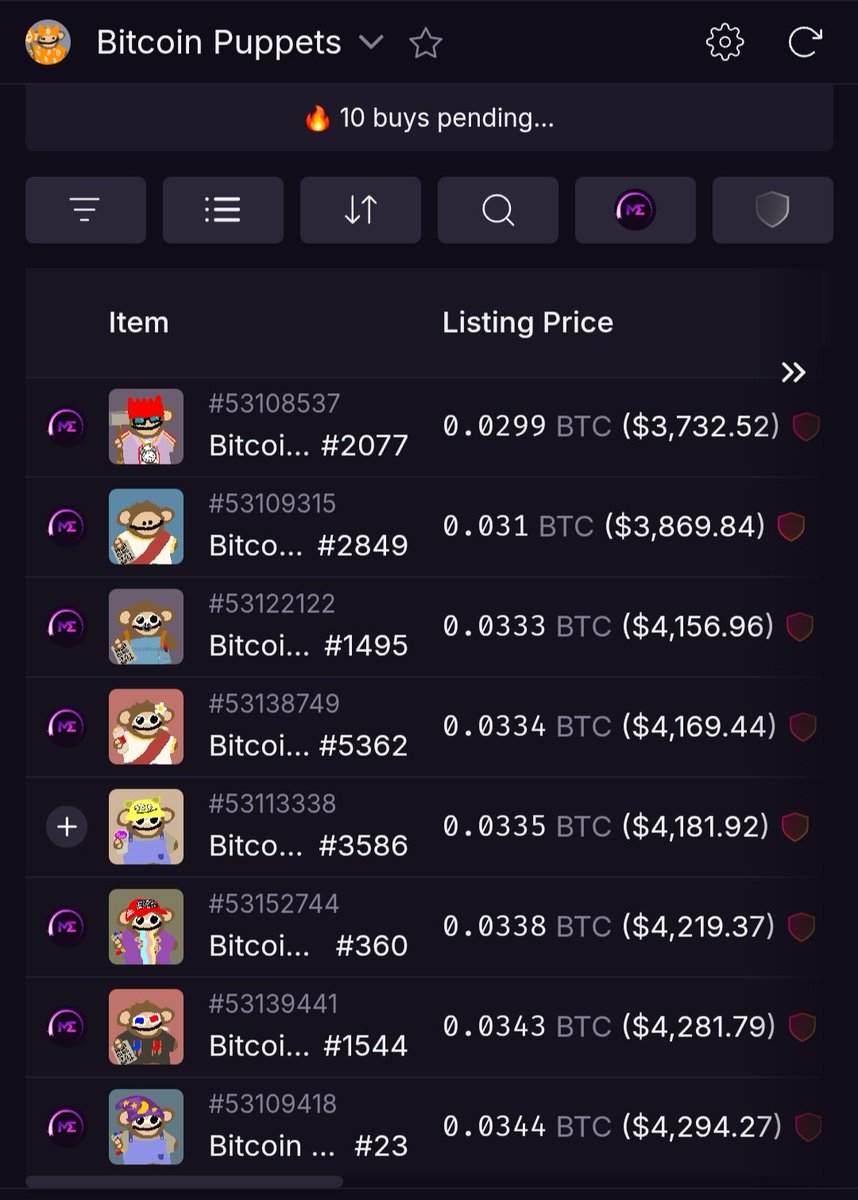
This screenshot shows only one art collection alongside many collectible-focused ones. Sometimes the timeline makes it look like this entire bitcoin art field is just charts and collectibles. I’ve helped to get digital works into museum collections myself and many of those will never show up in these lists, simply because so much of the scene’s attention is driven by the market. It’s understandable, but it creates a very distorted picture for people who aren’t yet interested in (or simply can’t follow) what’s happening in the art space on Bitcoin beyond the collectible layer.

English
45
31
163
36.9K
Alex👾 retweetledi
MidshipMan
MidshipMan@ManMidship·
No matter what, puppets are the face of ordinals. Doesn’t matter how hard you bitch about us or cry, we’re never fucking leaving 😘. Embrace 🌎☮️. Have fun trying to replicate, it can’t be duplicated. 😹🫵🌎☮️🧡🧡🧡🧡🏆
MidshipMan tweet mediaMidshipMan tweet mediaMidshipMan tweet media
English
3
11
72
4.2K
Alex👾 retweetledi
Max Long 🚀
Max Long 🚀@MaxLonged·
This will be my last tweet on this topic: @BitcoinPuppets is the most asymmetric bet in crypto right now. They are quite literally the Cryptopunk equivalent on Bitcoin. They have a controversial past, a lot of history, and the same questioning on the legitimacy of it being the first cultural collection on a chain. They have completely unique and original art. They have a brilliant community of people that believe in the vision - almost cult-like. And they are only sitting at a 0.038 BTC floor in a world where online identity is one of the most important aspects you can get.
Max Long 🚀 tweet media
English
52
59
334
24.2K
Alex👾 retweetledi
nayver
nayver@nayver·
You: Watching your Ordinals on Magic Eden Me: Watching my Ordinals on TV That shit hits differently. #BitcoinPuppets #KingsRoyal $PUPS 🌎☮️ btw
English
11
24
165
7.6K
Alex👾 retweetledi
kuyamark • ᴗ •
kuyamark • ᴗ •@kuyamark·
Bitcoin Puppets do a lil onboarding
kuyamark • ᴗ • tweet media
English
6
14
107
2.8K
Alex👾 retweetledi
Jiurn
Jiurn@Jiurn·
🟠 24H ORDINAL RECAP 🟠 Bitcoin puppets are going crazy and much more, A 🧵👇 1/12
Jiurn tweet media
English
18
31
109
7.7K
Zap
Zap@ZapApp·
The last time that Runes reached new ATHs a bunch of grifters and tourists showed up and pretended that they had been supporting Runes all along This post will serve as a timestamped ledger so that they can’t do it again Reply below to register your Proof-of-Belief in Runes👇
English
687
243
1.3K
44.5K
Alex👾 retweetledi
Banks
Banks@Banks·
***$500,000 GIVEAWAY*** Feeling generous and WOW so very blessed. This Twitter community has grown 9,000 members in a single day, I just traded +$300,000 in 24 hours, and Probably Nothing is the biggest crypto content platform on planet Earth. We are truly winning in ever category. To show my appreciation for all the overwhelming support I'm giving away an NFT that at once worth a whopping $500,000 USD (currently valued at around $40,000) to one LUCKY WINNER! Quote tweet this tweet with what would make you excited about NFT's again. Best response wins this guy. GOOD LUCK & AGAIN THANK YOU ALL SO MUCH. EVERY. LAST. PERSON.
Banks tweet media
English
1.4K
1.3K
7K
8.4M
Alex👾 retweetledi
Michael Saylor
Michael Saylor@saylor·
SAB 121 has been rescinded, allowing banks to custody Bitcoin. 🚀
Michael Saylor tweet media
English
1.5K
6.4K
36.1K
2.7M
Alex👾 retweetledi
Cointelegraph
Cointelegraph@Cointelegraph·
🇺🇸 NOW: Senator Cynthia Lummis is now chair of the Senate’s Digital Assets Subcommittee. She’s pushing the BITCOIN Act, aiming to create a U.S. Bitcoin reserve of 1M BTC in five years.
Cointelegraph tweet media
English
138
339
2.5K
175.7K
Alex👾 retweetledi
Gmtoshi
Gmtoshi@BitcoinNL·
$POOKA back into the top 10 daily volume and moving up nicely!🚀
Gmtoshi tweet media
English
9
24
79
2.1K
Alex👾 retweetledi
Frank
Frank@frankdegods·
happy bitcoin all time high 🇺🇸
English
66
54
692
36.8K