I spent my early years in Sanyati, Kadoma. I learned at Chiguvare Primary School and later did my secondary education at Sanyati Baptist High School. That’s why I’m still active in several local whatsapp groups from the area.
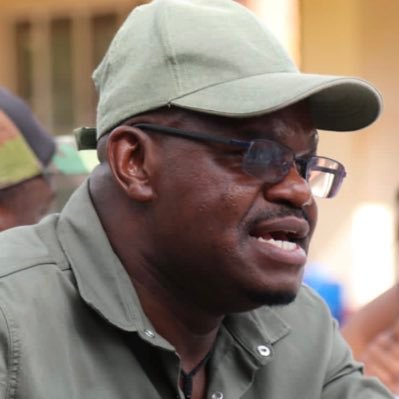
One of those groups has recently uncovered the truth: Knox is not a war veteran. He was nowhere near our liberation war. His real surname is Mutimusakwa. He only became friends with Geza when he worked as an ARDA manager in Sanyati.
Right now, he’s hiding in South Africa. Let there be no doubt - the man is an outright phony.
Me:
Tiri kufara, baba… tiri kufara baba! 🎼🎵🕺
(Singing in Frets' voice...)
Curious Bystander:
Ko muri kufareiko kudaro nhai?
Me:
Uri mutsva kuJerusalem here, kana kuti wakabva kure nhasi?
Curious Bystander:
Aa, chii chiri kuitika? Nditsanangurirewo.
Me:
Open cheque yedu kuZANUPF - yakadzoka kupolitics. Yakadzoka zvayo yakarara nemusana!
Curious Bystander:
Open cheque? Ipi iyoyo?
Me:
Inonzi Nelson Chamisa.
Curious Bystander:
Haa? Sei muchifara nezvazvo?
Me:
Because the man is a certified political failure. Two elections - two very clear defeats.
Anopatsanura nekurwisanisa vanhu, saka hapana opposition yakabatana ingambomira pasi pake. He is a religious zealot anonyepa kuti anorota hope dzaMwari masikati machena. A strategist asina strategy.
Uye pamusoro pezvose - akatopupura nemuromo wake kuti vanomutevera vese vari stupid!
Curious Bystander:
Mira zvishoma… uri kureva kuti munhu akadaro ndiye credible opposition leader here?
Me:
Credible? Handina basa nazvo! That's neither here nor there for me.
Chandinoda ndechekuti aripo, aine vateveri vake vakajaira zvakapusa. In fact, if I'm being honest - we want him more than his own supporters want him.
Curious Bystander:
Ko sei?
Me:
Nekuti anovimbisa electoral victory zvefake. Anoziva kuparadza momentum yeopposition panguva chaiyo - chaiyo yakafanira.
He is easy to distract, easy to divide, easy to neutralise. He is the safest opposition ZANUPF could ever ask for!
Curious Bystander:
Haa… pakaipa apa.
Me:
Hapana kuipa - pakanaka chose!
(Breaking into song again) 🎼🎵
Tiri kufara baba… tiri kufara baba!
Tiri kufara baba… tiri kufara baba! 🕺🕺🎶
I came across this compelling video and felt it deserved to be shared.
The man featured is retired Warrant Officer Class 2 Nyamakura - a soldier whose legacy extends beyond the parade ground. Fifteen years ago, he was part of the team that trained a then-young, now seasoned officer, Major Sean Mnangagwa, at the Zimbabwe Military Academy.
Today, he has transitioned from military service to the land, running a successful agricultural project that speaks directly to the ethos of discipline, self-reliance, and national development. His journey from uniform to productivity on the soil is a quiet but powerful illustration of Vision 2030 in motion - where experience, skills, and patriotism are reinvested into building the nation.
What the West Won’t Admit About Zimbabwe’s Land Reform
There is a reason why the narrative in Western capitals has gone quiet. For twenty-five years, the "experts" in London and Washington have been waiting for us to starve. They looked at the Fast Track Land Reform Programme and saw only the destruction of colonial property rights. They obsessed over the tractor count of 1998 while ignoring the human revolution of 2000. But while they were busy drafting sanctions and writing obituaries for our economy, Zimbabwe was quietly building something they never anticipated: the world’s first decentralised, climate-resilient agrarian model. The "breadbasket" didn't burn. It evolved.
The myth of the Rhodesian "golden age" is finally dead, buried by data they can no longer suppress. When the blistering El Niño droughts of the last decade hit Southern Africa, the corporate farming giants of our neighbours - heavily leveraged and reliant on energy-intensive overhead irrigation - buckled under the dual weight of debt and power deficits. But in Zimbabwe? The newly resettled A1 and A2 farmers held the line.
The weapon was Pfumvudza/Intwasa. While the West mocked it as 'primitive', it was actually a masterclass in precision climate adaptation. By trapping moisture at the root zone without the need for electricity or mechanisation, we standardised resilience across millions of plots. The science is irrefutable: conservation plots have been shown to retain up to 3.5% higher soil moisture in the critical topsoil layer compared to conventional tillage. In the brutal 2023/24 drought season, while conventional yields collapsed, Pfumvudza maize yields held 11.5% higher, and sorghum yields 20% higher. We didn't just redistribute land; we redistributed risk, creating a nation of agile adapters who use indigenous science to outmanoeuvre the climate crisis.
But let's not kid ourselves. Survival isn’t wealth. We have won the war for the soil, and through massive headway in irrigation development, we are winning the war against the rain gauge. We have built the dams and rehabilitated the water bodies; the physical infrastructure for a year-round greenbelt is in place. Yet, we have not yet won the war for capital to fully exploit it. The opportunity cost is staggering. Zimbabwe sits on a potential 2.2 million hectares of irrigable land, yet we are currently utilising just over 220,000 hectares - barely 10% of our capacity.
That is why the work of the newly constituted Land Tenure Implementation Committee (LTIC) is not just bureaucratic paperwork - it is the 2nd most important economic act since the Third Chimurenga began, coming closely behind the actual Land Reclamation itself. For years, critics called our land "dead capital." The LTIC is here to silence that laughter. Under direct Cabinet oversight, this body is finally turning the 99-year lease into a securitised, bankable, and transferable asset.
This is the key that unlocks the engine. By regularising these leases, we give the farmer the collateral to finance the high-tech irrigation systems required to bridge that 90% gap. We are unlocking billions of dollars in dormant value to marry our abundant water with our liberated soil. We are moving the nation decisively from "Land for Survival" to "Land for Wealth."
They said we broke the economy. We were just clearing the foundation for a structure they are too short-sighted to see. The land is ours. The water is ready. And now, thanks to the LTIC, the capital is finally coming home.
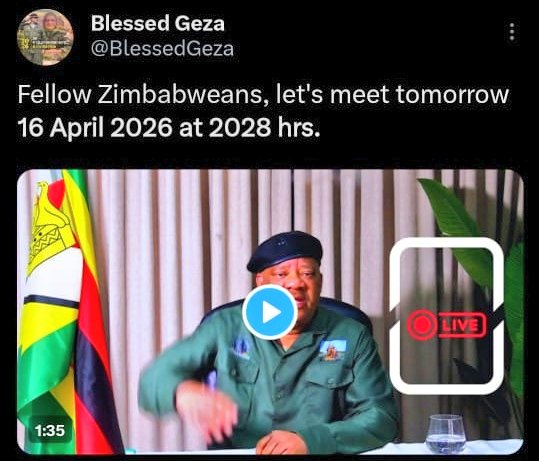
One Leader, One Line
The expulsion of Blessed Geza and Gifford Gomwe is not a forgotten footnote in the Party’s long march; it is a warning flare fired into the night sky. It signals, unmistakably, that indiscipline - especially when amplified through the reckless megaphone of social media - carries consequences in ZANUPF. Their removal was not an attempt to silence thought or debate. It was an act of institutional self-defence, meant to preserve order, hierarchy, and the coherence of the Party’s central brand.
That brand is His Excellency, President Emmerson Dambudzo Mnangagwa.
Every durable political party functions like a solar system: it survives because all bodies orbit a single, stable centre. In ZANUPF, that centre is President Mnangagwa. He is not merely the Head of State; he is the Party’s face, anchor, and reference point. Strategy, messaging, and mobilisation must revolve around him. Self-appointed unaligned spokespeople, freelance ideologues, and online gladiators are not exhibiting initiative; they are drifting into insubordination.
Social media, when properly harnessed, is a useful tool - a transmission belt for the President’s vision and the national interest. When abused, it mutates into shrapnel. Public insults, factional skirmishes, and performative outrage do not remain contained; they ricochet back to His Excellency and smear the Party’s name. In a ruling Party, this behaviour is not a private indulgence; it is a public liability.
ZANUPF is a rules-based organisation, not a street market of emotions. It has structures, procedures, and established channels for resolving grievances. The Party is not governed by WhatsApp voice notes or trending hashtags on X and Facebook. History is unambiguous: those who mistake noise for power eventually collide with the immovable wall of Party discipline. That wall has already claimed its examples of yesteryear.
Leadership demands restraint and control. ZANUPF carries the national mandate; its members are therefore expected to lead with maturity and unity. Borrowing the chaotic, impulsive communication habits of opposition formations is like importing termites into one’s own house; it corrodes the foundations from within and violates the Party’s culture and tradition.
Vision 2030 is the compass. The President’s developmental agenda is the assignment. Anything that diverts energy from it - be it ego-driven theatrics, online exhibitionism, or careless talk - is not activism. It is sabotage disguised as enthusiasm.
Discipline, therefore, is not optional. Loyalty is not decorative. In ZANUPF, the brand is settled, the centre is fixed, and the leader is unquestioned. Everyone else must understand their orbit - and stay within it.
2030, Party Sovereignty, and the Constitution
Anadi Sululu’s so-called “final notice” to Justice Minister Ziyambi Ziyambi is not constitutional vigilance; it is extra-judicial posturing. In Zimbabwe, public power is exercised only through authority conferred by the Constitution of Zimbabwe and statute. It does not arise from press statements, threats, or self-appointment. As a private citizen and former legislator, Sululu has no legal competence to direct, reprimand, or “police” a sitting Cabinet minister.
First principles are decisive. Political parties are voluntary associations that govern themselves through their constitutions and lawful internal processes. The Constitution protects citizens’ political rights and, critically, freedom of association. These guarantees insulate parties from external coercion in their internal affairs. ZANUPF therefore owes Sululu nothing. Its conference resolutions are products of internal democracy and bind only its members. Non-members may disagree; they may not intrude.
Second, the “2030 Agenda” is not the fancy of an individual. It is a position adopted by accredited delegates acting through party democracy. Disagreement does not transmute a lawful internal resolution into an illegality. Democratic pluralism protects dissent; it does not license intimidation or commandeering of another organisation’s will.
Third, Minister Ziyambi’s actions are lawful. In his capacity as Party Legal Secretary, he is entitled - indeed obliged - to advise on lawful pathways consistent with party resolutions. Nothing in the Constitution prohibits a political party from tasking its legal officers to assess compliance with law.
Advising is not governing; exploring legality is not usurpation.
Fourth, ministerial tenure is a constitutional matter, not an opposition talking point. Section 104 vests the appointment and removal of Ministers exclusively in the President. Only His Excellency President Emmerson Dambudzo Mnangagwa, as appointing authority, can hire or dismiss a Minister. Any suggestion that an opposition figure can compel resignation is constitutionally untenable.
Finally, enforcement of the Constitution belongs to the courts. Section 85 provides remedies through judicial process, including public-interest litigation. If Sululu believes the law has been breached, his remedy is to file papers - not issue ultimatums.
Zimbabwe is governed by law and structure, not noise. Party sovereignty, presidential prerogative, and judicial remedies are settled constitutional facts. Extra-judicial theatrics change none of them.
The real challenges will be faced in parliament. That's assuming ZanuPF doesn't bribe it's way through the process. With Tshabangu there it is now possibly a game over
NRZ Suspends Rail Traffic via Chicualacuala–Maputo Corridor Due to Flood Damage.
In X post the National Railways of Zimbabwe (NRZ) advised its customers and the general public that the railway line between Chicualacuala and Maputo has been temporarily closed following extensive washaways caused by heavy rains in Mozambique.
The disruption has affected the movement of rail traffic to and from Zimbabwe routed through this corridor. Mozambique Ports and Railways (CFM) has indicated that repair works will commence once water levels subside and conditions allow.
ZANUPF Secretary for Youth Affairs (Politburo), Hon. Tinoda Machakaire, has spoken. The position is unequivocal: there is no place for insults within ZANUPF. Party members and supporters are expected to conduct themselves with discipline, restraint, and respect for the organisation.
The standard is already set. H.E. the President, Cde E.D. Mnangagwa, leads with dignity, not noise, and that example is not optional - it is instructive.
I fully agree.
When Hon Minister @TateMavetera spoke about Govt being in negotiations with Google, Meta and other tech giants around the issue of monetisation for Zimbabwe based content creators, it sparked a lot of debate. Some felt there was no need for this conversation with Big Tech as one does not need national negotiations to monetize their individual accounts. This of course makes sense to some extend. Let me add my 2 cents to the discussion;
The core issue is that while global monetization programs exist, their gates are often locked for creators based in specific countries (geolocked). The discussions between the Govt and tech companies are about obtaining the right keys to these geographical barriers. These barriers generally fall into three categories:
1. Platform-Specific Country Restrictions:
This is the most direct barrier. Companies like Google (for YouTube AdSense) and Meta (for Instagram Reels bonuses or Facebook in-stream ads) maintain an official list of supported countries. Being outside this list means their automated systems will simply block a creator from applying, regardless of their subscriber count or viewership. Zimbabwe has frequently not been on these lists. This has led to many Zimbabweans getting say someone in the UK or elsewhere to register their accounts for them and do the monetisation processes from there so that they can be accepted. The discussion aims to formally include Zimbabwe, changing the platform's own operational rules.
2. Payment Gateway Limitations:
Assume a creator qualifies. Most platforms use international payment systems like PayPal, Wise, or direct bank transfers in major currencies. If these gateways have limited functionality with Zimbabwean banks, or if the platform's payment processor does not support Zimbabwe, then financially settling with creators becomes impossible for the platform. The negotiation involves working with the platforms, financial regulators, and banks to establish a compliant and reliable payment pathway.
3. Verification Hurdles
To prevent fraud, platforms require identity and tax information verification. They often rely on third-party services or specific national databases to confirm a creator's name, address, and tax ID. If their verification systems cannot reliably confirm details for Zimbabwean residents, the application will fail automatically. Discussions focus on getting these verification systems to recognize and accept official Zimbabwean documents.
In short, the discussion is not about creating new programs, but removing the specific "country lock" on the existing ones. An individual creator cannot solve these systemic, policy-level issues. Only structured, government-level engagement can address the corporate policies, financial infrastructure, and verification protocols that currently act as the gatekeepers.
This is what the minister was talking about. It is talking about tackling the precise technical and bureaucratic obstacles that stand between Zimbabwean talent and the global digital economy. I hope this adds some value to the discussion.
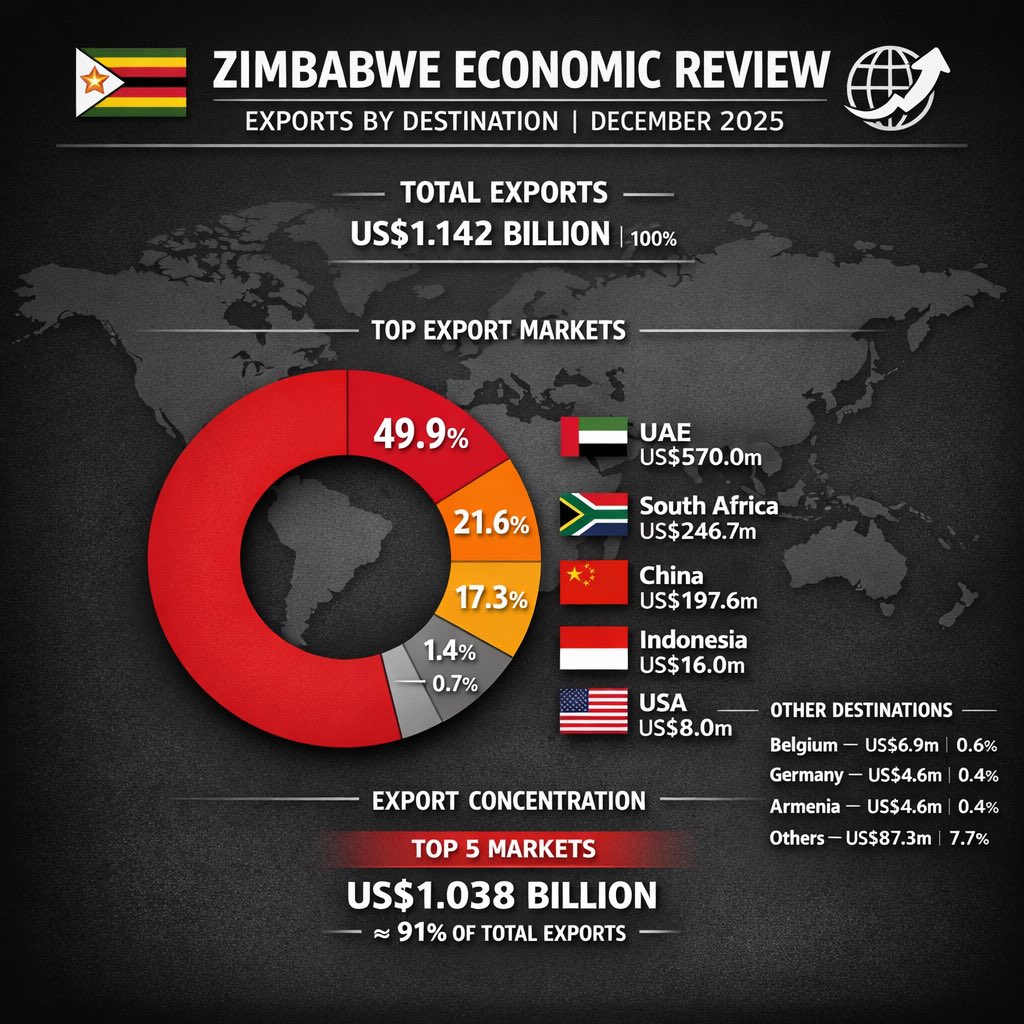
UAE, South Africa and China Account for Nearly 90% of Zimbabwe’s Exports.
Zimbabwe’s exports in November 2025 totalled USD 1.046 billion, with
🔵United Arab Emirates (44.4%),
🔵South Africa (21.8%) and
🔵China (21.2%)
These 3 countries dominate as key markets.
Together, the 3 countries absorbed about 87% of total export earnings, highlighting a strong concentration of Zimbabwe’s export flows in a few strategic destinations.
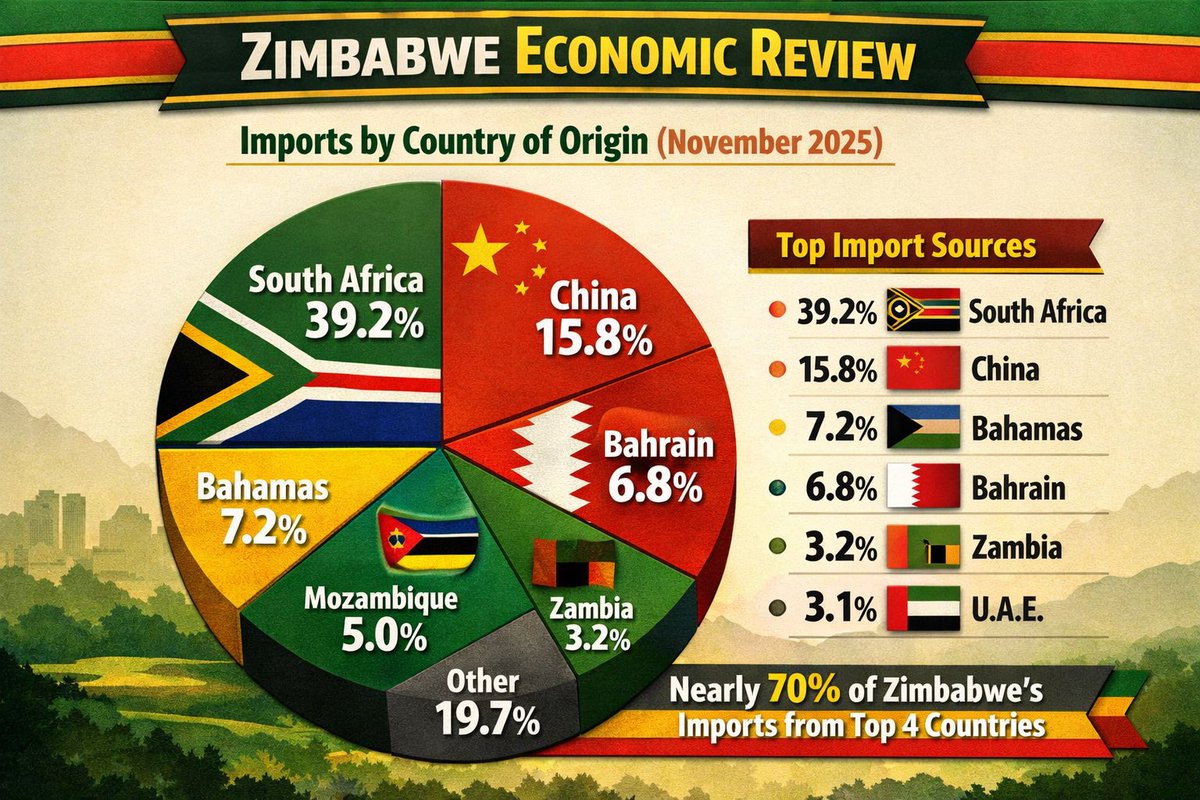
Imports by Country of Origin (November 2025).
Zimbabwe’s imports were highly concentrated among a few key trading partners.
🟢South Africa: 39.2%.
🟢China: 15.8%
🟢Bahamas: 7.2%, and
🟢Bahrain (6.8%).
Collectively, these 4 countries supplied nearly 70% of Zimbabwe’s total import bill.
Other import sources:
🟢Mozambique: 5.0%
🟢Zambia: 3.2%
🟢United Arab Emirates: 3.1%
Zimbabwe’s 2026 outlook is being driven by tangible economic fundamentals. The convergence of reduced volatility, gold-backed liquidity, and logistics reliability is restoring business confidence. These developments - alongside rising labour productivity - are the quiet, consequential markers of long-term structural rebuilding.
#ProgressUpdate
Bulawayo-Victoria Falls Road.
Another 5km section opened to traffic today at Insuza as of 07 January 2026.
This brings the total completed and opened length to 42.5 kilometres. Here is a breakdown of the progress by each contractor:
Progress Dashboard (Km Opened to Traffic):
.Bitumen World: 20.9km
.Fossil Contracting: 6.2km
. Bitumen Resources: 5.4km
. Syvern Investment: 5.0km
. Masimba Construction: 5.0km
. Tensor Systems: 0km (Works ongoing)
. Asphalt Products: 0km (Works ongoing)
. Linash Construction: 0km (Works ongoing)
📍 Total Opened: 42.5km
📍 Balance: 397.9km
Stay tuned for more updates!
#KilometerbyKilometer#InfrastructureDevelopment
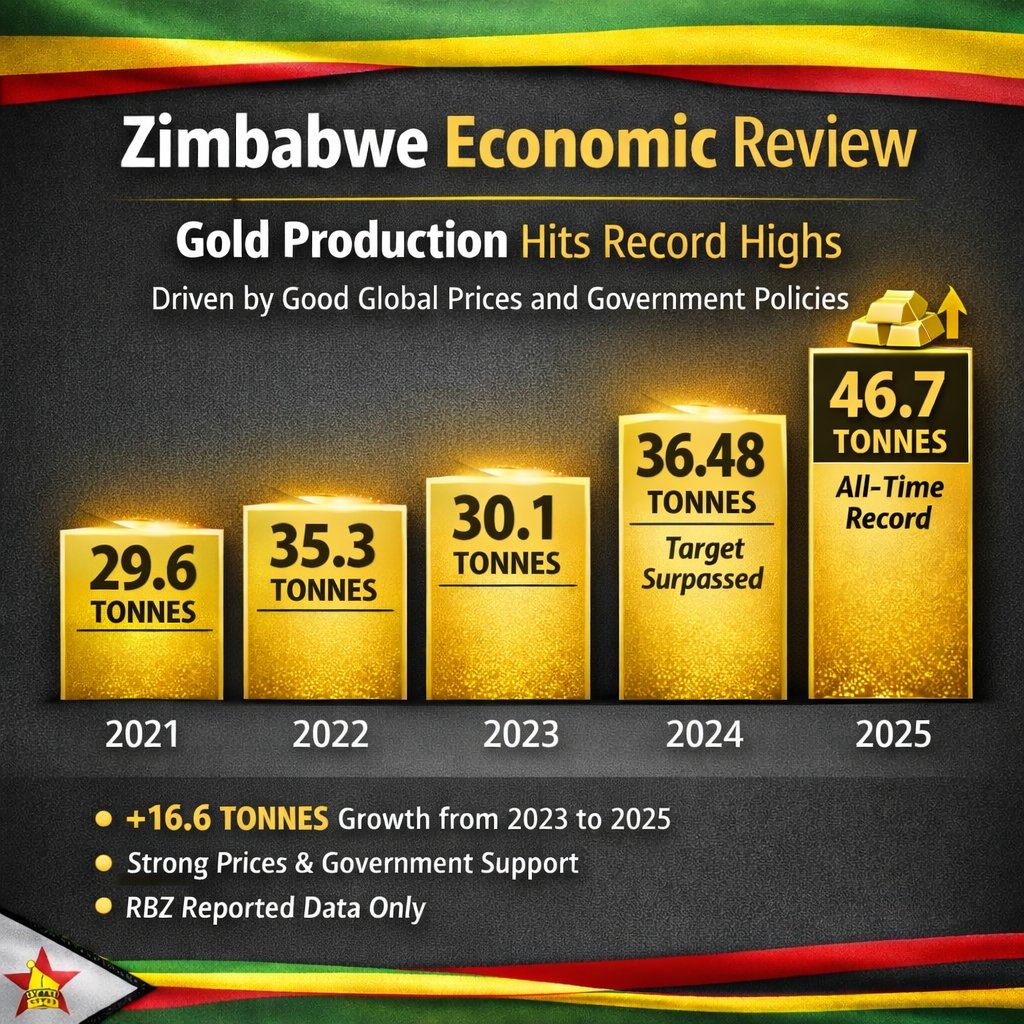
Gold Production Breaks Records.
Zimbabwe’s gold output surged to a new high, rising from 30.1 tonnes (2023) to 36.48 tonnes (2024) and an all-time record 46.7 tonnes in 2025.
Strong global gold prices and sustained Government policies continue to anchor growth in the mining sector.
On the NYSE trading floor, I was pleased to meet with Peter Tuchman, of Quatro M. Securities, the most celebrated trader on Wall Street, the “Einstein of Wall Street”. He has been a broker since 1985. Quite an institution!
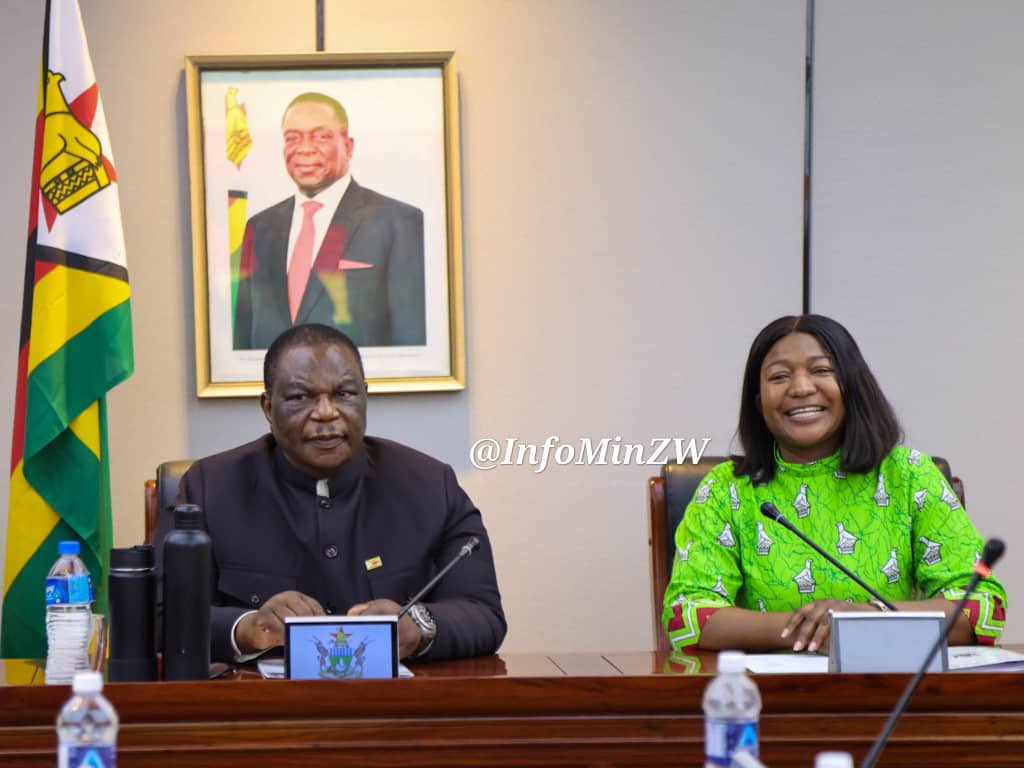
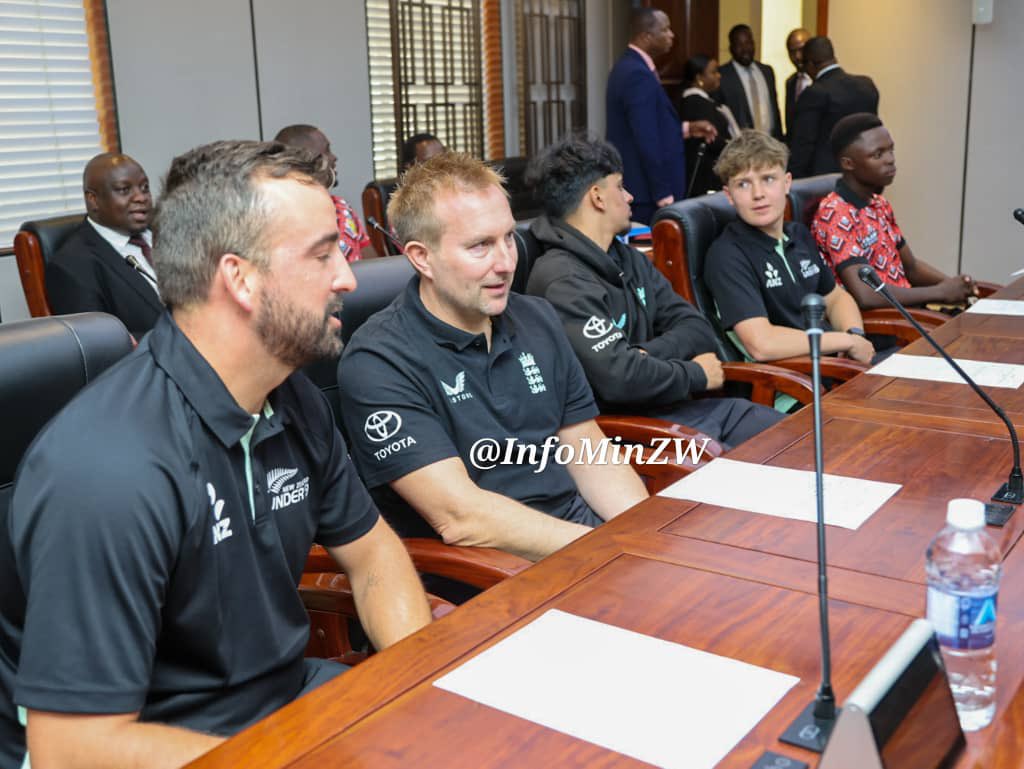
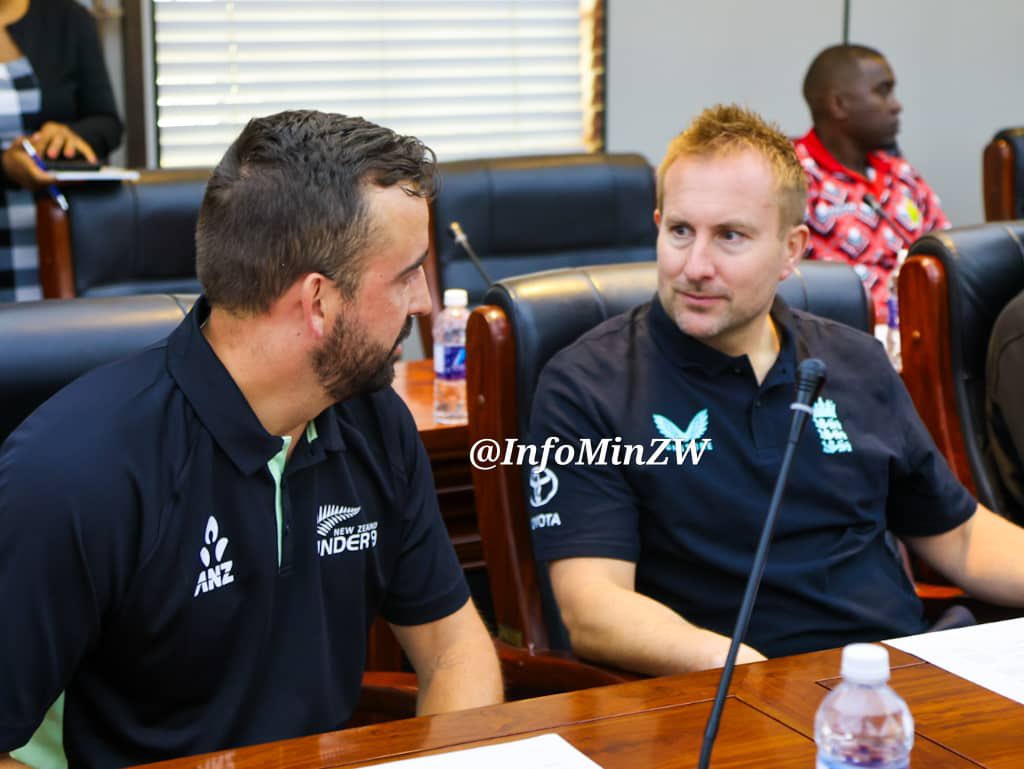
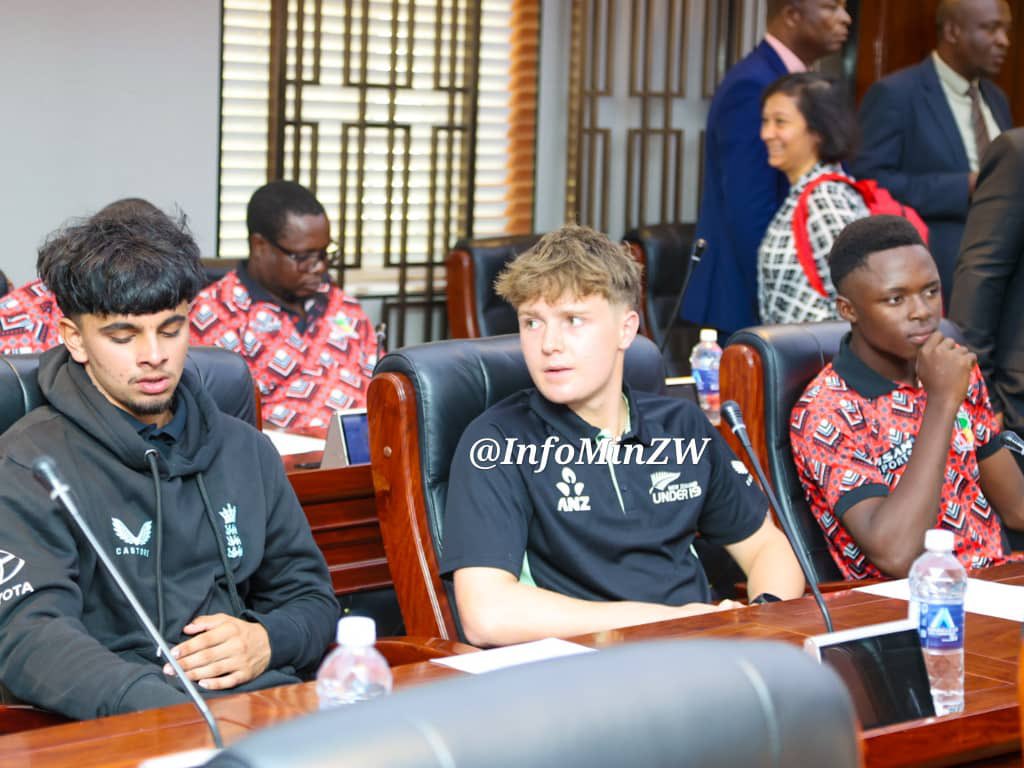
This morning, the Ministry of Sport, Recreation, Arts and Culture, led by Deputy Minister Hon. Emily Jesiah, together with representatives from the Zimbabwe Cricket and International Cricket Council, paid a courtesy call on the Acting President, Hon. Gen. (Rtd) Dr C.G.D.N Chiwenga, at the Munhumutapa offices, in Harare.