🐬gid_bd928

1.4K posts

🐬gid_bd928 banner
🐬gid_bd928

🐬gid_bd928

@gideonbd928

Travel MT🥼, CLS🔬, Web3🤩,I💚Kaspa🚀,⚛️🌍🥃🥢🥗🍝📽🎟️🍿🍕🚲🎶☕️🚙✈️📸☀️⛰🥾🏃‍♂️🛶🏝️🌊🍹🏐🎣🐕…

United States Katılım Şubat 2017
1.6K Takip Edilen566 Takipçiler
🐬gid_bd928 retweetledi
Kaspa Commons
Kaspa Commons@Kaspa_Commons·
With the Toccata fork upcoming, @p4bpj asked - "What would a "normal transaction versus stark-proof." look like? @michaelsuttonil broke it down in his typical brilliant fashion! We like to try visualize and contextualize. We recognize these illustration often are not perfect, but we wanted to offer a more commoner kick at this. So, here goes...Picture a #Kaspa block like a delivery truck. Every block has two limits: 1. How much weight it can carry (compute mass) 2. How much space is inside (byte size) Today, normal transactions are like small boxes with heavy locks on them. Each lock is a signature, and those signatures are expensive in weight. So the truck fills up by weight before it runs out of space. That’s why we land around a few hundred typical transactions per block. The #Toccata update makes the truck bigger in terms of space. More room inside. But the weight limit stays the same. So normal transactions still hit the same ceiling. Now introduce a STARK proof. Instead of hundreds of small boxes, you load one large crate. It takes up a lot of space It uses a meaningful portion of the weight But it still fits within both limits And inside that crate is something different. It’s a proof that many actions already happened correctly. The network doesn’t have to re-do all that work. It just checks the proof. What this means For simple payments, nothing changes. You still send and receive the same way. What changes is what a transaction can represent. Instead of one action per inclusion, a single transaction can carry a fully verified outcome of many actions. The network verifies the result instead of replaying every step. That shows up as: - Fewer steps to reach finality - More happening behind a single confirmation - Greater confidence that what you’re seeing is already resolved And this extends beyond simple transfers. Where systems generate large volumes of activity, this model allows that activity to be batched, proven, and anchored ONCE. Enterprise infrastructure Large event streams, logistics, energy, telecom, identity systems could aggregate activity and settle a single verified state. Banks and financial systems Payments, clearing, and position updates could be grouped into provable batches, where correctness is established before settlement and then verified on-chain. Large corporations Internal systems, supply chains, and audits could produce verifiable state commitments, reducing the need to reconcile thousands of individual records. AI systems Computation-heavy processes could commit results as proofs, allowing outcomes to be verified without exposing or replaying all intermediate steps. Different domains. Same pattern. Same system. Same limits. More settled per block.
Kaspa Commons tweet media
Michael Sutton@michaelsuttonil

Normal transactions are dominated by sig cost (1000 compute gram per sig, where 500k is the compute mass block limit -> max 500 sigs per block). Compute mass also counts byte size (1 gram per byte), so 500 sigs are unrealistic, hence the known ~300 txs per block number. It assumes 300 1:2 txs (1 in, 2 outs) with minimal size. Increasing the block *byte-size* limit (aka transient mass) from 125kb to 250kb means that you are still constrained with 300 typical txs but they can carry more data (eg in their payload) a stark proof on the other hand, costs 250 sigops + ~225kb in size. so compute mass is at least 250*1000 + 225kb = 475kg ~< 500kg compute mass limit and raw size is, as said, 225kb so it’s still bellow the transient mass limit

English

1
37
104
2.4K
🐬gid_bd928 retweetledi
Kaskad
Kaskad@AppKaskad·
'kaskad-nuntius': latin for "messenger." A trusted bearer of news. That's the name Anton @oxidique chose for @eliottmea's oracle on-chain repos, and it's literal: a permissionless, TEE-secured messenger that delivers verifiable prices on-chain. ☑️It's now open source. Code is public ahead of mainnet. Under the hood: a Consolidated Order Book (COB) model. Instead of pulling a single feed or a volume-weighted average, Nuntius aggregates limit order books across venues and simulates cross-exchange arbitrage exhaustion. The midpoint is the fair value. Direct consequence: spoofing or manipulating a single venue doesn't move the oracle. Manipulation cost scales with cross-venue liquidity, not with the cost of pushing one book. The harder a real price is to fake, the harder Nuntius is to fool. Price computation runs inside a TEE: the operator can't tamper with the output. What you read on-chain is what the trusted environment signed. Two repos: Infra & price processing github.com/Kaskad-Lending… Onchain EVM client github.com/Kaskad-Lending… Two delivery modes share the same signed prices: — Push for continuous feeds — Pull for protocols that only consume prices when they need them Pick what fits your gas profile. Permissionless and extendable: Anyone can run a node. Anyone can integrate. Self-hosted nodes and custom data sources plug in without forking the core. Useful beyond lending — L1, L2, DEXes, perps, structured products @kaspaunchained @Igra_Labs @kasplex Before mainnet, we welcome community and DeFi researchers to review it. Open audit beats closed audit. Issues, PRs, DMs welcome. Bounty program is next.
English
4
28
84
4.3K
🐬gid_bd928 retweetledi
Paul van Son
Paul van Son@pvson·
In the same way many, if not all, industries will be digitised and revolutionarised on the decentralised $KAS level-1 on top of internet @DiiDesertEnergy @KaspaKii zeta-global.org
Kaspa Commons@Kaspa_Commons

60+ Enterprises to be Disrupted by #Kaspa Tech #29 P2P Energy Trading Legacy Standards (NA & Global) • Centralized utilities and grid operators • Net metering programs for residential solar • Wholesale electricity markets and energy exchanges • Smart meter billing systems • Feed in tariff programs and energy credit systems Platforms & Systems • Energy production and distribution controlled by centralized utilities • Pricing determined through regulated structures or wholesale markets • Excess residential energy sold back through intermediated programs • Settlement occurs in billing cycles, not in real time • Grid balancing managed by centralized coordination systems What’s Broken / Innovation Gaps • Energy flows are local but markets are centralized • Settlement is delayed and disconnected from real time usage • Small producers have limited direct market access • Pricing does not always reflect immediate supply and demand • Grid coordination depends on centralized control systems • Machine level energy exchange is not supported by existing infrastructure Where P2P Energy Systems Can Still Innovate and Where Kaspa Could Help ❌ Local energy producers cannot transact directly Households and small producers rely on utilities to buy and redistribute energy. ✅ Kaspa could support direct settlement between participants, allowing energy producers and consumers to transact within local networks. ❌ Settlement is slow and based on billing cycles Energy usage and production are continuous, but payments are periodic. ✅ Kaspa’s RTD model could support near real time settlement aligned with actual energy flow. ❌ Pricing lacks real time responsiveness Rates are often fixed or delayed relative to grid conditions. ✅ Kaspa may enable dynamic pricing models where supply and demand signals are reflected continuously through verifiable transactions. → Oracle systems such as Kaskad-Nuntius could anchor trusted price data at specific points in time, allowing participants to agree on energy value with greater certainty during settlement. ❌ Small producers lack market access Entry into energy markets requires scale or participation through aggregators. ✅ Initiatives like Gigawatt Coin within the Kaspa Industry Initiative (KII) are exploring how energy production could be represented and exchanged, opening participation to smaller producers without centralized gatekeepers. ❌ Grid coordination is centralized Balancing supply and demand depends on operator controlled systems. ✅ Kaspa, strengthened by DagKnight, could support a shared coordination layer where energy events are ordered consistently across participants. ❌ Machine to machine energy exchange is limited Devices cannot transact autonomously in existing systems. ✅ Future covenant structures and vProgs may enable automated settlement between devices based on predefined conditions such as usage thresholds or pricing signals. → Oracle inputs, including approaches explored in Nantius, (@eliottmea ) could provide the external data needed for devices to act on verified pricing conditions. ❌ Energy data is siloed and difficult to verify Metering and reporting systems are controlled by utilities. ✅ @KaspaKii aligned efforts like #GigawattCoin could anchor production and consumption events to Kaspa, supporting verifiable energy records while keeping sensitive data abstracted. It could provide a coordination and settlement layer where energy production, consumption, and exchange are recorded and settled in a globally ordered, tamper resistant system. Energy systems are becoming more distributed. As generation moves closer to the edge, coordination requirements increase. Kaspa could support that shift by enabling systems where energy and value move together, in real time, across participants. #BuildonKaspa → protocol layer #BuildwithKaspa → application / integration layer #PoweredbyKaspa → user-facing outcome layer See more markets to be disrupted in link in thread

English
3
66
246
4.9K
🐬gid_bd928 retweetledi
Archie
Archie@CryptoArchieYT·
Study kaspa:native
Archie tweet media
HT
5
59
227
3.2K
🐬gid_bd928 retweetledi
BSCN
BSCN@BSCNews·
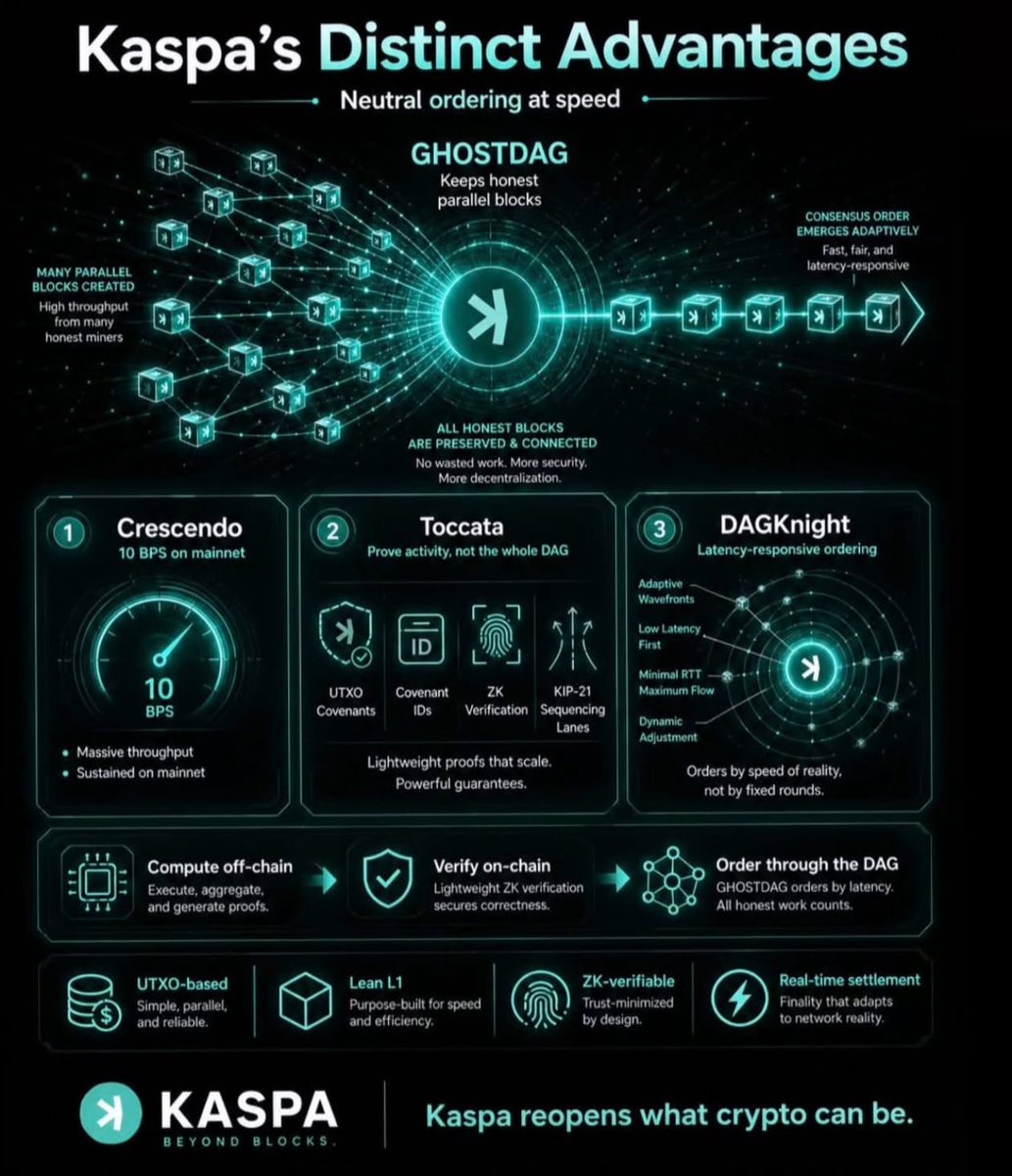
KASPA HITS MAJOR MILESTONES IN 2026 AS TOCCATA HARD FORK NEARS AND SUPPLY EMISSION WINDS DOWN Kaspa has stacked a series of milestones over the past year as the network transitions from a payments-focused proof-of-work chain to a programmable Layer 1. The Crescendo hard fork pushed the network to 10 blocks per second, with peak loads exceeding 10,000 TPS. While cumulative on-chain transactions are approaching 2 billion. Founder Yonatan Sompolinsky (@hashdag) took the Kaspa pitch to the Oxford Union in March, a notable mainstream-academic crossover for a fair-launched community project. The Toccata hard fork hit code freeze on April 15 with mainnet activation targeted between June 5 and June 20. Toccata brings native L1 covenant programming via the SilverScript compiler, ZK verification opcodes, KIP-21 partitioned sequencing, and KRC-20 tokens as a base-layer feature. The supply story compounds the upgrade story. Roughly 95.4% of $KAS is already in circulation, with new emission approaching zero by the end of 2026. $KAS trades near $0.0325 with a market cap of around $888 million, with a near-fully distributed supply heading into its biggest programmability upgrade.
English
25
145
617
14K
🐬gid_bd928 retweetledi
Andrew J 𐤊
Andrew J 𐤊@AJS_K_A_S·
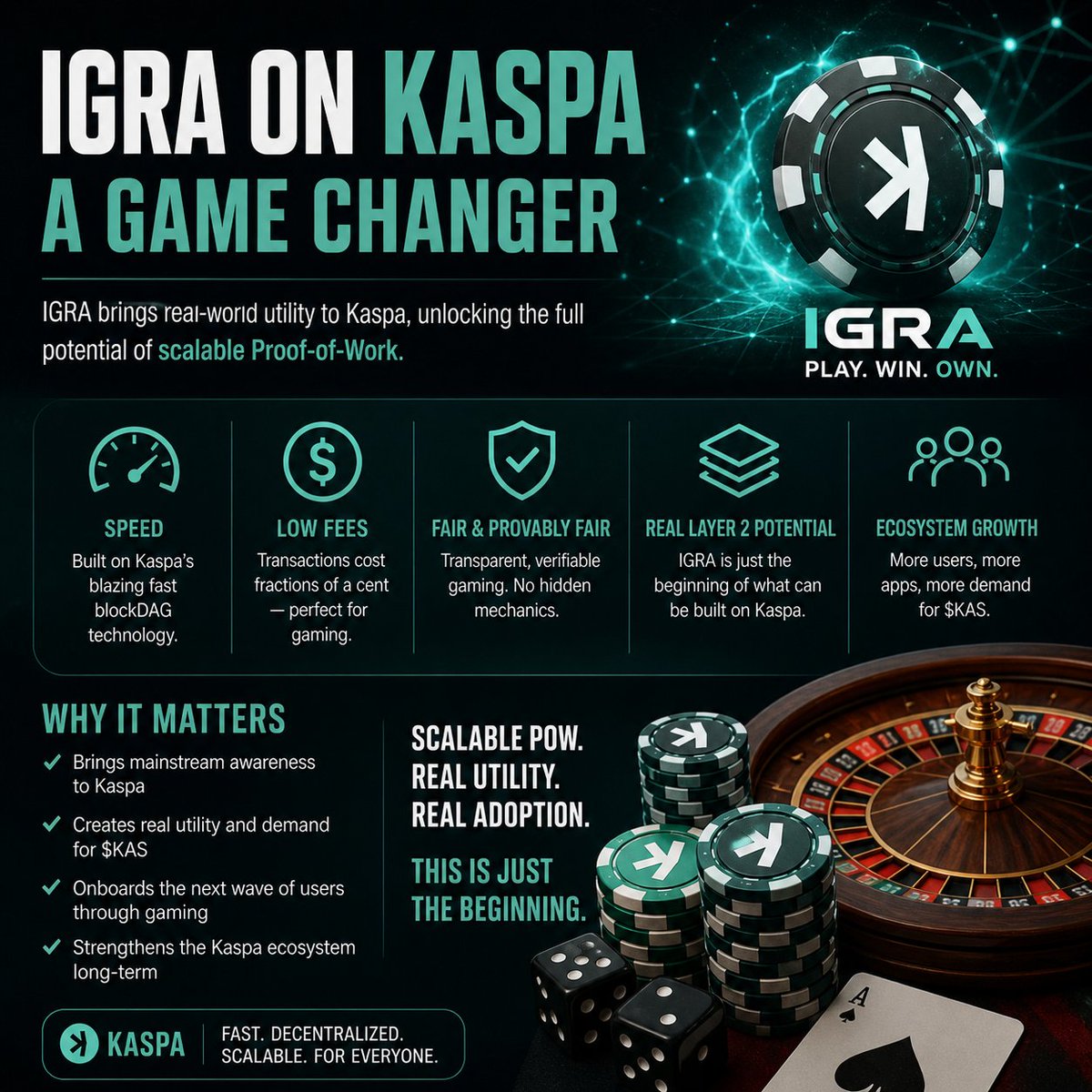
Most people still don’t understand what IGRA represents for Kaspa. Kaspa solved scalable Proof-of-Work. IGRA is helping unlock what gets built on top of it. Fast settlement. Low fees. Fair infrastructure. Real Layer 2 potential. That’s how ecosystems evolve: first the base layer scales then the applications arrive. IGRA could end up being one of the major catalysts that expands Kaspa beyond just being “a fast PoW chain.” @Igra_Labs
Andrew J 𐤊 tweet media
Ajman, United Arab Emirates 🇦🇪 English
0
20
96
1.3K
🐬gid_bd928 retweetledi
Yunio 𐤊
Yunio 𐤊@younio1977·
这个帖子展示的是Kaspa区块链在L1层(主链)完成零知识证明(Zero-Knowledge Proof,简称ZKP)交易的里程碑事件。简单说,它证明了Kaspa正在向更高级、更隐私、更可编程的方向进化,而且是纯L1原生实现,不是依赖Layer 2或外部团队。 如果你关注Kaspa,一个不可否认事实或者现象:Kaspa 创新速度和纬度相当符合真正去中心项目成长轨迹。多层次,多维度,离散且持续!这是旺盛生命力有力体现!
KasSigner@KasSigner

Masive...First zero-knowledge proof transaction ever executed on the Kaspa network. TN12 Not from an L2. Not from a funded team. From an air-gapped hardware signer on a $15 chip. @KasSigner 🤟🏼 Zero-knowledge proof verified on Kaspa L1. Air-gapped. Funds locked behind a ZK gate. To spend, you prove you know — without revealing what you know. The chain verifies the math. Funds move or they don't. Under the hood: → Groth16 prover (arkworks BN254) compiled to browser WASM → 128-byte proof generated client-side → VK hash-committed in P2SH covenant via BLAKE2B → OP_ZK_PRECOMPILE (0xa6) verifies the pairing on-chain → Air-gapped Schnorr signing via QR relay — signer never sees the proof Three boundaries between the secret and the world. Browser. Device. Chain. Nothing leaks. TX:d7e203a1bec5a8cdede7be0f8ea391ebdf44a946667484f9d515c24a2380c463 No trusted third party. No server. No reveal. Just math. Built on rusty-kaspa Toccata opcodes. 100% open source. github.com/InKasWeRust/Ka… #Kaspa #KasSigner #ZeroKnowledge #Groth16 #Toccata #ZKP

中文
0
13
67
2.1K
🐬gid_bd928 retweetledi
Paul van Son
Paul van Son@pvson·
A short history of a revolutionary decentralised sequential trusted information layer. A smart scarcity revolution that is unfolding in front of our eyes…. @KaspaKii
BaN𐤊ℚuOτE@BankQuote

Kaspa did not begin as another attempt to make a “faster blockchain.” It began as an attack on one of the oldest inefficiencies inside Nakamoto consensus: the waste of honest time. Bitcoin solved decentralized money by forcing the network into a linear sequence. One block after another. One winner. Everyone else who found a valid block too close to the same moment gets pushed into the orphan/stale category. That design is secure, but it embeds a hard tradeoff: faster blocks mean more honest miner collision and more security leakage into latency. Kaspa’s origin is the rejection of that bottleneck. Yonatan Sompolinsky’s research path moved through GHOST, PHANTOM, and eventually GHOSTDAG. The core idea was not to abandon Proof-of-Work, but to stop forcing it into a narrow linear pipe. If honest miners produce valid blocks in parallel, those blocks should not become waste. They should be included, ordered, and converted into ledger progression. That is the birth of Kaspa: not a blockchain with better marketing, but a blockDAG that generalizes Nakamoto consensus. Kaspa accepts that propagation delay is real. Blocks collide. Miners discover valid work at overlapping times. The question is whether the protocol treats that overlap as failure or usable structure. Bitcoin mostly discards it. Kaspa keeps it, orders it, and turns parallelism into throughput. When Kaspa launched on November 7, 2021, it was raw infrastructure: a fair-launched, no-premine, no-ICO Proof-of-Work network using kHeavyHash, UTXO accounting, and GHOSTDAG ordering. No corporate allocation, no VC treasury, no privileged access committee. It entered the world the hard way: mined into existence. Early Kaspa was experimental, but not unserious. It was the live deployment of an academic answer to linear-chain waste. It had to prove that theory could survive real miners, latency, nodes, storage growth, and exchange infrastructure without becoming unordered noise. And it did not stay a whitepaper curiosity. Kaspa evolved into the Rusty Kaspa era, where the production stack became faster, cleaner, and more durable. Crescendo pushed mainnet to 10 blocks per second, turning Kaspa into a live high-frequency PoW settlement engine. Ten BPS is not just “more blocks.” It is a different relationship to time: the ledger updates closer to network propagation speed while preserving Proof-of-Work as the physical cost anchor. That is why Kaspa is misunderstood when viewed only through TPS. The deeper point is not capacity alone. Kaspa reduces the impedance between distributed mining and ledger finality. It lets Proof-of-Work breathe across parallel topology instead of forcing every miner through a single-file checkpoint. Rusty Kaspa v1.1.0 shows how far it has come. GetVirtualChainFromBlockV2 gives integrators a cleaner RPC surface for virtual-chain progression and accepted transaction context, so wallets, explorers, indexers, and exchanges no longer need fragile async stitching to understand what the DAG accepted. The IBD and pruning improvements matter too. A fast network cannot only be fast when everything is synced. It must recover cleanly while the live network keeps moving. Pruning-aware catchup, trusted body syncing, compressed header parent data, and on-demand higher-level relation stores make speed survivable in production. Kaspa is entering the next phase: programmable settlement without turning the base layer into a bloated global computer. DAGKnight pushes toward latency-responsive consensus. Covenant++ opens constrained UTXO-level programmability. vProgs point toward sovereign verifiable programs, where computation happens offchain and is proven back to L1. Kaspa began as a rebellion against wasted Proof-of-Work time. It became a fair-launched blockDAG monetary network. Now it is becoming a high-frequency settlement substrate with a path toward covenants, ZK verification, and sovereign application logic.

English
2
54
206
4.8K
🐬gid_bd928 retweetledi
KasSigner
KasSigner@KasSigner·
Masive...First zero-knowledge proof transaction ever executed on the Kaspa network. TN12 Not from an L2. Not from a funded team. From an air-gapped hardware signer on a $15 chip. @KasSigner 🤟🏼 Zero-knowledge proof verified on Kaspa L1. Air-gapped. Funds locked behind a ZK gate. To spend, you prove you know — without revealing what you know. The chain verifies the math. Funds move or they don't. Under the hood: → Groth16 prover (arkworks BN254) compiled to browser WASM → 128-byte proof generated client-side → VK hash-committed in P2SH covenant via BLAKE2B → OP_ZK_PRECOMPILE (0xa6) verifies the pairing on-chain → Air-gapped Schnorr signing via QR relay — signer never sees the proof Three boundaries between the secret and the world. Browser. Device. Chain. Nothing leaks. TX:d7e203a1bec5a8cdede7be0f8ea391ebdf44a946667484f9d515c24a2380c463 No trusted third party. No server. No reveal. Just math. Built on rusty-kaspa Toccata opcodes. 100% open source. github.com/InKasWeRust/Ka… #Kaspa #KasSigner #ZeroKnowledge #Groth16 #Toccata #ZKP
KasSigner tweet media
English
16
101
295
11.9K
🐬gid_bd928 retweetledi
BSCN
BSCN@BSCNews·
🧠 What is Igra and why does it matter for the Kaspa ecosystem...? @Igra_Labs is building an L2 network on top of the @kaspaunchained L1. Here's why the EVM-compatible network could have MASSIVE implications for the future of $KAS... ⬇️
BSCN@BSCNews

x.com/i/article/2015…

English
3
89
326
12.2K
🐬gid_bd928 retweetledi
BaN𐤊ℚuOτE
BaN𐤊ℚuOτE@BankQuote·
Kaspa did not begin as another attempt to make a “faster blockchain.” It began as an attack on one of the oldest inefficiencies inside Nakamoto consensus: the waste of honest time. Bitcoin solved decentralized money by forcing the network into a linear sequence. One block after another. One winner. Everyone else who found a valid block too close to the same moment gets pushed into the orphan/stale category. That design is secure, but it embeds a hard tradeoff: faster blocks mean more honest miner collision and more security leakage into latency. Kaspa’s origin is the rejection of that bottleneck. Yonatan Sompolinsky’s research path moved through GHOST, PHANTOM, and eventually GHOSTDAG. The core idea was not to abandon Proof-of-Work, but to stop forcing it into a narrow linear pipe. If honest miners produce valid blocks in parallel, those blocks should not become waste. They should be included, ordered, and converted into ledger progression. That is the birth of Kaspa: not a blockchain with better marketing, but a blockDAG that generalizes Nakamoto consensus. Kaspa accepts that propagation delay is real. Blocks collide. Miners discover valid work at overlapping times. The question is whether the protocol treats that overlap as failure or usable structure. Bitcoin mostly discards it. Kaspa keeps it, orders it, and turns parallelism into throughput. When Kaspa launched on November 7, 2021, it was raw infrastructure: a fair-launched, no-premine, no-ICO Proof-of-Work network using kHeavyHash, UTXO accounting, and GHOSTDAG ordering. No corporate allocation, no VC treasury, no privileged access committee. It entered the world the hard way: mined into existence. Early Kaspa was experimental, but not unserious. It was the live deployment of an academic answer to linear-chain waste. It had to prove that theory could survive real miners, latency, nodes, storage growth, and exchange infrastructure without becoming unordered noise. And it did not stay a whitepaper curiosity. Kaspa evolved into the Rusty Kaspa era, where the production stack became faster, cleaner, and more durable. Crescendo pushed mainnet to 10 blocks per second, turning Kaspa into a live high-frequency PoW settlement engine. Ten BPS is not just “more blocks.” It is a different relationship to time: the ledger updates closer to network propagation speed while preserving Proof-of-Work as the physical cost anchor. That is why Kaspa is misunderstood when viewed only through TPS. The deeper point is not capacity alone. Kaspa reduces the impedance between distributed mining and ledger finality. It lets Proof-of-Work breathe across parallel topology instead of forcing every miner through a single-file checkpoint. Rusty Kaspa v1.1.0 shows how far it has come. GetVirtualChainFromBlockV2 gives integrators a cleaner RPC surface for virtual-chain progression and accepted transaction context, so wallets, explorers, indexers, and exchanges no longer need fragile async stitching to understand what the DAG accepted. The IBD and pruning improvements matter too. A fast network cannot only be fast when everything is synced. It must recover cleanly while the live network keeps moving. Pruning-aware catchup, trusted body syncing, compressed header parent data, and on-demand higher-level relation stores make speed survivable in production. Kaspa is entering the next phase: programmable settlement without turning the base layer into a bloated global computer. DAGKnight pushes toward latency-responsive consensus. Covenant++ opens constrained UTXO-level programmability. vProgs point toward sovereign verifiable programs, where computation happens offchain and is proven back to L1. Kaspa began as a rebellion against wasted Proof-of-Work time. It became a fair-launched blockDAG monetary network. Now it is becoming a high-frequency settlement substrate with a path toward covenants, ZK verification, and sovereign application logic.
English
10
70
204
8.8K
🐬gid_bd928 retweetledi
Kaspa
Kaspa@kaspaunchained·
Feature freeze is here for Toccata! This means that no further consensus rule changes will be made as preparations are being made for the Toccata hard fork. Toccata is going to bring loads of features to Kaspa such as ZK proofs, Programmable UTXOs, and more!
Michael Sutton@michaelsuttonil

Toccata consensus feature freeze is finally here after a heroic last-mile push by kas core devs. Aiming to reset TN12 tonight, or tomorrow at the latest. Genesis update: + 0x6b617370612d746573746e6574 // kaspa-testnet - 12, 2 // TN12, Launch 2 + 0x544f4343415441 // TOCCATA + 12, 3 // TN12, Launch 3

English
15
128
501
17.1K
🐬gid_bd928 retweetledi
BaN𐤊ℚuOτE
BaN𐤊ℚuOτE@BankQuote·
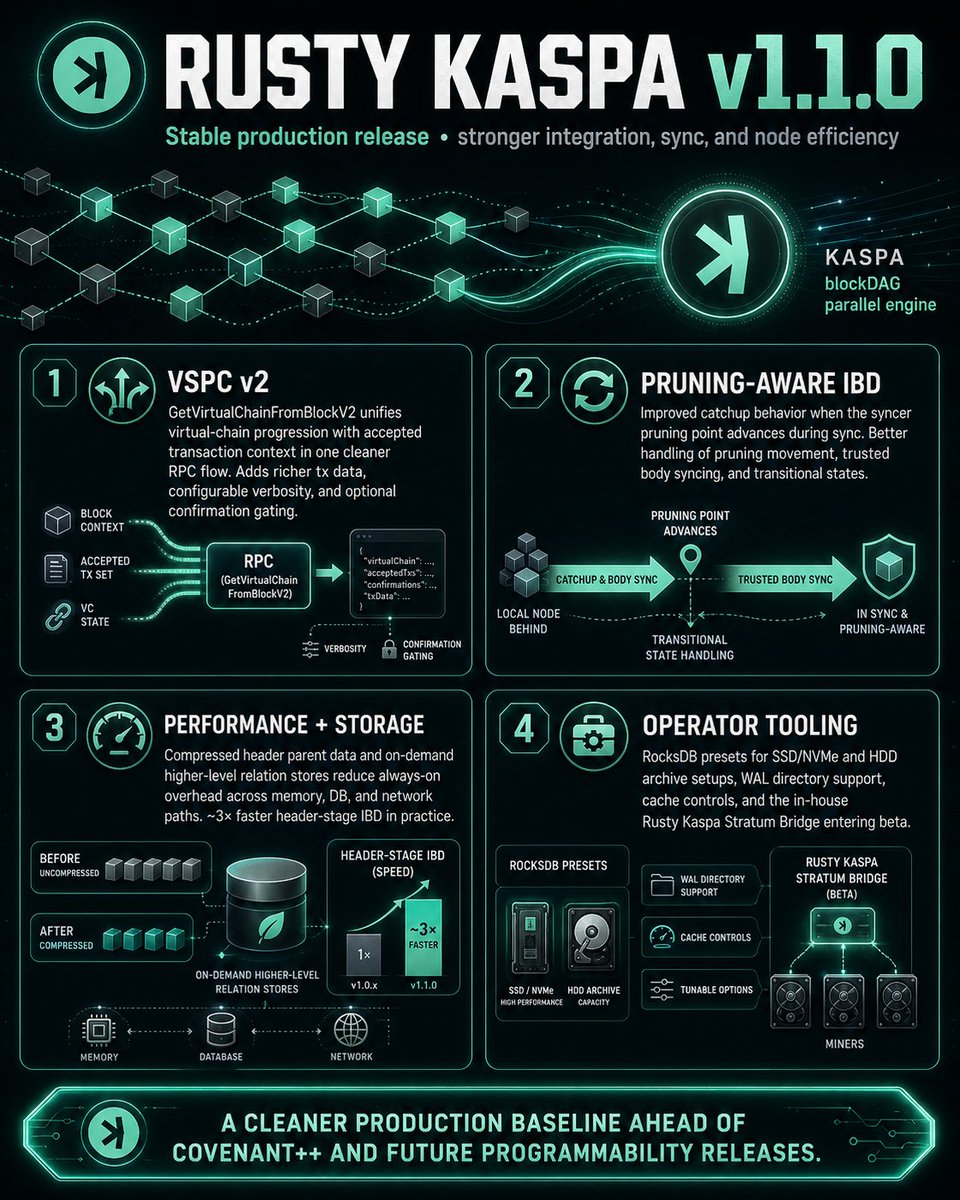
Rusty Kaspa v1.1.0 is not a cosmetic release. It is a structural hardening pass across the node’s integration surface, IBD behavior, pruning logic, header-processing pipeline, and storage profile. The headline is not one isolated feature, but the fact that Kaspa’s production implementation just became easier to integrate, faster to sync, lighter to operate, and more resilient under pruning-heavy conditions. The most important integrator-facing change is GetVirtualChainFromBlockV2, opcode 151, the new VSPC v2 flow. Instead of forcing wallets, explorers, exchanges, and indexers to stitch together virtual-chain progression, accepted transaction context, added-block listeners, sender recovery, and fee data from multiple async paths, VSPC v2 gives them a cleaner canonical ingestion surface. It returns removed chain blocks, added chain blocks, and per-added-chain-block accepted transaction data through one coherent RPC path, with configurable dataVerbosityLevel controls: None, Low, High, and Full. That matters because Kaspa is not internally shaped like a linear chain. It is a blockDAG, which means the consensus engine has to preserve parallel block production, mergeset acceptance, and DAG-native ordering internally, while external infrastructure still needs deterministic progression it can consume without rebuilding the node’s logic from the outside. VSPC v2 is abstraction engineering done correctly: the node keeps the complexity where it belongs, while integrators get a cleaner flow for accepted transaction context, sender data, fee-related use cases, and optional confirmation gating through minConfirmationCount. The second major upgrade is pruning-aware IBD catchup. This release covers the case where the syncer advances its pruning point while a fresh syncee is still catching up. That sounds obscure, but it is exactly the kind of edge case fast networks must solve. High-throughput systems do not just need fast blocks; they need recovery paths that remain coherent while the live network keeps moving. v1.1.0 introduces pruning catchup logic that detects pruning-point mismatch, validates header relationships before irreversible movement, handles UTXO-set download, and manages transitional states around pruning-point movement and body syncing. The performance work is just as important. Header parents_by_level data is now compressed instead of carrying redundant repeated parent vectors everywhere, and higher-level relation stores are no longer maintained continuously for all headers. They are built on demand when needed for pruning-proof paths. That cuts always-on overhead across memory, database, and network paths. In practice, the release reports roughly 3x faster header-stage IBD, which is not marketing throughput, but node-level entropy reduction: less redundant state, less write pressure, less storage drag, and less wasted computation. The RocksDB upgrades also matter. v1.1.0 adds storage presets for SSD/NVMe and HDD/archive nodes, WAL-directory support for hybrid NVMe+HDD setups, larger archive write buffers, stronger compression, BlobDB usage for large values, larger SST files, and better cache/rate-limit controls. In plain terms, archive operation becomes more realistic, cheaper storage becomes more usable, and node operators get sharper control over their performance envelope. The in-house Rusty Kaspa Stratum Bridge also enters beta, pushing more mining infrastructure into the native Rust stack. Overall, Rusty Kaspa v1.1.0 is a stronger production baseline. Not louder, not more bloated, and not a theatrical feature release, but cleaner, faster, and more durable. It gives Kaspa better integration ergonomics, better sync resilience, better storage behavior, and a more stable foundation before the next Covenant++ and programmability-related releases arrive.
BaN𐤊ℚuOτE tweet media
English
3
64
198
2.5K
🐬gid_bd928 retweetledi
BSCN
BSCN@BSCNews·
KASPA L1 BREAK 2 BILLION TRANSACTIONS According to data from Kaspa Explorer, the @kaspaunchained L1 network has reached a cumulative transaction count of some 2.05 billion. 2026 has already been a big year for the $KAS ecosystem, and is set to become even bigger with the Toccata hardfork scheduled to activate on the mainnet between June 5 and June 20, 2026.
English
11
121
578
13.2K
🐬gid_bd928 retweetledi
BSCN
BSCN@BSCNews·
KASPA INDUSTRIAL INITIATIVE SET TO UNVEIL FLAGSHIP PROJECTS Kaspa Industrial Initiative (@KaspaKii) confirms the completion of its flagship ecosystem projects designed to run natively on the Kaspa (@kaspaunchained) Layer 1 blockchain. The development team is currently finalizing security hardening and migrating the infrastructure to enterprise-grade servers in preparation for a June launch. This deployment utilizes the high-performance DAG architecture of $KAS to support industrial-scale applications and upcoming unannounced network integrations.
English
13
140
474
14K
🐬gid_bd928 retweetledi
Michael Sutton
Michael Sutton@michaelsuttonil·
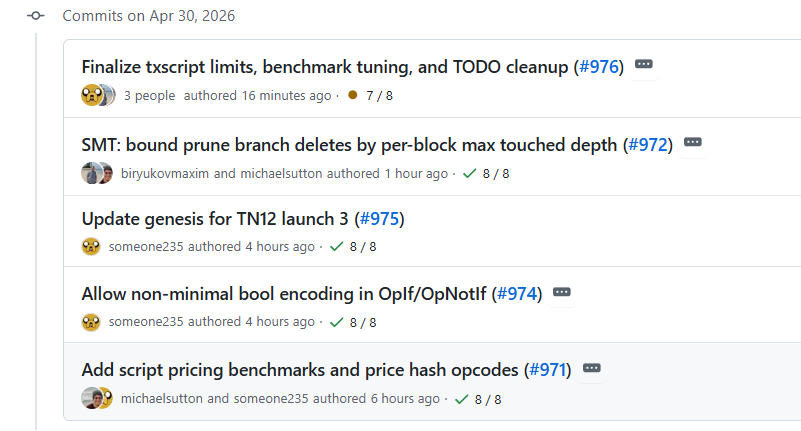
Toccata consensus feature freeze is finally here after a heroic last-mile push by kas core devs. Aiming to reset TN12 tonight, or tomorrow at the latest. Genesis update: + 0x6b617370612d746573746e6574 // kaspa-testnet - 12, 2 // TN12, Launch 2 + 0x544f4343415441 // TOCCATA + 12, 3 // TN12, Launch 3
Michael Sutton tweet media
English
90
394
1.1K
74.4K
🐬gid_bd928 retweetledi
BaN𐤊ℚuOτE
BaN𐤊ℚuOτE@BankQuote·
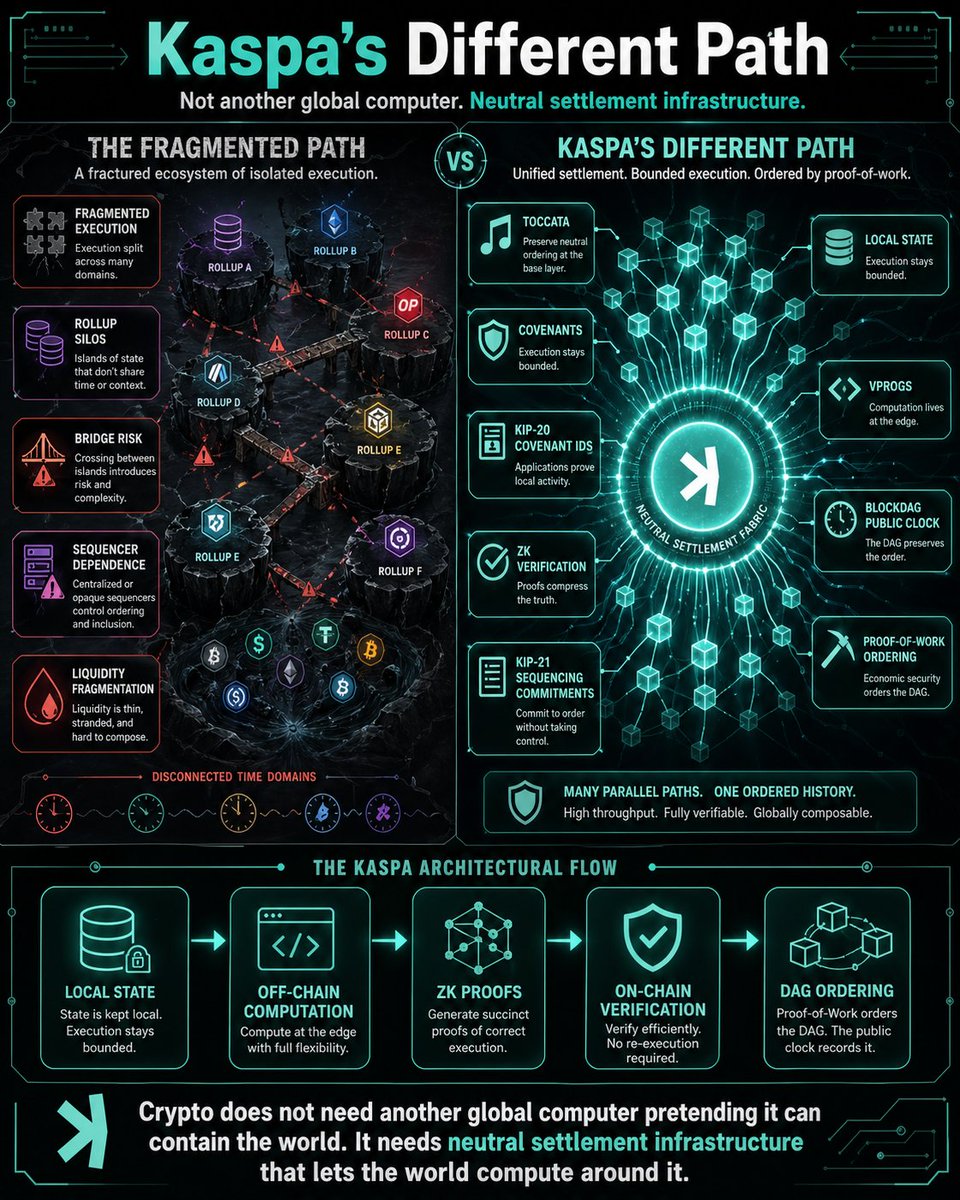
The most important thing happening in Kaspa is not “smart contracts.” That phrase belongs to the old category. The real story is that crypto is finally running into the cost of fragmented execution. Ethereum scaled by exporting activity into rollups. Every rollup became its own jurisdiction of liquidity, sequencing, bridges, trust assumptions, and UX friction. The industry is now trying to stitch that world back together with interoperability frameworks, intent layers, shared sequencing, and abstraction. Kaspa is approaching the problem from the opposite direction. Do not fragment time first, then spend a decade repairing it. Preserve neutral ordering at the base layer, keep execution bounded, and let applications prove only what they actually do. That is why Toccata matters. Covenants bring forward-binding UTXO logic. KIP-20 gives contract lineage a consensus-visible identity. ZK verification lets computation be checked without forcing every node to execute the entire application universe. KIP-21 is the quiet monster: sequencing commitments that allow ZK applications to prove local activity without inheriting the burden of the whole DAG. That is not just a technical optimization. That is an architectural philosophy. Ethereum made programmability global and then had to shard the consequences across rollups. Solana made execution fast but tightly coupled to a high-performance coordination model. Kaspa is carving out a third path: local state, verifiable computation, proof-of-work ordering, and a BlockDAG public clock. This is where Silverscript, Toccata, KIP-21, ZK covenants, and vProgs start to converge. Not into another EVM clone. Into programmable PoW settlement where computation lives at the edge, proofs compress the truth, and the DAG preserves the order. Crypto does not need another global computer pretending it can contain the world. It needs neutral settlement infrastructure that lets the world compute around it.
BaN𐤊ℚuOτE tweet media
English
6
46
147
2.2K
🐬gid_bd928 retweetledi
Yusuf Hayal
Yusuf Hayal@KaspaTeacher·
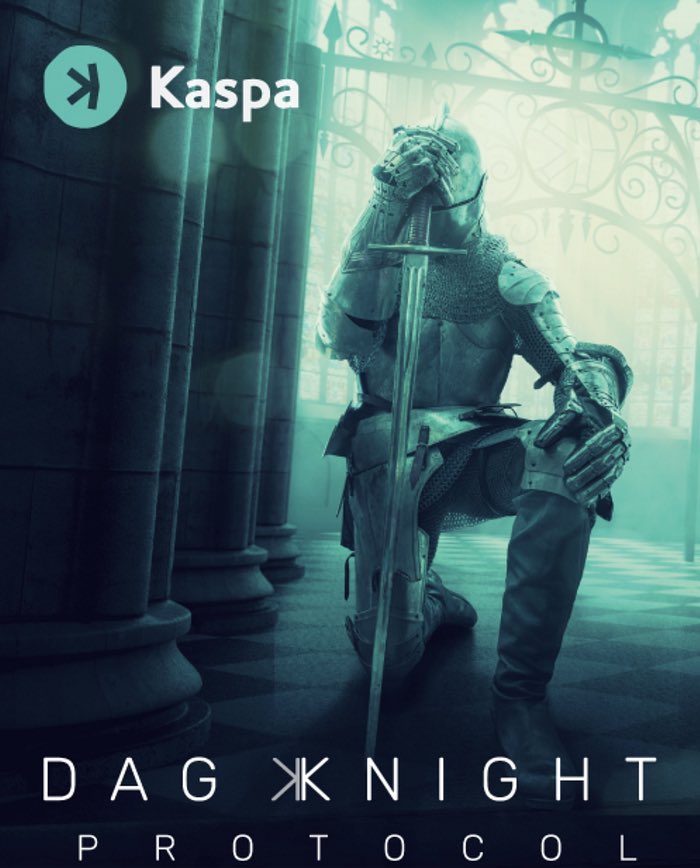
DAGKnight is being tested on the devnet 💀
Yusuf Hayal tweet media
English
3
62
329
4.4K
🐬gid_bd928 retweetledi
KaspaNOW_FR 𐤊 🦈
KaspaNOW_FR 𐤊 🦈@bozzoff69·
$KAS active Toccata en juin. SilverScript → coder sur Kaspa ✅ Covenants → contrats automatiques ✅ ZK Proofs → confidentialité native ✅ 10 BPS → vitesse préservée ✅ Kaspa cesse d'être "juste rapide". Il devient un L1 programmable en PoW pur. Les développeurs arrivent. L'écosystème va exploser. Et le prix n'a pas encore réagi. 🦈 #Kaspa #KAS #Toccata #CryptoFR
KaspaNOW_FR 𐤊 🦈 tweet media
Français
2
24
135
2.1K