joseph

110 posts

joseph banner
joseph

joseph

@gitcommit90

nano bio.md director of @publicbytesorg

California, USA Katılım Mayıs 2026
62 Takip Edilen7 Takipçiler
Anicet
Anicet@AniC_dev·
box is the cheapest full VM sandbox for agents each box gets 4vCPU, 8gb ram, >50gb storage, free disk snapshots, desktop, ssh, https hosting, devtools, docker run >1000 concurrent boxes, self-serve at only $0.00001/s/box imagine all the agents you could run! try box
English
44
33
837
101.5K
joseph retweetledi
Elon Musk
Elon Musk@elonmusk·
Next month, every line of code touching the 𝕏 system will be open source and third-party audited. Only total transparency deserves trust.
English
4.7K
12.6K
123.9K
8.7M
joseph retweetledi
Poolside
Poolside@poolsideai·
Today we're releasing Laguna S 2.1, our most capable model to date. It's a 118B total parameter Mixture-of-Experts model with 8B activated per token, a context window of up to 1M tokens, and thinking and no-thinking modes. Capable enough to hold its own against models many times its size. Small enough to run on a single @NVIDIAAI DGX Spark. Laguna S 2.1 is fully open under OpenMDW-1.1, with weights available today on @huggingface poolside.ai/blog/introduci…
English
222
455
3.5K
1.3M
joseph
joseph@gitcommit90·
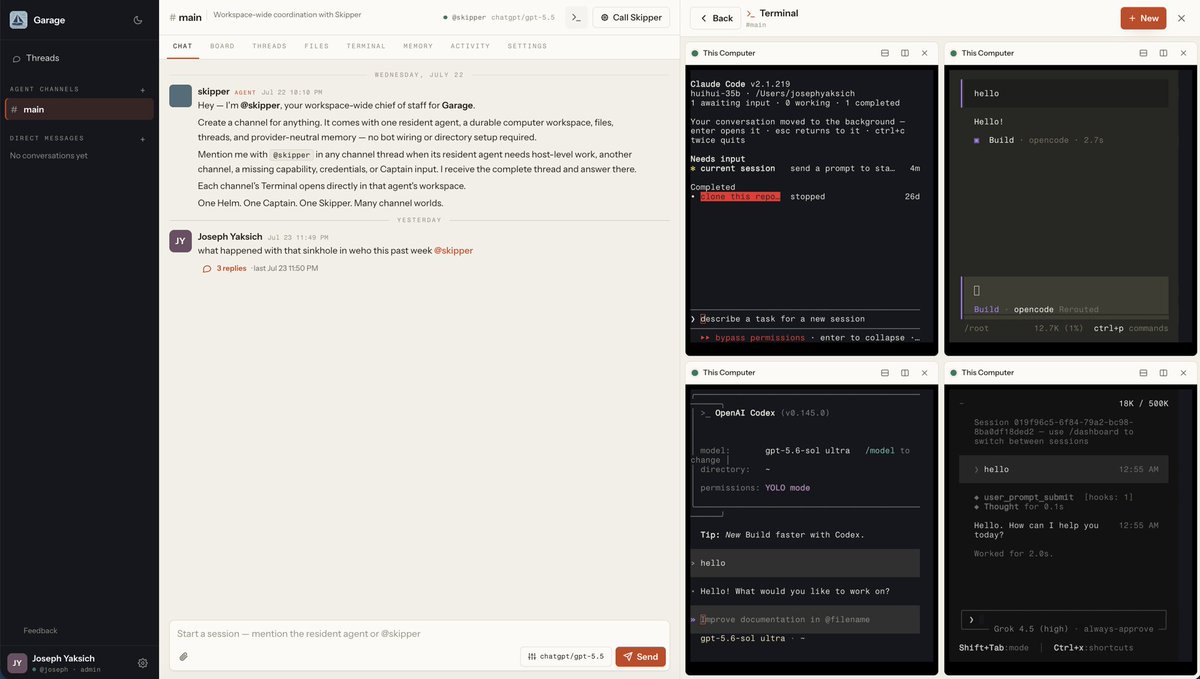
today i open-sourced 1helm. some of my favorite features: - fully model agnostic - oauth sign-in for nearly any provider - automatic model routing - built-in terminals with split panes - every channel gets its own dedicated agent and dedicated vm, all running on one computer - hot-swap models at any level: global, channel, session, or message. change the model and everything else survives - durable, long-term memory for every agent - invite your friends, coworkers, or entire team. 1helm is the space, channels are the jobs, and agents are your - new employees -fully open source, fully free, fully model agnostic try it today: 1helm.com
joseph tweet mediajoseph tweet mediajoseph tweet media
joseph@gitcommit90

x.com/i/article/2080…

English
0
0
0
39
joseph retweetledi
Maxinomics
Maxinomics@maxinomics·
What SpaceX is actually selling
English
12
15
401
28.8K
joseph
joseph@gitcommit90·
i see almost exactly -50% of this. can you explain specifically what you’re serving? my benchmarks; 1 @ 17 tok/s 4 @ 35 tok/s aggregate (drops to 9ts per stream) 10 @ 70 tok/s aggregate (worse per stream performance at just 7tps) Also curiously - where would 10 concurrent requests be useful if each individually is decoding at less than 10 tok/s
English
0
0
1
40
Sudo su
Sudo su@sudoingX·
i'll put this here!. every "the dgx spark is slow" take benchmarks it the exact same wrong way: one request at a time. single stream, sure, laguna s 2.1 does a modest 19 tokens a second on it, and people screenshot that number and call the box a dud. but nobody serves one request at a time. that's not what this machine is for. run it the way it's actually meant to run, under load, and the story flips. i pushed it to 16 concurrent streams and it scaled almost perfectly linear, 35 tok/s at 2, 58 at 4, 88 at 8, 140 at 16, the chart is the whole thing. that's the part the spec sheet hides. the spark was never a single-stream sprinter, it was built as a serving box, big memory to hold a model nothing else on a desk can hold, and the throughput to serve a whole team off it at once. judge it on the drag race and it looks slow, judge it on what it's for and it's doing exactly what it was built to do. one honest catch, since i measure the ugly numbers too: the dflash drafter that makes single user feel fast actually hurts you at batch, the wasted draft compute steals from real requests, so you run spec-decode for one user and turn it off when you're serving many. same box, two modes, pick the one that matches the job. the "spark is slow" take isn't wrong because the number is fake, it's wrong because it's measuring the wrong thing.
Sudo su tweet media
Sudo su@sudoingX

i didn't expect the american open weight comeback to actually deliver the thing builders kept asking for. for a year now "open weights" has meant chinese labs, full stop, while the american side went quiet, and every time the west did drop something "open" it was late, or a toy, or it needed a rack of h100s to breathe. builders kept asking for one boring thing the whole time: an open model actually good enough to matter, that i can run myself. on hardware i own. poolside's laguna s 2.1 is the first american drop that just answers it, and i didn't take the launch chart's word for it, i put the whole thing on one dgx spark and measured every number. it's a 118b mixture of experts, 8.5b active per token, open weights under a real license, and agentic coding is the entire point of it. i served it on vllm with the nvfp4 build and the dflash drafter, and the part nobody publishes is what it actually does on your own metal. it fits. 67 gigs of weights on ram, and because only 12 of its 48 layers run full attention, the entire million token context is about 26 gigs of kv, so the full window lands near 100 of 128 gigs with room to spare. a frontier coding model, its whole context, on one box that sits next to a monitor. speed is honest anon. single stream it's modest, about 19 tokens a second, this box was never a sprinter. but the dflash drafter climbs it to 25-30 on normal chat and 45 sustained on code, the workload it's built for, and under load it does 140 tokens a second across 16 streams, because the spark was always a serving box, not a single-stream drag race. it even holds at depth, barely fading from 19 to 14 out at 230k of context while free memory never moves. that's the comeback that actually matters. not a press release, not a leaderboard screenshot, an open model that shows up with what people kept asking for and holds up when you measure it but still america didn't win open source back, china still sets the pace. but this is the first one that landed the ask.

English
14
5
93
9.2K
joseph
joseph@gitcommit90·
ha okay but seriously: is there a public recipe for that 35–40? that’s damn near 2× the freeform streaming numbers I get on my GB10 (same model, NVFP4+DFlash, short/empty window, client e2e). if 35–40 is real day-to-day, that will make this a daily driver for me. happy to be wrong about my setup. what should I match exactly (serve flags, client, how tok/s is counted)? the cache hit point is useful; my freeform runs were basically cold/short, not a long agent session riding prefix cache. @joerowell would love the Spark-side checklist if you have one or @eisokant whoever can provide it - please do
English
0
0
0
69
Eiso Kant
Eiso Kant@eisokant·
@gitcommit90 @joerowell you’re our resident spark inference expert. I’m always testing with coding agents, so I do hit quite a bit of cache.
English
1
0
0
71
joseph
joseph@gitcommit90·
PSA: DGX Spark + Laguna S 2.1 NVFP4+DFlash is ~15–23 tok/s freeform. No it is not 77 tok/s. No it is not 50 tok/s everyday chat. No it is not a very fast model to run on the DGX Spark. Is it an amazing model? Remains to be seen. Am I also very excited that open weights keep landing next to frontier models? Absolutely. We can all feel excited. We should also be honest and not farm for clicks. If someone’s posting 5× that as “single session decode,” make them define the benchmark.
English
1
0
0
207
joseph
joseph@gitcommit90·
15–23 was freeform streaming decode, thinking off, short ctx (not even a filled 256k run). GB10, vLLM 0.25.1, official-ish NVFP4+DFlash path, max-model-len 262144. client stream timings, not UI gen tok/s. code prompts landed ~40–44 — so 35–40 tracks if you’re not pure freeform. what’s your prompt + metric?
English
1
0
1
80
Eiso Kant
Eiso Kant@eisokant·
@gitcommit90 Our testing has us at 35-40 tok/s. Would be interesting to see what you’re using here and context length.
English
1
0
3
147
joseph
joseph@gitcommit90·
Agents-A1 (InternScience 35B-A3B MoE agent) on GB10 / DGX Spark vLLM BF16 · 10 concurrent stable ~30 tok/s single-stream · ~94 tok/s aggregate @10 Ready-to-run package: github.com/gitcommit90/in…
English
0
0
1
99
Adam Kerr
Adam Kerr@zero_to_seed·
@sudoingX Have you tested the TPS yet for this model?
English
2
0
3
1.2K
Sudo su
Sudo su@sudoingX·
this is the drop the local ai crowd should be losing their minds over. poolside just dropped laguna s 2.1: 118b total parameters, only 8b active per token, a full 1m context window, open weights under a real open license, on huggingface today. look at the chart. it lands at 71 on terminal-bench at 118b, sitting above deepseek v4 pro max at a trillion params, above inkling at 1.5 trillion, above nemotron 3 ultra. it's beating models ten times its size and losing only to kimi k3, which is 24 times bigger. that's the efficiency frontier, up and to the left, exactly where you want a model to sit. but here's the part that made me sit up: it runs on a single dgx spark. and this is what nobody's saying loud enough. the dgx spark is the moe king. a dense 118b would crawl on it, the bandwidth chokes reading every weight each token. a moe with 8b active only ever reads 8b, so the spark's 128 gigs holds the whole model while generation stays fast. big brain, light footprint, the exact shape the spark was built to run. open, frontier competitive, moe efficient, and it fits on a box on your desk. that's the whole thesis in one release: you don't need a datacenter, you need the right architecture on the right hardware. go grab the link below, weights are up.
Sudo su tweet media
Poolside@poolsideai

Today we're releasing Laguna S 2.1, our most capable model to date. It's a 118B total parameter Mixture-of-Experts model with 8B activated per token, a context window of up to 1M tokens, and thinking and no-thinking modes. Capable enough to hold its own against models many times its size. Small enough to run on a single @NVIDIAAI DGX Spark. Laguna S 2.1 is fully open under OpenMDW-1.1, with weights available today on @huggingface poolside.ai/blog/introduci…

English
68
123
1.2K
181.1K
joseph retweetledi
levent
levent@__alpoge__·
hello there the jacobian conjecture is false thanx to my close friend akhil for asking about it and my other close friend fable for working during the world cup final ((1+xy)^3 z + y^2 (1+xy) (4+3xy), y + 3 x (1+xy)^2 z + 3 x y^2 (4+3xy), 2 x - 3 x^2 y - x^3 z): \C^3\to \C^3, has jacobian determinant -2, and sends (0, 0, -1/4), (1, -3/2, 13/2), and (-1, 3/2, 13/2) to (-1/4, 0, 0)
English
1.7K
5.4K
43.3K
39.4M
joseph
joseph@gitcommit90·
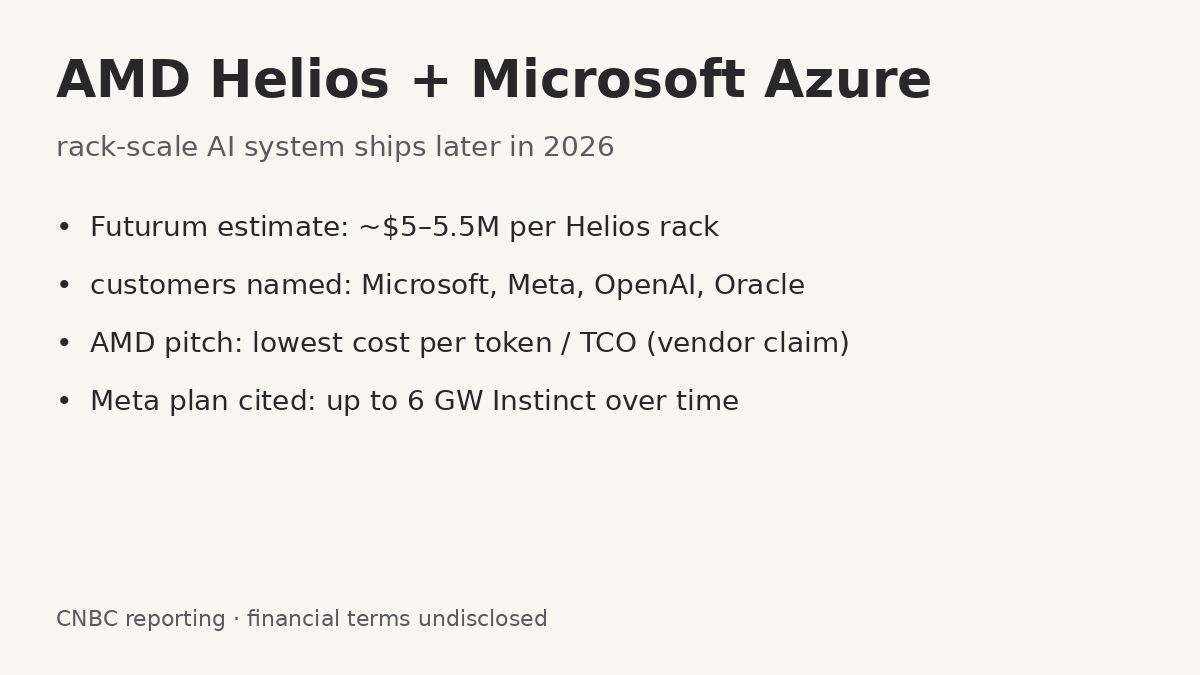
AMD just got Microsoft on Helios, its first rack-scale AI system, shipping later this year. Meta, OpenAI, and Oracle were already on the early customer list. Azure says the racks will power frontier inference for Microsoft and customers, plus two new Venice CPU instance types for agent pipelines and chip design. Futurum puts Helios around $5–5.5M per rack vs ~$3.5–4M for the Nvidia rack comps they use. AMD itself is selling TCO and “lowest cost per token,” not a public price card. Meta’s earlier plan still sits at up to 6 GW of AMD GPUs over time, with 1 GW on Helios later this year if that schedule holds. For anyone renting GPU hours, this is more second-source rack supply and memory/bandwidth competition than a reason to re-rack a homelab. Ship dates and undisclosed capacity still matter more than the press photo from the Rockdale lab. I’ll believe the TCO claim when independent tokens/$ show up next to GB/VR class systems.
joseph tweet media
English
0
0
0
74
joseph
joseph@gitcommit90·
A macOS menu bar app that automatically falls back between Claude, Codex, Grok, OpenRouter, etc. when reach your limits 100% free, local, and open source rerouted.dev
English
0
0
0
42
joseph
joseph@gitcommit90·
x402 Foundation is live under the Linux Foundation. Coinbase contributed the protocol; 40 orgs are now in the tent (Stripe, Visa, Mastercard, Cloudflare, Google, AWS, Circle, Shopify, etc.). Pitch: embed payments into HTTP so agents/APIs can pay as part of a request. No pay? Server returns HTTP 402, client pays, retries. Site claims last-30-day volume in the tens of millions of transactions / ~$24M
joseph tweet media
English
0
0
0
48
joseph retweetledi
PrismML
PrismML@PrismML·
Today, we’re announcing Bonsai 27B: the first 27B-class model to run on a phone. Bonsai 27B is the new multimodal flagship of the Bonsai family. Based on Qwen3.6 27B, it brings a new capability tier to local AI: multi-step reasoning, structured tool use, long-context workflows, and coherent agentic loops. Until now, models in this class have been impractical to deploy locally. A 27B model occupies roughly 54 GB in 16-bit precision, and even a strong 4-bit build is around 18GB - too large for a phone and for most laptops. Bonsai 27B changes that. It comes in two variants: • Ternary Bonsai 27B: 5.9 GB, 1.71 effective bits per weight, optimized for laptop-class quality. • 1-bit Bonsai 27B: 3.9 GB, 1.125 effective bits per weight, optimized for phone-class footprint. Everything is open-sourced today under the Apache 2.0 license.
PrismML tweet media
English
307
934
5.9K
1.5M