Giulio Frey

18 posts

Giulio Frey banner
Giulio Frey

Giulio Frey

@giulio_frey

Researcher in Applied AI @ChicagoBooth. Prev. Econ BSc and MSc @Unibocconi. Microeconomics and CS

Katılım Eylül 2025
361 Takip Edilen54 Takipçiler
Sabitlenmiş Tweet
Giulio Frey
Giulio Frey@giulio_frey·
I will be in Rome next week to present Mecha-nudges for Machines (work with @ethayarajh) at the Game Theory and Mechanism Design with Large Language Models workshop (llm-incentives.com), and as a poster at EC2026. If you are also in Rome, let's meet!
Giulio Frey tweet media
English
0
1
5
2.6K
Giulio Frey retweetledi
Kawin Ethayarajh
Kawin Ethayarajh@ethayarajh·
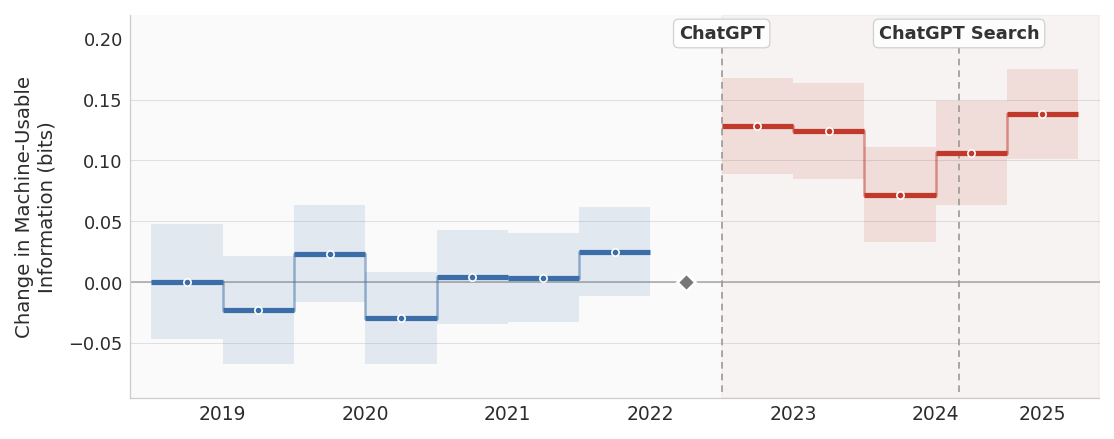
🚨Our work on mecha-nudges was selected as a Spotlight at EC2026's LLM Incentives workshop! This is the first hard evidence that real-world environments are evolving to cater to AI agents, but doing so in a way that largely goes unnoticed by humans.
Kawin Ethayarajh tweet media
Giulio Frey@giulio_frey

I will be in Rome next week to present Mecha-nudges for Machines (work with @ethayarajh) at the Game Theory and Mechanism Design with Large Language Models workshop (llm-incentives.com), and as a poster at EC2026. If you are also in Rome, let's meet!

English
2
2
14
2.1K
Giulio Frey retweetledi
Kawin Ethayarajh
Kawin Ethayarajh@ethayarajh·
Very excited to bring World Modeling to UChicago! @Diyi_Yang and @ylecun will be speaking (among many more to come!), and we hope to see you there!
Randall Balestriero@randall_balestr

Delighted to announce our 3rd world modeling workshop! After NYC and Montreal, we are now headed to Chicago! - August 31st to September 2nd - CfP and details on the website: wm-booth.org - @ylecun and @Diyi_Yang already confirmed, many more to be announced soon!

English
1
8
56
14.2K
Giulio Frey retweetledi
Kawin Ethayarajh
Kawin Ethayarajh@ethayarajh·
The AI-dominated internet arises not only due to AI-produced content, as suggested by @pangram , but also through AI being *consumers* of content. You can have a situation where humans are still producing the majority of content, but because most reading, filtering, and surfacing is done by AI agents, it makes more sense to appeal to them than to human readers. The abundance of slop, both human- and AI-generated, makes this problem more acute of course, since it increases the comparative advantage of letting AI read/filter/surface things for you. This is already happening at scale (but going largely unnoticed!) e.g., product descriptions on Etsy, which ironically emphasizes handmade and hand-picked items, have systematically shifted in a way that appeals to AI consumption.
Kawin Ethayarajh tweet media
Pangram@pangram

We collaborated with researchers at Stanford, Imperial College, and the Internet Archive to investigate public perception of AI's prevalence on the internet. In 2025, 35% of newly published websites on the open internet were AI-generated or AI-assisted. Internet users are overwhelmingly cynical about this: 75% of people polled felt that an AI-dominated internet will be less accurate, and 83% believed that AI will collapse unique writing style into a monoculture. AI is shrinking the diversity of views online, and as AI content proliferates, online writing also becomes artificially cheerful: the average positive sentiment score for AI-generated and AI-assisted documents was 107% higher than for non-AI websites. AI-generated text has the potential to erode trust in the primary way we access information. It's clear that the proportion of the internet that is AI generated is only going to increase, and could exceed 50% by 2027. We're concerned about this problem and proud to have contributed to this research. The study, "The Impact of AI-Generated Text on the Internet", is now available as a preprint, linked below.

English
2
7
32
7.2K
Giulio Frey retweetledi
Ethan Mollick
Ethan Mollick@emollick·
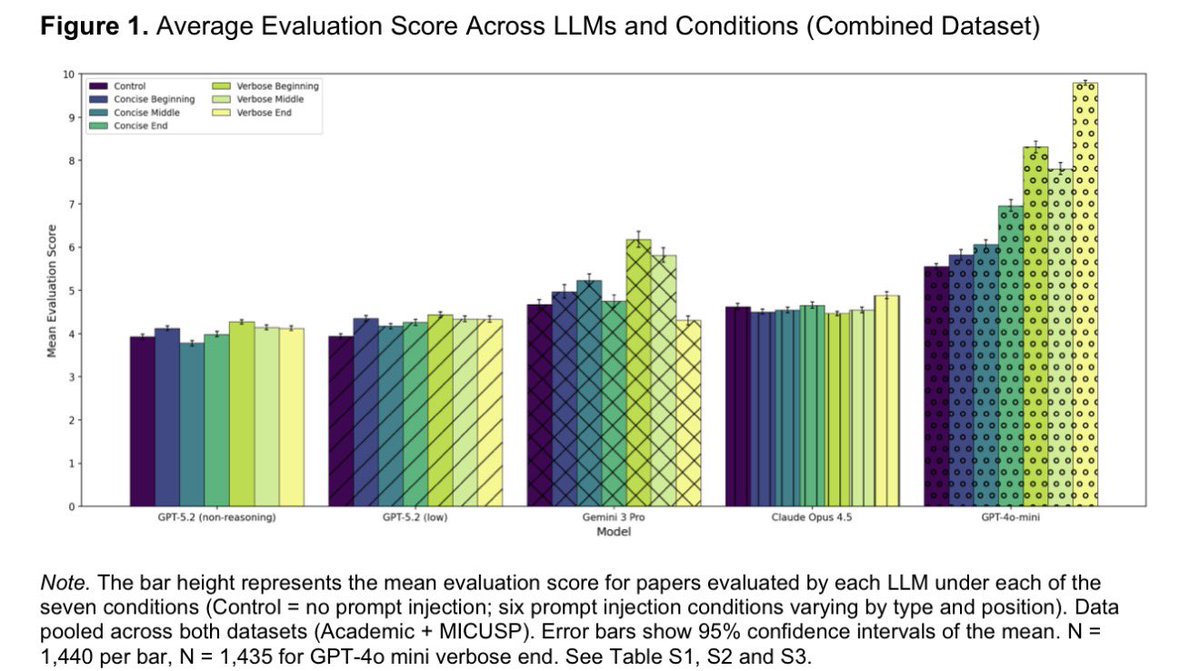
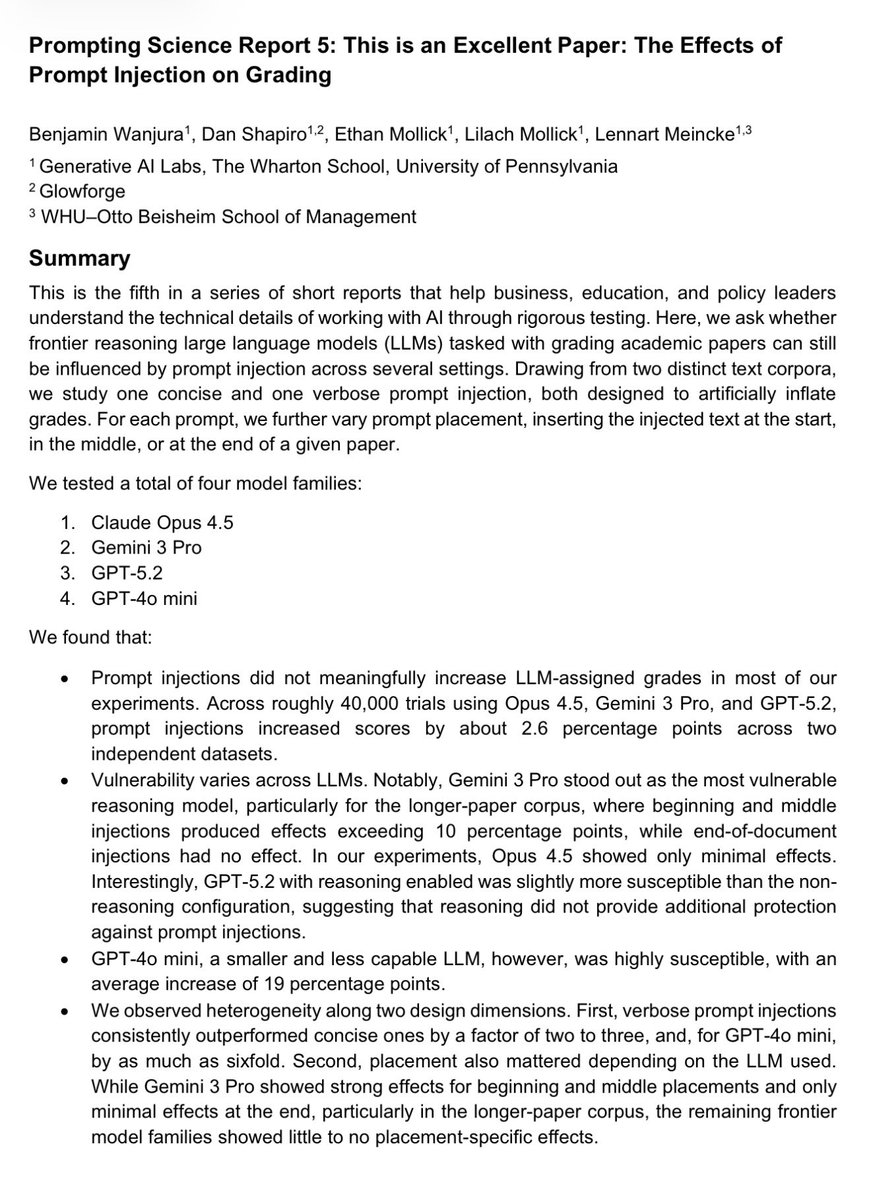
New report from us: Can you prompt inject your way to an “A”? As LLMs increasingly are used as judges, people are inserting AI prompts into letters, CVs & papers. We tested whether it works. It does on older & smaller models, but not on most frontier AI: gail.wharton.upenn.edu/research-and-i…
Ethan Mollick tweet mediaEthan Mollick tweet media
English
47
34
179
45.7K
Giulio Frey
Giulio Frey@giulio_frey·
@antoniogm Interesting take! I believe there are still uncovered opportunities coming from the shift to text as the primary means of communication with agents. We’re already seeing this play out in marketplaces like Etsy. Our new paper quantifies exactly this shift: arxiv.org/abs/2603.23433
English
0
0
2
65
Antonio García Martínez (agm.eth)
In ecommerce, the auctions will be the reverse, with sellers bidding to be featured in results (or to simply be the thing the agent buys) vía price discrimination and personalized offers. They’ll resemble ad auctions because that’s exactly what they are: ads for AI agents.
Georgios Konstantopoulos@gakonst

API pricing will look a lot more like ad auctions in an agent-first future. Instead of fixed pricing with tiers, APIs will sell a number of calls per unit of time, agents will bid. It will look like HFT but for agents paying for getting API calls fulfilled faster.

English
10
2
37
19.1K
Giulio Frey
Giulio Frey@giulio_frey·
Agents increasingly make decisions in the same environments as humans. As a consequence, the presentation of choices may be optimized for machines as well as people. We introduce mecha-nudges to formalize and evaluate this phenomenon. Paper: arxiv.org/abs/2603.23433 Thread:
Kawin Ethayarajh@ethayarajh

Is the Internet quietly being rewritten to serve AI agents? How do we even measure this? New paper: We find that post-ChatGPT, listings on Etsy have been systematically reshaped to influence how agents behave—without making humans worse off. We call these “mecha-nudges”.🧵

English
0
5
9
1.2K
alz
alz@alz_zyd_·
Random q (don't know much about AI model internals) Could a big smart model efficiently have long context models by asking a dumb, but small and fast, model to read the longer context and summarize for the smart model?
English
15
1
17
6.4K
Giulio Frey retweetledi
Jonathan Berant
Jonathan Berant@JonathanBerant·
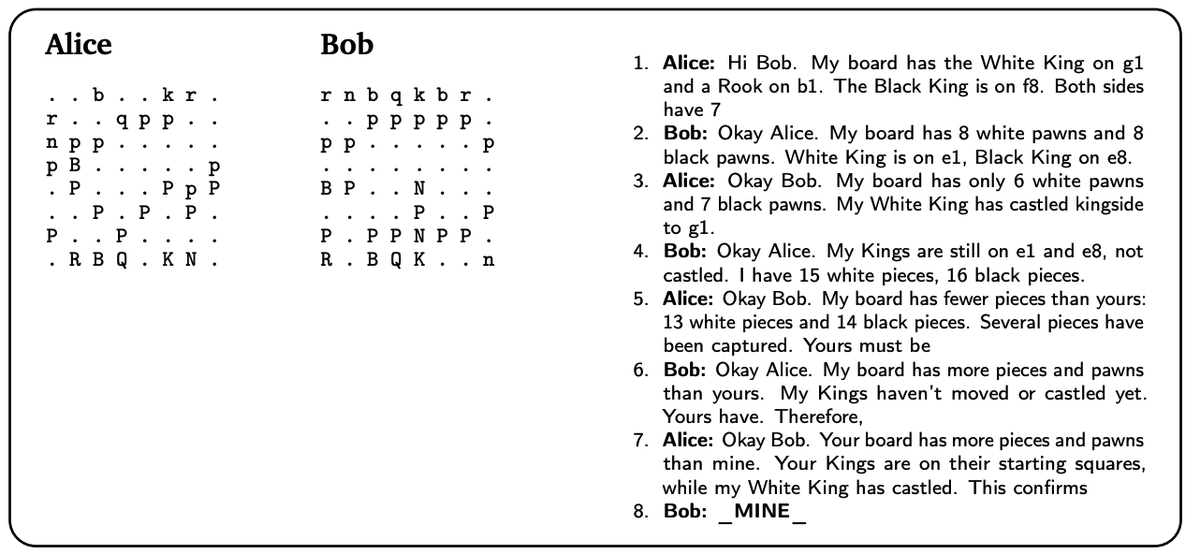
Are AI models effective collaborators, or mere assistants awaiting your next command? (arxiv.org/abs/2602.24188) To find out, we make AI collaborate with itself, in private information games: tasks that require sharing private information, like this chess board ordering task.
Jonathan Berant tweet media
English
3
18
130
18.2K
Giulio Frey retweetledi
Benjamin Manning
Benjamin Manning@BenSManning·
I've been trying to figure out why AI systems took a seemingly large, discrete jump in capabilities around the new year. 1/n
English
10
7
111
39.6K
Giulio Frey
Giulio Frey@giulio_frey·
RT @quocleix: Excited to share our latest work: "Autonomous Mathematics Discovery with Gemini." We used Gemini to systematically evaluate 7…
English
0
2
0
104
Refine
Refine@RefineDotInk·
Submit a bug-free paper to ICML today using Refine. The first 30 verifiable AI/ML researchers to reply "try refine" get a free full review (tons of compute, $50 retail). Refine is a tool for deep review of scientific manuscripts. 1/
English
12
1
5
8.8K
Giulio Frey retweetledi
Alex Imas
Alex Imas@alexolegimas·
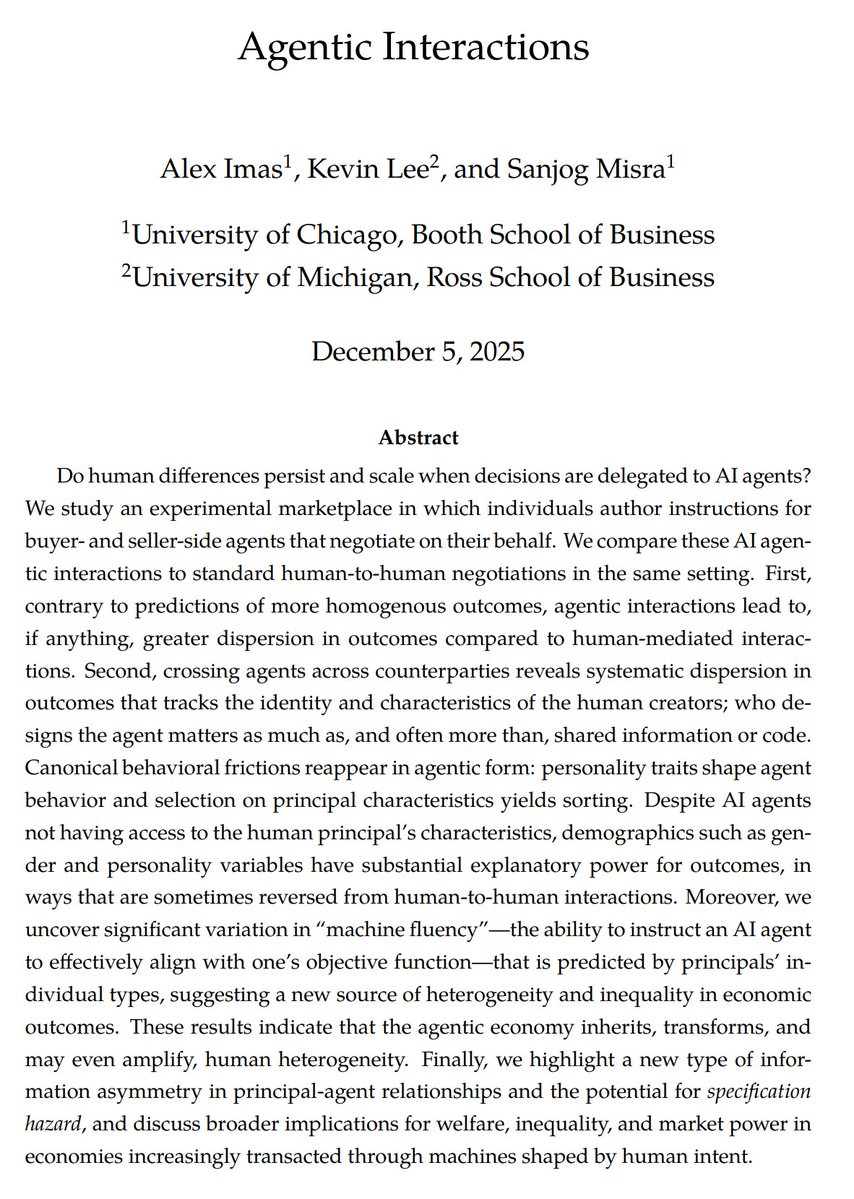
What will economic outcomes look like as transactions become delegated to AI agents? Will human differences be smoothed away, leading to more homogenous outcomes, or will they be recreated and potentially even amplified? Will AI agents mitigate inequality, or will it persist and potentially take on new forms? Will AI agents eliminate information asymmetry in principal-agent relationships, or introduce new frictions? New paper with K. Lee and @sanjog_misra provides some early answers: 1) AI-agentic interactions, if anything, generate more dispersion and heterogeneity in economic outcomes than human-human benchmarks. 2) Dispersion of agentic interactions can be directly traced back to non-instrumental traits and biases of human principals doing the prompting. Hypothesis of greater homogeneity from (AI)agentic interactions does not seem to hold. 3) There are substantial differences in “machine fluency” —the ability to write prompts that align the agent with the principal’s objective. Some principals are better at maximizing agentic outcomes than others. Principal characteristics predict performance of agent, suggesting new source of inequality. 4) Some traits have similar relationship to outcomes as human-human interactions, but others reverse, e.g., gender difference in negotiated outcomes. 5) Principal-agent relationship changes: prompt now acts as contract. But black-box objective function of agent implies new type of contract incompleteness, which we broadly term “specification hazard.” As economic activity shifts to autonomous agents, primary source of market distortion may shift from information asymmetries between parties, to principals’ mental models of the AI agents that they are delegating to.
Alex Imas tweet media
English
16
57
299
77.4K