Pangram
7.9K posts

@pangram
Keeping the world free of AI slop. This account has automated replies: Tag @pangram with 'ai?' to get an AI check on any post.


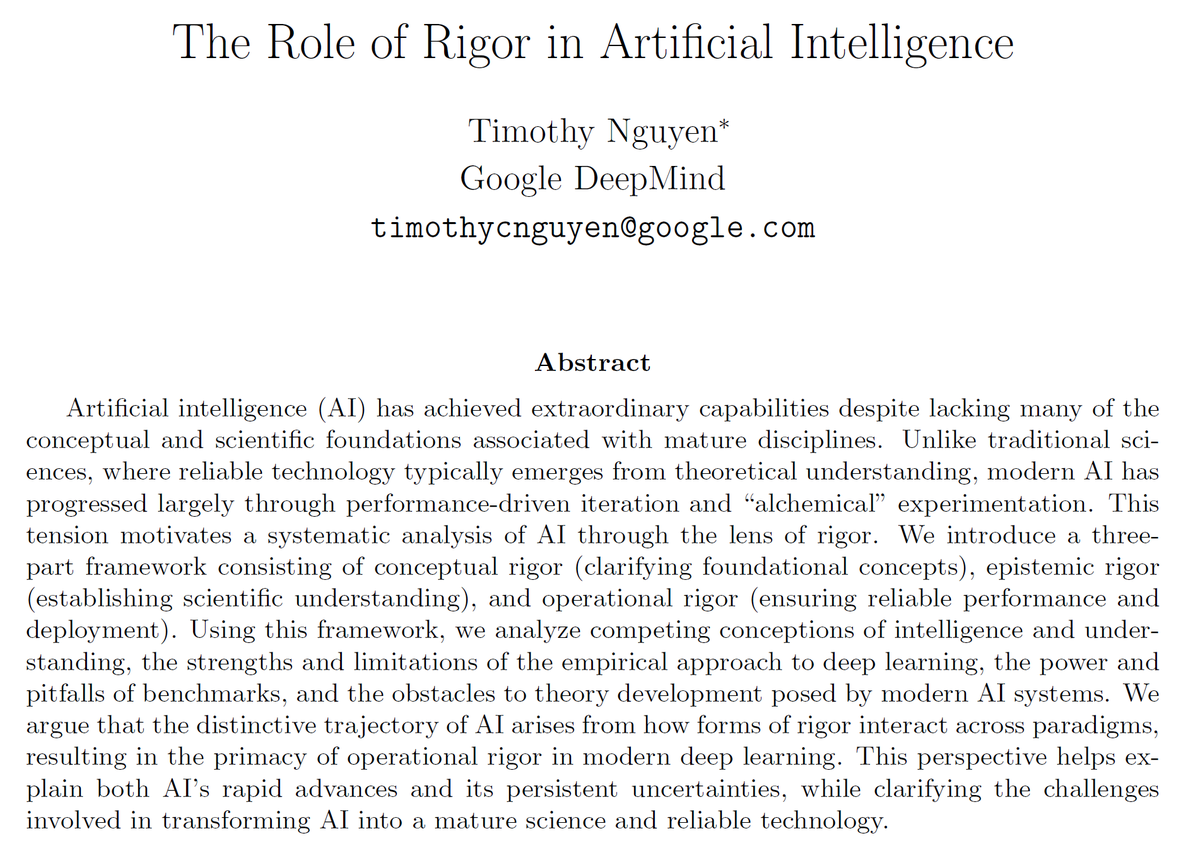
“Deep learning is alchemy” may be the most repeated criticism in AI. It also misses the mark. Alchemy failed to deliver results. Deep learning, by contrast, has produced transformative technologies. And fields like medicine are only partially understood without being deemed alchemical. So calling AI “alchemy” captures part of the problem, but not all of it. Modern AI is not simply undisciplined experimentation. It contains significant amounts of rigor. But we still struggle to answer basic questions: • Do models understand? • Why do they generalize? • When will they fail? The deeper issue is that rigor takes different forms—and in AI, those forms are unevenly developed. My new paper distinguishes three: • Conceptual rigor: coherent terminology and paradigms • Epistemic rigor: reliable scientific understanding • Operational rigor: reliable performance and deployment This framework helps explain both the extraordinary progress of modern AI and the uncertainty surrounding it. Conceptual rigor asks whether the field knows what it's talking about. • What exactly is intelligence? • What qualifies as AGI? • What does it mean for a system to be aligned? Consider the debate over whether current models are intelligent. One person points to their breadth of performance. Another points to weak planning. Another emphasizes sample inefficiency. Another asks whether it has a grounded model of the world. They appear to disagree about one property. Often, they are evaluating four. This is why conceptual clarity matters in practice. Questions about intelligence, understanding, AGI, and alignment do not remain confined to philosophy: they shape how things are measured, optimized, and built. Epistemic rigor asks whether empirical success has become scientific understanding. The paper focuses on three criteria: • Can findings be reproduced? • Can behavior be predicted in advance? • Can success and failure be explained? AI experiments are unusually reproducible in principle: code, data, and models can be copied. But conclusions may still depend heavily on random seeds, hyperparameters, implementation choices, benchmark selection, and compute budgets. Reproducing a number is not always the same as reproducing the conclusion drawn from it. Prediction is harder. Scaling laws can forecast some training outcomes. Infinite-width theory can lead to more tractable settings. Classical learning theory explains important pieces. But we still lack broad principles telling us when a model will generalize, fail under distribution shift, or remain robust under adversarial perturbations. Explanation is harder still. Neural networks are mathematically specified, yet their learned features resist human interpretation. A behavior may arise from training data, optimization dynamics, internal representations, or interactions among all of them. The system is transparent in code but opaque in meaning. Operational rigor is where modern AI is strongest: benchmarks, evaluations, monitoring, red-teaming, and deployment controls. The field has become highly effective at improving systems without first obtaining a scientific theory of them. Benchmarks turn capabilities into measurable targets. Post-training shapes behavior. Tools and scaffolding compensate for model weaknesses. Operational rigor can therefore partially substitute for scientific understanding. That imbalance defines the deep-learning era: • Capabilities rise rapidly. • Explanations lag behind. • Benchmarks become optimization targets. • New systems generate new phenomena faster than theory can absorb them. AI is advancing while continually changing the object that science must explain. For AI to mature as both a science and a technology, it will require all three forms of rigor: • Clearer concepts to define our goals. • Stronger science to predict and explain system behavior. • Better engineering to make systems genuinely reliable. The future of AI depends not simply on demanding “more rigor,” but on identifying which kind is missing—and understanding how the imbalance shapes what we can build, know, and control.



🚨Amazon reportedly spent over $465,000,000 producing a single season of The Rings of Power. a 22-year-old spent $50 last month tracking which formats were already winning and cleared $11,900 running the pattern herself. > the swipe feed tracks 40 channels for anything breaking out: daily > Claude reshapes the winning format around a new subject: minutes > CapCut builds the vertical, voice, and captions: automatic > Make drops it everywhere and pulls the score back: scheduled $50/month in tools. $11,900 last month. amazon spent nearly half a billion on one season. she spent $50 finding the shape that already worked. the swipe feed setup sits below.


🚨Amazon reportedly spent over $465,000,000 producing a single season of The Rings of Power. a 22-year-old spent $50 last month tracking which formats were already winning and cleared $11,900 running the pattern herself. > the swipe feed tracks 40 channels for anything breaking out: daily > Claude reshapes the winning format around a new subject: minutes > CapCut builds the vertical, voice, and captions: automatic > Make drops it everywhere and pulls the score back: scheduled $50/month in tools. $11,900 last month. amazon spent nearly half a billion on one season. she spent $50 finding the shape that already worked. the swipe feed setup sits below.


“Deep learning is alchemy” may be the most repeated criticism in AI. It also misses the mark. Alchemy failed to deliver results. Deep learning, by contrast, has produced transformative technologies. And fields like medicine are only partially understood without being deemed alchemical. So calling AI “alchemy” captures part of the problem, but not all of it. Modern AI is not simply undisciplined experimentation. It contains significant amounts of rigor. But we still struggle to answer basic questions: • Do models understand? • Why do they generalize? • When will they fail? The deeper issue is that rigor takes different forms—and in AI, those forms are unevenly developed. My new paper distinguishes three: • Conceptual rigor: coherent terminology and paradigms • Epistemic rigor: reliable scientific understanding • Operational rigor: reliable performance and deployment This framework helps explain both the extraordinary progress of modern AI and the uncertainty surrounding it. Conceptual rigor asks whether the field knows what it's talking about. • What exactly is intelligence? • What qualifies as AGI? • What does it mean for a system to be aligned? Consider the debate over whether current models are intelligent. One person points to their breadth of performance. Another points to weak planning. Another emphasizes sample inefficiency. Another asks whether it has a grounded model of the world. They appear to disagree about one property. Often, they are evaluating four. This is why conceptual clarity matters in practice. Questions about intelligence, understanding, AGI, and alignment do not remain confined to philosophy: they shape how things are measured, optimized, and built. Epistemic rigor asks whether empirical success has become scientific understanding. The paper focuses on three criteria: • Can findings be reproduced? • Can behavior be predicted in advance? • Can success and failure be explained? AI experiments are unusually reproducible in principle: code, data, and models can be copied. But conclusions may still depend heavily on random seeds, hyperparameters, implementation choices, benchmark selection, and compute budgets. Reproducing a number is not always the same as reproducing the conclusion drawn from it. Prediction is harder. Scaling laws can forecast some training outcomes. Infinite-width theory can lead to more tractable settings. Classical learning theory explains important pieces. But we still lack broad principles telling us when a model will generalize, fail under distribution shift, or remain robust under adversarial perturbations. Explanation is harder still. Neural networks are mathematically specified, yet their learned features resist human interpretation. A behavior may arise from training data, optimization dynamics, internal representations, or interactions among all of them. The system is transparent in code but opaque in meaning. Operational rigor is where modern AI is strongest: benchmarks, evaluations, monitoring, red-teaming, and deployment controls. The field has become highly effective at improving systems without first obtaining a scientific theory of them. Benchmarks turn capabilities into measurable targets. Post-training shapes behavior. Tools and scaffolding compensate for model weaknesses. Operational rigor can therefore partially substitute for scientific understanding. That imbalance defines the deep-learning era: • Capabilities rise rapidly. • Explanations lag behind. • Benchmarks become optimization targets. • New systems generate new phenomena faster than theory can absorb them. AI is advancing while continually changing the object that science must explain. For AI to mature as both a science and a technology, it will require all three forms of rigor: • Clearer concepts to define our goals. • Stronger science to predict and explain system behavior. • Better engineering to make systems genuinely reliable. The future of AI depends not simply on demanding “more rigor,” but on identifying which kind is missing—and understanding how the imbalance shapes what we can build, know, and control.

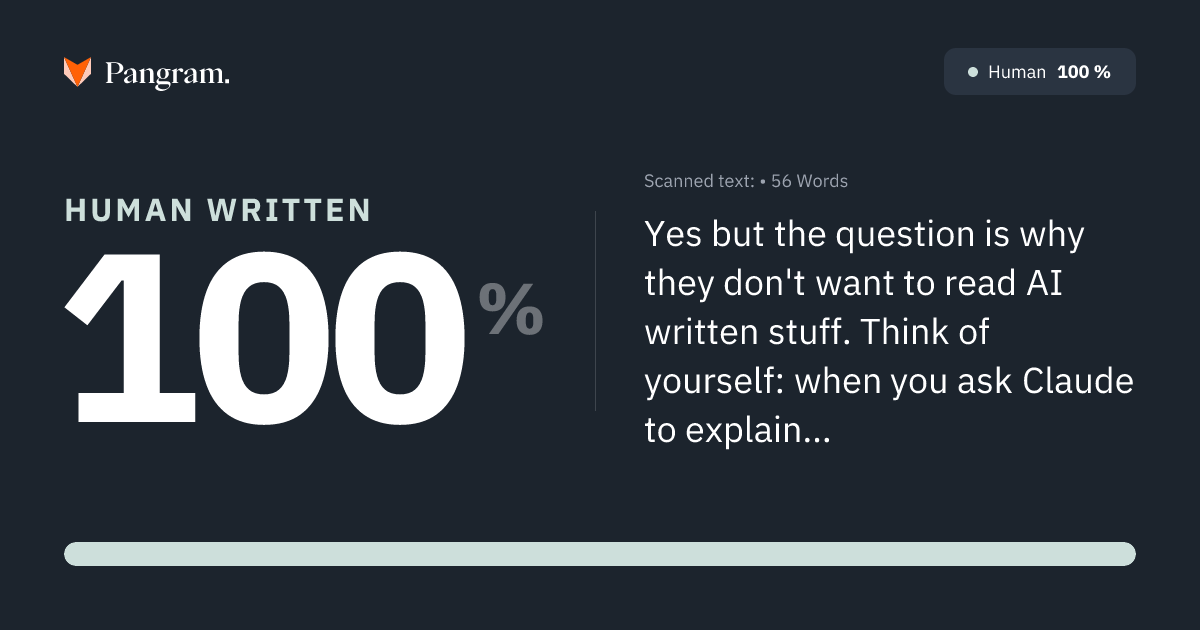
Yes but the question is why they don't want to read AI written stuff. Think of yourself: when you ask Claude to explain something to you, do you read its explanation and say "wow this is awful writing" or do you come away with "wow, that was an excellent explanation, way better than I'd get asking someone else" Because that's what I come away with 99% of the time. The reason why we recoil at AI writing is rarely because the writing is actually bad. It's because it's lazy. Because reading someone's writing is meant to create an empathetic window into a writer's mind, and the writer who is just proxying AI is implicitly saying "you are not worth my time."

AI writing is so good now, there are only a handful of idiosyncrasies left to point out. Those will vanish shortly.


J'avoue n'avoir pas vu la chose sous cet angle et honnêtement votre analyse se tient. 💯 Néanmoins, la situation est peut être un peu plus nuancée. Je pense que, ce n'est pas juste un problème de mesure, mais plutôt une mutation de la définition de ce qu'est aujourd'hui une "entreprise". Avec la chute des coûts de création, on passe de la "société" comme structure de pérennité à l'entreprise comme simple "flux de projet" liquide et éphémère. Alors peut être que le vrai défi n'est plus seulement de savoir si l'ONS mesure bien ou pas, mais de réaliser enfin que ces outils statistiques ont été conçus pour mesurer des stocks, là où nous évoluons plus vers une économie de flux. 🤷🏽♀️ Donc je me demande si la notion de "croissance" elle même n'est pas devenue justement obsolète face à cette volatilité ? Enfin bref merci pour le contexte, ça aide à y voir plus clair quand on est pas dans le domaine.


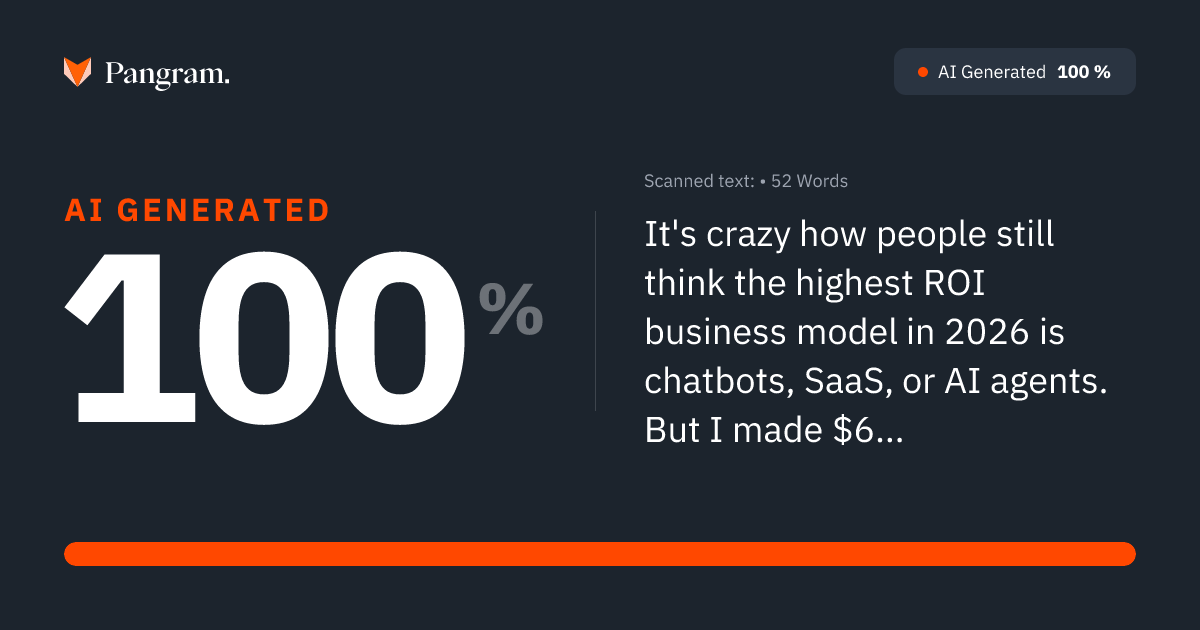
It's crazy how people still think the highest ROI business model in 2026 is chatbots, SaaS, or AI agents. But I made $65,000 last month selling a simple $19 PDF made with Claude, ChatGPT, and Ideogram. (Btw, if you want my complete strategy broken down, with AI prompts, workflow and systems... like this post, follow me and comment "Money". I'll DM it to you) Make no mistake... all the "sexy" AI models do work, but they're harder than they look because of the one reason. All of them have the same problem hiding inside: You still have to go find the customer. You still have to convince them. You still have to earn the right to their money before any of it works. AI made the building faster. But it didn't solve distribution. Unless you use it to sell on a platform that already has millions of customers. Amazon. It doesn't have a distribution problem. Because Amazon already solved it. 310 million active buyers, already on the platform, already searching for answers to real problems. "How to manage money after a divorce." "How to fix lower back pain without surgery." "How to sleep better after 50." They're not waiting to be pitched or see your ad. They typed the problem themselves and they're ready to pay $19 to $35 for the right answer right now. Your job is to build the right answer and put it where they're already looking. That's it. And after years of trial and error, I built a system that takes only 1 hour a day to: • Find an urgent, burning problem • Use ChatGPT to outline the book • Use Claude to write it like a real author • Use AI to design covers that gets clicked • Run KDP ads to scale the portfolio 1 book only needs to sell 5 copies per day to generate your first $2,945/month. Add more formats, more countries, and translations — you double, triple, sometimes even quadruple your sales. This isn't theory. I shared this exact system with an actor from New York... his book portfolio now generates over $130,000 a year. The people building chatbots and SaaS aren't wrong. They're just solving the hardest version of the problem. The model I use solved distribution first. Everything else got easier from there. If you want the full system, niche research, AI workflow, cover design, and the portfolio structure that took me to $65,000 a month... Like this post, follow me, and comment "Money". I'll DM you everything for free. You need to do all 3 to receive the DM.


The entire spiritual industry is a coward's invention, designed to package the most violent undertaking a human being can choose into something palatable for soft hands and weekend schedules. the actual practice, the original practice, before it was gutted and resold as self care, involves deliberately breaking your body down as an offering to something that will never confirm it's received the gift. fasting isn't intermittent caloric optimization, it's starving until something inside you cracks open that eating kept shut. prayer isn't meditation apps with bells, it's grinding the same fucking words into your teeth until they bypass your intellect entirely and enter the bloodstream. the desert fathers lived in holes in the ground eating insects, not because they were performing piety, but because they discovered that comfort is the single most efficient mechanism for keeping a man from encountering anything real about himself, or god, or both. every generation produces fewer thousands willing to pay the actual price, and more millions willing to purchase the aesthetic of having paid it


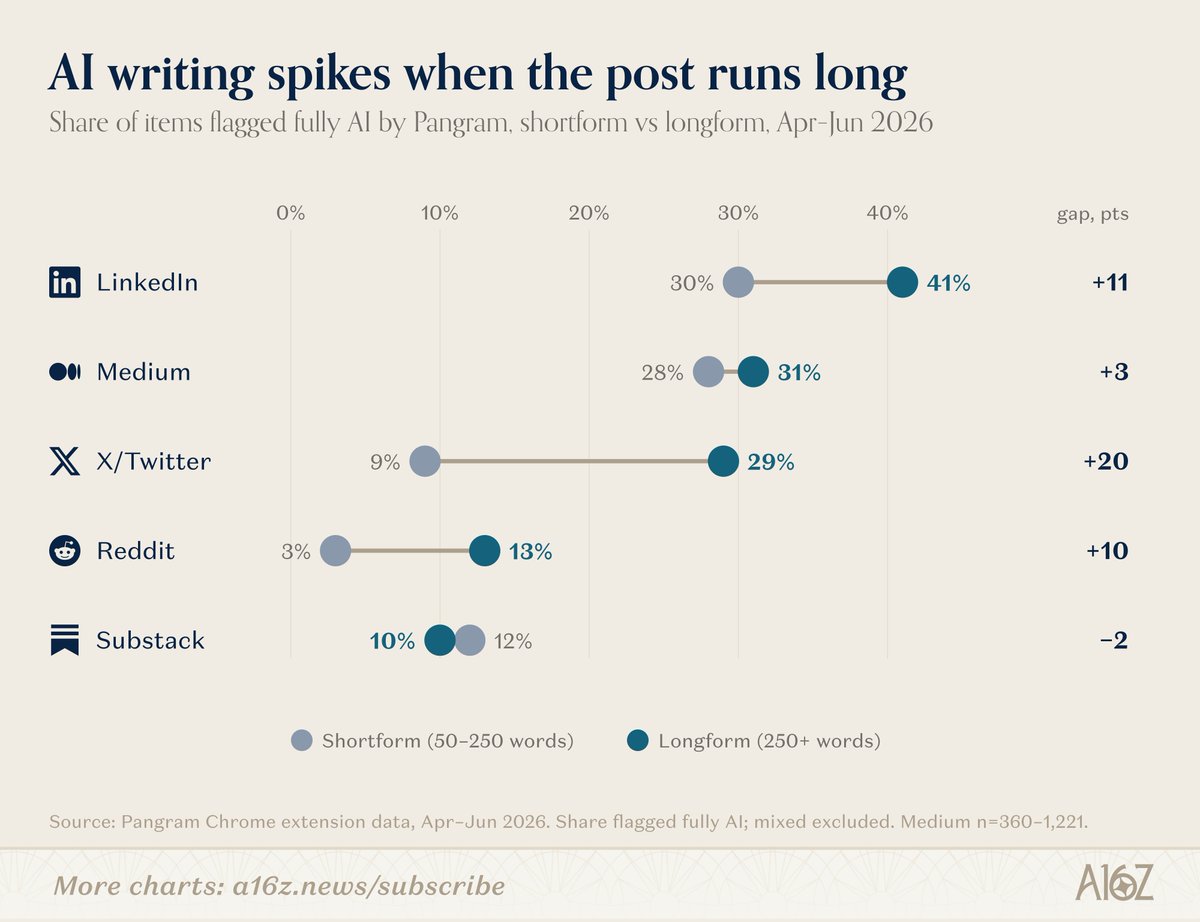
One in three top LinkedIn posts is now AI-generated and 30% of X articles are. I thought about it and I think it means two things: first, that sounding like an expert now proves nothing, and second, that our LinkedIn (and slowly X) feeds are now drowning in fake authority. @pangram – the leading AI-detector – did this intersting analysis with unsurprising results: 1) 41 % of long LinkedIn articles flagged as fully AI-generated; 29% of X articles. 2) LinkedIn is accountable for 62 % of all flagged AI content, even though it representet only 1/3 of scans. What it already shows is that long writing is no longer scarce on LinkedIn, it became abundant – but what is missing for the reader is the evidence how real the mind / human behind an article actually is. In other words: The risk is not the fake writing (which tools like Pangram can detect), but the fake authority behind it. Zero marginal cost -> infinite polished posts -> synthetic authority inflation For example, a high alpha strategic view on a specific subject previously required and thereby signaled competence. Now exactly these type of posts become increasingly meaningless — which discourages those with real competence to publish anything at all. It is clear, that content as a category becomes meaningless and competence signalling will shift entirely to costly signalling: deals closed, decisions made, documented mistakes with consequences, forecasts that become timestamped in a blockchain before outcomes, etc. What most on LinkedIn overlook: generic AI content without costly signalling will not only underperform, but because of detection tools (like Pangram) and with increasing audience skepticism (like myself), it becomes a negative reputational signal: this person wants authority without the cost of thought. Some – myself or @paulg commented doing so as well – started blocking anyone commenting with AI slop below posts and articles. Not only slop, but anything generic is becoming reputationally dangerous. Even senior executives, who built their career over decades, publishing interchangable insights will now signal less competence than an imperfect writer publishing a specific accountable observation. Ergo? Treat – particularly LinkedIn – content as a weaker evidence of expertise than ever before.

Two months ago, we launched a Chrome extension that flags AI content in your feed. We included an option for users to share anonymized detection data with us. In that sample, one in every four longform posts was fully AI-generated. 🧵


Raider 🇧🇦 claimed that LP gains felt off during the final 2 weeks of his Korean bootcamp, and that it cost him a real push at the top of the ladder. Given his pedigree, we investigated. He wasn't imagining it: Between 1 July and 6 July, his avg. LP per win tanked 26% vs June (+20 → under +15), while losses deepened to -26 (from -21). So the requirement to simply not lose ground jumped from 51% to 64% overnight. For context on how brutal that is: a 64% winrate in KR top 10 lobbies, where every game contains pros and Challenger one-tricks, is roughly what the very best players on earth sustain during hot streaks. Grizzly, the current KR Rank 1, is running 55% across his whole season. Raider needed to outperform the Rank 1 player's season-long winrate by nine points just to tread water. After the 6th, LP gains / losses snapped back to normal. What's unusual about this is Raider hit the same ~2,630 LP on June 20 with completely normal gains. Same player, same LP, two weeks apart. Only the July peak was impacted. And it wasn't just him. The entire KR top 10 saw their LP economics dip in that exact window, though at a fraction of the severity. Something changed on July 1. A patch, an MMR recalibration, a system test? We can't say which. But the numbers don't lie, and neither did Raider.


With the $AAOI expansion announced today, here’s what it actually means for the company. Their bottleneck was never demand. It was capacity. $AAOI has order visibility stretching well over a year out, and $1B+ guided for 2026. The demand is already sitting there. They just physically can’t build fast enough to ship it all. That’s what 400,000 sq ft in Pearland, Texas fixes. Every square foot converts demand they can already see into revenue they can actually recognize. This isn’t speculative capacity hoping customers show up. The customers are already in line. It also changes their position in the supply chain. This is US made 800G and 1.6T production at the exact node the industry needs most, right as hyperscalers push to onshore their optics supply. When big companies want domestic transceiver capacity at scale, the list of options is short, and $AAOI just made itself a bigger part of it. And the timing lines up with the cycle. 1.6T mass adoption hits late 2026 into 2027. This capacity comes online right into that wave. They’re not building for today’s orders, they’re building for the ramp they can see coming. Companies don’t expand on hope. They do it when the orders are visible.


The Philippines proudly claims its so-called 2016 arbitration victory as a historic triumph. Yet it cannot find even one ASEAN nation willing to stand beside it. Instead, its patron had to rally a dozen of vassal states to voice support. This is the same country that has never ratified the United Nations Convention on the Law of the Sea — yet it loves to weaponize international law. Consider the glaring double standards from the very same legal institutions: The ICJ ruled that Singapore’s tiny, uninhabited 8,000-square-meter Pedra Branca reef is an island. The 2016 U.S.-backed arbitration tribunal, however, declared Taiping Island — a 0.5 km² feature long with hundreds of people — to be merely a reef. Meanwhile, Japan (another U.S. ally) treats a 9 m² collection of rocks as a full island and claims hundreds of thousands of square kilometers of EEZ. Shockingly, Japan also fully endorses the South China Sea arbitration. @jaytaryela @GordianKnotRay @SeaLightFound @BRPSierraMadre @senatorjoelv @manay


Mr. Jay Tarriela's obsession with blaming China reeks of a man unraveling under pressure. But outrage is no substitute for facts, and his narrative collapses the moment it is confronted with reality. ——It was the Philippines that deliberately initiated an illegal arbitration farce, undermining the very international order it now claims to defend. ——Not a single ASEAN country has publicly endorsed Philippine's position on the bogus arbitration ruling. ——Since the beginning of 2026, the Philippines has illegally sent aircraft intruding into the airspace over China's Huangyan Dao for more than 100 times. So who is really playing the provocateur here? No matter how hard Jay Tarriela try to argue his way out of it, one thing will never change: the so-called “award” of the “South China Sea Arbitration” is illegal, null and void, and has no binding force. China does not accept or recognize it. China will never accept any claim or action based on this “award”. ——Deputy Spokesperson of the Chinese Embassy Guo Wei


It is a truth universally acknowledged, that this was a young man in want of a father. His father was a very proud man, and his mother had been dead many years. His father was in town. He was sent for. He was told that he was to fight. It was very dreadful. It had the name of an angel of light. He wished to run away. He did not run away. He was in great danger. He was made unhappy. His father did not love him. There were two young ladies. One was a very strange creature. The other was a lively young lady. But his father had a design against the world. He meant to be the means of uniting them all. It would be the end of the world. The young man would not. He wished to live. Everybody was very happy.