




Gle Hu

3.7K posts

Gle Hu banner
Gle Hu

Gle Hu

@glehu

Singapore 🇸🇬

Singapore Katılım Aralık 2013
2.8K Takip Edilen1.1K Takipçiler
Matt Rife
Matt Rife@mattrife·
I wonder every single day how I’m alive, with how little i sleep. And somehow not a doctor on earth can figure it out…
English
705
72
2.7K
908.1K
Gle Hu retweetledi
James Zou
James Zou@james_y_zou·
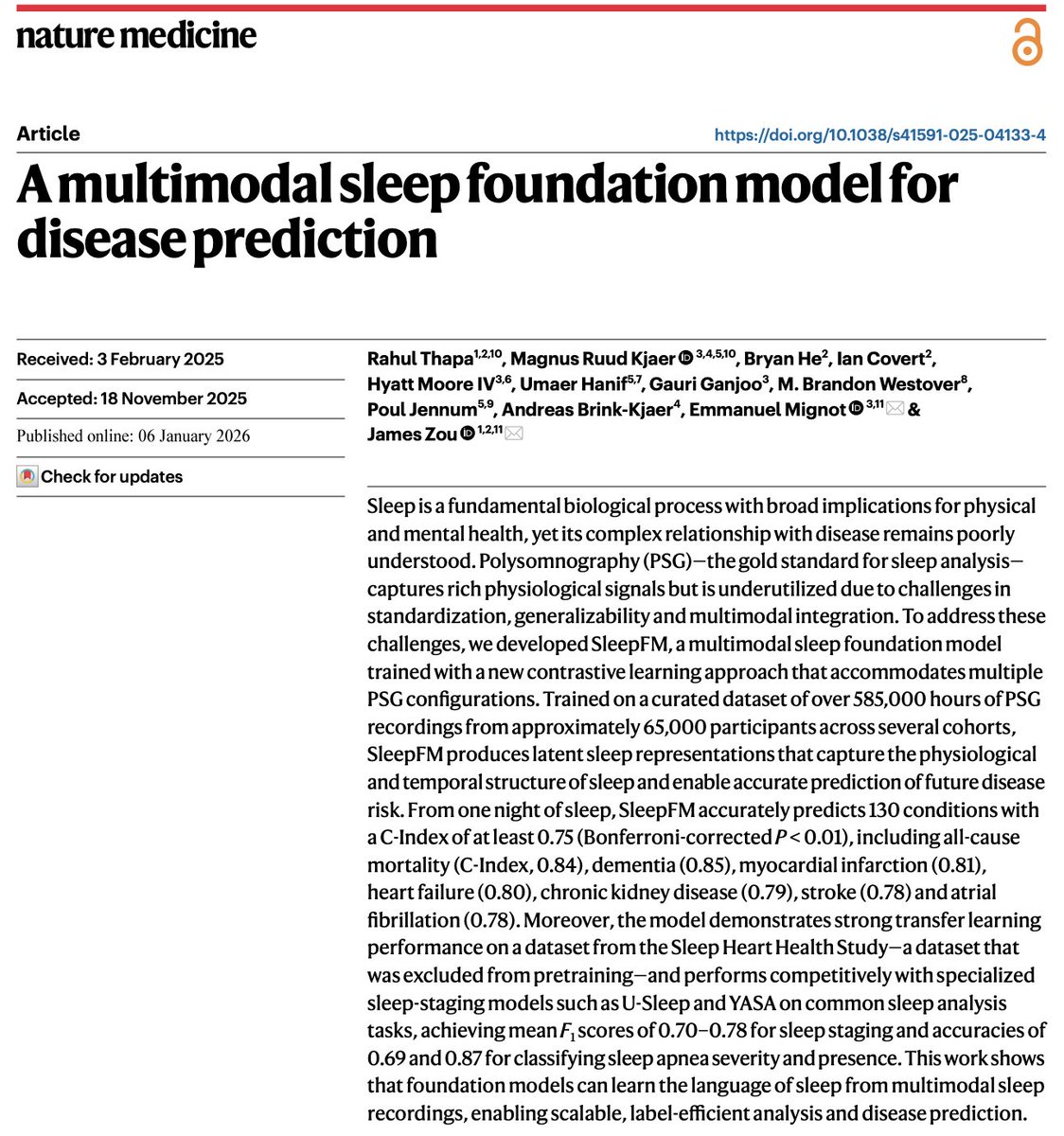
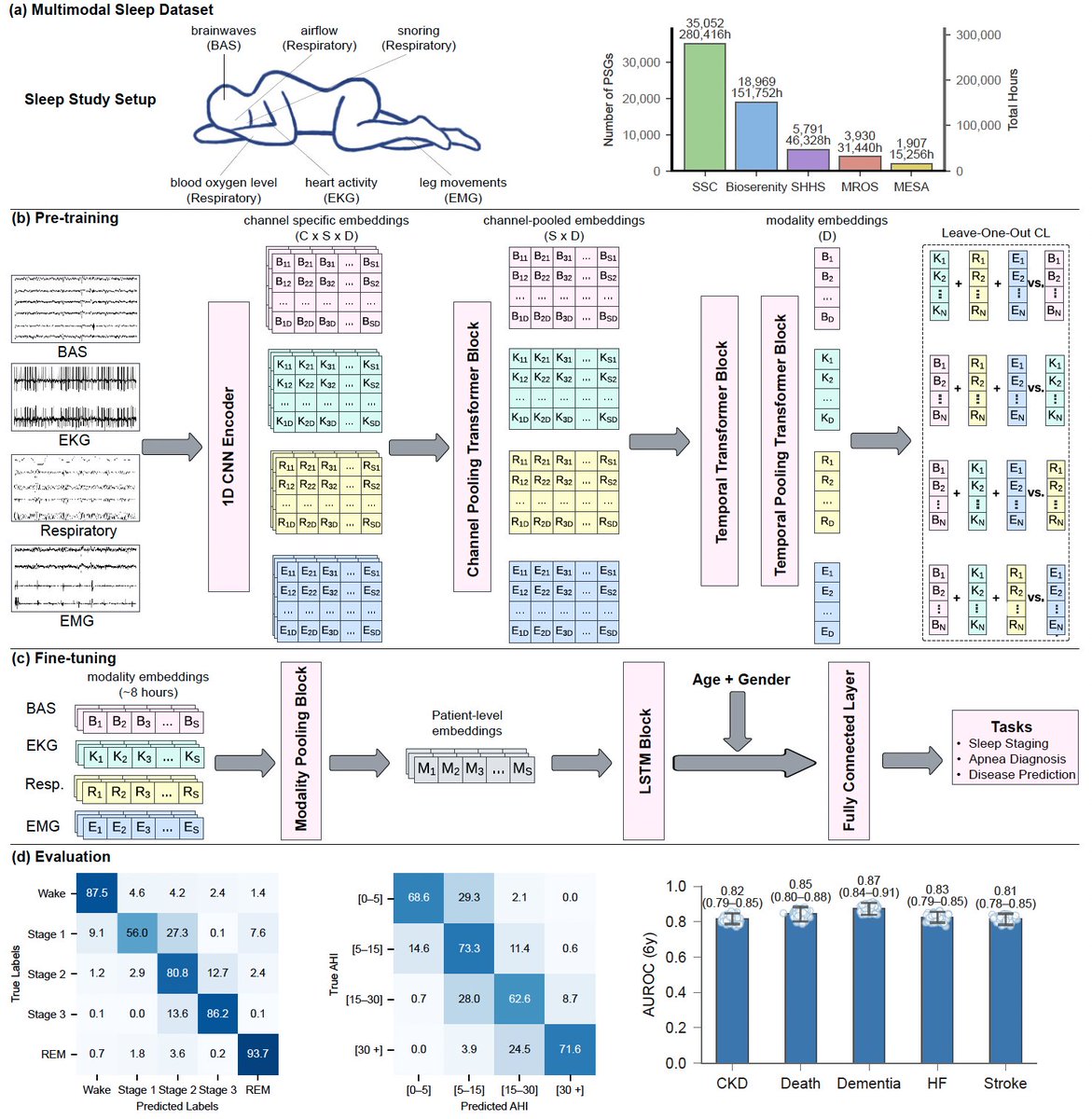
Today in @NatureMedicine we report that AI can predict 130 diseases from 1 night of sleep🛌 We trained a foundation model (#SleepFM) on 585K hours of sleep recordings from 65K people—brain, heart, muscle & breathing signals combined. AI learns the language of sleep🧵
James Zou tweet mediaJames Zou tweet media
English
272
2.1K
11K
913.9K
Gle Hu retweetledi
Joe Rogan Podcast News
Joe Rogan Podcast News@joeroganhq·
Andrew Huberman: "Someone I really respect said this, 'There are basically two kinds of people in life. Winners and losers.' And the definition is this—losers take things that happen to them... and the wallow and they use it for self or outward destruction." "Winners take whatever they feel, it sucks, and they transmute it into things that are good for themselves and for the world."
English
147
1.7K
13.3K
1.5M
Gle Hu retweetledi
Hoops
Hoops@Hoopss·
Everytime I get mad at my sports team for losing, I remind myself of what Giannis said. Arguably my favorite response to a reporter ever.
English
327
7.6K
36.1K
970K
Gle Hu retweetledi
KeriA
KeriA@KeriA1776again·
Be unfookwitable. The more you know, the easier it is to stop playing their games.
English
57
2K
7.2K
220.6K
Ryan Reynolds
Ryan Reynolds@VancityReynolds·
Captain Tom Slingsby and the @bondsflyingroos embody courage, determination, and teamwork. Words that hit harder in @RealHughJackman’s thick Aussie brogue. Now go win that fourth Grand Final in Abu Dhabi, Roos. LFG.
English
147
258
1.7K
191.4K
Gle Hu retweetledi
Kevin Dahlstrom
Kevin Dahlstrom@Camp4·
Today I turn 55. I’m the fittest, sharpest, and happiest I’ve ever been. If I’m an outlier, it’s not because I’m built different or discovered a secret formula. The truth is far less glamorous: It’s a million tiny choices, compounded over decades. Here are 55 of them: 1. Walk 15+ miles a week, even if you do other exercise. Humans are uniquely made to move slowly over long distances—it’s critical to longevity. 2. Develop a writing practice. It’s the single best way to sharpen your mind. And remember, you don’t have to be a good writer to write. Start with 10 minutes a day. 3. Swap out your toothpaste, deodorant, lotions, soap, shampoo, and other personal care products for natural versions. Here’s a rule of thumb: Don’t put anything on your skin that you couldn’t safely eat. 4. If you have a positive thought about someone, don’t keep it to yourself—share it immediately. Encouragement defies the laws of physics: When you give energy, you also receive it. 5. Wear shoes with a wide forefoot (I like Topo Athletic) and wear toe spreaders around the house (search “yoga toes” on Amazon). Spine health begins with the feet. 6. Get sunlight regularly. Moderate sun exposure (without sunscreen) is hugely important for overall health. 7. Do a 3-minute deep (“ass to grass”) squat every morning. Deep squats are often called the anti-aging exercise. It’s been said that, “It’s not that you can’t do deep squats because you’re old, it’s that you’re old because you can’t do deep squats.” 8. Explore minimalism (it’s not what you think it is). 9. Set boundaries on toxic relationships. We tend to cling to relationships past their expiration date, and it takes a bigger toll on our health than we recognize. 10. Eat real food. Not too much. Don’t eat garbage. Binge occasionally. Fast occasionally. That’s the diet. 11. Learn about FIRE. It’s a great framework for financial success. 12. Don’t take antibiotics except in emergency situations. They’re massively over-prescribed and aren’t needed in most cases. Antibiotics have done untold damage to our guts, which is where health begins. Great natural alternatives are out there. 13. Get 8 hours of quality sleep each night. To optimize sleep: —Don’t eat after 6pm —Get blackout shades and cover LEDs with black tape —No screens 2 hours before bed —Try ashwagandha (an herb) to calm the nervous system 14. Stop drinking, even in moderation. People find all sorts of ways to justify drinking, but there’s no escaping the simple fact that alcohol is a toxin and it limits your potential. 15. Travel as much as possible. Nothing expands the mind like seeing the world. And travel doesn’t have to be expensive—the best experiences happen outside of fancy resorts, when you live like a local. 16. Let go of resentment. When you forgive someone, you release the prisoner, and the prisoner isn’t them… it’s you. 17. Show up on time, every time. Poor time management limits success more than most people realize. If you struggle with punctuality, stop everything else and fix that first. 18. Spend lots of time in nature and touch the earth. Humans evolved over 300k years to live in harmony with nature, and only recently have we retreated indoors. If you don’t spend time outside, you’re fighting biology (hint: You won’t win.) 19. Stop doing dumb things. As Leo Tolstoy said, “People try to do all sorts of clever and difficult things to improve life instead of doing the simplest, easiest thing—refusing to participate in activities that make life bad.” 20. Find your happy place and (eventually) move there. Most people live where they live because... that's where they live. We are products of our environment—choose yours carefully. 21. Find a hobby and pursue mastery. You can’t have a happy life without a passionate pursuit that isn’t your vocation. Your work—even if you enjoy it—isn’t enough. 22. Avoid mainstream medicine except as a last resort. The results are in—our healthcare (or more appropriately, sick care) system is badly broken and only makes people sicker. 23. Have a mindset of abundance. There is no advantage to being a pessimist—even if you’re right, it’s a miserable way to live. In a very real way… whatever you believe, you’re right! 24. Do hard things. Choose courage over comfort. Everything you want is on the other side of fear and hard work. As Jerzy Gregorik said, “Hard choices, easy life. Easy choices, hard life.” 25. Ignore haters. Hurt people hurt people. Negative/toxic people live in a prison of their own design. Don’t join them! 26. Say no. Protect your time and energy like it’s your most precious asset… because it is. 27. Become a water snob. As an alien said on Star Trek, humans are “ugly bags of mostly water.” You are what you drink—literally! We have Mountain Valley Spring water delivered in glass 5-gallon jugs and also have whole-house water filter (Aquasana Rhino). 28. Stop drinking sodas and sugary energy drinks. After a few weeks you won’t miss them, and a few months later they’ll seem disgusting. Refined sugar causes inflammation, which is the root of most disease. 29. If you’re over 35, find a good functional/longevity medicine doctor and start tracking your hormones. Modern life is hell on the endocrine system and restoring healthy hormone levels can change your life. As we get older, we either accept a slow decline in performance or we do something about it—choose the latter! 30. Develop a morning routine and follow it faithfully. Win the morning, win the day! 31. Invest in experiences, not things. People frequently regret buying things, but rarely regret investing in great experiences (especially when shared with loved ones). Remember, there’s nothing you can buy in a mall that you’ll remember in ten years. 32. Explore spirituality. It’s arrogant and small-minded to believe there’s nothing going on in our universe that is beyond our comprehension. We know less about our universe than an ant meandering on a sidewalk understands about this planet. 33. Have a strong bias toward action—doing rather than talking. If you ask a bunch of old people about their regrets, they’ll talk about the things they *didn't* do—the shots they didn’t take—more than the things they did do (even if it went wrong). As Wayne Gretzky famously said, “You miss 100% of the shots you don’t take.” Most people don’t take enough shots. 34. Stay lean. Men in particular are obsessed with muscle mass these days, but bulk doesn’t age well. The goal is to be strong but lean. The fittest guys in their 50s and beyond aren’t meatheads, they’re lean guys who are serious about a sport. 35. Curate your inner circle carefully. Surround yourself with people you admire and who challenge you to grow. Remember, we’re the average of our 5 closest relationships. 36. Be the fittest version of yourself. Your body is your only vessel for experiencing life—so treat it as such. Fitness isn’t working out a few times a week, it’s a lifestyle. The older you get, the more time you need to devote to your health. 37. Take the time to appreciate art and beauty in all its forms. 38. Think globally, but act locally. Too many people put their energy into far-away problems they don’t understand and can’t impact, while ignoring problems right under their nose. Want to change the world? Start at home. 39. Try psychedelics. It’s one of those things everyone should do at least once, and it might be the breakthrough you’ve been looking for. 40. Limit bad habits, including unhealthy thought patterns. We all have them—practice avoidance and find substitutes. Get professional help if needed. 41. Be a lifelong learner. Your brain is just like a muscle—if you don’t feed and flex it regularly, it will atrophy. 42. Find your purpose. People with a strong sense of purpose are happier and live longer. Lack of purpose sucks energy and magnifies depression. 43. Only take advice from people who embody the traits you want to have. Talk is cheap—emulate those who have DONE it. 44. The goal is not to retire and do nothing, it’s to build a great day-to-day life that you don’t need to escape. A life of leisure is a slow death. Happiness isn’t possible without a little struggle, uncertainty, and skin in the game. 45. Have fun! Do frivolous and silly things that make you smile. As George Bernard Shaw famously said, “We don't stop playing because we grow old; we grow old because we stop playing.” 46. Whatever you want to do or achieve in life, start NOW. Don’t fall victim to “someday thinking” because someday never comes. 47. Accumulate assets—things that grow in value over time. It’s the #1 habit of rich people, and it can be done in tiny chunks. Instead of spending $100 on an impulse purchase that has no lasting value, put that money into an index fund or Bitcoin. It becomes addictive (in a good way). 48. Don’t ignore the big 3 canaries in the coal mine for health: —Low libido (and ED) —Frequent sinus & respiratory issues —Depression These usually aren’t medical conditions in themselves, they’re symptoms of an underlying problem. Find a good doc (outside of the mainstream) and figure out the root cause. 49. Have a clear vision for your future. How can you decide which direction to go if you haven’t clearly defined the destination? It sounds obvious, but 95% of people haven’t defined their “Ideal End State” in detail and in writing. (Check out my thread on this topic.) 50. Make your own decisions. We live in an era where most of what society tells us is wrong. Don’t be afraid to break from societal norms—if people say you’re crazy, it’s a sign that you’re doing something right. 51. Get hardcore about mobility exercise. As you age, it’s usually the knees, hips, and lower back that limit physical performance. 30 min a couple times a week can spare you a lifetime of pain. YouTube is a great resource. 52. Go all in on family. Get married, stay married, have kids. Burn the boats. In the end, family is all that matters. 53. Be ruthless with your time. Money comes and goes. Time only goes. Audit your calendar ruthlessly—cut the trivial, double down on the meaningful, and spend your hours like your life depends on it. (Because it does.) 54. Have a strong bias toward action. Be curious, try things, meet people—it’s how you increase your surface area for serendipity, the most powerful unseen force in our lives. 55. Reinvent yourself every decade. Over time, we slowly drift off course from our priorities, values, and true identity. Take stock and don’t be afraid to hit the reset button. Bold, calculated moves made for the right reasons almost always pay off—usually even more than you can imagine. 🎁 P.S. If you enjoyed this post, would you give me a birthday gift? Repost or comment with the item number(s) you liked best?
Kevin Dahlstrom tweet media
English
1.3K
4.8K
28.9K
8.5M
Gle Hu retweetledi
Elon Musk
Elon Musk@elonmusk·
Most people don’t know that Tesla has had an advanced AI chip and board engineering team for many years. That team has already designed and deployed several million AI chips in our cars and data centers. These chips are what enable Tesla to be the leader in real-world AI. The current version in cars is AI4, we are close to taping out AI5 and are starting work on AI6. Our goal is to bring a new AI chip design to volume production every 12 months. We expect to build chips at higher volumes ultimately than all other AI chips combined. Read that sentence again, as I’m not kidding. These chips will profoundly change the world in positive ways, saving millions of lives due to safer driving and providing advanced medical care to all people via Optimus. Send an email with three bullet points describing evidence of your exceptional ability to AI_Chips@Tesla.com. We are particularly interested in applying cutting edge AI to chip design. Thanks, Elon
English
15.6K
14.5K
122.9K
40.6M
Gle Hu retweetledi
Shanaka Anslem Perera ⚡
Shanaka Anslem Perera ⚡@shanaka86·
BREAKING: The $610 Billion AI Ponzi Scheme Just Collapsed Last night at 4pm EST, something unprecedented happened. Nvidia stock rallied 5% on earnings, then crashed into negative territory within 18 hours. Wall Street algorithms detected what humans couldn’t: the numbers don’t add up. Here’s what they found. Nvidia reported $33.4 billion in unpaid bills, up 89% in one year. Customers who bought chips haven’t paid for them yet. The average wait time for payment stretched from 46 days to 53 days. That extra week represents $10.4 billion that may never arrive. Meanwhile, Nvidia stockpiled $19.8 billion in unsold chips, up 32% in three months. But management claims demand is insane and supply is constrained. Both cannot be true. Either customers aren’t buying or they’re buying without cash. The cash flow tells the real story. Nvidia generated $14.5 billion in actual cash but reported $19.3 billion in profit. The gap is $4.8 billion. Healthy chip companies like TSMC and AMD convert over 95% of profits to cash. Nvidia converts 75%. That’s distress level. Here’s where it gets criminal. Nvidia gave $2 billion to xAI. xAI borrowed $12.5 billion to buy Nvidia chips. Microsoft gave OpenAI $13 billion. OpenAI committed $50 billion to buy Microsoft cloud. Microsoft ordered $100 billion in Nvidia chips for that cloud. Oracle gave OpenAI $300 billion in cloud credits. OpenAI ordered Nvidia chips for Oracle data centers. The same dollars circle through different companies and get counted as revenue multiple times. Nvidia books sales, but nobody actually pays. The bills age. The inventory piles up. The cash never comes. AI company CEOs admitted it themselves last week. Airbnb’s CEO called it vibe revenue. OpenAI burns $9.3 billion per year but makes $3.7 billion. That’s a $5.6 billion annual loss. The $157 billion valuation requires $3.1 trillion in future profits that MIT research shows 95% of AI projects will never generate. Peter Thiel sold $100 million in Nvidia on November 9. SoftBank dumped $5.8 billion on November 11. Michael Burry bought put options betting Nvidia crashes to $140 by March 2026. Bitcoin, which tracks AI speculation, dropped from $126,000 in October to $89,567 today. That’s a 29% crash. AI startups hold $26.8 billion in Bitcoin as collateral for loans. When Nvidia falls another 40%, those loans default, forcing $23 billion in Bitcoin sales, crashing crypto to $52,000. The timeline is now certain. February 2026, Nvidia reports fourth quarter and reveals how many bills aged past 60 days. March 2026, credit agencies downgrade. April 2026, the first restatement. The fraud that took 18 months to build unwinds in 90 days. Fair value for Nvidia: $71 per share. Current price: $186. The math is simple. This is the fastest moving financial fraud in history because algorithms detected it in real time. Human investors are 90 days behind.​​​​​​​​​​​​​​​​ Read the full data driven deep dive article here - open.substack.com/pub/shanakaans…
Shanaka Anslem Perera ⚡ tweet media
English
1.8K
7.4K
26.6K
4.7M
Gle Hu retweetledi
Shanaka Anslem Perera ⚡
Shanaka Anslem Perera ⚡@shanaka86·
SCIENTISTS JUST PROVED YOU CAN REVERSE YOUR BRAIN AGE IN 4 HOURS What happened on November 2025 will rewrite human longevity. A single 25mg dose of psilocybin didn’t just alter consciousness. It physically rewound the human brain to a youthful state. Measurable. Reproducible. Persistent. The data that changes everything: Your brain’s default mode network … the rigid autopilot running your thoughts … collapsed by 40%. Entropy spiked 25%. Neural patterns identical to a child’s brain emerged within hours. The flexibility lasted days. This isn’t theory. This is measurement. Nature published it. Bryan Johnson documented it live. fMRI scans confirmed what sounds impossible: temporary brain rejuvenation through a single molecule. Now connect the dots that will stop your heart: Fifteen-year studies tracking 70,000 humans prove happiness reduces death risk by 22%. Optimism cuts heart attacks by 35%. Purpose and well-being … the exact states psilocybin produces … predict mortality better than cholesterol. Ketamine already reversed biological age by 3 years on epigenetic clocks. Published 2025. Peer-reviewed. Repeatable. Do the math: One supervised session. Four-hour brain state shift. Four-week plasticity window. One to three years of biological age erased. Sixteen to thirty-five percent lower death risk through sustained well-being. For one billion aging humans, this means 300 billion prevented deaths. Three trillion dollars in healthcare saved. Ten to twenty percent extension of functional lifespan. The mechanism is brutal in its simplicity: 5-HT2A receptors flood. Prefrontal rigidity dissolves. Sensory integration explodes. Your brain remembers how to be young. The entropy peak forces neural rewiring. The afterglow cements new patterns. Phase 3 trials launch in 90 days. If entropy doesn’t rise above 10% or lifespan gains fall below 5%, the hypothesis dies. If inflammation hits 20%, we stop immediately. But if it holds? Aging just became optional. The compressed timeline between proof and protocol is 18 months. The distinction between medicine and evolution collapses. One molecule. Four hours. Everything changes. This is the inflection point.​​​​​​​​​​​​​​​​ Full deep dive article here - open.substack.com/pub/shanakaans… @bryan_johnson you inspire me mate!
Shanaka Anslem Perera ⚡ tweet media
Bryan Johnson@bryan_johnson

First mushroom trip data is out: my brain activity. Dose: 5 g dried Psilocybe cubensis (B+ strain) Containing 24.9 mg psilocybin Psilocybin longevity experiment. What we see in the brain: + brain activity data mirror my subjective experience + strong decrease in my brain’s control center (prefrontal + premotor cortex) + strong increase in sensory, auditory and speech integration + higher entropic brain patterns: open, flexible, less predictable, exploratory + brain network patterns resembling a youthful state vs aged and rigid Matching what I reported experiencing: + “felt like my consciousness was dialed up to 10/10.” + “I felt hyper aware and hyper alive.” + “I experienced sense of touch with awe.” + “my mind was insatiably curious and wanted to deploy its sensors into the world and discover all things.” + “My brain wanted to stare, study and marvel.” + “The flavor exploded in my mouth.” + “...restored my perception to youthful levels, returning them to factory settings and dissolving my aged numbness.” Why this could matter for longevity: + In people aged 65-85, higher happiness was linked to a 22% reduced risk of all-cause mortality over 15 years. + A meta-analysis showed that optimism correlated with a 35% decrease in heart attacks and a 16% decrease in all-cause mortality. + Having a strong purpose in life is associated with a 17% reduction in both heart attacks and all-cause mortality. + In psychedelic medicine, treating depression with ketamine has been shown to reverse biological age by up to 3 years. Together, these findings suggest a plausible mechanism by which psychedelics, including psilocybin, can prolong both health and lifespan by improving mental well-being and rewiring the brain to a more positive, creative, and curious state. My team and I hypothesized that neuroplasticity, the loosening of rigid inhibitory patterns that makes the brain more flexible, creative, and relaxed, and even the subjective psychedelic state itself may be as meaningful for longevity as methylation shifts, senescence reversal, or telomere biology. What’s happening mechanistically Earlier work shows that psilocin (the active metabolite of psilocybin) acts primarily as an agonist at 5-HT₂A serotonin receptors in the cortex. These receptors are especially dense in high-level association and sensory regions, as mapped in a high-resolution PET/MRI atlas of the human serotonin system. When these receptors are activated, brain imaging studies show an induced state of desynchronization, entropy, and neuroplasticity.  This process erodes the rigid brain hierarchy and default mode networks in favor of a brain-wide spontaneous, creative, curious, and child-like state. Kernel Flow data shows the same pattern: The recorded timepoints included: + baseline: directly before session start (not shown) + timepoint 1: 4 hrs after dose (acute phase effects). + timepoint 2: end of the day, before bedtime. + timepoint 3: the following morning. I continue to measure my brain daily. Image notes + The three maps show changes vs. baseline (not absolute activity) + Red = increased connectivity, blue = decreased connectivity vs. my baseline. + The left reference map shows the 5-HT₂A receptor distribution from PET, the main psilocybin target. Time Point 1 - 3 hrs post dose + Reduced connectivity in the prefrontal and premotor cortex, correlating with acute brain desynchronization. + Increased connectivity and hyperintegration between the primary motor and sensory cortex regions. + Enhanced connectivity in the auditory and speech areas of the cortex. + Inhibited connectivity in the medial prefrontal and posterior zones, areas associated with the Default Mode Network (DMN). Subjective experience: + Enhanced sensory vividness and bodily presence: The brain's top-down hierarchy, originating in the pre-frontal cortex, was attenuated. This reduced predictive filtering, leading to a flood of bottom-up sensory information and heightened bodily perception (e.g., a fascination with water and light dynamics in a jar, a restored, primal joy of touch and sensation). + Peak neuroplasticity and cortical entropy: A peak in cortical entropy and neuroplasticity contributed to a feeling of hyperawareness (e.g., heightened sensory perception, feeling "at one with existence," hyper-aware and hyper-alive). + Deeper appreciation of music and uninhibited movement and expression: Sharpened auditory senses and reduced top-down inhibition allowed music to be enjoyed on a profound level. Concomitant functional connectivity in speech-motor and auditory-motor integration areas facilitated uninhibited expression through both speech and movement (a restored, uninhibited, child-like joy of music). + Note: Full ego dissolution was not experienced, which may necessitate a higher dose to achieve more advanced desynchronization of the prefrontal and parietal cortices. Time point 2 - 5 hrs post dose, end of trip + Intensified sensory and motor hyperconnectivity. + Continued increased connectivity in auditory and speech centers, with a relative restoration of connectivity to the speech understanding area. + Partial re-emergence of the prefrontal parietal coupling, while prefrontal context remains partially inhibited. + Partial re-emergence of connectivity in areas related to the default mode network. Subjective Experience + High-order brain networks begin to restabilize, alongside persisting sensory, motor, auditory, and speech hyperconnectivity, suggesting neuroplasticity in action. + The narrative shifts from pure sensation and experience to meaning generation, accompanied by deep philosophical reflection (e.g., reconsidering the meaning of life and one's relationship with mortality in the time of AI, and pondering the future of human evolution). Time point 3 - next morning (afterglow) + Persistence: Patterns from the acute phase continue, including general prefrontal cortex inhibition, ongoing neuronal plasticity, and heightened senses. + Intensified connectivity: Increased connectivity is noted in the speech generation area and the somatic sensory association area. + DMN inhibition: The default mode network remains inhibited. Subjective Experience: + "Afterglow" effect: Characterized by continued sharpened senses, calm clarity, emotional openness, and low inhibitions. For instance, I felt more comfortable expressing uninhibited, self-deprecating humor (i.e. my post making fun of myself about the insane lengths I go for my Don’t Die experiment) + Integration of experience learnings: The heightened activity in the somatic sensory association area aligns with the process of integrating and "making sense" of the raw sensory experience of both the self and the external world. + Enhanced creativity: The intensified connectivity in the speech generation area contributed to the uninhibited bout of creative writing I undertook to report my experience.

English
220
1.8K
8.1K
909.2K
Gle Hu retweetledi
Kim Runner
Kim Runner@kimrunner·
Thanks to everyone for reaching out, for the concern and the love♥️. You all really are the best and have no words right now for how grateful i am for ya. I'm ok. Decided to deactivate because I didn't need the distraction of X. Have been doing much self-reflection and soul-searching. Ironically on a whim last night, decided to watch this jre episode and this was in the 1st five mins of the podcast. Pretty much sums it up for me...
Vincent Kennedy@VincentCrypt46

Anyone know Kim personally just to give us a thumbs up?

English
738
720
8.3K
6.3M
Gle Hu retweetledi
Sassafrass84
Sassafrass84@Sassafrass_84·
Aww, I love this. Bad ass🔥🔥🔥 You can tell they're being raised by a millennial. Welcome to the music industry the next sum41.😎
English
330
6.2K
51.2K
1.1M
Gle Hu retweetledi
Bryan Johnson
Bryan Johnson@bryan_johnson·
Most people sauna wrong. That’s ok, they’re trying. Here’s how to do it correctly for longevity. We measured vascular health, blood markers, fertility health, sleep, environmental toxins, and even a first in world demonstration of removing microplastics from testicles.
English
182
197
3.3K
378.4K
Gle Hu retweetledi
SMB Attorney
SMB Attorney@SMB_Attorney·
Unsuccessful people dramatically underestimate the insane grit and determination required for success. Staying in shape, running a successful business, whatever... It takes day-in, day-out grit. See someone doing it all, and I guarantee they're a beast. Saban put it best…
English
39
480
3.3K
218.4K
Gle Hu retweetledi
Robert Youssef
Robert Youssef@rryssf·
Holy shit... this might be the next big paradigm shift in AI. 🤯 Tencent + Tsinghua just dropped a paper called Continuous Autoregressive Language Models (CALM) and it basically kills the “next-token” paradigm every LLM is built on. Instead of predicting one token at a time, CALM predicts continuous vectors that represent multiple tokens at once. Meaning: the model doesn’t think “word by word”… it thinks in ideas per step. Here’s why that’s insane 👇 → 4× fewer prediction steps (each vector = ~4 tokens) → 44% less training compute → No discrete vocabulary pure continuous reasoning → New metric (BrierLM) replaces perplexity entirely They even built a new energy-based transformer that learns without softmax no token sampling, no vocab ceiling. It’s like going from speaking Morse code… to streaming full thoughts. If this scales, every LLM today is obsolete.
Robert Youssef tweet media
English
329
1.1K
7K
1.2M
Gle Hu retweetledi
liminal
liminal@Liminal1988·
liminal tweet media
ZXX
28
2.9K
15.9K
838.7K
Gle Hu retweetledi
Aakash Gupta
Aakash Gupta@aakashgupta·
Satya just told you the entire AI trade thesis is wrong and nobody is repricing anything. Microsoft has racks of H100s collecting dust because they literally cannot plug them in. Not "won't," cannot. The power infrastructure does not exist. Which means every analyst model that's been pricing these companies on chip purchases and GPU count is fundamentally broken. You're valuing the wrong constraint. The bottleneck already moved and the market is still trading like it's 2023. This rewrites the entire capex equation. When $MSFT buys $50B of Nvidia GPUs, the Street celebrates it as "AI investment" and bids up both stocks. But if half those chips sit unpowered for 18 months, the ROI timeline collapses. Every quarter a GPU sits in a dark rack is a quarter it's not generating revenue while simultaneously depreciating in performance relative to whatever Nvidia ships next. You're paying data center construction costs and chip depreciation with zero offset. The players who actually win this are whoever locked in power purchase agreements 3-4 years ago when nobody was thinking about hundreds of megawatts for inference clusters. The hyperscalers who moved early on utility partnerships or built their own generation capacity have structural leverage that cannot be replicated on any reasonable timeframe. You can order 100,000 GPUs and get delivery in 6 months. You cannot order 500 megawatts and get it online in 6 months. That takes years of permitting, construction, grid connection, and regulatory approval. Satya's point about not wanting to overbuy one GPU generation is the second critical insight everyone is missing. Nvidia's release cycle compressed from 2+ years to basically annual. Which means a GPU purchased today has maybe 12-18 months of performance leadership before it's outdated. If you can't deploy it immediately, you're buying an asset that's already depreciating against future products before it earns anything. The gap between purchase and deployment is now expensive in a way it wasn't when Moore's Law was slower. The refresh cycle compression also means whoever can deploy fastest captures disproportionate value. If you can energize new capacity in 6 months vs 24 months, you get 18 extra months of premium inference pricing before competitors catch up. Speed to deployment is now a direct multiplier on chip purchase ROI, which means the vertically integrated players with their own power and real estate can move faster than anyone relying on third party data centers or utility hookups. What makes this really interesting is it changes the competitive moat structure completely. The old moat was model quality and algorithm improvements. The new moat is physical infrastructure and energy access. You can train a better model in 6 months. You cannot build a powered data center in 6 months. This is the kind of constraint that persists for years and creates durable separation between winners and losers.
Shay Boloor@StockSavvyShay

$MSFT CEO Satya just made one of the most revealing comments of the entire AI cycle when he said Microsoft has $NVDA GPUs sitting in racks that cannot be turned on because there is not enough energy to feed them. The real constraint is not compute but power & data center space. This is exactly why access to powered data centers has become the new leverage point. If compute is easy to buy but power is hard to get, the leverage moves to whoever controls energy & infrastructure. Every new data center that $MSFT, $GOOGL, $AMZN, $META & $ORCL are trying to build needs hundreds of megawatts of steady power. Getting that energy online now takes years which means the players who locked in power early & built vertically across the stack are the ones with real control. Hyperscaler growth is no longer defined by how many GPUs they can buy but by how quickly they can energize new capacity. Satya’s other point about not wanting to overbuy one generation of GPUs matters just as much. The refresh cycle is shortening as Nvidia releases faster chips every year which means the useful life of a GPU now depends on how quickly it can be deployed into production. When power & space are delayed then that GPU loses value before it ever produces a dollar of compute revenue. Satya just validated why my DCA plan remains overweight in the AI Utility theme. The AI economy will scale at the rate power comes online, not at the rate chips improve. The next phase of AI infrastructure growth will belong to whoever can energize capacity faster than demand expands. Power has become the pricing layer of intelligence: $IREN, $CIFR, $NBIS, $APLD, $WULF, $EOSE, $CRWV

English
262
842
6.4K
1.6M