Glenn

42.5K posts

Glenn banner
Glenn

Glenn

@GlennLuk

Co-founder/BoD @HealthCareInc | Previously @Catalyte_io | VC/PE @Investcorp Technology Partners — Tech | Econ Development | Investing | China/APAC

New York, NY Katılım Şubat 2010
431 Takip Edilen27.4K Takipçiler
Glenn
Glenn@GlennLuk·
During high inflation periods, some analysts like to focus on the lower real number. During the deflationary period, many of them switched to nominal. Need more consistency! There is good deflation (productivity-driven). There is also bad deflation (indicator of low demand). There is also good inflation (incomes rising). And bad inflation (input costs going up).
English
1
0
3
113
Glenn
Glenn@GlennLuk·
Now that energy prices are on the rise, I just can't wait for all the China deflation doomers to suddenly switch to being inflation doomers and change the filter on their GDP watching glasses from nominal to real.
Gavekal@Gavekal

As the Iran war continues, higher commodity prices will mechanically lift China's headline inflation. This will likely push the PPI out of deflation and could turn the GDP deflator positive, fulfilling a government goal to reverse price declines.

English
7
19
192
12.4K
Glenn retweetledi
Ivan Burazin
Ivan Burazin@ivanburazin·
The founder of a $4B inference company says that if you're building agents, foundational models could become your IP. According to @lqiao, 90% of the world's data is still private and locked inside applications and enterprises. Foundation models are trained on public internet + labeling company data, which is barely 10% of all the data. And this is why your application and foundation models are misaligned by definition. Companies building agents don't treat models as APIs. They opt for a product-model co-design. - Models continuously learn from your private data - Pick up domain-specific intelligence - Run faster - Cost less - Scale to millions of users
English
17
42
374
53.5K
Glenn
Glenn@GlennLuk·
The sound of a thousand China analysts furiously switching all of their analysis, tables and charts from nominal back to real GDP.
English
3
1
31
2K
Glenn
Glenn@GlennLuk·
@AngelicaOung My mom is better at filming family events with her iPad
English
1
0
17
763
Angelica 🌐⚛️🇹🇼🇨🇳🇺🇸
Straight to Jail for TVBS camera man who had ONE JOB and completely messed up centering the subjects. It’s a historic meeting! Or has the potential to be. Hopefully there was a more competent videographer around.
TVBS World Taiwan@tvbsworldtaiwan

🚨 Breaking: Taiwan's KMT Chairwoman Cheng Li-wun meets Xi Jinping in Beijing in an event marking the first KMT-CCP leadership meeting in nearly a decade. ★ news.tvbs.com.tw/english/3174482

English
11
3
89
7.3K
Defund BART
Defund BART@DefundBART·
@GlennLuk Yes but you are playing the same game. JR East is not all of Japan's railways, yet you are comparing all of China railway to JR East. Four other JR companies (West, Central, Kyushu and Hokkaido) operate Shinkansen services. So not a great comparison.
English
1
0
5
506
Glenn
Glenn@GlennLuk·
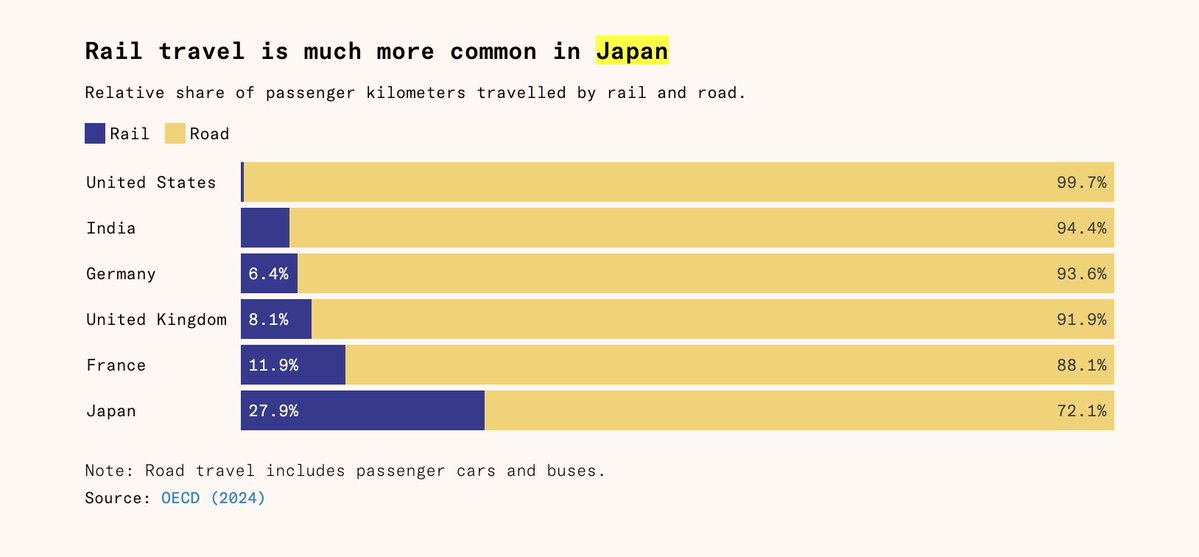
1) I agree that Japan has a great rail system. 2) But I have a quibble with this specific quote: "Just one Japanese company, JR East, carries more passengers than China’s entire railway system" It is true that JR East handles more rides per day than China Railways: ▪️ JR East ~16M rail passengers per day ▪️ China Railways avg. ~12.6M/day But this is not apples to apples. JR East includes not only Shinkansen (HSR) service but regional commuter rail (20-40 minute trips through the "Suica" zone in Tokyo). China Railway only provides long-distance (intercity) service. You can see this clearly in the average trip length: ▪️ JR East ~26 km per trip (blended mix of 15-25 km regional/commuter trips and ~250 km Shinkansen HSR trips) ▪️ China Railways avg. ~386 km per trip On a passenger-km basis, China Railways is ~12x larger than JR East. And China Railway is not China's "entire railway system". China has >50 local metro systems with rail operations that are administered independently of China Railway.
Samuel Hughes@SCP_Hughes

Japan has the world’s best railway system. 28% of Japanese passenger-kilometers are by rail. Germany manages 6.4%, and the USA manages 0.25%. Just one Japanese company, JR East, carries more passengers than China’s entire railway system, and four times as many than Britain’s. What is the secret of its success? worksinprogress.co/issue/why-japa… Part of the answer is that Japanese railway companies don't just operate trains. They run hospitals, supermarkets, department stores, amusement parks, office complexes, and retirement homes around their railway stations. One of them co-built Tokyo Disneyland. Another owns a baseball team. A third created its own all-women musical theater in 1914, which is still running today. The logic is elegant: a railway increases the developable value of land around its stations, but normally that value accrues to landowners, not the railway operator. Japanese railway companies captured this value by owning and developing the land themselves. About half of the revenue of Japanese railway companies comes from ‘side businesses’ like these. Allowing railway operators to capture more of the value they created meant that more lines were profitable, making a far larger system financially viable. This may sound like a radically novel approach. But in fact, an exactly similar system existed in nineteenth-century America. The success of Japanese railways does not lie in some unreplicable feature of Japanese culture: it lies in good policy. If they learnt the right lessons from it, many countries could replicate Japan’s success. Read more (much more) in @Borners1's & @carto_graph's new piece for @WorksInProgMag Issue 23.

English
28
119
1.2K
135K
Glenn
Glenn@GlennLuk·
@business Reminder that "hybrids" are basically ICE vehicles with regenerative braking systems. So Toyota is making a long-term bet on ICE in the U.S. here. cnbc.com/2025/11/18/toy…
English
3
1
11
2.4K
Glenn
Glenn@GlennLuk·
Just as the OPEC oil crises created an entry point for fuel-sipping Japanese sedans in the 1970s … … EV tech is creating an entry point for Chinese automakers in the 2020s. The disruptors of a half-century ago are now the ones most at risk of being disrupted themselves.
Glenn tweet mediaGlenn tweet media
English
5
70
281
69.8K
Glenn retweetledi
andrew chen
andrew chen@andrewchen·
why are spreadsheets the GOAT of no code tools? - unintimidating interface, just type numbers in a grid - easy to make something useful - shareable with a link - copy and make your own - insanely deep use cases (as a database, CRM, forecasting tools, etc) - finance team loves it, and they approve the budgets lol how many of these translate to agentic coding tools? - it's chat, could the UI be simpler? - you can build one-shot apps easily - insanely deep - share the output with a link - finance loves it as it gives more leverage and will cut SaaS costs There's more to do, but history rhymes. It has to be easier to share the code (not just the output), better management of forks, and more demonstration of operating leverage. But it's so powerful that it's inevitable agentic coding spreads as wall-to-wall as spreadsheets have And as I argued before, agentically coded apps I think will ultimately subsume spreadsheets completely. Maybe some will still want a grid UI, but underneath will be agentically created code
English
25
9
80
12.8K
Glenn
Glenn@GlennLuk·
@YanJian40647127 To make your point, you will need to articulate why you think long-distance/intercity and regional/metro services should roll up under a single administrative entity.
English
0
0
8
298
Samuel Hughes
Samuel Hughes@SCP_Hughes·
Japan has the world’s best railway system. 28% of Japanese passenger-kilometers are by rail. Germany manages 6.4%, and the USA manages 0.25%. Just one Japanese company, JR East, carries more passengers than China’s entire railway system, and four times as many than Britain’s. What is the secret of its success? worksinprogress.co/issue/why-japa… Part of the answer is that Japanese railway companies don't just operate trains. They run hospitals, supermarkets, department stores, amusement parks, office complexes, and retirement homes around their railway stations. One of them co-built Tokyo Disneyland. Another owns a baseball team. A third created its own all-women musical theater in 1914, which is still running today. The logic is elegant: a railway increases the developable value of land around its stations, but normally that value accrues to landowners, not the railway operator. Japanese railway companies captured this value by owning and developing the land themselves. About half of the revenue of Japanese railway companies comes from ‘side businesses’ like these. Allowing railway operators to capture more of the value they created meant that more lines were profitable, making a far larger system financially viable. This may sound like a radically novel approach. But in fact, an exactly similar system existed in nineteenth-century America. The success of Japanese railways does not lie in some unreplicable feature of Japanese culture: it lies in good policy. If they learnt the right lessons from it, many countries could replicate Japan’s success. Read more (much more) in @Borners1's & @carto_graph's new piece for @WorksInProgMag Issue 23.

Samuel Hughes tweet media
English
154
917
3.4K
645.2K
Glenn
Glenn@GlennLuk·
Japan is already at high levels of income and has the core maglev technology but has not been able to commercially support the huge investment required to increase average speed on its rail network from ~200-265 km/hr to ~500 km/hr (operational speed) under a maglev system. That is because you might only effectively shave off 15-20 minutes of time on heavily trafficked routes like Tokyo-Osaka (~515 km). But in China, there are intercity routes between huge cities like Beijing and Shenzhen where maglev could shave upwards of ~3 hours off the current 8-hour trip (on G trains). Judging by how much traffic there is between Beijing-Shanghai for a 4-5 hour rail trip gives you an idea of the potential traffic increase on the Beijing-Shenzhen route. Marginal reduction in transit times in Japan won't generate the incremental demand that you will see in China for higher-speed services.
English
1
4
35
3.4K
Glenn
Glenn@GlennLuk·
China is approaching levels of income/productivity that can support mass-market demand for 4-5 hour terrestrial intercity services between cities like Beijing and Shenzhen, even at construction costs that are an order-of-magnitude higher per km. x.com/GlennLuk/statu…
Glenn@GlennLuk

The commercial risk factor to jump straight into maglev “Ultra-HSR” without an existing lower-speed traditional HSR network will be much, much higher — likely to the point where you just would not expect it to be practical or feasible.

English
1
4
30
4.9K
Doge Xiaoping ☭
Doge Xiaoping ☭@DogeXiaoping·
@GlennLuk Am I understanding this wrong, or are you comparing chinese metro (excluding regional rail) to japanese metro + regional rail?
English
1
0
1
110