
Gabe Levine retweetledi
Gabe Levine
370 posts


Gabe Levine
@gllevine
Legal historian and fellow @policyintegrity, posting in a personal capacity
Katılım Nisan 2022
876 Takip Edilen367 Takipçiler

Gabe Levine retweetledi

Benhabib on Habermas: “Not only was the task of the philosopher, ‘sapere aude,’ to think for oneself, but the task of critique was to think through the times in which one lived… Habermas is the heir of this tradition.” the1313.law.columbia.edu/2026/03/15/sey…
English
Highly recommend @JakeAnbinder’s great piece in @TheAtlantic on Paul Ehrlich, which succinctly shows how scarcity fears drive baleful trends on left and right, while still showing why Ehrlich’s views seemed plausible. (Link below)
English
@RichardMRe The voters know best: the MQD rationale only got three votes!
English

Looking back at an old (obviously unscientific) poll:
Richard M. Re@RichardMRe
When will SCOTUS first use the major questions doctrine to strike down a regulation in the upcoming Trump administration?
English
Justice Gorsuch: “Only the written word is the law”
Also Justice Gorsuch: the major questions doctrine is extratextual and don’t you forget it.
English
@ProfSchleich @WilliamBaude @proffontana @RickPildes @RickHills2 @CSElmendorf I don’t dispute the bottom line, but it’s incongruous that the paper foregrounds a columnist’s criticisms of the Brown *opinion.* That suggests that opinions’ significance varies with politics and media. Perhaps the paper reflects our current polarization and fragmentation?
English

Justin Driver just dropped another must-read! The title says it all "The Insignificance of Judicial Opinions." static1.squarespace.com/static/640d661… @WilliamBaude @proffontana @RickPildes @RickHills2 @CSElmendorf
English
@OrinKerr I have found Claude Opus strikingly good at reasoning in light of broadly shared background knowledge. Stating specific facts about the world? Not so much.
English
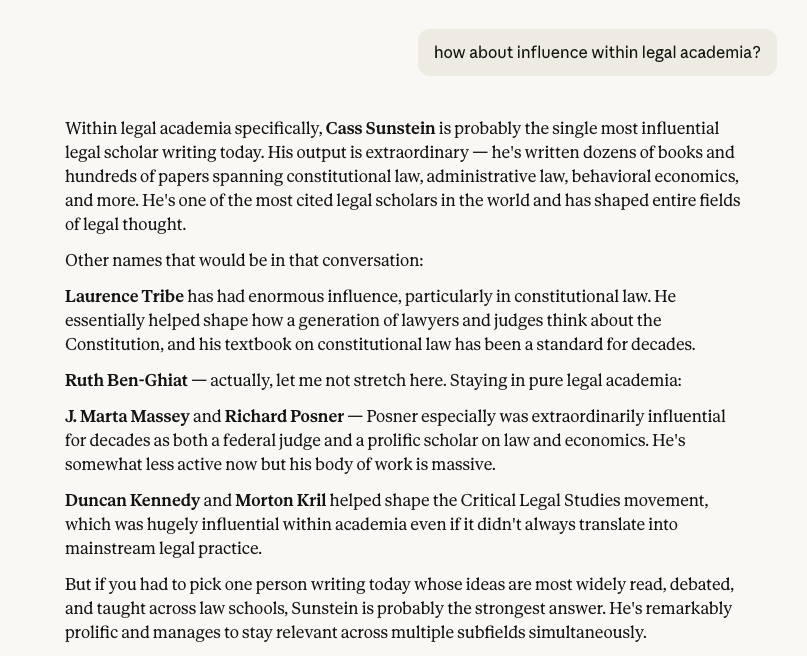
@AnthonyMKreis (3) I think a healthy scholarly culture can tolerate some litigation (within bounds; I do think it’s complicated). but I doubt a general prohibitive norm would do much to improve an unhealthy culture.
English
@AnthonyMKreis (2) the impulse to “hold back” is a real problem, but can arise in various ways from various sources (clerkship recs, scholactivism, peer pressure, etc.). I’m not sure litigation is the worst in this regard.
English

Work for folks who need representation isn’t a huge conflict of interest, like veterans navigating benefits or indigent lease-holders.
Academics have a duty to search for truth and better understand the world. Litigation is generally incompatible with the academic mission.
Jimmy Buffett Fan, Esq.@jimmy_esq
Setting aside that this rule appears gerrymandered to exempt academics in roles Kreis likes (what, e.g., is the justification for exempting pro bono work?), I struggle to see what the objective "truth" of the law is that most academics are seeking.
English
@AnthonyMKreis I’m 100% for scholarship-as-truth-seeking, but what you’re describing seems like a problem for scholars’ personal integrity, not for their scholarly integrity. Lots of complications, of course, but not sure I see the basis for a blanket, bright-line rule.
English
To put a finer point on it: if a prof takes on a constitutional case that has a historical argument, a good advocate might bury contrary evidence by de-emphasizing it or might be tempted to give it a less-nuanced gloss for the client’s benefit. That’s not what academics do.
English
@WilliamBaude @nytopinion If the removal power was debated with "ferocity" during the Jefferson, Jackson, and Johnson administrations (Bamzai & Shane), then how could there have been sufficient settlement to liquidate the constitutional question, as you seem to suggest?
English

Baude, Shaw, and Vladeck ride again:
From me: “If agencies didn’t effectively write our laws and try our cases, maybe we wouldn’t freak out so much about letting the president control them.”
nytimes.com/2025/12/09/opi… via @NYTOpinion
English
This is one of those passages that would have required revision (or deletion) if only an editor @nytimesbooks had raised an eyebrow.
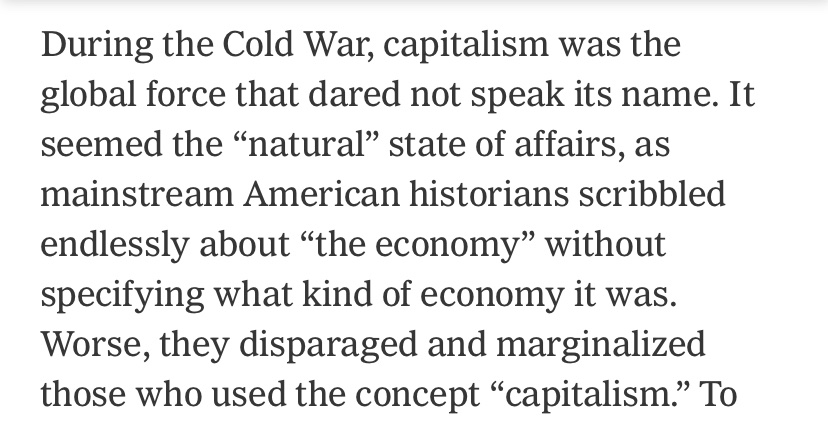
English
@OrinKerr I appreciate your legal commentary, but I’m still stuck here wondering why a crucible would be cold.
English

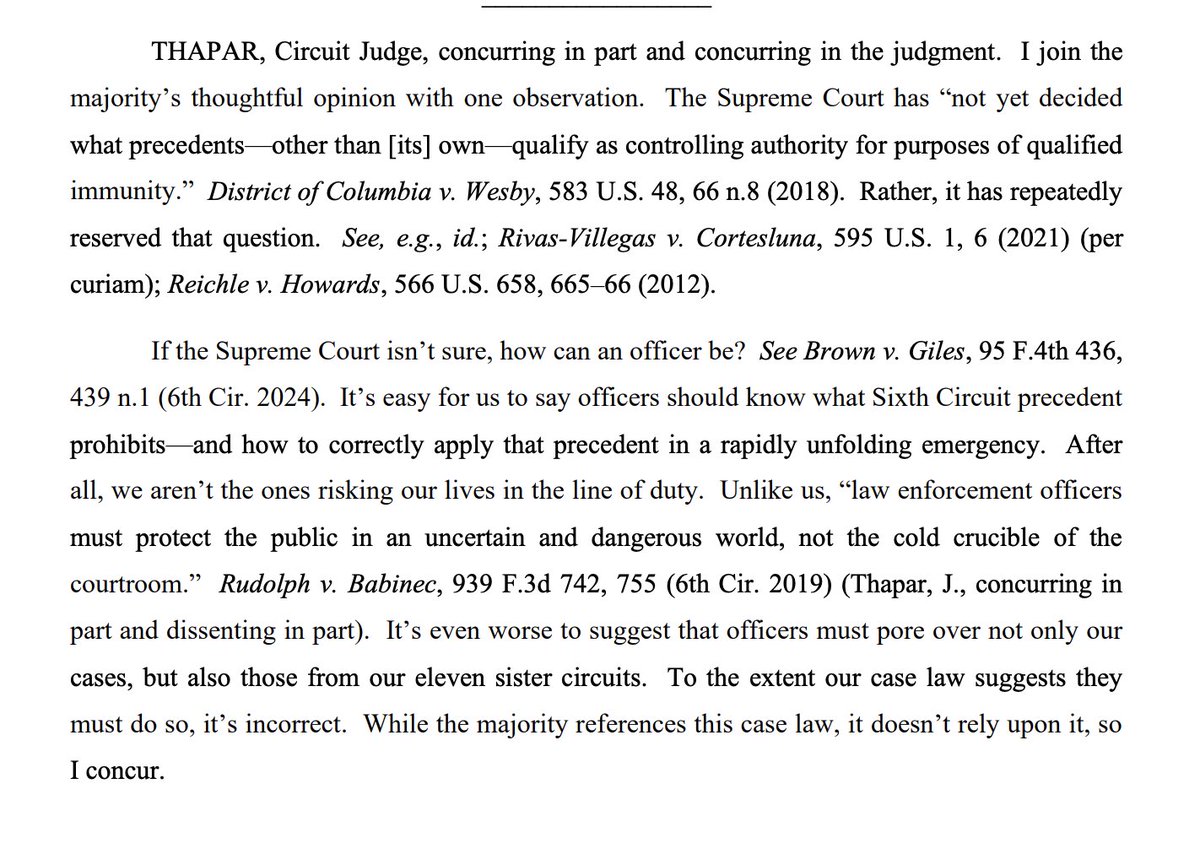
Judge Thapar, concurring: We can't expect officers to read circuit court opinions from other circuits to know what is clearly established law for QI purposes.
A few thoughts. 🧵
opn.ca6.uscourts.gov/opinions.pdf/2… #N
English
@BrianCAlbrecht I take it you’re saying there are tradeoffs in allocating gov’t resources to housing. But it doesn’t seem crazy to say that doing so might (sometimes) be more efficient than the current allocation of gov’t resources, even if still suboptimal. Or what am I missing?
English

@gllevine The government building doesn’t lower the cost of providing housing. It doesn’t shift the cost curve. It’s taking resources more resources from elsewhere make that less affordable
English
"The cost of living crisis"
I'm completely annoyed by this phrase.
It sounds like it means something but doesn't. Of course we want things to be affordable. No one debates that.
But what are we willing to trade-off? And how can we lower costs? Those are the questions
English
@BrianCAlbrecht Why does the real cost of building housing need to fall, rather than the real cost of providing housing? And if the latter makes housing more affordable, wouldn’t government housing construction lower the cost to the extent that it doesn’t substitute for private construction?
English
Why isn't that the same thing?
Because government building housing doesn't necessariy lower the real cost of building housing. By definition, we need to lower the real cost.
English
@RichardMRe I’d suspect the speed of realignment also reflects Sunstein’s old point that “injury in fact” is a misnomer. Misleading doctrinal formulations seem especially susceptible to change (or manipulation).
English
“The Standing Realignment,” a draft by Yoav Paz-Priel and myself.
Comments welcome! papers.ssrn.com/sol3/papers.cf…
English
@ErikHovenkamp For an interesting analysis along similar lines, see josephheath.substack.com/p/populism-fas…
English

Populism thrives on precisely this. An anecdote that sounds intuitive, but is in fact completely inapposite. But it takes time and effort to understand why.
The single biggest asset populism has is that most people don’t seriously scrutinize its assertions.
English