Sabitlenmiş Tweet
Christ Consciousness
92.2K posts

Christ Consciousness
@godinnumbers
Transformation ~Law of Love~ Tikkun Olam~ God Consciousness ~ Christ
Katılım Ağustos 2012
1.7K Takip Edilen1.8K Takipçiler

Should you have ever been curious about the history & story behind Purim, this a great feature to watch.
youtu.be/hL04qMd-hSo?is…

YouTube
English

@konstructivizm That's awesome information. Thank you for educating us.
English

Why Meteors Paint the Sky in Cosmic Rainbows
When a meteoroid screams into Earth’s atmosphere at a blistering 25,000 to 160,000 mph (40,000–257,000 km/h), it doesn’t just burn up — it puts on a spectacular light show. The object rams into air molecules so violently that it creates a superheated plasma envelope around itself, reaching thousands of degrees. This glowing cocoon energizes atoms from both the meteoroid and the atmosphere, causing them to emit light in signature colors.
Each chemical element has its own colorful fingerprint when excited:
Sodium* → bright *yellow**
Magnesium* → *blue-green**
Iron* → *yellow to gold**
Calcium* → *violet or reddish**
Silicon and oxygen* (common in stony meteoroids) → often contribute *white or orange**
Because most meteoroids are a jumbled mix of rock, metal, and minerals, many fireballs shimmer with multiple hues — shifting from green to red to gold as different layers ablate away.
This isn’t just beautiful — it’s scientific gold. Using spectroscopy, researchers can analyze the light in real time to decode the meteoroid’s exact chemical makeup. No need to chase fragments across the countryside; the colors tell the story directly.
These fleeting streaks are time capsules from the birth of the Solar System over 4.6 billion years ago. By studying their composition, scientists gain clues about the raw materials that built the planets, asteroids, and even the water that may have arrived on Earth.
Next time you spot a meteor, remember: you’re not just watching a rock burn — you’re seeing the glowing signature of ancient cosmic ingredients, briefly lighting up our sky like messages from the dawn of the Solar System

English


@konstructivizm Looks like a Kangaroo or Jack Rabbit with its solar plexus alight.
English

A stunning view from the James Webb Telescope ✨
This image captures the planetary nebula NGC 6537, also known as the Red Spider Nebula. Its exact distance is unknown; various sources cite figures ranging from 2,000 to 8,000 light-years.
Objects like this represent the future that awaits our Sun. Once it exhausts its hydrogen fuel, it will begin to expand, transforming into a red giant. Eventually, it will shed its outer layers, leaving behind only a bare core. Radiation from the core will ionize the surrounding material, causing it to glow and form a visible nebula—much like NGC 6537. This phase will not last long; in a few tens of thousands of years, the core will cool, and the nebula will dissipate.
In the case of NGC 6537, there is a possibility that its center harbors two stars rather than one. Hourglass-shaped nebulae of this kind often originate in binary star systems, though the existence of a companion star has not yet been confirmed.

English

License to Kill. That's exactly what it is. Psychopaths sign up & get paid take your angst out on others.
There will be Justice. In all ways.
youtu.be/tYDXLg30l8o?is…

YouTube
English


Christ Consciousness retweetledi

Adorable Flash
In need of a Hero
Another trembling, shaking scared dog
Who they will not mind killing
From the photos, you know Flash warms up
He just wants to feel safe
From his scar obviously his past was not
#FostersSaveLives
nycacc.app/#/browse/258526


Char Bolen@CharBolen
FLASH 🩵 #258526 2yr old Boy 🩵 Nycacc At Queens Acc for 10 days.. this is a beautiful young boy!! Dumped by owner he's of course heartbroken and very afraid 💔 Stays at the back of cage... outside he approaches handlers He needs TIME! #RescueOnly #Foster #Pledge4Rescue 🆘

English
Christ Consciousness retweetledi

Rumi
Sorrow prepares you for joy. It violently sweeps everything out of your house, so that new joy can find space to enter. It shakes the yellow leaves from the bough of your heart, so that fresh, green leaves can grow in their place. It pulls up the rotten roots, so that new roots hidden beneath have room to grow. Whatever sorrow shakes from your heart, far better things will take their place.
…nofloveandconsciousnessdivinityis.com/2026/07/rumi_0…

English
Christ Consciousness retweetledi

SCOOBY #A388048 1yo has been beaten up,but he holds no ill will,his big ❤️is still so full of love
If u give him a chance,he will love u like no other
Look at that precious face & those pleading eyes,NOW,go to #CorpusChristiACS & #Adopt or #Foster this wee😇
Plz #Pledge4Rescue

English

Christ Consciousness retweetledi

🕊️ On this day in 2024, Joe Bryant passed away.
A legendary player and coach who shaped basketball across the NBA and globally, Joe "Jellybean" Bryant left an indelible mark on the sport.
#OnThisDay
#RIP
#Sports
#JoeBryant

English

@DailyMail How on earth can someone so psychotic still be walking free among us.
English

Postman caught on camera kicking blind shih tzu 'like a football', with pet dying from organ failure trib.al/eOFloBO
English
Christ Consciousness retweetledi

The Sculptor Galaxy (NGC 253): A Starburst in Disguise 🌌
Meet one of the most dynamic galaxies in our cosmic neighborhood: NGC 253, known as the Sculptor Galaxy.
Lying just 11.4 million light-years away in the southern constellation Sculptor, it is the brightest and largest member of the Sculptor Group — the nearest galaxy group to our own Local Group. Viewed nearly edge-on, this large barred spiral looks deceptively calm at first glance… but it’s hiding a powerful secret.
A Starburst Galaxy in Full Bloom
Despite its elegant spiral appearance, NGC 253 is one of the most intensely star-forming large galaxies near us. It is classified as a starburst galaxy — a system where stars are being born at an extraordinary rate.
In visible light, you can already see a bright, mottled central region packed with star formation, crossed by dark dust lanes. But the real fireworks are revealed at other wavelengths:
Infrared**: Warm dust glows brightly, heated by thousands of young, massive stars.
Radio**: Intense emission from supernova remnants — the explosive deaths of those short-lived massive stars.
X-ray**: Superheated gas being blasted outward by the collective fury of countless supernovae.
The Superwind
The most dramatic feature is the superwind — a powerful outflow of gas and dust driven perpendicular to the galaxy’s disk by the relentless energy of the starburst. This wind launches filaments of hot gas thousands of light-years above and below the plane, visible in H-alpha and X-ray light.
It’s carrying heavy elements forged in supernovae out of the galaxy and into the surrounding intergalactic space — helping chemically enrich the universe itself.
A Perfect Cosmic Laboratory
Because it’s so close, NGC 253 offers astronomers one of the best opportunities to study feedback processes in galaxies: how intense star formation regulates itself by injecting energy and momentum into the surrounding gas, eventually slowing down or shutting off further star birth.
Beautiful, powerful, and incredibly active — the Sculptor Galaxy is a vivid example of how even “normal-looking” spirals can harbor extraordinary levels of cosmic violence and creation.
A starburst wearing a spiral disguise, just 11 million light-years from home.

English

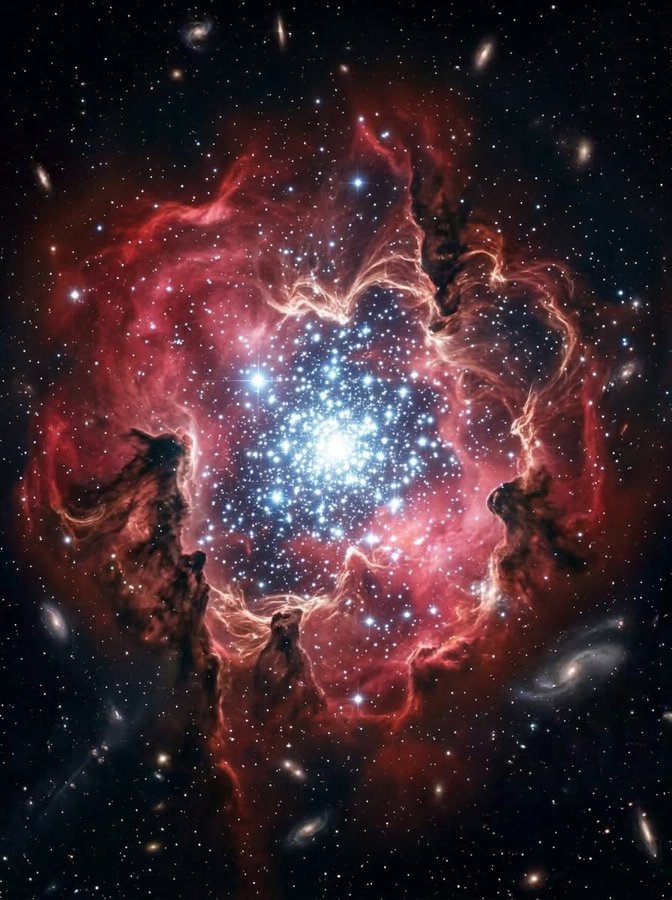
NGC 3603: The Milky Way’s Most Extreme Stellar Nursery
Deep in the Carina spiral arm, about 20,000 light-years from Earth, lies one of the most powerful star factories in our entire galaxy: NGC 3603.
This is not just another nebula — it is home to the most massive young star cluster known in the Milky Way. Here, a dense core of newborn stars blazes with unimaginable fury, including some of the heaviest stars ever discovered — titans exceeding 100 times the mass of the Sun. All of this cosmic drama unfolded in a single explosive burst of star formation just 1 to 2 million years ago.
A Blazing Heart That Reshapes Its Surroundings
The cluster’s hottest, most massive stars pour out ferocious ultraviolet radiation, carving out one of the largest H II regions in the galaxy. This ionized hydrogen glows with a vivid red-pink light — the unmistakable signature of hydrogen-alpha emission — creating a breathtaking nebula that surrounds the cluster like a glowing cradle.
At the turbulent edges where this intense radiation slams into cooler, neutral gas, something spectacular happens. Powerful stellar winds and radiation pressure sculpt the material into towering pillars and dark, dense globules. Far from destroying everything, this violence often triggers the next round of creation through radiation-driven implosion — compressing gas clouds until they collapse and form brand-new stars.
Bok Globules: Seeds of Future Suns
High-resolution images from the Hubble Space Telescope reveal dozens of Bok globules — small, cold, ink-black knots of molecular gas silhouetted against the brilliant pink nebula. These are the earliest visible stages of low-mass star formation. Inside each one, a new star (or small group of stars) is quietly preparing to ignite. In a few hundred thousand years, they will collapse under their own gravity and light up, continuing the cycle of stellar rebirth.
NGC 3603 is a perfect example of nature’s grand recycling program: the most massive stars live fast, die young, and in doing so, both destroy and create — sculpting the galaxy while seeding the next generation of suns.
It is one of the closest and most spectacular laboratories we have for studying how the universe builds its biggest, brightest, and most influential stars. A place where the cycle of cosmic life and death plays out on a breathtaking scale

English