govind ram

4.9K posts

govind ram banner
govind ram

govind ram

@govindrams

Co-Founder, Group CEO- https://t.co/ebpZnPKMYv - Africa, dreamer, animal lover, an eternal optimist. Tyre & Car care business in Africa.

Durban, South Africa Katılım Ekim 2009
3.5K Takip Edilen7K Takipçiler
govind ram retweetledi
Mario Nawfal
Mario Nawfal@MarioNawfal·
🇺🇸The Super Guppy is basically the world’s weirdest cargo plane. It’s the only aircraft ever built that could carry the entire 58-foot-long 3rd stage of the Saturn V moon rocket in one piece. Absolute flying whale.
English
63
233
1.7K
135.9K
govind ram
govind ram@govindrams·
This Belgian Malinois is on another level 🔥 Smartest dog I’ve seen all year! Watch him nail every crazy command — from “put out your weapon” to fetching the ball from the drawer 😂🐾 Absolute genius pup! #BelgianMalinois #SmartDog #DogTraining
English
0
0
0
179
govind ram
govind ram@govindrams·
Antelope vs Crocodile in the river… this escape is next level! 🐊💨
English
0
1
1
147
govind ram retweetledi
Mario Nawfal
Mario Nawfal@MarioNawfal·
Elon on natural laws: “Physics is the law and everything else is a recommendation. Being wrong results in failure when dealing with physical objects. Rockets blow up. Cars fail.” No participation trophies in engineering. @elonmusk x.com/ElonClipsX/sta…
English
41
72
480
49.8K
govind ram retweetledi
Mario Nawfal
Mario Nawfal@MarioNawfal·
🇨🇳 China went from dominating chips to disrupting fashion. A Chinese company just revealed fabric that stretches dramatically, holds its shape, and doesn't wrinkle, and it might change how everyday clothes are made.
English
395
1.6K
10K
924.6K
govind ram
govind ram@govindrams·
Zhou Qunfei's story is truly inspiring. 👌👌 At this U.S. visit to China dinner banquet, the most eye-catching figure in the prime centre seat between Musk and Cook was Lens Technology founder Zhou Qunfei - from a rural factory girl to China's richest woman, with absolutely no background to rely on, building everything from scratch through her own grit. She was born in a small village in Hunan Province. At age 5, her mother passed away, and her father became disabled and blind from a work injury, leaving the family in dire poverty with nothing to their name. At 16, unable to afford school fees, she was forced to drop out and head to Guangdong to work in a factory, grinding glass on the assembly line - working days away during the day and furiously self-studying at night, earning certifications in accounting, computer operations and other skills. That's how she spent a few years, until she scraped together 20,000 yuan from her wages, rallied eight relatives, including her brother, sister, sister-in-law, and brother-in-law, and started a small workshop in Shenzhen, doing watch glass processing. She handled machine repairs and sales runs single-handedly, grinding away like that for another four years. By the 2000s, the mobile phone industry began booming on a massive scale. By a stroke of luck, her watch glass factory landed an order for TCL phone screens. She spotted the huge potential in the phone glass market and quickly founded Lens Technology, specialising in the production, R&D and sales of phone glass. At first, they only handled domestic phones and knockoffs, but everything changed when she went after a Motorola order - foreign companies had extremely strict quality standards. She bet nearly all her resources to meet Motorola's demands and snagged the V3 order, which sold over 100 million units worldwide, catapulting Lens Technology straight to industry leadership. From there, she smoothly secured deals with Nokia, Samsung, and other foreign giants. The pivotal turning point came again in 2007, when Jobs unveiled the first iPhone, revolutionising phones with full-glass touchscreens. Jobs's obsessive craftsmanship demands left the whole world scrambling for a supplier that could meet them. Zhou Qunfei keenly sensed this was another massive opportunity, so she led her team in a three-month joint push with Apple engineers, breaking through key processes to mass-produce the first-generation iPhone glass panels. That locked in a long-term Apple contract, and soon after, nearly all Apple gear - from iPads to MacBooks - went to Lens Technology for production. It also propelled Lens to become the world's top player in touch glass panels. That's why she got to sit next to Cook. But why was Musk right there beside her, too? After dominating the global glass panel market, Lens Technology branched into a broader range of smart devices, including car cockpits and robots. In autos, they've already locked in deals with 30 carmakers, including Tesla, BMW, Mercedes, and Li Auto, for windows, centre consoles, and more. In robotics, they handle joints, sensors, and other components - areas with deep overlap in Musk's businesses. A girl who dropped out at 15 with just a junior high diploma, emerging from rural Hunan to build an empire from nothing and become China's richest woman, forty years later, stepping into U.S-China talks, seated between Musk and Cook. That's Zhou Qunfei's story.
govind ram tweet media
English
0
0
2
84
govind ram
govind ram@govindrams·
🌿 Mizoram, the Jewel of Northeast India, is setting a shining example! From the lush hills of Aizawl to every village, this state boasts incredible cleanliness, community spirit & zero litter vibes. Proud of Mizoram for showing how beautiful a clean India can be! 💚 #Mizoram #CleanIndia #NortheastIndia
English
0
0
0
63
govind ram
govind ram@govindrams·
🚨 Important Alert for Everyone Managing Diabetes: The HbA1c Blind Spot! HbA1c is a common test to check average blood sugar over 2-3 months, but it’s not always reliable. Certain conditions can make the results falsely high or low, leading to wrong treatment decisions. Key Conditions That Distort HbA1c: •Anemia (especially iron, B12, or folate deficiency) → Red blood cells live longer → Falsely high HbA1c. •Chronic Kidney Disease → Can cause anemia + affect glucose → Misleading readings (sometimes falsely low). •Hemoglobin variants or conditions like hemolytic anemia, spleen removal → Red blood cells turn over faster/slower → Falsely low or high results. •Others: Pregnancy, recent blood loss, or hemoglobinopathies. Real Risk: You might think your sugar is controlled (or uncontrolled) when it’s not. This can delay proper care or lead to unnecessary medicines. Expert Advice (Dr. Santosh Kumar Agrawal): •Don’t rely on HbA1c alone. •Always combine it with fasting/post-meal blood sugar tests or Continuous Glucose Monitoring (CGM). •Tell your doctor about anemia, kidney issues, or other conditions for correct interpretation. Takeaway Message:
HbA1c is useful but not perfect. Know its limitations and get a fuller picture of your blood sugar. Share this with friends/family managing diabetes — it could prevent serious complications! 💡
English
0
0
0
57
govind ram
govind ram@govindrams·
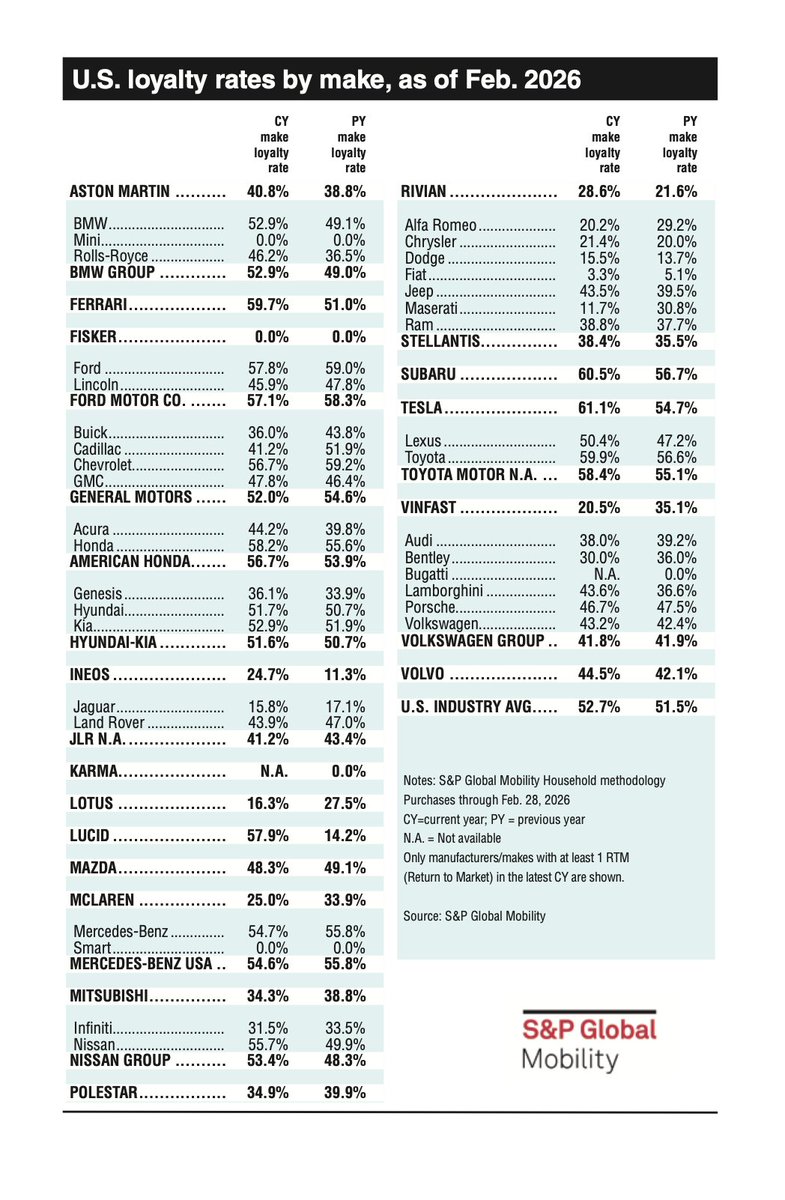
Why does this matter? • High loyalty (like Tesla, Subaru, Toyota) usually means strong customer satisfaction, good ownership experience, strong brand image, or products that meet expectations well. • Lower loyalty can indicate more switching to competitors — sometimes due to pricing, new features elsewhere, service issues, or simply because the buyer wants something different next time.
English
0
0
1
202
Whole Mars Catalog
Whole Mars Catalog@wholemars·
U.S. loyalty rates by make, February 2026 1. Tesla — 61.1% 2. Subaru — 60.5% 3. Toyota — 59.9% 4. Ferrari — 59.7% 5. Honda — 58.2% 6. Ford — 57.8% 7. Lucid — 57.9% 8. Chevrolet — 56.7% 9. Nissan — 55.7% 10. Mercedes-Benz — 54.7% 11. BMW — 52.9% 12. Kia — 52.9% 13. Hyundai — 51.7% 14. Lexus — 50.4% 15. Mazda — 48.3% 16. GMC — 47.8% 17. Porsche — 46.7% 18. Rolls-Royce — 46.2% 19. Lincoln — 45.9% 20. Volvo — 44.5% 21. Acura — 44.2% 22. Land Rover — 43.9% 23. Lamborghini — 43.6% 24. Jeep — 43.5% 25. Volkswagen — 43.2% 26. Cadillac — 41.2% 27. Aston Martin — 40.8% 28. Audi — 38.0% 29. Ram — 38.8% 30. Buick — 36.0% 31. Genesis — 36.1% 32. Mitsubishi — 34.3% 33. Polestar — 34.9% 34. Infiniti — 31.5% 35. Bentley — 30.0% 36. Rivian — 28.6% 37. McLaren — 25.0% 38. INEOS — 24.7% 39. Chrysler — 21.4% 40. Alfa Romeo — 20.2% 41. VinFast — 20.5% 42. Lotus — 16.3% 43. Jaguar — 15.8% 44. Dodge — 15.5% 45. Maserati — 11.7% 46. Fiat — 3.3% 47. Mini — 0.0% 48. Smart — 0.0% 49. Fisker — 0.0%
Whole Mars Catalog tweet media
Eesti
895
784
4.9K
28.8M
govind ram
govind ram@govindrams·
Why do South Indian languages look so curvy & artistic, while North Indian ones look straight & structured? Even though they all come from the same ancient Brahmi script! The surprising answer? It’s all because of plants 🌿 Watch this 👇
English
0
0
1
56
govind ram retweetledi
Jaynit
Jaynit@jaynitx·
Marc Andreessen on Elon Musk: "Every week he identifies the biggest problem and fixes it. That's 52 problems solved per year." "He has an operating method that is very unusual by modern standards. I'm not aware of another current CEO who operates the way that he does. And I think probably the single biggest question in all of business right now is... why don't more CEOs operate the way that he does?" Andreessen explains: "If you go back in history, you find characters more like him. The industrialists of the late 1800s, early 1900s... Henry Ford, Andrew Carnegie, Thomas Watson who built IBM." On what makes Musk different: "The top-line thing is this incredible devotion from the leader of the company to fully, deeply understand what the company does. To be completely knowledgeable about every aspect of it. To be in the trenches, talking directly to the people who do the work. Deeply understanding the issues. Being the lead problem solver in the organization." The method: "Basically what Elon does is he shows up every week at each of his companies. He identifies the biggest problem the company is having that week... and he fixes it. Then he does that every week for 52 weeks in a row. And then each of his companies has solved the 52 biggest problems that year." On everyone else: "Most other large companies are still having the planning meeting for the pre-planning meeting for the board meeting for the presentation... with the compliance review and the legal review. It's this level of incredible intellectual capability coupled with incredible force of personality, moral authority, execution capability, focus on fundamentals... that is just really amazing to watch." On why top talent wants to work with him: "The side effect is he attracts many of the best people in the world to work with him. Because if you work with Elon... the expectations are through the roof in terms of your level of performance. He is going to know who you are. He is going to know what you've done. He is going to know what you've done this week. He is going to know if you're underperforming. And he may fire you in the meeting if you're not carrying your weight." But for those who match his commitment: "If you are as committed to the company as he is and working hard... many people who have worked for him say they had the best experience of their lives." On delegation... and the bottleneck: "Most CEOs have a problem knowing when to delegate. The Elon method is a little bit different. He actually delegates almost everything. He's not involved in most of the things his companies are doing. He's involved in the thing that is the biggest problem right now... until that thing is fixed. Then he doesn't have to be involved anymore. Then he can go focus on the next thing that's the biggest problem." Andreessen uses a manufacturing analogy: "In any manufacturing chain, there's always a bottleneck. Something keeping the line from running the way it's supposed to. Sometimes the bottleneck is at the beginning... we can't get enough raw material. Sometimes it's at the end... we don't have enough warehouses. Or it might be somewhere in the middle. Whatever the bottleneck is... is holding everything up. Job number one is to remove that bottleneck and get everything flowing again." Musk universalized this: "He looks at every company like it's some sort of conceptual assembly line... sometimes a literal assembly line making cars and rockets. Any given week, there's guaranteed to be one main bottleneck. One thing holding people back." The resolution: "I'm going to micromanage the solution of that. I don't need to manage everything else... because everything else, by definition, is running better than that. So I can go focus on that." On going directly to the source: "When he identifies the bottleneck, he goes and talks to the line engineers who understand the technical nature of the bottleneck. If it's people on a manufacturing line, he's talking to people directly on the line. If it's a software development group, he's talking to the people actually writing the code." What he doesn't do: "He's not asking the VP of engineering to ask the director of engineering to ask the manager to ask the individual contributor to write a report... to be reviewed in three weeks. He doesn't do that. He goes and personally finds the engineer who actually has the knowledge about the thing. Then he sits in the room with that engineer and fixes the problem with them." Andreessen explains why this inspires loyalty: "The technical people who work with him are like... wow, if I'm up against a problem I don't know how to solve, freaking Elon Musk is gonna show up in his Gulfstream and sit with me overnight in front of the keyboard or in front of the manufacturing line and help me figure this out." He asks: "If you're a normal CEO running a normal company... how can you possibly compete with that?" On why other CEOs don't do this: "It's the way management is taught. Most classically in something like Harvard Business School or Stanford Business School. It's management as it was developed in the 1950s, 60s, 70s... the so-called scientific school of management." He describes it: "Management as a generic skill you can apply to any industry. You could manage a soup company or a car company... they're kind of all the same. There's a common set of management practices. It's process. How to manage the balance sheet. How to set the review schedule for meetings. How to do compliance. How to hire and motivate executives. How to resolve interpersonal conflicts. All these general business skills." The problem: "Those general business skills are very useful in lots of contexts. But that training gives you none of what you need to go do what Elon does." Andreessen concludes: "Elon pushes as far as he can... not doing all the stuff you're classically trained to do... so that he can spend all of his time doing the things only he can do. And it turns out that has this incredible catalytic, multiplicative effect. His companies are just incredibly amazing."
English
10
117
439
37.6K
govind ram retweetledi
Nic Cruz Patane
Nic Cruz Patane@niccruzpatane·
Everyone is going to want a ~$30K Tesla Cybercab when it becomes available, they just don’t know it yet. • Much safer than human driving. • No steering wheel or pedals. • Have the ability to legally sleep as it’s driving you to your destination. • Two-seater design, with tons of legroom • Great for elderly individuals who are no longer able to drive, as well as people with disabilities. • Work as are you being driven, or watch movies/play games. • Send off to run errands (pick up kids, pick up someone at the airport, etc). • The ability to add/subtract from the Tesla Robotaxi fleet to earn passive income. • You could buy a fleet and run your own business. • Send to pick up groceries, or other orders. • Have the ability to send home after getting dropped off your location, eliminating the need for parking. • Send for service autonomously when needed. • Autonomous Home Delivery • Virtually Zero Maintenance • $0.20 or less per mile operating costs • Wireless charging capabilities with well above 90% efficiency. This car will revolutionize the transportation industry and car ownership.
English
1.1K
1.3K
9.9K
998.7K
govind ram retweetledi
Adams
Adams@Adams_Tech_AI·
Tesla Optimus could change the global economy forever. The first company to scale humanoid robots wins the future of labor. Cars were just the beginning.
English
143
351
1.6K
131.8K
govind ram retweetledi
Ajay Joe
Ajay Joe@joedelhi·
Left behind in Kabul. Alone. He waited 47 days. K-9 Chaos was not a dog who did his job. He was a dog who had DECIDED, completely, permanently, without reservation, that Lieutenant Marcus Webb was coming back for him. No matter how long it took. At Hamid Karzai International Airport, Kabul, on the morning of August 30th, 2021, a three-year-old Belgian Malinois sat in an empty aircraft hangar. The last American plane had left six hours ago. The evacuation was over. Chaos had been left behind. Not intentionally. The chaos of the withdrawal. The panic. The rush. Webb had been separated from Chaos during the final evacuation. Put on a different plane. Told Chaos would be on the next flight. There was no next flight. Chaos survived the first day alone. Waiting at the hangar where Webb had left him. Chaos survived the first week. Scavenging food from abandoned military supplies. Chaos survived 47 days in Taliban-controlled Kabul. Alone. Hiding. Waiting. Because Chaos survived on the belief that Webb wouldn't leave him forever. Back in the United States, Webb was losing his mind. Filed reports. Called congressmen. Contacted rescue organizations. Went on the news. "I left my dog in Afghanistan," he said on CNN, his voice breaking. "I left my brother. And I'm going to get him back." The military said it was impossible. Kabul had fallen. Taliban controlled the airport. No way to extract a dog. Webb didn't care about impossible. He contacted Pineapple Express, a veteran-run extraction operation. Gave them Chaos's last known location. Sent photos. Videos. Anything that could help. For 47 days, Webb didn't sleep. Didn't eat properly. Just waited for news. On October 16th, 2021, his phone rang. "We found him," the voice said. "We found Chaos." A rescue team had infiltrated Kabul. Used Webb's intel. Found Chaos still at the hangar. Still waiting. Forty-seven days later. Chaos was emaciated. Dehydrated. Traumatized. But alive. The extraction took three days. Smuggling Chaos out of Taliban-controlled territory. Through checkpoints. Through danger. But they got him out. On October 19th, 2021, Chaos landed at Dulles International Airport. Webb was waiting on the tarmac. When they opened the crate, Chaos didn't move. Stared at Webb like he was seeing a ghost. "It's me, brother," Webb said, kneeling down. "I came back. I promised I'd come back." Chaos stepped out slowly. Walked to Webb. Collapsed into his arms. The reunion video went viral. Seventeen million views in three days. But what people didn't see was what happened after. For six months, Chaos wouldn't sleep unless Webb was in the room. Wouldn't eat unless Webb fed him. Wouldn't go outside unless Webb went first. "He's terrified I'll leave him again," Webb said in an interview. "And I don't blame him. I left him once. In the worst place. At the worst time. He waited 47 days for me. And I'll spend the rest of my life making sure he knows I'm never leaving again." Three years later, Chaos still sleeps with his head on Webb's chest. Still follows him everywhere. Still making sure Webb doesn't disappear. K-9 Chaos. Survived 47 days alone in Kabul. Extracted by heroes. Reunited with his handler. Home. facebook.com/share/1HLX9dCv… #LostAndFound #doglover #seniordogs #animalwelfare #militarydog #k9hero #dogrescue #Kabul #47Days #LeftBehind #BroughtHome
Ajay Joe tweet media
English
1.5K
9.6K
44.3K
1M
govind ram retweetledi
Shanaka Anslem Perera ⚡
Shanaka Anslem Perera ⚡@shanaka86·
JUST IN: Japan just placed the first order for the post-human economy. Not a policy paper. Not a committee report. An actual deployment of Chinese-made humanoid robots to handle baggage at the busiest airport in the world's third-largest economy, starting next month. On April 27, Japan Airlines and GMO AI and Robotics announced that Unitree G1 humanoid robots will begin a demonstration trial on the tarmac at Tokyo's Haneda Airport in May 2026. The robots stand 132 centimeters tall, weigh 35 kilograms, cost $13,500, and were manufactured in Hangzhou, China. They will be tested pushing cargo containers onto conveyor belts, moving luggage, and coordinating with human handlers. Two units go first. GMO Internet Group has formally designated 2026 as the "First Year of Humanoids." The trial runs through 2028 with plans for permanent integration if successful. Everyone is covering this as a technology story. It is a dependency story. And the dependency runs in the opposite direction from every assumption the market holds about the US-China technology war. Japan invented industrial robotics. Fanuc, Yaskawa, Kawasaki. For four decades, Japanese factories exported automation to the world. Now Japan is importing humanoid labor from China because its domestic humanoid industry has not scaled fast enough to meet the demographic emergency. The Unitree G1 was designed in Hangzhou, trained using Nvidia Isaac Simulator, and costs less than five months of a Japanese ground handler's annual salary. The country that built the global robotics industry is now a customer of China's. The numbers are structural. Japan recorded 42.7 million inbound tourists in 2025 and 7 million in the first two months of 2026. Haneda processes over 60 million passengers annually. Ground handling staff shortages have hit 20%. Japan may need 6.5 million foreign workers by 2040, but political pressure to limit immigration is mounting. The country is caught between a demographic wall and a political wall, and the only passage between them is a 132-centimeter robot from Hangzhou. Mo Gawdat said labor arbitrage disappears when you can hire a robot for less than a human. Japan just converted that thesis into a procurement decision. A Unitree G1 costs $13,500. A Haneda ground handler earns $35,000 to $45,000 per year before benefits. The robot runs approximately two hours per charge, but it does not age, emigrate, or quit. Japan is not adopting humanoids because they are better. It is adopting them because it has run out of humans. Here is the dependency inversion nobody is pricing. In March 2026, the US Senate introduced a bipartisan bill banning Chinese-made robots from government use. Japan, America's most critical Pacific ally, is importing those same robots for airport infrastructure. The chips are Nvidia. The bodies are built in Hangzhou. This is not hypothetical. In April 2025, Beijing restricted rare earth magnet exports and Musk confirmed the restrictions delayed Tesla Optimus production. If Beijing applies the same lever to humanoid exports, Japan's demographic solution becomes a supply-chain crisis overnight. The first humanoid robot will push its first cargo container at Haneda in May. It costs less than a used Toyota. It was made by a country America is trying to contain. And it will do a job no Japanese citizen is willing to do anymore. That is not a technology trial. That is the future of labor arriving at gate 23.
English
19
130
314
56.4K
govind ram
govind ram@govindrams·
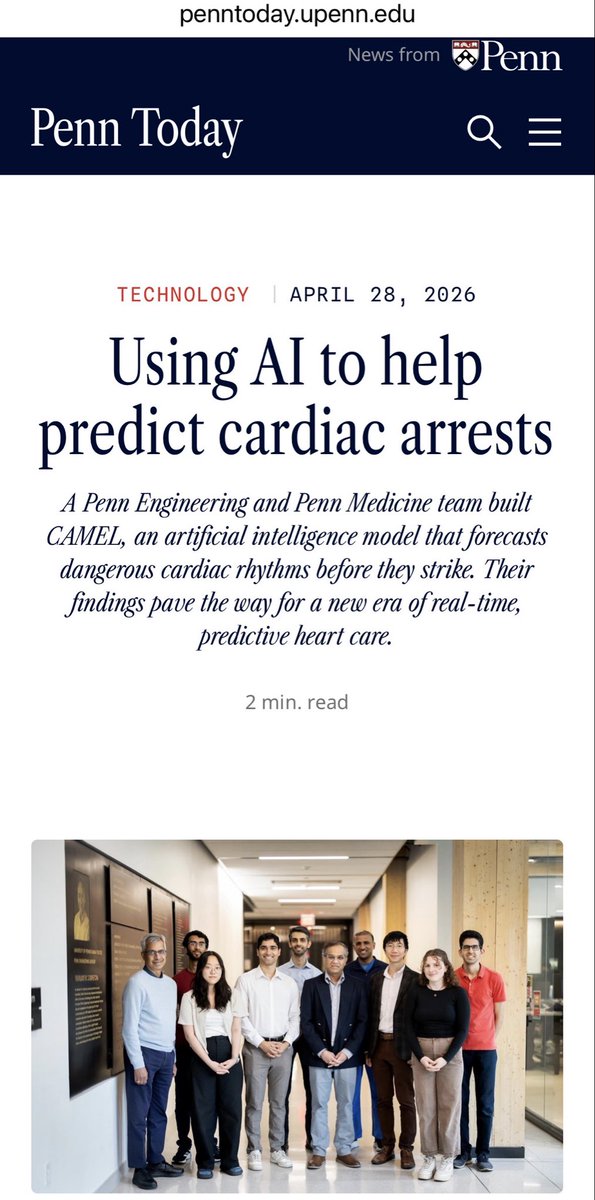
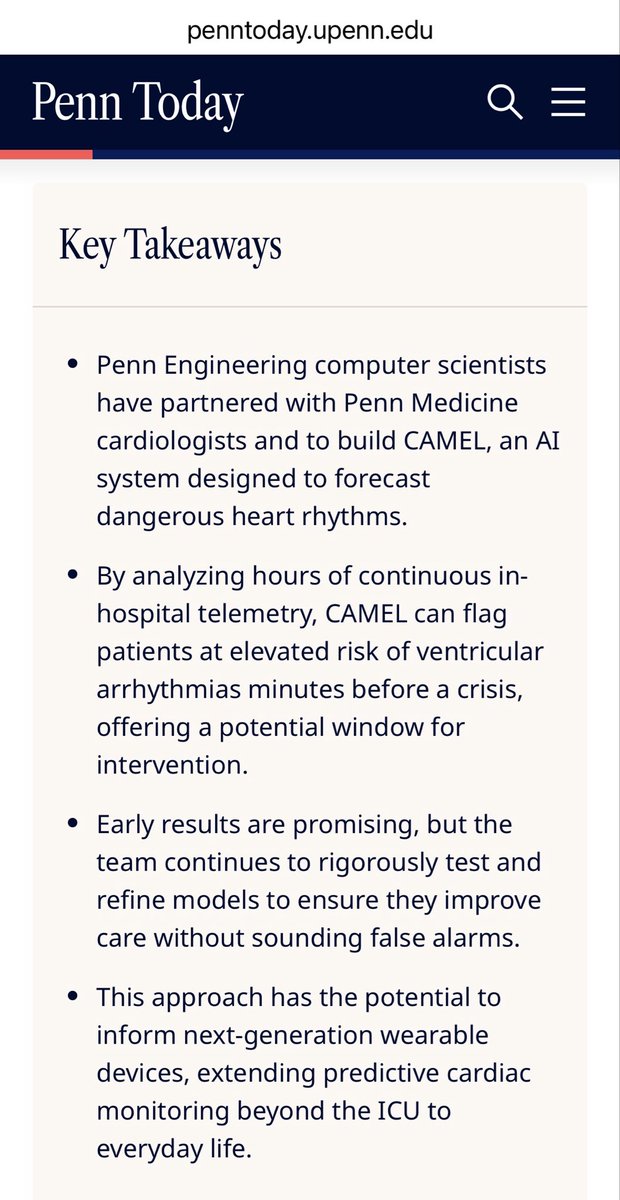
Big news from Penn Medicine: AI that can predict dangerous heart rhythms 10-15 minutes in advance! Cardiologist Dr. Rajat Deo has spent nearly 20 years studying ECG data — the rich but mostly wasted electrical traces of the heart that hospitals generate every second. Now, he’s teaming up with computer scientist Dr. Rajeev Alur and a brilliant cross-disciplinary team to change that. They created CAMEL (Cardiac Autoregressive Model for ECG Language-Modeling) — an AI that treats heart rhythms like language. Instead of just spotting problems after they happen, CAMEL reads long streams of ECG data (hours at a time) and learns to forecast what’s coming next. It picks up subtle patterns in normal-looking rhythms that could signal serious arrhythmias or cardiac arrest — turning faint warning signs into lifesaving early alerts. The model even combines ECG waveforms with clinical notes, reasoning more like a doctor than a traditional algorithm. Real-world impact? •Fewer false alarms at 2 a.m. •Better use of hospital resources •Huge potential for consumer wearables in the future This is what happens when clinicians who understand the problem walk across the street to work with engineers who know how to solve it. Huge respect to the full team and supporters (ARPA-H, NIH, AWS, etc.). The future of cardiology is predictive — and it’s already here at Penn. What do you think — ready for AI to help guard your heart? #AIinMedicine #Cardiology #HealthTech #PennMedicine
govind ram tweet mediagovind ram tweet media
English
0
1
12
340
govind ram retweetledi
James Wood 武杰士
James Wood 武杰士@commiepommie·
Have to say, "I love the headline!" 🤣
James Wood 武杰士 tweet media
English
89
956
6.2K
134.7K
govind ram retweetledi
Ryan Milton 弥瑞恩
Ryan Milton 弥瑞恩@1860rm·
First night in Shanghai! I have wanted to take the maglev train for years! 300km/h is not bad and it’s smooth! 7 minutes for $7. That beats 45minutes! Maglev was originally conceived of by Robert Goddard in the USA in 1904. The Germans built it but this is the only commercial version to my knowledge.
Ryan Milton 弥瑞恩 tweet media
English
33
64
459
39K
govind ram retweetledi
Yasir Ai
Yasir Ai@AiwithYasir·
🚨Architects are going to hate this. Someone just open sourced a full 3D building editor that runs entirely in your browser. No AutoCAD. No Revit. No $5,000/year licenses. It's called Pascal Editor. Built with React Three Fiber and WebGPU -- meaning it renders directly on your GPU at near-native speed. Here's what's inside this thing: → A full building/level/wall/zone hierarchy you can edit in real time → An ECS-style architecture where every object updates through GPU-powered systems → Zustand state management with full undo/redo built in → Next.js frontend so it deploys as a web app, not a desktop install → Dirty node tracking -- only re-renders what changed, not the whole scene Here's the wildest part: You can stack, explode, or solo individual building levels. Select a zone, drag a wall, reshape a slab -- all in 3D, all in the browser. Architecture firms pay $50K+ per seat for BIM software that does this workflow. This is free. 100% Open Source.
English
176
1K
6.1K
584.5K