The GreenWave

3.7K posts

The GreenWave banner
The GreenWave

The GreenWave

@GreenWaveMJ

"We read between the lines, connect the dots & ask the probing questions ". Bear Stearns (II "All America" ranked team) , Cowen, First Union Sec

New York, NY Katılım Aralık 2014
1.3K Takip Edilen2.1K Takipçiler
The GreenWave
The GreenWave@GreenWaveMJ·
@stevep9903 Schedule III though timing unknown. Also, I believe it is a prelude to eventual descheduling.
English
1
0
3
40
Chuck Schumer
Chuck Schumer@SenSchumer·
One second, Trump is the “Peace President.” The next, he’s dragged us into war. And his address tonight? It doesn’t matter. His words are meaningless—he says what’s convenient, then does the opposite. This is how you burn trust, risk lives, and lead our country into chaos.
English
794
421
1.2K
46.2K
The GreenWave
The GreenWave@GreenWaveMJ·
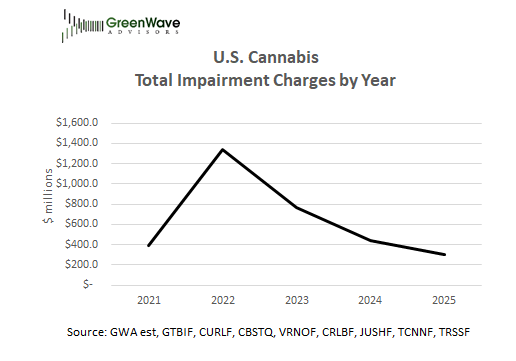
As the chart shows, 2022 was the peak year for impairment charges. Is the worst behind us? I'd bet yes (assuming federal reform) . $MSOS $GTBIF $CURLF $CRLBF $JUSHF $AAWH $TRSSF $VRNOF $TCNNF 162
The GreenWave tweet media
English
0
0
11
913
The GreenWave
The GreenWave@GreenWaveMJ·
As suggested in February's "GreenWave Buzz", the Trump Administration priorities bode well for Cannabis reform. Priority: National Security Issue: Drug Cartels (CCP/Mexican) and vicious transnational gangs are infiltrating our streets. Solution: Designate drug cartels and transnational gangs as Foreign Terrorist Organizations and empower law enforcement to arrest and deport. Impact on Cannabis: Decreases supply of the illicit market which mitigates price compression and leads to revenue growth. The read through on this - actions speak louder than words. This is another step in the right direction as it relates to cannabis reform. Revenue growth = multiple expansion = higher valuations. $MSOS $GTBIF $CURLF $CRLBF $JUSHF $AAWH $TRSSF $VRNOF $TCNNF marijuanamoment.net/trump-admins-w…
English
1
2
12
618
The GreenWave
The GreenWave@GreenWaveMJ·
Another incremental positive ..
R A W S A L E R T S@rawsalerts

🚨#BREAKING: Starting April 20, 2026, the U.S. Army will raise the maximum enlistment age from 34 to 42 years old and remove the waiver requirement for individuals with a single prior conviction for marijuana possession.

English
0
0
0
321
Chuck Schumer
Chuck Schumer@SenSchumer·
ICE needs to leave the airports NOW. Trump needs to pay TSA workers NOW, and push Republicans to reach a deal. No intimidation forces at our airports. No more chaos at checkpoints. Enough is enough.
English
5.8K
428
2.3K
280.8K
Anthony Varrell
Anthony Varrell@V_arrell·
This is giving me flashbacks of the Origin House acquisition. Yikes.
The GreenWave@GreenWaveMJ

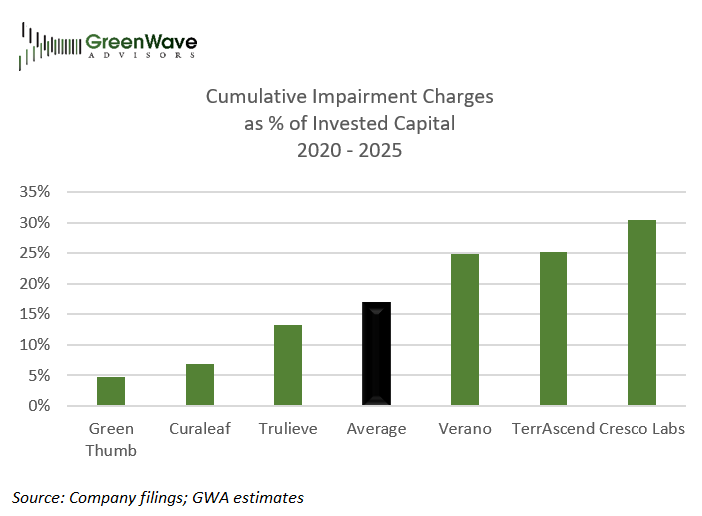
Across 2020–2025, the #cannabis industry experienced repeated waves of goodwill + asset impairments due to: 1.) Overpriced acquisitions during the 2018–2021 bubble 2.) Slower-than-expected legalization 3.) Price compression 4.) Overcapacity (greenhouses, cultivation assets) 5.) Declining market caps → forced accounting write-downs 👉 The sector has transitioned from overexpansion → balance sheet repair. The following chart illustrates the cumulative impairment charges (2020 - 2025) as a % of invested capital for the top MSOs. Again, @GTIGrows is the leader having written off only 5% of invested capital defined as equity + debt - cash (at peak level). More on this topic in an upcoming GreenWave Buzz subscribe at greenwaveadvisors.com $MSOS $GTBIF $CURLF $CRLBF $JUSHF $AAWH $TRSSF $VRNOF $TCNNF
English
5
0
8
3.6K
The GreenWave
The GreenWave@GreenWaveMJ·
Across 2020–2025, the #cannabis industry experienced repeated waves of goodwill + asset impairments due to: 1.) Overpriced acquisitions during the 2018–2021 bubble 2.) Slower-than-expected legalization 3.) Price compression 4.) Overcapacity (greenhouses, cultivation assets) 5.) Declining market caps → forced accounting write-downs 👉 The sector has transitioned from overexpansion → balance sheet repair. The following chart illustrates the cumulative impairment charges (2020 - 2025) as a % of invested capital for the top MSOs. Again, @GTIGrows is the leader having written off only 5% of invested capital defined as equity + debt - cash (at peak level). More on this topic in an upcoming GreenWave Buzz subscribe at greenwaveadvisors.com $MSOS $GTBIF $CURLF $CRLBF $JUSHF $AAWH $TRSSF $VRNOF $TCNNF
The GreenWave tweet media
English
1
5
22
5.4K
The GreenWave
The GreenWave@GreenWaveMJ·
👀
The Antelope@__OuttaControl_

Update on my previous ramblings - and this one comes straight from CMS.gov, published late last night. The official Substance Access Beneficiary Engagement Incentive page is live. Here's what it confirms: • April 1. In writing. On a federal government website. Not Mehmet Oz at a podium - CMS.gov. For anyone who was dubious of the April 1 start date, there it is. • Up to 3mg per serving of tetrahydrocannabinols - delta-8, delta-10, THCA - in orally administered products. Confirmed clinical parameter. No synthetics. Naturally occurring cannabinoids only. Someone at CMS wrote that specification deliberately. • Medicare does not pay for the products. ACOs fund up to $500/year per patient voluntarily out of their own shared savings. Patients pay nothing. But here's why that's actually the stronger signal: ACOs are risk-bearing organizations with their own money on the line. When they voluntarily fund cannabinoid therapy, it's because they believe it will reduce hospitalizations and downstream costs. So what was initially presented as a government subsidy is instead a market-based validation of therapeutic efficacy. That's big! But to me the most important line in the entire document (buried in the FAQ) is this one: "If the legal limits on hemp-derived products changes, as with Section 781 of the FY2026 Agriculture Appropriations Act, CMS will adjust its definition in accordance with the law." Read that again. CMS is explicitly acknowledging the November Farm Bill cliff, and rather than saying the program will end, they're saying the definition might adjust. In my opinion, that is not the language of an agency expecting its program to be shut down in eight months, rather the language of an agency anticipating the underlying law to change around it. So the architecture isn't just taking shape - it's now being published on government websites. Happy Sunday. Touch some grass, hug your dog (or your kid / partner / neighbor if you're not lucky enough to have a dog). We are living in heavy times. The news cycle is relentless, the macro is brutal, and if you're a cannabis investor you've been white-knuckling it for years with very little to show for it. So take this small kernel of good news - a government agency quietly publishing a federal program page on a Friday night that confirms, in writing, that progress is real and happening. And let it be enough for today. **Not financial advice. Just a guy reading federal documents so you don't have to.


ART
1
0
7
1.4K
Jeremy
Jeremy@minneappleis·
@GreenWaveMJ @jamiecampbell @JDerevyanny @JT_in_LA @thestanleybros It’s not a reimbursement at all. The participants (doctor) get a certain amount of $ for annual care per beneficiary (patient). They would be drawing off that aggregate bucket to buy the CBD in lieu of another treatment they could use the same $ for. Make sense?
English
3
0
0
156
The Antelope
The Antelope@__OuttaControl_·
Not spiking the football (and obv neither is the market) but two items dropped today that, read together, are worth noting for anyone tracking cannabis rescheduling. First: The Medicare CBD pilot launching April 1 will allow full-spectrum products, meaning trace THC is included. The government could have narrowed this to CBD isolate. They didn't. That's a quiet but meaningful acknowledgment of the entourage effect - that the combination of cannabinoids produces better clinical outcomes than CBD alone. You don't design a Medicare pilot around full-spectrum products without believing the THC interaction matters therapeutically. And before anyone says 'the hemp industry just lobbied for this' - Charlotte's Web would have taken isolate coverage and celebrated. The full-spectrum spec is a clinical design choice, not a lobbying win. Second: Rep. Reschenthaler (R-PA) introduced H.R.7987 today, creating a safe harbor for national securities exchanges to list cannabis companies and prohibiting federal adverse action against businesses that serve cannabis operators. Here's the dot-connect: Schedule I is defined as 'no currently accepted medical use.' The federal government is now covering full-spectrum cannabinoid products (including THC) for seniors through a physician-recommended Medicare pilot. You cannot hold both of those positions simultaneously forever. HHS already formally concluded in 2023 that cannabis has accepted medical use. The EO directed the AG to expedite rescheduling. The pilot is now building the real-world evidence record that makes DEA resistance increasingly indefensible. The rescheduling isn't done. 280E relief isn't here yet. But consider what today actually represents: on the same day a federal health agency quietly acknowledged that THC has therapeutic value by designing a Medicare pilot around it, a Republican congressman introduced legislation to let cannabis companies list on national exchanges. One is the scientific predicate. The other is the capital markets infrastructure. You don't build the second without the first eventually following. Cautious optimism is the right posture. But the architecture is taking shape
English
13
18
108
25.4K
The GreenWave
The GreenWave@GreenWaveMJ·
👀
The Antelope@__OuttaControl_

Not spiking the football (and obv neither is the market) but two items dropped today that, read together, are worth noting for anyone tracking cannabis rescheduling. First: The Medicare CBD pilot launching April 1 will allow full-spectrum products, meaning trace THC is included. The government could have narrowed this to CBD isolate. They didn't. That's a quiet but meaningful acknowledgment of the entourage effect - that the combination of cannabinoids produces better clinical outcomes than CBD alone. You don't design a Medicare pilot around full-spectrum products without believing the THC interaction matters therapeutically. And before anyone says 'the hemp industry just lobbied for this' - Charlotte's Web would have taken isolate coverage and celebrated. The full-spectrum spec is a clinical design choice, not a lobbying win. Second: Rep. Reschenthaler (R-PA) introduced H.R.7987 today, creating a safe harbor for national securities exchanges to list cannabis companies and prohibiting federal adverse action against businesses that serve cannabis operators. Here's the dot-connect: Schedule I is defined as 'no currently accepted medical use.' The federal government is now covering full-spectrum cannabinoid products (including THC) for seniors through a physician-recommended Medicare pilot. You cannot hold both of those positions simultaneously forever. HHS already formally concluded in 2023 that cannabis has accepted medical use. The EO directed the AG to expedite rescheduling. The pilot is now building the real-world evidence record that makes DEA resistance increasingly indefensible. The rescheduling isn't done. 280E relief isn't here yet. But consider what today actually represents: on the same day a federal health agency quietly acknowledged that THC has therapeutic value by designing a Medicare pilot around it, a Republican congressman introduced legislation to let cannabis companies list on national exchanges. One is the scientific predicate. The other is the capital markets infrastructure. You don't build the second without the first eventually following. Cautious optimism is the right posture. But the architecture is taking shape

ART
0
2
20
1.4K
The GreenWave
The GreenWave@GreenWaveMJ·
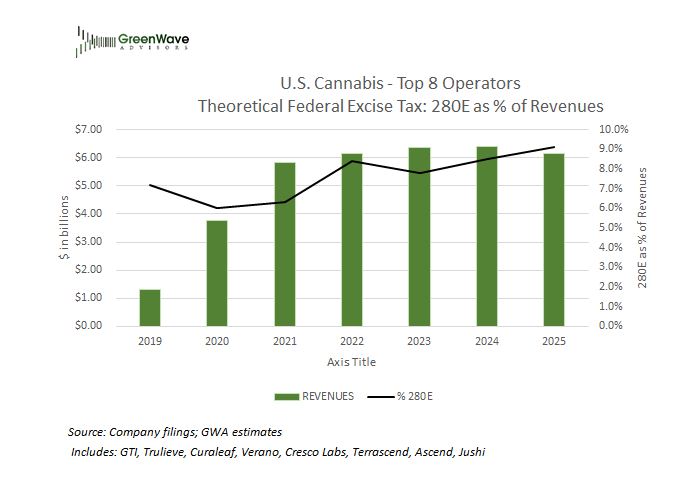
@JDerevyanny Excise tax could theoretically be ~ 9 - 10%. As a cross check = assuming 45% Gross Profit x 21% tax rate = 9.5%.
The GreenWave tweet media
English
0
0
0
60
Jerry Derevyanny
Jerry Derevyanny@JDerevyanny·
@GreenWaveMJ Rethinking it likely comes with an excise tax attached that equals the lot revenue unless s3 happens first…
English
2
0
1
150
The GreenWave
The GreenWave@GreenWaveMJ·
Section 280E comes from a specific moment in U.S. tax history tied to drug policy. It originated after a 1981 court case involving a drug dealer named Edmondson v. Commissioner. In that case, the Tax Court allowed the taxpayer—who was illegally selling drugs—to deduct ordinary business expenses under standard tax rules. At the time, this was aimed at illegal drug operations and was not designed for legal state cannabis businesses. So the question is -- had Congress known decades later, that it would impact state legal cannabis businesses, would it have acted in a similar manner? IMHO, the answer is no. Its time to rethink 280E. $MSOS
Marijuana Moment@MarijuanaMoment

Marijuana Businesses Can't Force Court To Do 'Imaginary' Rescheduling Review To Exempt Them From 280E Tax, IRS Says: "This would create a seismic rift between how substances are controlled and identified under the CSA." marijuanamoment.net/marijuana-busi…

English
1
0
6
822