@georg_dev@mattpocockuk I've been using my locally built VoxType (it's an open-source Rust project) that leverages my GPU. Works pretty fast with the "base.en" model.
@tomasz_ducin@mariuszgil also events have already happened in the past and we want the system to become eventually consistent with them and commands are used to move the system into a future state if possible
@maxleiter@Alex__Bit I have a good ESLint rule idea. We can disallow nested loops and switch statements when break and continue keywords present. It will remove the ambiguity from the code.
@maxleiter@Alex__Bit I would recommend moving the while loop into a separate function and replace the break statements with return statements. This way you would clearly see the intent: breaks for leaving the switches and returns for leaving the loop.
@jullerino@vitest_dev I recently tried to upgrade to Vitest v1 myself, and some of my tests broke unexpectedly, but I haven’t had time to look into it just yet.
Could someone from the @vitest_dev community have a look at this PR where I'm trying to upgrade to Vitest 1.0? Been banging my head against the wall for a while trying to figure out what's wrong... github.com/trpc/trpc/pull…
Mocha to Vitest migration automation, now available on the Intuita Registry! 🚀
👨💻 One-click code automations (free & OSS) straight into your IDE/CLI: Intuita.io/mocha-to-vitest
🏢 Enterprise customers: Put your code migrations on autopilot with Intuita and save weeks of engineering time -> Intuita.io/contact
❤️ Join our community & chat with us: Intuita.io/community#mocha#vitest#vite#javascript
1/4 You can incrementally migrate to the Next.js App Router with A/B testing.
The pages under the Pages Router stay under legacy paths and its App Router copies live under future paths.
The app redirects some users from legacy to future paths.
And we have a codemod for it!
🚀MSW (@ApiMocking) V2 migration automations are now available on the Intuita Automations Registry!
- Discover MSW V2 migration automations.
- One-click run any automation straight into your IDE/CLI.
- Edit any automation codemod in Codemod Studio.
👉 intuita.io/msw-v2
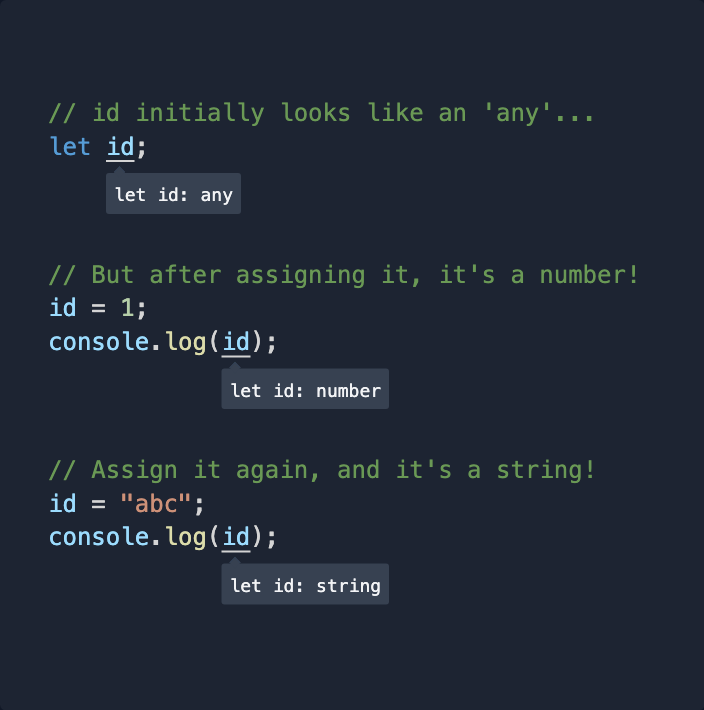
🔥 TypeScript Tip 🔥
One of TypeScript's coolest undocumented features is the 'evolving any'.
You specify a let without an annotation.
Then any time you assign to it, it changes its type!
@intuita_io Once the buffer contains the required bytes, it calls back the finite-state machine. The former repeats the cycle until all the stream has been consumed. We also check the data validity using hash digests.
@intuita_io Then, we then open the file for reading. We use the structure called circular buffer to move data from the file into a finite-state machine that interprets the bytes. That machine requires the circular buffer of a finite byte count depending on the particular step it is in.
🥳New Feature: Now you can continuously see the incoming jobs from the CLI in the VS Code extension.
This brings a more harmonious experience between Intuita CLI and VSCE.
💻 CLI Quickstart: intuita.io/cli
🖼️ VSCE quickstart: intuita.io/vsce#javascript#AI
🚀 @emberjs V5 migration automations are now available on the Intuita Automations Registry!
- Discover Ember.js V5 migration automations.
- One-click run any automation straight into your IDE/CLI.
- Edit any automation codemod in Codemod Studio.
👉 Intuita.io/migrations/emb…
@nicknisi I have been working on writing more advanced codemods with the whole ecosystem around it, you can check it out here: #the-platform" target="_blank" rel="nofollow noopener">docs.intuita.io/docs/intro#the…, it's all open-sourced.
@nicknisi You can use jscodeshift for codemods that modify projects statelessly (file by file) and you care about AST-level changes. Anything requiring state or type information needs more complex tools.
@JoshuaKGoldberg@nicknisi Also TS AST leverages the "abstract" part of AST a lot, e.g. a SourceFile node containing a SyntaxList node to group all top-level statements. I suppose it is purely for convenience.
@JoshuaKGoldberg@nicknisi Since TypeScript is a super-set of JS, I assume it was easier to came up with more suitable AST from scratch than to create node types on top of ESTree. Actually, I recall Babel/Esprima/Acorn diverge from ESTree with specific node types.