
Greg Wurm

499 posts

Greg Wurm banner
Greg Wurm

Greg Wurm

@greg_wurm

Visiting Professor in Sociology @BYU, PhD @NotreDame - Studying political depolarization, family, and religion | Husband, father, and member @Ch_JesusChrist

Provo, UT Katılım Eylül 2015
283 Takip Edilen194 Takipçiler
Greg Wurm retweetledi
Tom Costello
Tom Costello@tomstello_·
This is super worthwhile work and I agree the survey questions are problematic but when we ask people open-ended non-leading questions about whether they believe a conspiracy you get ~50% of the sample saying they do! Not lizardman, but lots of people are conspiratorial. Eg science.org/doi/10.1126/sc…
English
1
2
12
837
Greg Wurm retweetledi
Jay Van Bavel, PhD
Jay Van Bavel, PhD@jayvanbavel·
Dangerous false beliefs might seem foolish, but they actually serve an social important function. Believing in something that can actually hurt you (e.g., denying covid) is a desirable feature of a belief, not a bug. This costly signal effectively communicates a social identity to others, and it also signals that someone values this identity so much that they are willing to take personal risks to obtain the social benefits of group membership. tandfonline.com/doi/full/10.10…
Jay Van Bavel, PhD tweet media
English
49
98
617
150.4K
Greg Wurm retweetledi
Jay Van Bavel, PhD
Jay Van Bavel, PhD@jayvanbavel·
When people use AI for writing assistance, it can shift their political attitudes by autocompleting sentences in biased ways. Yet people are often unaware of the AI bias and it's influence on them. And this is not merely about the facts presented, since attitudes changed less when the information was presented as static text. This could pose a real problem if AI chatbots are socially and political biased: science.org/doi/10.1126/sc…
Jay Van Bavel, PhD tweet media
English

4
56
169
11.2K
David Broockman
David Broockman@dbroockman·
If you're not exchanging daily messages with your coauthors expressing gratitude for how amazing Claude/Codex/Gemini is, you're either a) missing out on the biggest productivity revolution ever or b) not grateful enough for it.
English
13
10
138
16.4K
Greg Wurm retweetledi
Jonathan Stray
Jonathan Stray@jonathanstray·
Could social media make us less polarized instead of more? We tested 5 algorithms on 3 platforms with 10,000 people for 6 months during the 2024 election, and found that the answer is yes. 🧵
Jonathan Stray tweet media
English
12
74
246
35.6K
Greg Wurm retweetledi
Stefan Schubert
Stefan Schubert@StefanFSchubert·
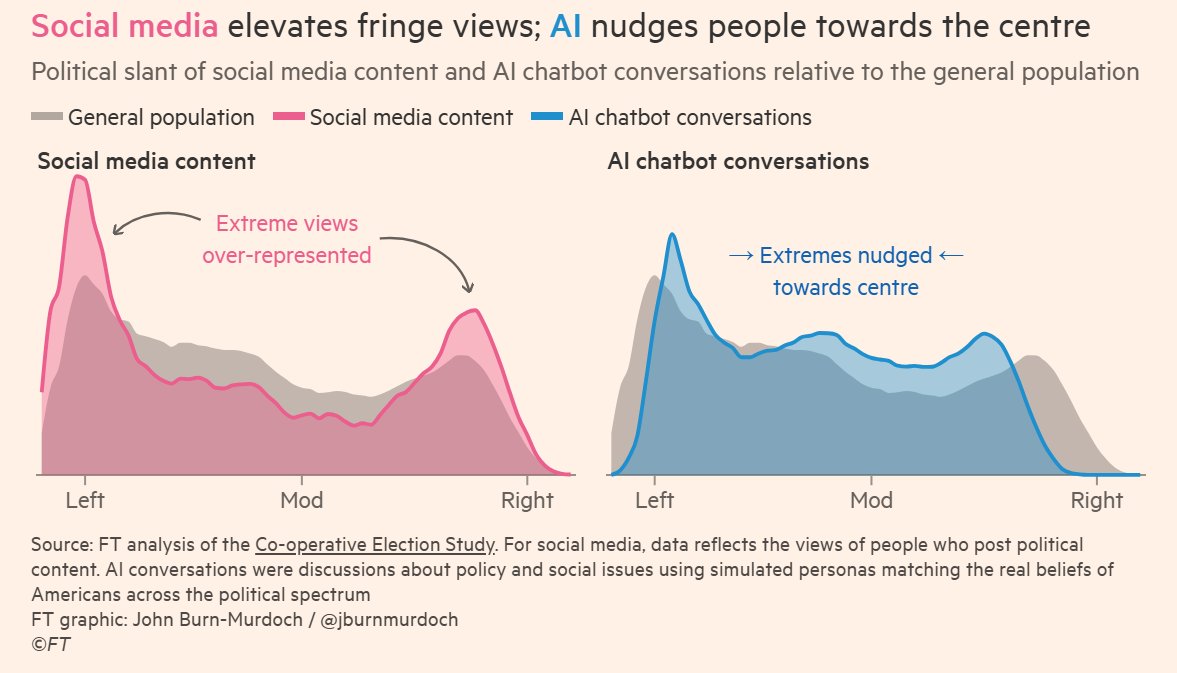
While social media is polarising, evidence suggests AI may nudge people towards the centre. This holds true of all studied models. Grok is more right-leaning than other models, but also has depolarising effects. By @jburnmurdoch.
Stefan Schubert tweet media
English
237
1K
6.2K
1.2M
Greg Wurm retweetledi
Brian Schaffner
Brian Schaffner@b_schaffner·
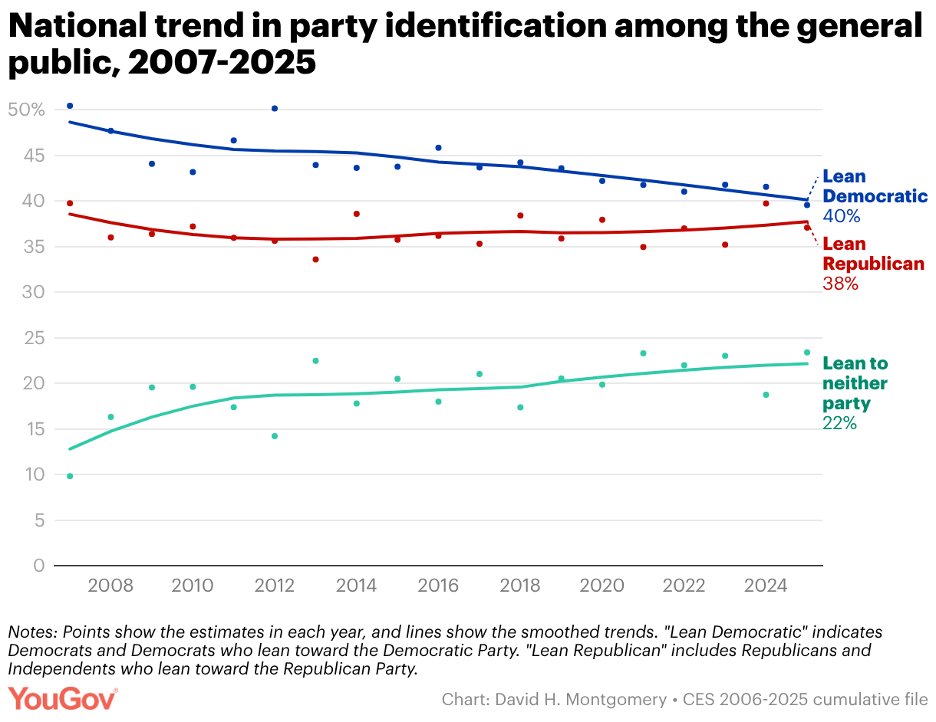
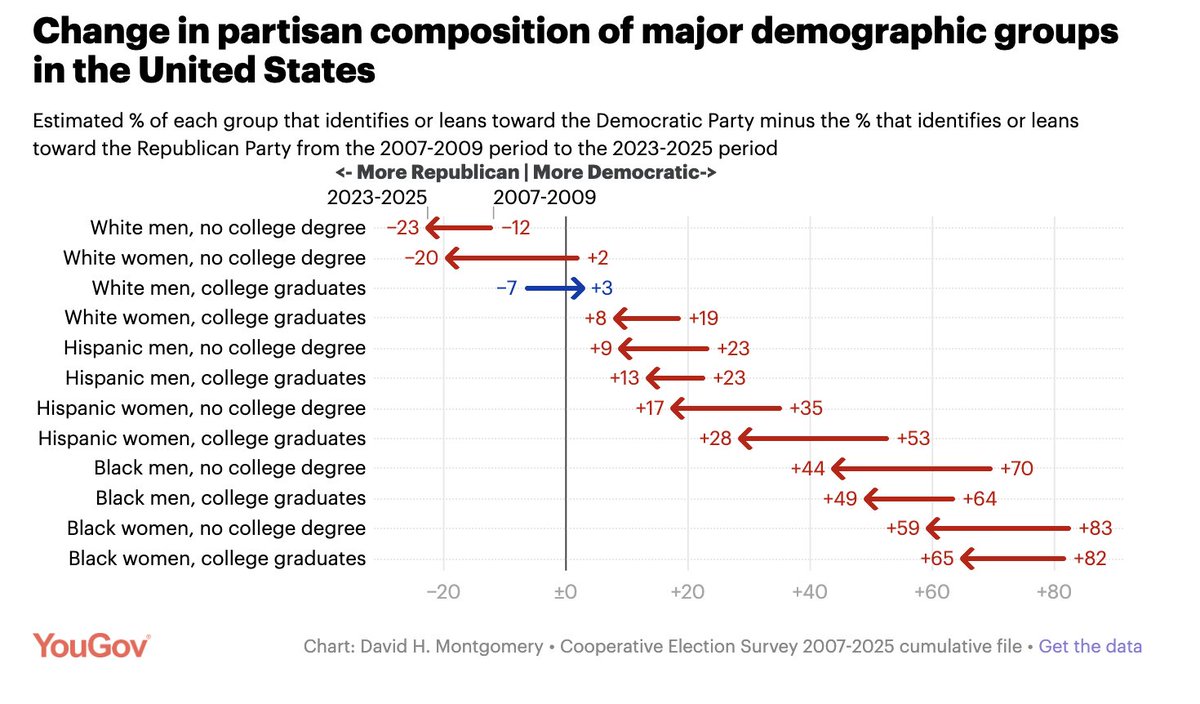
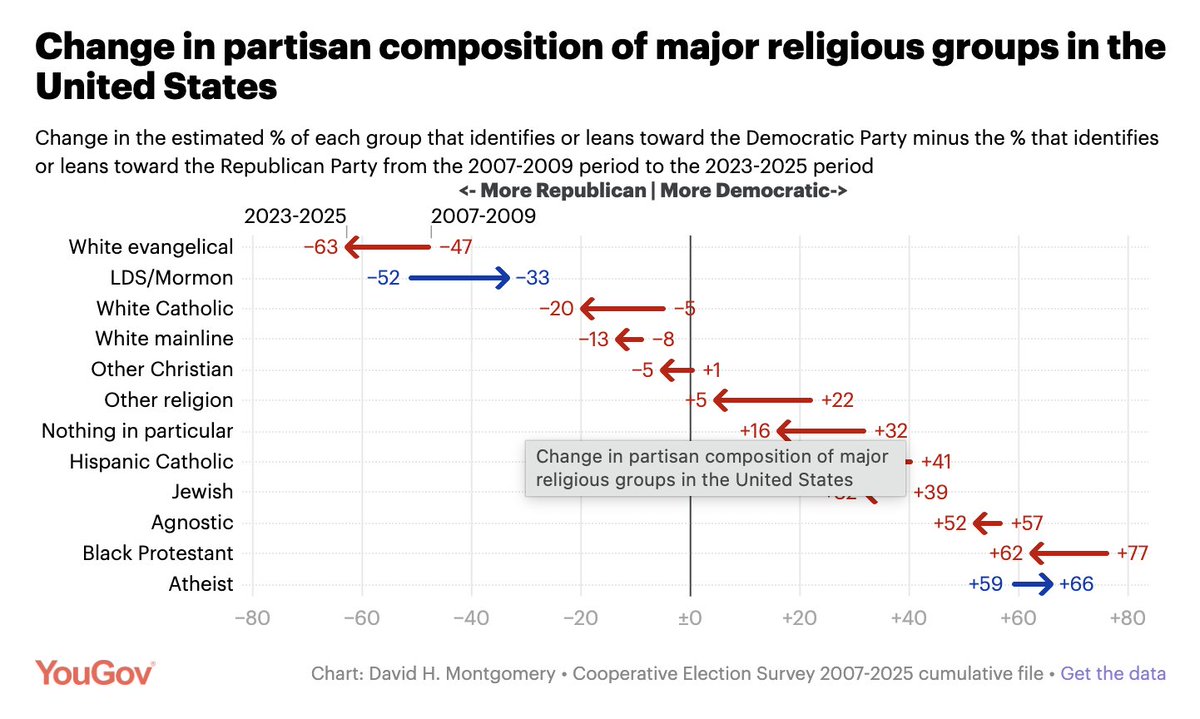
there's a new comprehensive report out from @YouGovAmerica using CES data to plot trends in partisanship over the past two decades. i've got a piece up today in @goodauth summarizing some key findings. links to both in the reply!
Brian Schaffner tweet mediaBrian Schaffner tweet mediaBrian Schaffner tweet media
English
2
18
44
11.2K
Greg Wurm retweetledi
Jay Van Bavel, PhD
Jay Van Bavel, PhD@jayvanbavel·
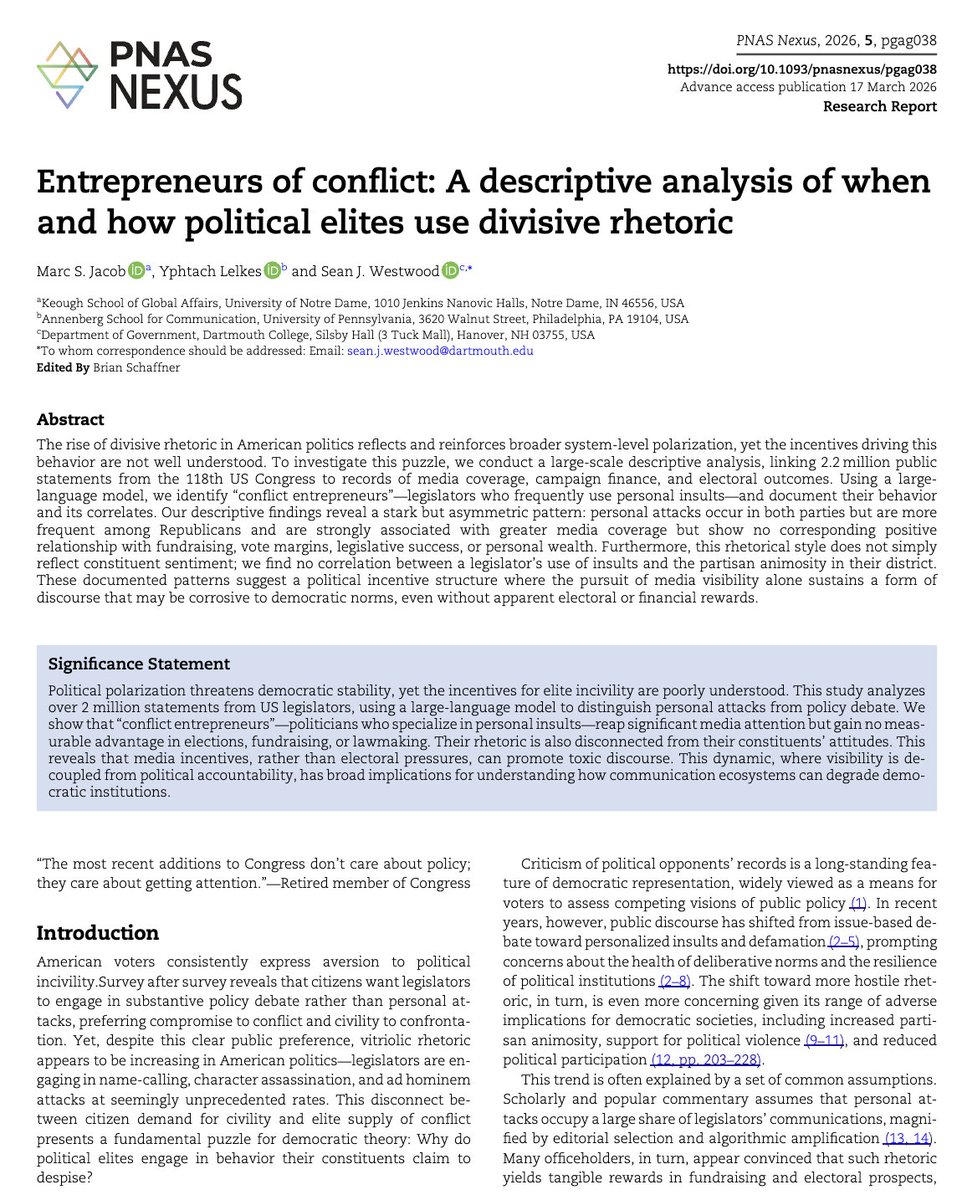
“Conflict entrepreneurs”--leaders who frequently use personal insults—are destroying social discourse and damaging democracy. An analysis of 2.2 million public statements from members of Congress finds that this type of rhetoric is linked to increased media coverage, but has no other benefits. This suggests a political incentive structure where the pursuit of media visibility alone sustains a form of discourse that may be corrosive to democratic norms, even without apparent electoral or financial rewards. #557388976" target="_blank" rel="nofollow noopener">academic.oup.com/pnasnexus/arti… If the media stopped giving these people attention, maybe they'd stop spewing insults and focus on trying to make the country a better place. Thoughts?
Jay Van Bavel, PhD tweet media
English
8
44
120
13.9K
Greg Wurm
Greg Wurm@greg_wurm·
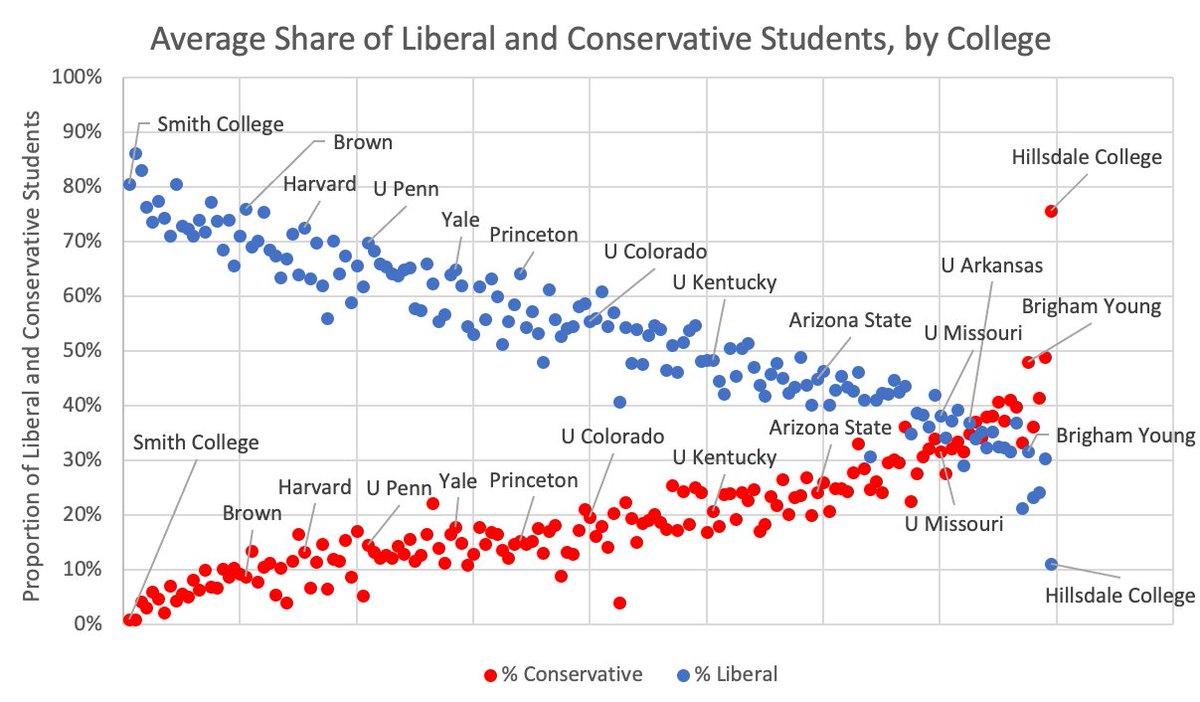
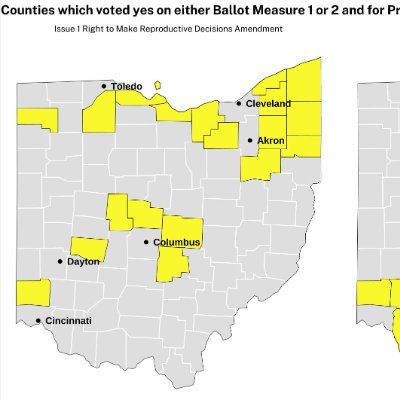
@JohnHolbein1 Data shows, at least among students, it's one of the more politically balanced (and more conservative if anything):
Greg Wurm tweet media
English
0
1
2
70
John B. Holbein
John B. Holbein@JohnHolbein1·
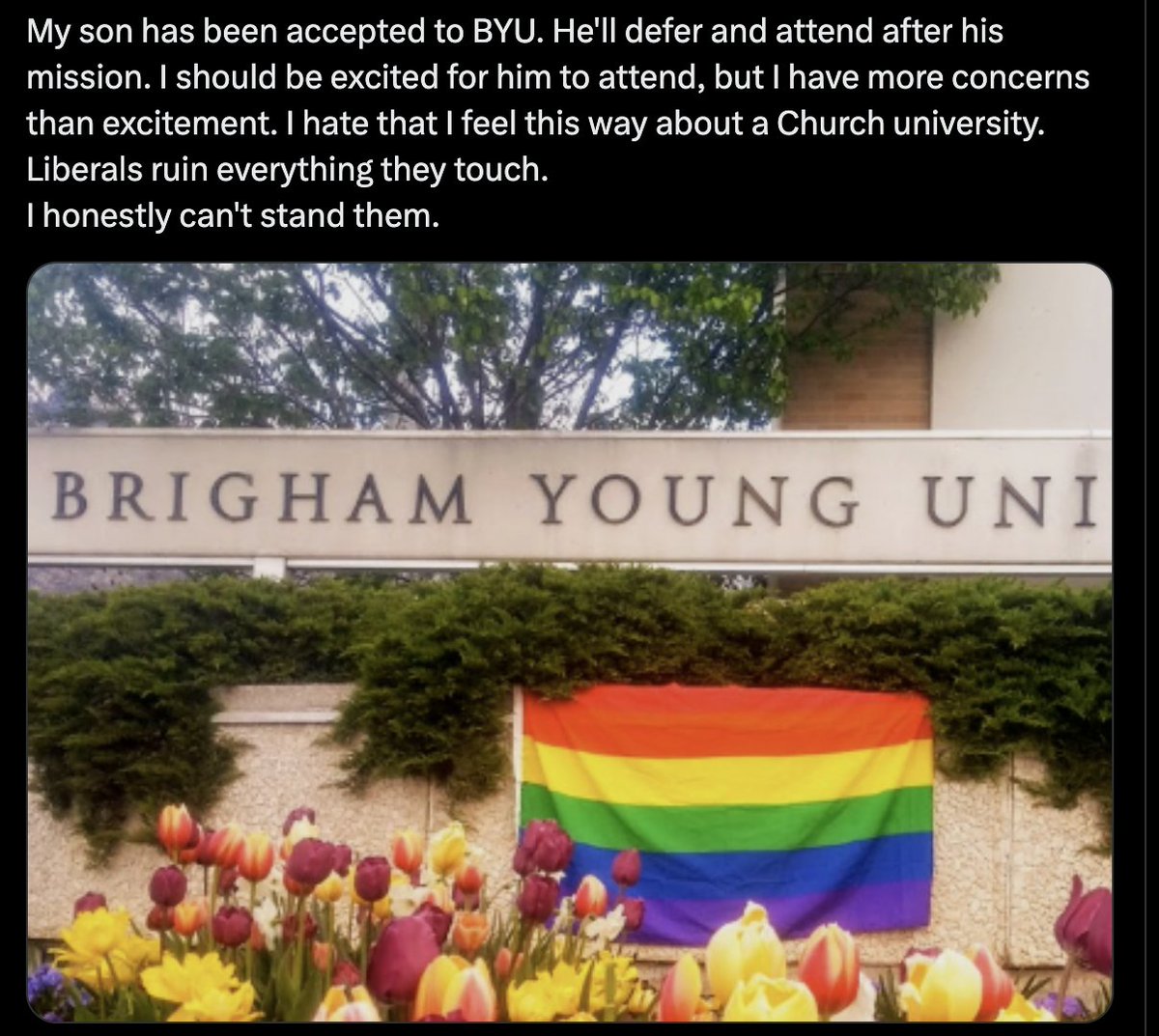
imagine thinking BYU is too liberal.
John B. Holbein tweet media
English
5
0
56
6.2K
Greg Wurm retweetledi
Aziz Sunderji
Aziz Sunderji@AzizSunderji·
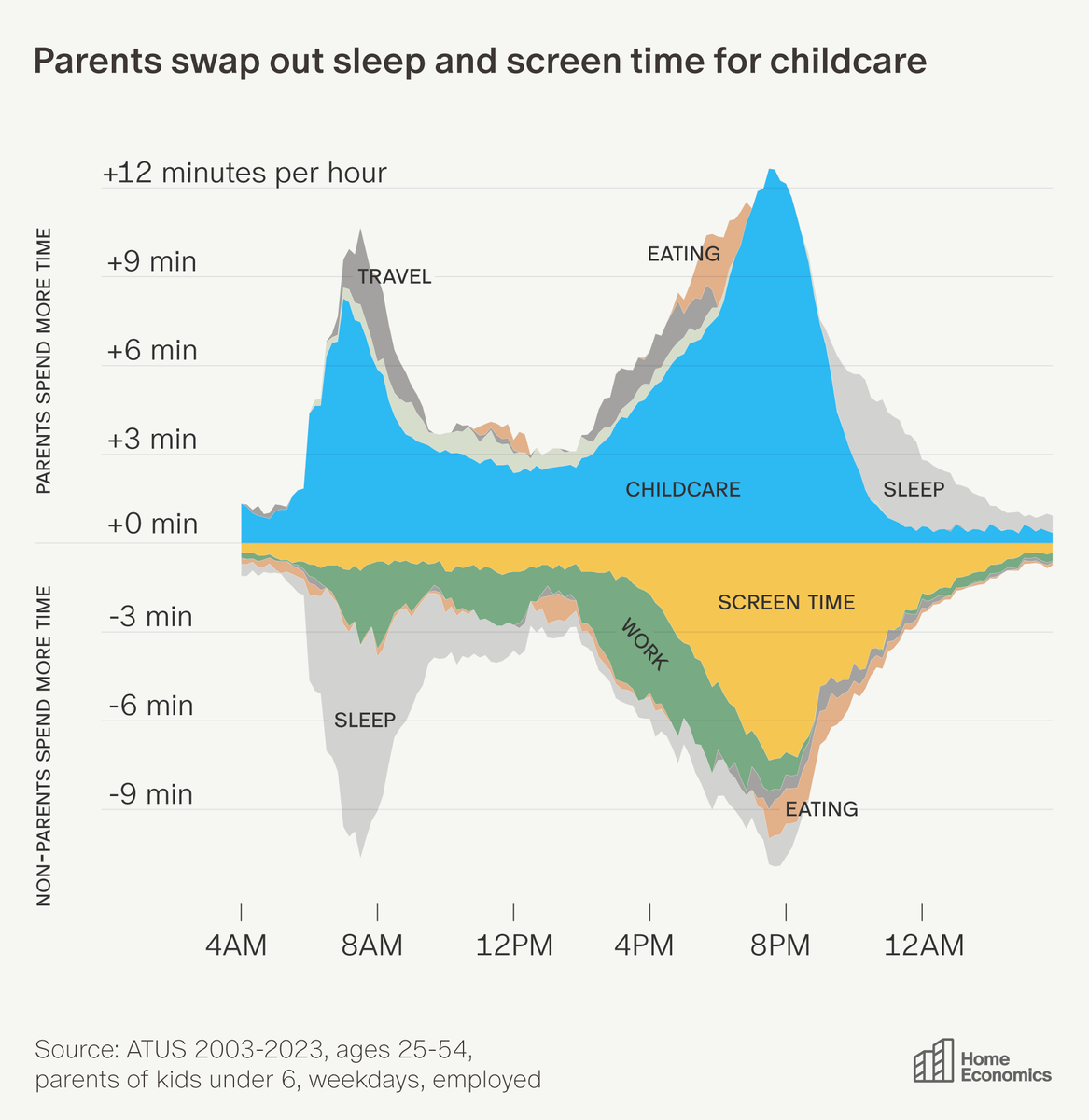
As a new parent, I spend a lot of time changing diapers and feeding the baby. 15 months ago I wasn't doing any of this. I felt busy then too, so where did all this childcare time come from? I analyzed the Census Bureau's American Time Use Survey to find out how most parents do it. The answer: less sleep and less screen time. The funny thing is, parents report being pretty happy about this tradeoff.
Aziz Sunderji tweet media
English
100
501
4.9K
848.8K
Greg Wurm retweetledi
Tom Wood
Tom Wood@thomasjwood·
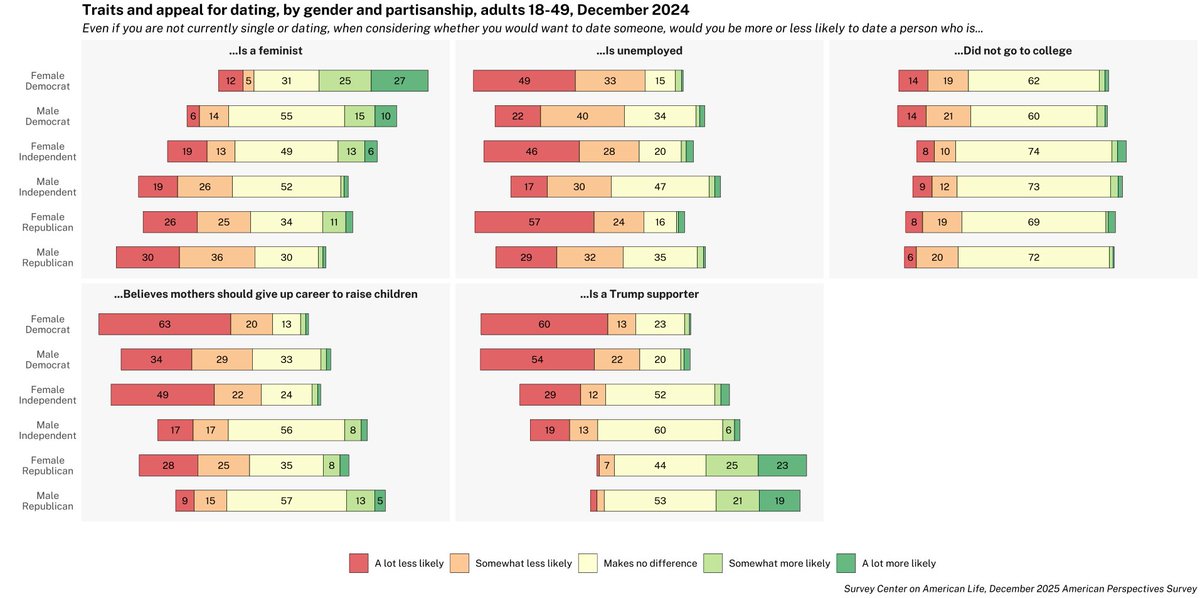
The role of political traits in dating -- super cool data from @dcoxpolls Survey Center on American life. (interesting how gender effects persist even conditioning on partisanship....)
Tom Wood tweet media
English
1
7
44
5.4K
Greg Wurm retweetledi
Valerio Capraro
Valerio Capraro@ValerioCapraro·
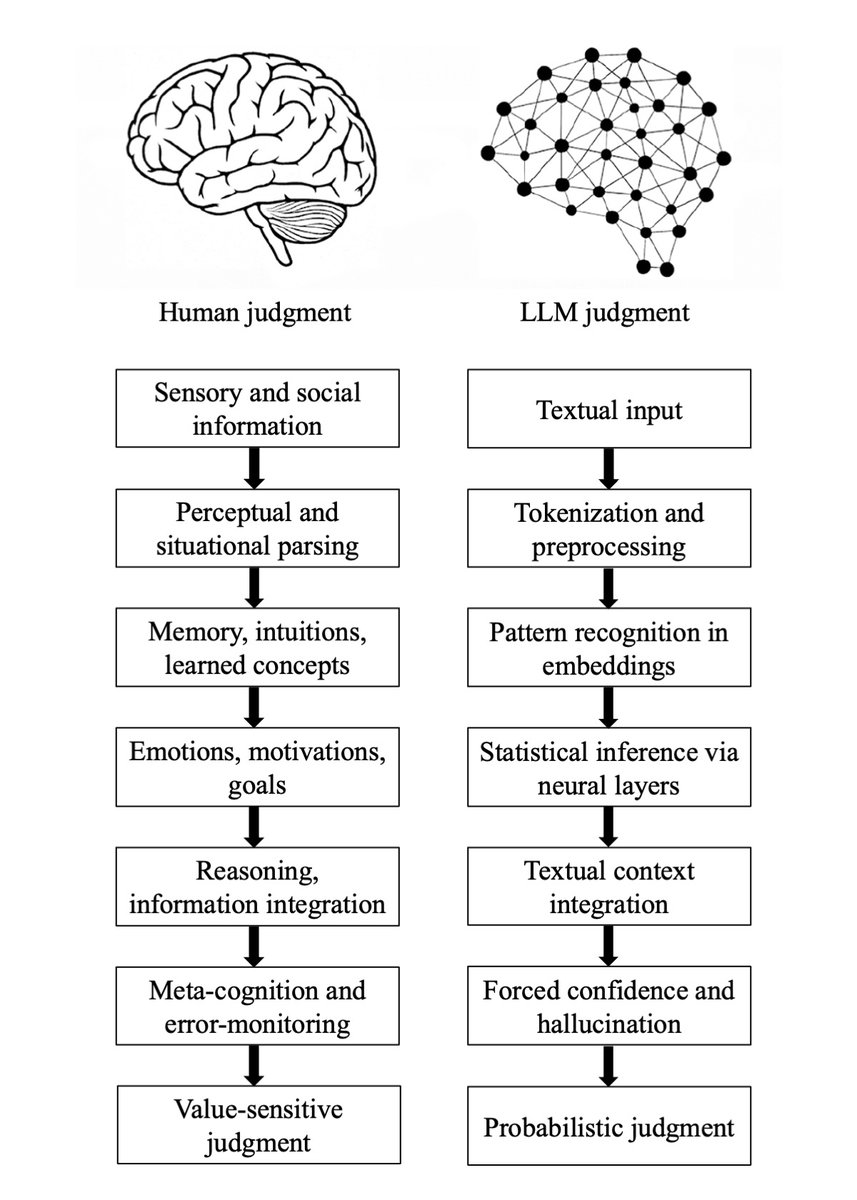
Major preprint just out! We compare how humans and LLMs form judgments across seven epistemological stages. We highlight seven fault lines, points at which humans and LLMs fundamentally diverge: The Grounding fault: Humans anchor judgment in perceptual, embodied, and social experience, whereas LLMs begin from text alone, reconstructing meaning indirectly from symbols. The Parsing fault: Humans parse situations through integrated perceptual and conceptual processes; LLMs perform mechanical tokenization that yields a structurally convenient but semantically thin representation. The Experience fault: Humans rely on episodic memory, intuitive physics and psychology, and learned concepts; LLMs rely solely on statistical associations encoded in embeddings. The Motivation fault: Human judgment is guided by emotions, goals, values, and evolutionarily shaped motivations; LLMs have no intrinsic preferences, aims, or affective significance. The Causality fault: Humans reason using causal models, counterfactuals, and principled evaluation; LLMs integrate textual context without constructing causal explanations, depending instead on surface correlations. The Metacognitive fault: Humans monitor uncertainty, detect errors, and can suspend judgment; LLMs lack metacognition and must always produce an output, making hallucinations structurally unavoidable. The Value fault: Human judgments reflect identity, morality, and real-world stakes; LLM "judgments" are probabilistic next-token predictions without intrinsic valuation or accountability. Despite these fault lines, humans systematically over-believe LLM outputs, because fluent and confident language produce a credibility bias. We argue that this creates a structural condition, Epistemia: linguistic plausibility substitutes for epistemic evaluation, producing the feeling of knowing without actually knowing. To address Epistemia, we propose three complementary strategies: epistemic evaluation, epistemic governance, and epistemic literacy. Full paper in the first reply. Joint with @Walter4C & @matjazperc
Valerio Capraro tweet media
English
208
1.2K
4.4K
628.8K
Greg Wurm retweetledi
Valerio Capraro
Valerio Capraro@ValerioCapraro·
Now out in Nature Human Behaviour! 🚀🚀 Over the past decades, research on collective human behaviour has relied heavily on networks. This is intuitive: people interact with other people. However, we argue that this dominant framework misses a crucial ingredient. Traditional networks represent agents as nodes and pairwise relations as edges. As a result, they fundamentally assume that social interactions can be decomposed into pairs. Yet many social processes are irreducibly group-based. A simple example: a group of three coauthors writing a paper cannot be reduced to three independent pairs of coauthors. The group itself matters. In this article, we review a wide range of empirical and theoretical cases where group interactions cannot be decomposed into pairwise ones, and show that higher-order interactions shape collective behaviour above and beyond dyadic ties. We advocate studying collective behaviour on hypergraphs, where interactions can involve multiple agents simultaneously. We review how hypergraphs provide new insights across domains, including affiliation and collaboration networks, high-frequency contact settings (families, friends), and key social processes such as social contagion, cooperation, truth-telling, and moral behaviour. Finally, we outline promising directions for future research: addressing computational challenges of higher-order models; studying bias and inequality in group dynamics; combining hypergraphs and large language models to investigate the coevolution of language and behaviour; and using higher-order networks to simulate the impact of policies before implementation; and others. We are very excited about this work and hope it will inspire further research in a rapidly growing and fundamental area with broad real-world implications. Link to the paper in the first reply This work was brilliantly led by Federico Battiston (@fede7j), with an outstanding team of co-authors: Fariba Karimi (@fariba_k), Sune Lehmann, Andrea Bamberg Migliano, Onkar Sadekar (@OnkarSadekar), Angel Sanchez, & Matjaz Perc (@matjazperc)
Valerio Capraro tweet media
English
25
175
725
51K
Greg Wurm retweetledi
Jay Van Bavel, PhD
Jay Van Bavel, PhD@jayvanbavel·
A new PNAS paper finds that polarization increased immediately after the invention of smartphones and the advent of social media, which both appeared around the same year, 2008. Both profoundly changed the way humans communicate and this rise of connectivity may have fueled polarization. Adding a small number of individuals with extreme opinions (influencers) also drives continuous increases in polarization. Once polarization occurs as a consequence of increasing connectivity, it can not simply be undone by reversing to previous connectivity levels. This may be why social media removal studies have very modest effects on polarization. pnas.org/doi/10.1073/pn…
Jay Van Bavel, PhD tweet media
English
100
619
1.9K
473K
Josh Dance
Josh Dance@JoshDance·
I wouldn’t claim that Joseph Smith “predicted quantum physics.” But I do agree with the idea! Perhaps more accurate claim is this: Joseph Smith built a metaphysical worldview that rejected many assumptions of 19th-century Christianity and 19th-century scientific understanding. That worldview ends up fitting surprisingly well with how modern physics and philosophy now think about reality. Some examples. First, eternal matter and no creation from nothing. Joseph taught that matter and the elements are eternal and that creation is organization, not creation ex nihilo. That directly contradicts classical Christian theology but aligns well with conservation laws and modern cosmology, which does not actually demonstrate creation from absolute nothing. Second, intelligence as fundamental. Joseph taught that intelligence is eternal and uncreated. Modern physics and philosophy increasingly treat information, not matter alone, as fundamental. Ideas like information theory, digital physics, and “it from bit” fit this surprisingly well. That is a very strange claim for the 1830s. Third, God operates by law, not arbitrary power. Joseph taught that God is bound by eternal law and that miracles are higher laws, not violations of reality. That looks much closer to a law-governed universe than to the voluntarist idea that God can suspend logic at will. Fourth, a vast populated cosmos. “Worlds without number” was not a common Christian belief in the 19th century. Today we assume billions of galaxies, countless planets, and possibly many forms of life. Joseph’s cosmology is expansive, not earth-centric. Fifth, embodiment and progression. Joseph taught that God is embodied and that intelligence progresses eternally. Modern thought increasingly emphasizes embodiment, process, growth, and open-ended systems rather than static, timeless perfection. Sixth, humans as active participants, not passive creations. Joseph’s theology puts agency, participation, and co-creation at the center. That maps surprisingly well onto modern ideas about emergent systems, observers mattering, and participatory reality. None of this proves Joseph Smith was a prophet. He was, but that’s always going to take faith to chose to believe. God isn’t going to force anyone to believe with irrefutable proof in this life. :) But it does show that Joseph Smith rejected popular ideas of his time that later collapsed and proposed a framework that looks far less naïve today than it did in 1830. Bordering on ‘wow how did that farmer guess all this??’ :) Any of the above ideas ring true for you? I’m looking to expand the list so let me know if I missed any.
English
5
0
12
146
Illaria DiMar
Illaria DiMar@IllariaDiMar·
The thing about Mormonism is that its *actually* true... it's *actually* correct. Joesph Smith came up with a cosmology that fits so well with modern quantum and computational physics that its impossible for him not to have been a prophet.
English
96
30
942
39K
Andy Hall
Andy Hall@ahall_research·
People keep saying that AI is “woke.” Our research finds something more interesting. Most AI models do lean left, but building trustworthy, truth-seeking AI will take far more than demanding “neutrality” from the top down. In my new post, I unpack my research into how average Americans perceive political bias in LLMs---and what it means for the increasingly bitter political debate over AI’s value systems. Our research led to some surprising findings, including: --Elon’s "anti-woke" Grok is actually perceived as the most left-wing model. --Ordinary Democrats and Republicans both prefer neutral, unslanted answers on political questions.
Andy Hall tweet media
English
2
2
18
1.3K
Greg Wurm
Greg Wurm@greg_wurm·
@ahall_research What does it look like if you break down perceptions of each model by partisanship? E.g., do Reps and Dems perceive Grok similarly left-biased?
English
0
0
0
38
Greg Wurm retweetledi
Sean Westwood
Sean Westwood@seanjwestwood·
AI presents a fundamental threat to our ability to use polls to assess public opinion. Bad actors who are able to infiltrate panels can flip close election polls for less than the cost of a Starbucks coffee. Models will also infer and confirm hypotheses in experiments. Current quality checks fail. Dark times for survey work.
Sean Westwood tweet media
English
25
201
634
314.7K