Gennady Rudkevich

15.6K posts

Gennady Rudkevich banner
Gennady Rudkevich

Gennady Rudkevich

@grudkev

Quantitative Researcher/Economist. Former Assistant Professor of Political Science, focusing on Russia and Central Asia. All views my own.

Northern Virginia Katılım Eylül 2015
352 Takip Edilen7.9K Takipçiler
Sabitlenmiş Tweet
Gennady Rudkevich
Gennady Rudkevich@grudkev·
Ukrainian vs. Russian leadership
Gennady Rudkevich tweet mediaGennady Rudkevich tweet media
English
1.2K
28.1K
183K
0
Gennady Rudkevich
Gennady Rudkevich@grudkev·
Here is a list of Western national elections held in 2024 (after the global inflation crisis). Note what happened to incumbent popular support. UK: Tories (-46%) Belgium: Open Vld (-36%) Croatia: HDZ (-8%) France: LREM (-36%) Lithuania: TS–LKD (-30%) US: Harris (Democrats) (-7%)
English
0
30
43
7K
Gennady Rudkevich
Gennady Rudkevich@grudkev·
@laschasmails GD's share of the vote in rural areas went up by more than that. There are precincts there GD got 90-95% of the vote this time around. After getting 50-60% in 2020.
English
0
1
7
83
Roman Udot
Roman Udot@romanik_·
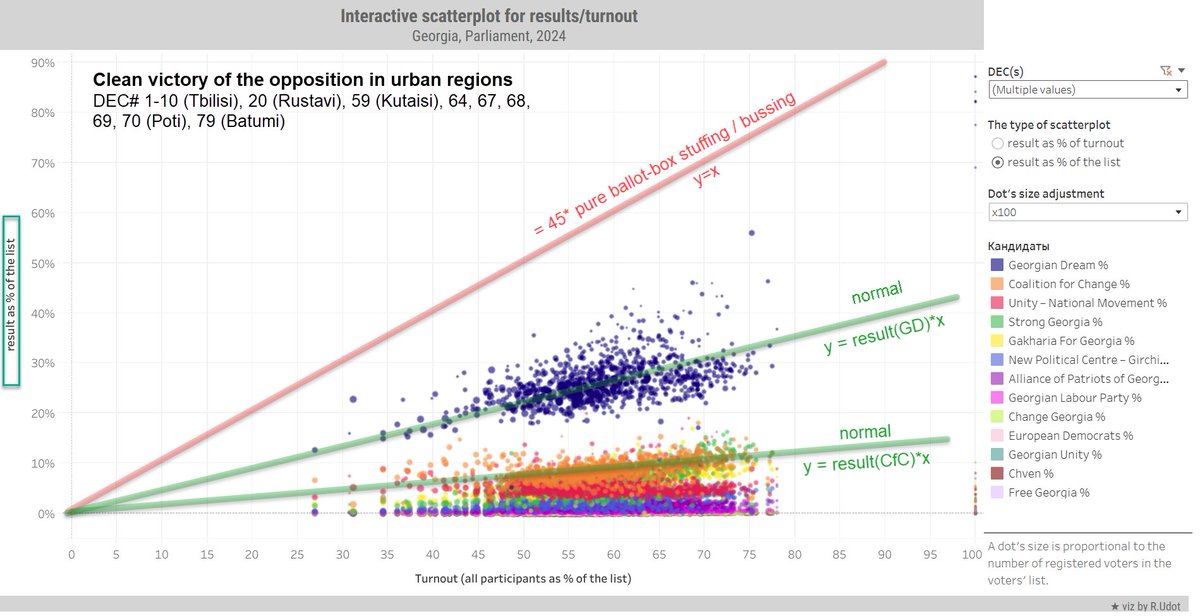
FRAUD IN GEORGIA Although the overall statistical impression of the elections in Georgia was positive (x.com/romanik_/statu…) , the Devil, as usual, was in the details. The respected Levan Kvirkvelia pointed out a discrepancy between urban and rural voting patterns. His observation was confirmed, indicating manipulations favouring the ruling party in specific districts, i.e. all except districts DEC 1-10 (Tbilisi), 20 (Rustavi), 59 (Kutaisi), 64, 67, 68, 69, 70 (Poti), and 79 (Batumi). There is a method or hypothesis known as the Sobyanin-Sukhovolski's (S-S). For instance, you can find it mentioned here: electoralpolitics.org/en/articles/mo… According to this method, if we plot voting results on the following axes: X-axis = turnout (number of voters / registered voter list) Y-axis = candidate/party result (number of votes for the party / registered voter list) we observe these patterns: In fair voting, the slope of the point cluster aligns with the candidate’s percentage (if a candidate has 30% support in the population, then out of every 100 voters, 30 support the candidate, or y = 0.3 * x). In cases of ballot stuffing, the slope of the cluster is 45° (out of every 100 stuffed ballots, all 100 are for the beneficiary of the fraud or y = x). For the victim, the slope is 0° (out of every 100 stuffed ballots, 0 is stuffed for the victim). In the case of 'misrecording', when votes are not only stuffed in favour of the beneficiary of the fraud but are also added by taking them away from other parties, the slope becomes steeper, or y > x. For the victim, the slope is negative (they don't get any votes with the growth of the turnout, they lose them). This pattern can be observed in the data from Georgia when dividing it into two groups: Group 1: DEC 1-10 (Tbilisi), 20 (Rustavi), 59 (Kutaisi), 64, 67, 68, 69, 70 (Poti), 79 (Batumi). Group 2: all other districts. It is clear that the S-S hypothesis holds in Group 1 but not in Group 2. This discrepancy suggests a basis for suspecting fraud in Group 2, while no such grounds were observed in Group 1.
Roman Udot tweet mediaRoman Udot tweet media
Roman Udot@romanik_

Election Data from Georgian Parliamentary Elections Through informal observer networks, I acquired a file with data from the Georgian Central Election Commission (CEC). Notably, these data aren't published on the CEC website and omit the total registered voters and invalid ballots. For some peculiar reason, Georgia's CEC never releases such data digitally, though commission protocols are available online as images, including counting machines' “receipts” this year. Our 'Election Audit' team currently is wrestling with recognizing 3,100 Georgian(!)-language protocols. As in Moldova, we don’t observe clear fraud indicators like those in Russian elections. In the “carcinogenic zone” of high turnouts, we find no malignant formations. Nor do we see the classic "straight-line drawing" style typical of Russian-Azerbaijani fabrications. But don't believe me, see it for yourself™ : public.tableau.com/app/profile/ro…

English
56
539
1.6K
304.4K
Gennady Rudkevich
Gennady Rudkevich@grudkev·
Basically, a democracy is collapsing if gov't institutions (the bureaucracy, courts, police, electoral commissions) are actively working to get the ruling party elected. These actions are generally sufficiently deniable that it's hard to definitively prove fraud is taking place.
English
0
1
3
301
Gennady Rudkevich
Gennady Rudkevich@grudkev·
For example, gov't workers are pressured to attend rallies and to vote for the ruling party. Local elites are bribed to turn out voters in their regions. It's particularly effective in poorer areas. The courts make an example of a few opposition politicians and journalists. Etc.
English
1
5
14
2.3K
Gennady Rudkevich
Gennady Rudkevich@grudkev·
In most cases, democratic backsliding doesn't mean going from free and fair elections to brazen ballot stuffing and large-scale arrests of opposition figures. Instead, the ruling party increasingly uses government resources and institutions to give itself unfair advantages.
Pjotr Sauer@PjotrSauer

It remains unclear if the Georgian opposition will be able to galvanise enough support in the coming days. Western officials and election monitoring groups have stopped short of saying the elections had been stolen theguardian.com/world/2024/oct…

English
2
16
44
5.6K
Gennady Rudkevich
Gennady Rudkevich@grudkev·
There are multiple election precincts in Georgia where the ruling GD obtained more than 90% of the vote (in some cases, significantly more than 90%). A quick search suggests there were far fewer such lopsided results in 2020. For example: results.cec.gov.ge/#/en-us/electi…
English
1
16
41
6.5K
Gennady Rudkevich
Gennady Rudkevich@grudkev·
@GeneVorobyov They do, but it's strange to see such huge swings in areas more prone to shenanigans while GD's national share of the vote is barely changed.
English
0
0
0
16
Gennady Rudkevich
Gennady Rudkevich@grudkev·
Not sure how many times people need to be warned, but if you're a citizen of a Western country, do not under any circumstances travel to Russia. bbc.com/news/articles/…
English
4
19
48
2.9K
Gennady Rudkevich
Gennady Rudkevich@grudkev·
@DrRadchenko We should also be weary about making predictions based on a sample of 1 or 2, especially when the events in question happened under very different domestic and global conditions.
English
1
0
11
890
Gennady Rudkevich
Gennady Rudkevich@grudkev·
6. Realistically, the only ways to turn the Russian public against Putin is for A) Russia to unambiguously lose the war (no one likes losing) and/or B) for a total economic collapse. Neither is likely to happen, at least for the foreseeable future.
English
0
0
0
346
Gennady Rudkevich
Gennady Rudkevich@grudkev·
5. People point to German or Japanese post-WWII behavior as examples of people atoning for their country's behavior. But that atonement required a decade-long occupation of Germany and is still lacking in many ways in Japan.
English
1
1
4
769
Gennady Rudkevich
Gennady Rudkevich@grudkev·
To people surprised over the Russian public's continued support for Russia's invasion of Ukraine despite the war's legality/morality and the high cost paid by Russia: A) the support isn't as strong as it seems, and B) it's the same kind of support we see in similar countries.
English
1
2
9
1.5K