
Gustavo Barbieri
3.6K posts
Gustavo Barbieri
@gsbarbieri
Computer Hacker and Entrepreneur
Sertãozinho-SP, Brazil Katılım Haziran 2009
388 Takip Edilen993 Takipçiler

@ThePrimeagen the real flex is git itself honestly. the protocol was designed for human commit speeds and now it's absorbing machine-gun code generation without breaking. whoever thought through the object model in 2005 accidentally future-proofed everything
English

I would like to make my apologies for defending M$, but I must from time to time.
I have to put respect on github for handling the amount of shit code that has been added over the last 3 months.
literally 10s of billions of lines of code that will never see the light of a CPU
ThePrimeagen@ThePrimeagen
GitHub has been around since April 10, 2008 Agent's came out yesterday yes, GitHub was in fact NOT designed for Agents
English
What I don’t get is people using GitHub do all-agent workflows. They have a local machine that gets the work done, send to GH as PR, other agents review and test it. And some Actions as well. Given no multi human interacting, it could all be local: run the actions locally (usually build and run tests) and also reviewers. I bet a local “mail spool” with review over email could do.
English
@henriquebastos Did you move to another network during your absence or just quit networks altogether? How was that?
English

I am surprised I am enjoying coming back to Twitter. The un-hyped Pi-verse makes it worth it. Every day I learn a ton from the People of Pi. 🙇
English
@gustavokov A velha lógica do “inimigo do meu ‘inimigo’ é meu amigo”
Português

É impressionante que tenhamos chegado a esse ponto
Combat Antisemitism Movement@CombatASemitism
🇬🇷 Athens, today: At an “anti-imperialist” demonstration, we spotted this shocking banner: “Glory to the Axis of Resistance” featuring Hamas, Hezbollah, the Houthis, and Iran. The worst terrorist groups in the Middle East, glorified in Europe.
Português
Yet some folks will dismiss modern AI as “fancy tab completions”…
Bo Wang@BoWang87
Prof. Donald Knuth opened his new paper with "Shock! Shock!" Claude Opus 4.6 had just solved an open problem he'd been working on for weeks — a graph decomposition conjecture from The Art of Computer Programming. He named the paper "Claude's Cycles." 31 explorations. ~1 hour. Knuth read the output, wrote the formal proof, and closed with: "It seems I'll have to revise my opinions about generative AI one of these days." The man who wrote the bible of computer science just said that. In a paper named after an AI. Paper: cs.stanford.edu/~knuth/papers/…
English


@hoje_no Eu não sou tão conhecedor de história mas tbm não sou muito burro, mas o fato deles estarem quase todos juntos num local é meio que de uma burrice imensa né? Se de fato for confirmado que eles juntos, claro.
Português

Os Aiatolás estavam reunidos na cidade de Qom para eleger um novo líder supremo, mas foram surpreendidos por um ataque israelense que destruiu o local da reunião. Segundo fontes locais, há muitos mortos e feridos.
Português
@gustavokov Valeu, essa semana dou um olhada! To com alguns FII também, um saco fazer manual o trampo
Português
@gsbarbieri A ferramenta é 3 coisas, 1) um scraper mais sofisticado com um chromium rodando num profile privado numa sessão weston própria - que vc pode acessar com RDP 2) um agregador dos dados 3) gerador de "sinais" com base em algumas heurísticas
Português
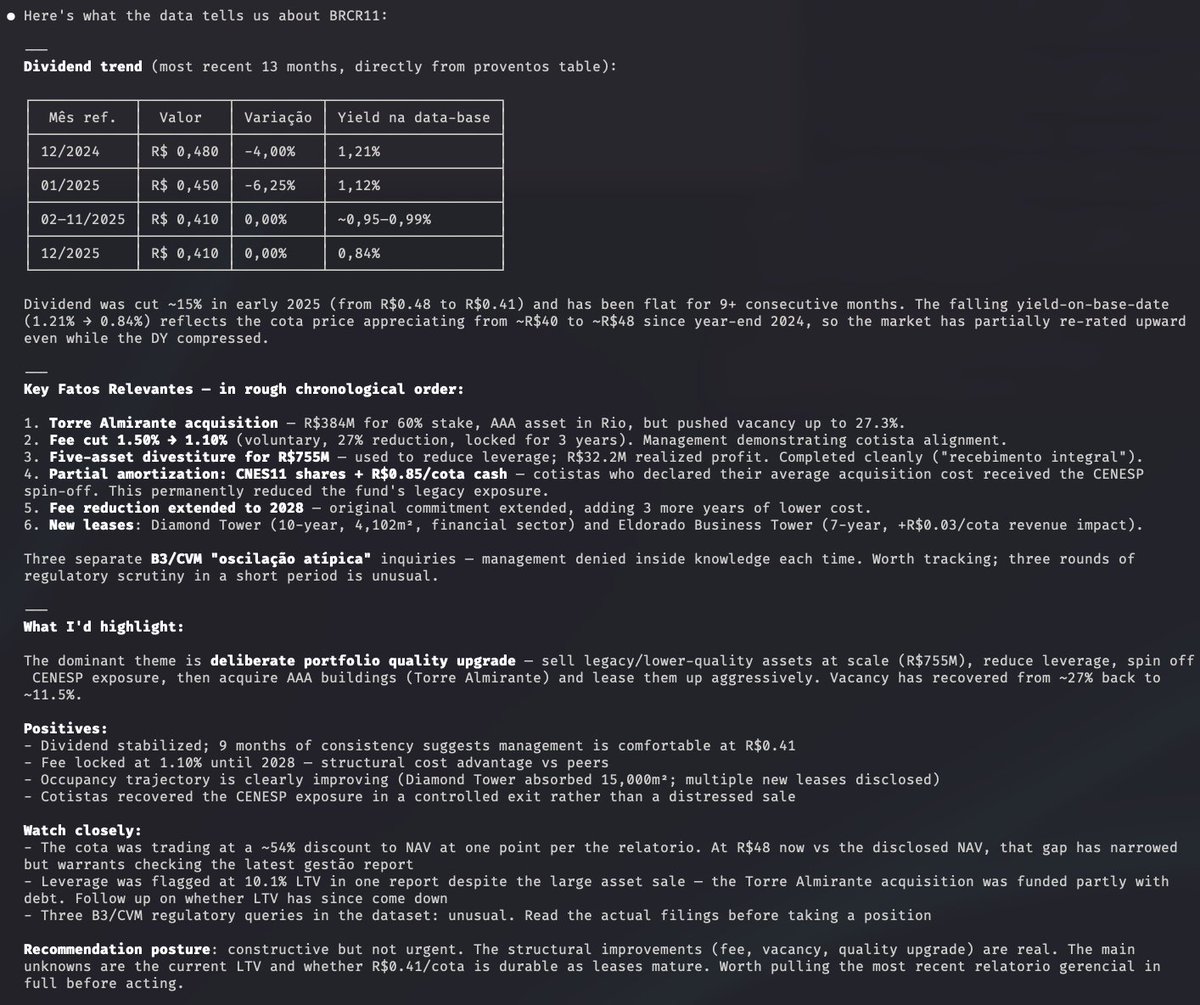
Fiz uma ferramentinha RAG pra automatizar algumas análises de fundos e ações. Eis o que o claude tem a dizer com base nos dados do BRCR11.
Português
O que me irrita e me fez perder a esperança de melhorar é que o petismo vem, esfrega na cara o que é, mas não passa 6 meses a turma, inclusive imprensa, já está doidinha pra cair na conversa de novo.
Português
worth reading!
Chris Lattner@clattner_llvm
The Claude C Compiler is the first AI-generated compiler that builds complex C code, built by @AnthropicAI. Reactions ranged from dismissal as "AI nonsense" to "SW is over": both takes miss the point. As a compiler🐉 expert and experienced SW leader, I see a lot to learn: 👇
English
🧐
Thomas Wolf@Thom_Wolf
Shifting structures in a software world dominated by AI. Some first-order reflections (TL;DR at the end): Reducing software supply chains, the return of software monoliths – When rewriting code and understanding large foreign codebases becomes cheap, the incentive to rely on deep dependency trees collapses. Writing from scratch ¹ or extracting the relevant parts from another library is far easier when you can simply ask a code agent to handle it, rather than spending countless nights diving into an unfamiliar codebase. The reasons to reduce dependencies are compelling: a smaller attack surface for supply chain threats, smaller packaged software, improved performance, and faster boot times. By leveraging the tireless stamina of LLMs, the dream of coding an entire app from bare-metal considerations all the way up is becoming realistic. End of the Lindy effect – The Lindy effect holds that things which have been around for a long time are there for good reason and will likely continue to persist. It's related to Chesterton's fence: before removing something, you should first understand why it exists, which means removal always carries a cost. But in a world where software can be developed from first principles and understood by a tireless agent, this logic weakens. Older codebases can be explored at will; long-standing software can be replaced with far less friction. A codebase can be fully rewritten in a new language. ² Legacy software can be carefully studied and updated in situations where humans would have given up long ago. The catch: unknown unknowns remain unknown. The true extent of AI's impact will hinge on whether complete coverage of testing, edge cases, and formal verification is achievable. In an AI-dominated world, formal verification isn't optional—it's essential. The case for strongly typed languages – Historically, programming language adoption has been driven largely by human psychology and social dynamics. A language's success depended on a mix of factors: individual considerations like being easy to learn and simple to write correctly; community effects like how active and welcoming a community was, which in turn shaped how fast its ecosystem would grow; and fundamental properties like provable correctness, formal verification, and striking the right balance between dynamic and static checks—between the freedom to write anything and the discipline of guarding against edge cases and attacks. As the human factor diminishes, these dynamics will shift. Less dependence on human psychology will favor strongly typed, formally verifiable and/or high performance languages.³ These are often harder for humans to learn, but they're far better suited to LLMs, which thrive on formal verification and reinforcement learning environments. Expect this to reshape which languages dominate. Economic restructuring of open source – For decades, open-source communities have been built around humans finding connection through writing, learning, and using code together. In a world where most code is written—and perhaps more importantly, read—by machines, these incentives will start to break down.⁴ Communities of AIs building libraries and codebases together will likely emerge as a replacement, but such communities will lack the fundamentally human motivations that have driven open source until now. If the future of open-source development becomes largely devoid of humans, alignment of AI models won't just matter—it will be decisive. The future of new languages – Will AI agents face the same tradeoffs we do when developing or adopting new programming languages? Expressiveness vs. simplicity, safety vs. control, performance vs. abstraction, compile time vs. runtime, explicitness vs. conciseness. It's unclear that they will. In the long term, the reasons to create a new programming language will likely diverge significantly from the human-driven motivations of the past. There may well be an optimal programming language for LLMs—and there's no reason to assume it will resemble the ones humans have converged on. TL; DR: - Monoliths return – cheap rewriting kills dependency trees; smaller attack surface, better performance, bare-metal becomes realistic - Lindy effect weakens – legacy code loses its moat, but unknown unknowns persist; formal verification becomes essential - Strongly typed languages rise – human psychology mattered for adoption; now formal verification and RL environments favor types over ergonomics - Open source restructures – human connection drove the community; AI-written/read code breaks those incentives; alignment becomes decisive - New languages diverge – AI may not share our tradeoffs; optimal LLM programming languages may look nothing like what humans converged on ¹ x.com/mntruell/statu… ² x.com/anthropicai/st… ³ wesmckinney.com/blog/agent-erg… ⁴ #issuecomment-3717222957" target="_blank" rel="nofollow noopener">github.com/tailwindlabs/t…
ART

Português
Expectativa para 2026: Europa enviando soldados para a Ucrânia para impedir novas agressões da Rússia de Putin.
Realidade em 2026: Europa enviando soldados para a Groenlândia para impedir uma agressão dos EUA, de Donald Trump.
Esta noite chegaram soldados dinamarqueses e amanhã está prevista a chegada de soldados alemães. A Suécia também se mostrou disposta a enviar navios e soldados para reforçar a ilha.
Português
Dois pontos:
1. Trump consegue que coloquem exército lá sem ele gastar um tostão.
2. Europa mostrando que prefere não entrar em uma batalha de fato, colocar exército pra fazer número não tem risco algum, colocar na Ucrânia tem um risco enorme (de perder militares, armamentos e tomar um contragolpe russo)
Porém dado o segundo ponto, o primeiro não é muito útil.
Só que dado o segundo ponto, qual a chance da Europa ter alguma chance contra USA ali na Groenlândia?
Português
Amazing read. And interestingly enough, what he says in the beginning is something that I keep saying to my coworkers. People that distort Knuth’s citation really drives me angry
Jeff Dean@JeffDean
Performance Hints Over the years, my colleague Sanjay Ghemawat and I have done a fair bit of diving into performance tuning of various pieces of code. We wrote an internal Performance Hints document a couple of years ago as a way of identifying some general principles and we've recently published a version of it externally. We'd love any feedback you might have! Read the full doc at: abseil.io/fast/hints.html
English
it's not interpreted directly, there is no "eval" or equivalent ("Function(code)"), the system was tricked to return an object with a "then", which happened to be a function, in that case the JS promise will call this function, the function itself is local (not user injected), but the way Chunk.prototype.then was written it would end calling user-provided code... quite ingenious, see details at medium.com/profusion-engi…
English

@rauchg That's a lesson Java developers learned a decade earlier with JSF and its serialized ViewState: Don't deserialize untrusted inputs using a format that is interpreted by the language. This Flight protocol looks unnecessarily complicated.
English