Hamilton Brewer

91 posts

Hamilton Brewer

Hamilton Brewer

@hamilton_brewer

Katılım Ağustos 2017
534 Takip Edilen39 Takipçiler
Hamilton Brewer
Hamilton Brewer@hamilton_brewer·
@I_D_A_U_ @JavierBlas Any sense on the tone from the physical traders? See dated has come off, clearly paper got shellacked today. Wondering if CFDs start pricing tighter mkt if the actual flow thru SoH is basically unch
English
1
0
0
17
Javier Blas
Javier Blas@JavierBlas·
It turns out that oil financial and physical markets do converge -- just not in the way that many were expecting. Dated Brent is now below $100 a barrel (from $145 last week), and physical differentials in the key pricing window have plunged >$10 from a few days ago.
English
54
93
942
228.2K
Hamilton Brewer
Hamilton Brewer@hamilton_brewer·
@Mooonski @tleilax___ Well hello Limewire. You once nuked our family’s pc growing up. Alas, I see you’re back to terrorize me
English
0
0
0
30
Yet another commodity guy
Confirmation that you need to pay and that it "naturally exclude any vessels with connections to the enemy"
هنر جنگ@dolfiniran

۱۷:۲۰/ ۲۸ فروردین اعلام باز شدن تنگه هرمز با شرایط کاملا خاص و در هماهنگی کامل با نیروهای متولی موضوع انجام شده و عملا بسیار محدود خواهد بود. این عبور که موکول به تداوم اجرای شروط آتش بس است سه شرط خواهد داشت: اول اینکه عبور از مسیر تعیین شده ایران صورت می گیرد. ورود به تنگه از شمال جزیره لارک و خروج از تنگه از جنوب لارک خواهد بود و به این ترتیب تنگه هرمز به طور کامل به آب های سرزمینی ایران منتقل می شود. این یک تغییر تاریخی، بی سابقه ‌و ماندگار در خلیج فارس است و سیادت ایران بر تنگه را برای همیشه تضمین می کند. به این ترتیب در واقع ایران در حال اجرای یک عملیات ‘تغییر مسیر’ بی سابقه در تنگه است. شرط دوم که در توییت وزیر خارجه هم آمده این است که فقط کشتی های ‘تجاری’ حق عبور از تنگه را خواهند داشت. تشخیص اینکه کدام کشتی تجاری است با ایران خواهد بود و این طبعا شامل شناورهای دارای هرگونه ارتباط با دشمن نخواهد شد و بنابراین عبور عملا با تشخیص ایران محدود شده و آزاد نخواهد بود. شناورهای تجاری عبور کننده نیز باید عوارض تامین امنیت را به ایران بپردازند. سومین شرط نیز این است که عبور با هماهنگی نیروهای متولی دریانوردی ایران در تنگه یعنی نیروی دریایی سپاه صورت خواهد گرفت. با در نظر گرفتن مجموعه این شرایط عبور از تنگه محدود، با پرداخت عوارض و با مدیریت ایران خواهد بود و این همان چیزی است که از ابتدای جنگ ایران در پی آن بوده و اکنون آن را به امریکا تحمیل کرده است.

English
8
8
155
17.1K
Unintended Consequence
Unintended Consequence@UnintendedCons5·
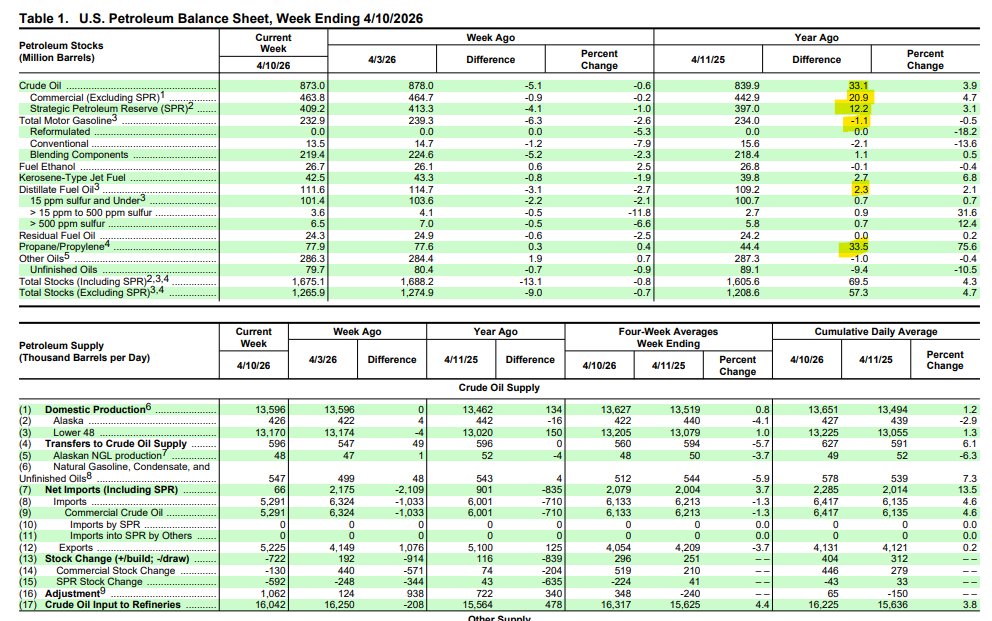
Big EIA draws. Get used to that for a while. Notably - demand is excellent. Prices have had no impact. The excess inventories highlghted over last year will be in freefall. I'd expect a much larger draw next week.
Unintended Consequence tweet media
English
8
7
100
4.8K
Neal Kumar
Neal Kumar@NealFKumar·
Separate out phyical premiums in a specific location vs. loss of supply globally. When I worked at PIRA they drilled out of me arbs/price etc. to look at global supply/demand over the short and long term. Which I'm grateful for. Dr. Ross of course understood how to market to his clients but he knew the fundamentals of price which are supply/demand/inventory/spare capacity change, globally over time. North Sea physical diffs can be higher or lower based on the specific dates/pricing/refinery demand or whatever games the North Sea traders are playing at the time and how their CFDs or derivatives are pricing in or out. What matters is the loss of production over whatever this period of time will be during the war, the inventory draw (SPRs and commercial), and then where price has to balance supply/demand to allow for inventory and spare capacity to get rebuilt. It is very difficult for me to think that a 600mln-1bbl bbls draw at least of crude + products is going to result in anything except substantially higher prices across the board. Product inventories both govt and commercial in particular have to be rebuilt and cracks have to move up to incentivize this, meaning crude will have to follow up product flat price even if short term cracks are negative to force crude conservation (this will create a product draw, already happening in the US). Import bbls cheaper than native bbls have to flow to Europe to make cracks positive, especially with no Urals or Russian VGO. We are seeing this at speed, and once the paper traders' risk managers are not in complete panic and traders get paid their bonuses from last year in full, they will start to bid the paper higher.
English
1
0
3
160
Javier Blas
Javier Blas@JavierBlas·
Tentative signs -- with a lot of emphasis on tentative-- of easing in the European physical oil market. Dated Brent is falling below $120, and lots of offer today on the key trading window (compared to overwhelming bids in recent days). Physical premia also dropping a bit.
English
27
62
498
154.9K
Hamilton Brewer
Hamilton Brewer@hamilton_brewer·
@options_insight Dealers caught short topside gamma exacerbating the spot move higher? Any sense if that’s worked its way thru the mkt?
English
0
0
1
378
Imran Lakha | Options Insight
Imran Lakha | Options Insight@options_insight·
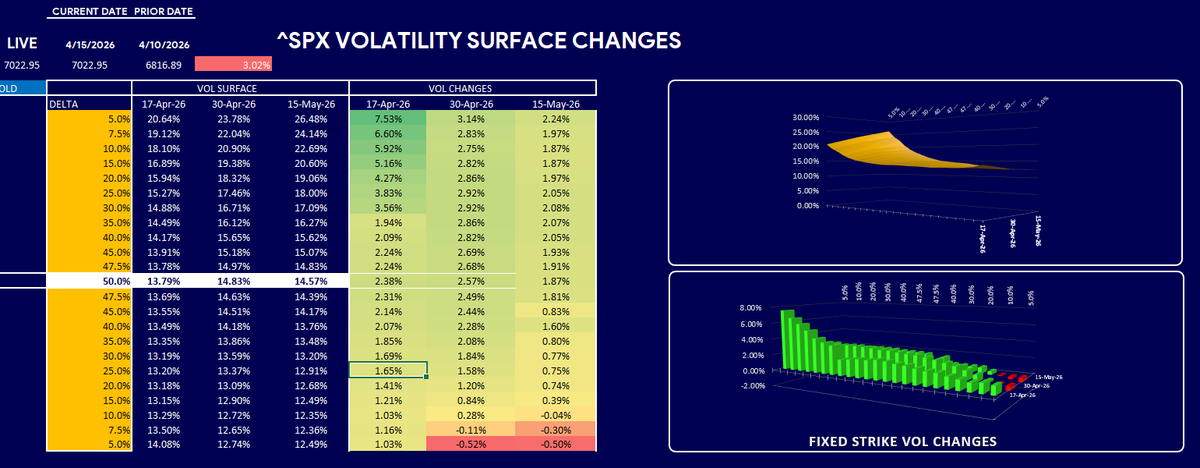
Since last Friday spot up 3% in a straight line and fixed strike vol bid only. Doesn't smell like a market that is long gamma...
Imran Lakha | Options Insight tweet media
English
4
5
65
11K
Anton Likhodedov
Anton Likhodedov@ALikhodedov·
It is roughly equal the BFOETM cash forward (the difference is EFP which has been minimal so far). In terms of delivery timing (on BFOETM forward) my understanding that it would be sellers option - so I imagine with current structure she will deliver as late as possible (late June). If you do not do an EFP before expiry June future settles on ICE Brent index. The formal description is below but back of the envelope the methodology is meant to represent actual physical cargo trades for June delivery - on expiration date/time (calculated in 3 different ways). ice.com/publicdocs/fut…
English
2
0
3
147
Rory Johnston
Rory Johnston@Rory_Johnston·
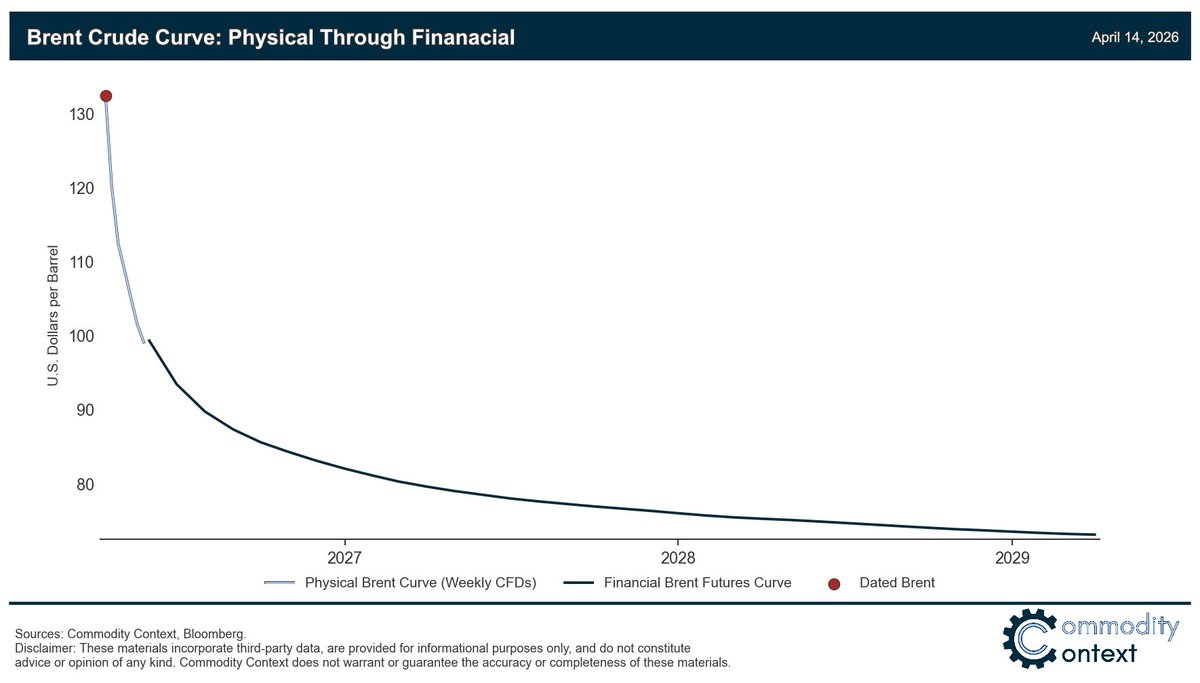
Charting the Brent complex today to add some context to the numbers bouncing around. Pretty well everything weird in the current oil market can be explained via *extreme* backwardation (i.e., near-term delivery premia), and as you can see the intense futures curve backwardation extends into even more acute backwardation in the physical Brent CFD pricing curve. Keep in mind that physical deliveries are currently going for ~$20/bbl *over* Dated Brent atm, representing yet more backwardation through to final delivery and yielding ~$150/bbl physical crude acquisition price. Brent phys traders please do share your feedbacks on anything critical I've glossed over (or how best to visualize that physical delivery premia)
Rory Johnston tweet media
English
43
60
469
152K
Hamilton Brewer
Hamilton Brewer@hamilton_brewer·
@ALikhodedov @investinguab @Rory_Johnston To confirm I understand, the June ICE Brent contract (expiry 30Apr) is a volume weighted average of June BFOETM cash fwds traded for June loading? If that’s roughly correct, are there currently any BFOETM cash fwd trades already building the average?
English
1
0
1
145
Anton Likhodedov
Anton Likhodedov@ALikhodedov·
@investinguab @Rory_Johnston no - Dated on 30.04 will reflect May physical loadings, June ICE Brent - June (later) loadings. I would though expect them to get closer on expiry... But cannot guarantee. It did happen for the previous future.
English
2
0
10
941
Hamilton Brewer
Hamilton Brewer@hamilton_brewer·
@FlipperMsc @CRUDEOIL231 Thanks for color. So assuming flat price and curve shape remain the same for simplicity, where do you get $122 convergence price from?
English
0
0
0
56
flipper
flipper@FlipperMsc·
@CRUDEOIL231 I think you are wrong in convergence assessment. Ice Brent index has another essentially date tenor of duration. So if today's Dates (132.74) holds the ice index will converge to something closer to 122. Which is still substantial carry of more than $1 dollar per day.
English
2
0
6
2.9K
JH
JH@CRUDEOIL231·
What is the North Sea physic mkt, and how should the gap between the paper and physical markets be resolved? Every time I post about the physical market, I see a lot of complaints about why oil prices aren't rising further. Many ppl even criticize me, claiming I’m not explaining things properly. First, I’ll summarize the basic components of the North Sea market. ICE Brent Futures: A financially settled paper contract used primarily for broad directional hedging and speculation without the intention of physical delivery. EFP (Exchange of Futures for Physical): A swap that acts as a bridge, allowing a trader to convert a paper futures position into a physical cargo contract. Forward Brent: A standardized OTC physical swap for future delivery. It represents actual oil but remains non-dated bc the exact loading schedule is not yet determined. Dated Brent: The global benchmark price for physical crude. It is assessed daily by agencies like Platts based on actual trades of the most competitive grade within the BFOET+WTI basket, triggered once specific loading dates are confirmed (typically 10-30 days prior). CFD: A short-term swap representing the price difference between Forward Brent and Dated Brent. It is used to plot the physical forward curve and assess whether the market is in contango or backwardation. DFL (Dated to Frontline): A swap that links the physical Dated Brent assessment directly to the front-month ICE Futures contract, managing exposure between the physical and financial markets. Diff (Grade Basis): The premium or discount applied to a specific physical cargo relative to the Dated Brent benchmark. Driven by crude quality, logistics, and refinery demand, this unhedgeable spread is where physical traders generate profit. This alone should be enough. From there, I’ll explain how the gap between the paper market and the physical market actually closes. A massive divergence between Dated Brent (physic) and ICE Brent futures (paper) typically indicates acute near-term physical tightness relative to forward expectations. If Dated Brent remains at $120-130/bbl leading into the expiration of the front-month ICE Brent futures contract (currently around $100/bbl), the futures contract must converge toward the physical price. The convergence is not optional; it is mathematically enforced by the exchange's settlement rules and market arbitrage. This operates through three primary mechanisms: 1) Cash Settlement via the ICE Brent Index ICE Brent futures are cash-settled upon expiration and do not involve physical delivery. Expiring contracts are settled against the ICE Brent Index. The Index is a calculated average of trading activity in the relevant physical Forward BFOET(Brent, Forties, Oseberg, Ekofisk, Troll)+WTI Midland market during the final trading days of the futures contract. Bc Forward Brent and Dated Brent are intrinsically linked, a physical market sustaining $130 will generate an ICE Brent Index near $130. Consequently, any futures positions left open at expiration are forcibly settled at this higher Index price. 2) The Arbitrage Channel (EFP Mechanism) If a $30 spread exists between paper and physical markets, traders will immediately exploit the arbitrage using the EFP mechanism. Traders buy the undervalued ICE Brent futures at $100 and simultaneously sells a physical Forward Brent cargo at $130. They execute an EFP to swap their long paper futures position into a long physical Forward position. The newly acquired long physical position cancels out their short physical position, locking in a profit (minus the EFP swap cost). To execute this arbs on a large scale, traders must aggressively buy ICE futures. This massive purchasing volume forces the futures price up until the gap closes and the arb window is eliminated. 3) Forced Short Covering Market participants holding short positions in the ICE Brent futures market face extreme risk if the physical market disconnects to the upside. Knowing the contract is destined to cash-settle against a $130 physical Index, paper shorts cannot afford to hold their $100 positions into expiration. They are forced to buy back their futures contracts to close their positions before the expiry date. This forced buying—often resulting in a short squeeze—accelerates the upward momentum of the ICE futures price, driving it into alignment with the physical market. Through the combination of final index settlement and active EFP arbs, the paper market is structurally tethered to physical reality as expiration approaches. #oott #iran
English
103
315
1.8K
336.6K
Hamilton Brewer
Hamilton Brewer@hamilton_brewer·
@Rory_Johnston If you applied hist. relationships vs the current situation, what is the expected price impact? Assuming 1) underproduce 800mio-1bio bbls 2) draw of potential 800mio from inventory 3) SPR releases & offsets etc. I know difficult to put in a formula but wondering if you've modeled
English
0
0
0
281
Rory Johnston
Rory Johnston@Rory_Johnston·
IEA ready for further SPR releases on top of the record 400 million barrels already announced. Even if this crisis ends by the end of the month the market is looking at upwards of a BILLION barrels unproduced given Gulf shut-ins. Won't be surprised to see more SPR announcements
Rory Johnston tweet media
English
17
32
216
38.4K
Hamilton Brewer
Hamilton Brewer@hamilton_brewer·
@ALikhodedov Poorly worded question. I meant, assuming we underproduce 800mio-1bio barrels & draw 800mio from inventory, what is the expected price impact. Just typing that out don't need to be a genius to know it's higher lol, but curious re the inputs (ie end in Apr or May, restarts, etc)
English
1
0
0
87
Anton Likhodedov
Anton Likhodedov@ALikhodedov·
@hamilton_brewer you mean supply response? I do not have a model for that but supply response will be irrelevant on 3-6mo horison ....
English
1
0
3
291
Anton Likhodedov
Anton Likhodedov@ALikhodedov·
Reading some macro commentary - both on X and on distribution lists. Main theme - how things are getting better and Trump not having appetite for another military escalation (and I would agree with latter). The weird part is that almost noone mentions production/inventories - seems that the market cared in March, but now when supply crunch got more severe, decided to move on. Escalate to deescalate, negotiate- it is all fine. But every day we are losing 13mb of liquids production and 10mb of inventory. If US blockade goes into force, we will be losing another 1.5mbd. I am not even talking about other stuff (gas, fertilisers etc). So while sentiment may be better and military risks may be lower, commodity inventory math gets worse and worse. It is essentially a time bomb - and unless it is diffused relatively quickly the world is in trouble. One could have an idea that it all will get mostly resolved before shit really hits the fan - it is possible, but to just ignore the biggest elephant in the room is bizzarre. The market assumes that "it will get resolved" - and I agree with that - too many powerful actors would suffer if it did not. But it also acts as if it does not matter how long would the resolution take, which is categorically not true. PS For the record, I am an optimist and in some ways "nothing ever happens" guy - just cannot understand how is it possible to simply ignore the problem right in front of you.
English
8
6
47
4.4K
Rory Johnston
Rory Johnston@Rory_Johnston·
No, WTI isn't trading at a premium to Brent Front month WTI contract is barrels for May delivery; front month Brent now trading June WTI premium you're seeing is just huge prompt pressure (WTI prompt backwardation just hit a record) Delivery-month adjusted WTI-Brent spread:
Rory Johnston tweet media
English
25
82
653
88.3K
Anton Likhodedov
Anton Likhodedov@ALikhodedov·
Yes, thank you - this is what I assumed in my original comment, although have never actually done it. But given that ICE Brent/WTI is only one of 4 variables and others (MEH-WTI, DFL, freight) are large and volatile - ok you can calculate and see if the arb is open or not, but it does not tell you whether Brent/WTI is too low or too high. In normal times MEH-WTI, DFL etc are much more stable and also just smaller vs Brent-WTI, so you can link arbitrage to the spread. But now it is different. To put another way - in normal times Brent/WTI spread explains, I think a bigger part of arb calculation than now - when other components are large and not stable.
English
3
0
1
259
Hamilton Brewer
Hamilton Brewer@hamilton_brewer·
@tleilax___ Incredible story. Feels like this anecdote belongs in the book The World for Sale!
English
0
0
3
338
Yet another commodity guy
Yet another commodity guy@tleilax___·
A Trading Lore story : Calories, Credit and Kalashnikovs They sent us to Yemen to sell sugar. That was the official wording, anyway. In commodity trading, the official wording is usually the funniest part. We were not shipping teddy bears or Swiss watches. We were shipping cheap calories in fifty-kilo bags to one of the poorest places on earth, through a war zone, to men our compliance department would have preferred to describe only in the passive voice. I was middle-aged by then, old enough to know better and still young enough to get on the plane. My company wanted a long-term sugar deal in Yemen. The buyers controlled the only refinery in the part of the country they held. If you wanted to feed those provinces something cheap, safe, and easy to move, sugar was the obvious answer. People who have never been poor tend to underestimate sugar. It keeps. It travels. It does not ask for refrigeration, stable electricity, or functioning roads. Stir it into tea and you have calories. Tea, in turn, means boiled water, which in places like that is not a lifestyle detail. It is risk management. At the airport, a four-wheel drive was waiting on the tarmac side of the chaos. So was an armed escort. Someone handed me a bulletproof vest with the cheerful efficiency of a hotel porter offering a rain umbrella. Three or four hours, they said. Through the desert, they said. Better to leave now, they said. Nobody said anything reassuring, which I appreciated. Reassurance in those places is usually a sign that somebody is lying. We drove for hours across a landscape that looked less like a country than like the aftermath of an argument between God and artillery. Villages were broken open. Houses were pocked and slumped. Children stood in the dust and watched us go by with the flat expressions of people who had already seen too much to be impressed by another convoy. Yemen was poor before the war. War had simply made the place more honest about it. By the time we arrived, the light had turned the color of old brass. The gathering was set around a large tent, because the men we had come to meet were semi-nomadic and saw no reason to pretend otherwise. There were a few hundred people, maybe more. Boys, old men, cousins, guards, spectators. Everyone seemed to have an AK-47. Not metaphorically. Literally everyone. If there had been a kid carrying a rifle, I would not have been surprised. We waited off to one side in a smaller tent while the choreography sorted itself out. Tea arrived. More men arrived. A few very serious-looking fellows stared at me as if calculating my resale value. Half an hour later, I was ushered forward to meet the man who mattered. He was perhaps in his sixties. Perhaps in his seventies. In that part of the world, age is often less a number than a texture. He sat on carpets inside the tent, calm and composed, and to my surprise he reminded me a little of my grandfather. Not in politics, obviously. More in the face. The eyes. The way some men can sit perfectly still and make everybody else seem hurried. Tea was poured. Polite conversation was made. Then we discussed the real matter at hand, which was whether his side would buy roughly half a billion dollars' worth of sugar from my side over the next five years. There is something wonderfully absurd about the fact that global trade, for all its models and freight curves and credit committees, eventually comes down to one man in a tent deciding whether he likes the other man's manner. We negotiated, because one must. Nobody ever feels they have made a good deal unless they have suffered a little on the way to it. There was some back and forth, a little theatre, a little firmness, a few pauses to let silence do its work. In the end we shook hands on terms. We agreed on a fixed lump sump premium for payment terms, because in Islam, credit itself is haram. That was the contract. No lawyers. No signatures. No polished conference room. The man did not write, and in any case had no interest in memorialising the agreement in the style preferred by European auditors. His word was his bond. Which is a noble principle, though a difficult one to explain to compliance. I remember thinking, not for the last time in my career, that the internal memo would be far stranger than the actual risk. Afterward they gave us lunch. Meat grilled over fire. More tea, won't sleep. Late afternoon settling over the camp. For a brief hour it all felt almost ordinary, which is the most dangerous feeling in places like that. Once something starts to feel ordinary, you begin to forget where you are. Fortunately the guards had not forgotten. They told us it was time to leave. You did not want to drive those roads after dark. Too many ways to disappear. Mines. Ambushes. Bad luck. Storms. Mechanical issues. The desert has a broad imagination. So we climbed back into the vehicle and began the long drive out, racing the light over dirt roads and through the mountains, all the way back to where civilization, such as it was, resumed its administrative duties. That should have been the end of it. A good trading story. One more entry in the large and not especially honorable anthology of how commodities actually move around the world. But a week later, a humanitarian convoy took the same dirt road through the mountains that we had taken. The Americans droned it. Same road. Same type of vehicle. Same landscape. Different luck. That was the moment, I think, when I decided that physical commodity trading in those parts of the world had become too literal for me. I had always known the business involved freight, credit, politics, and appetite. I had not realized until Yemen that sometimes the margin was measured in timing, dust, and whether somebody looking at a screen from very far away decided your car belonged in the world. In the trade, we say "time is of the essence". In Yemen, I learned just how true that could be.
English
14
20
226
14.5K
Hamilton Brewer
Hamilton Brewer@hamilton_brewer·
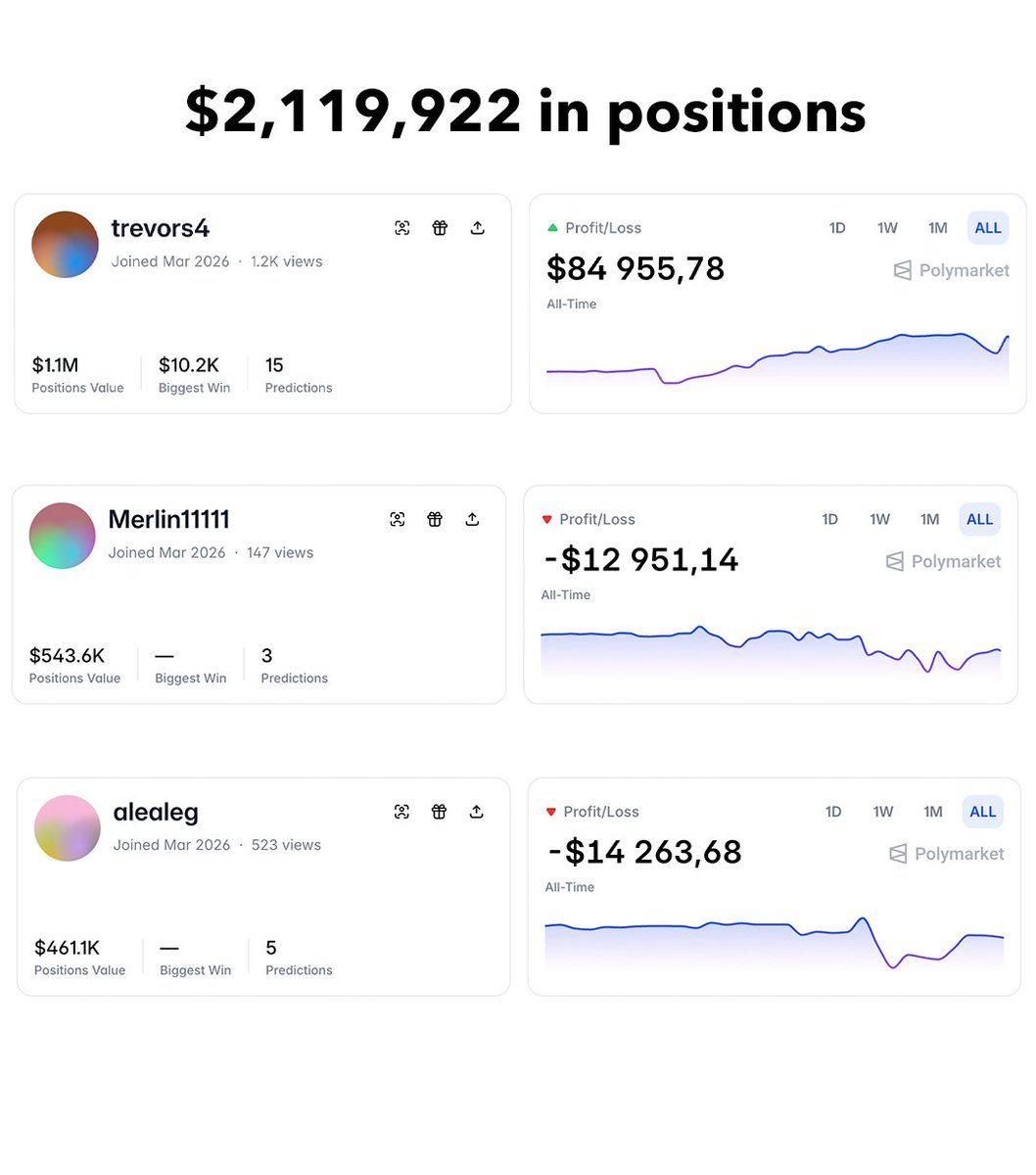
@itslirrato Is the payout usually that unattractive if this were an insider? Risk 2.1mio to make 2.6mio doesn’t scream like a great trade. I guess if it’s a sure thing who care lol
English
0
0
1
200
Lirratø
Lirratø@itslirrato·
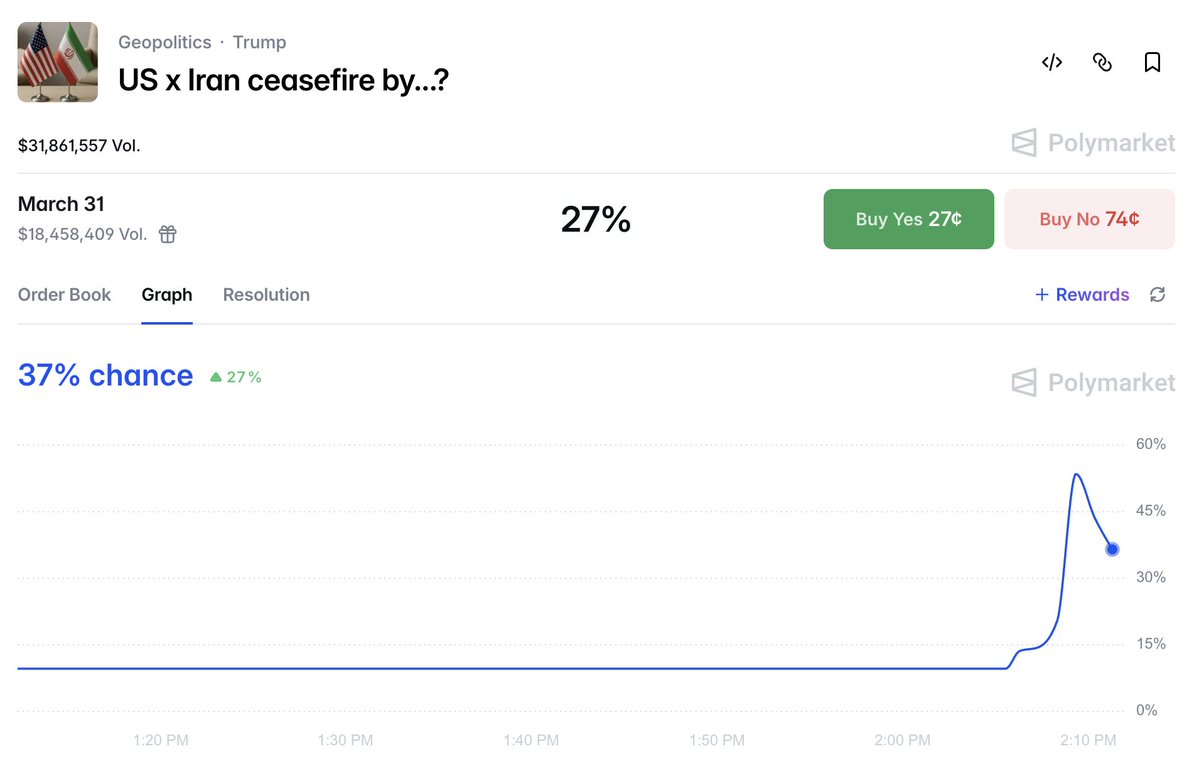
Just uncovered a suspicious group of wallets with $2,119,922 in positions They weren’t hard to find: All 3 follow the exact same funding pattern with massive tranches - Fresh wallets (joined March 2026) - Funded via Solana with zero prior history - No other onchain activity - Betting NO on US x Iran ceasefire by March 31 - Betting NO on US forces entering Iran by March 31 - Betting YES on US forces entering Iran by April 30 Total Potential Payout: $2,590,844 There’s zero doubt these belong to the same entity And $2.1M across fresh wallets on the same thesis doesn't look like a coincidence I’ll drop the links to these wallets in the replies so you can track what they do next
Lirratø tweet mediaLirratø tweet mediaLirratø tweet media
English
45
68
346
38.8K
Hamilton Brewer
Hamilton Brewer@hamilton_brewer·
@itslirrato do you track if they already took profit (ie sold the position out)? or are they holding onto the trades?
English
0
0
0
32