
Hap Rho
74.2K posts


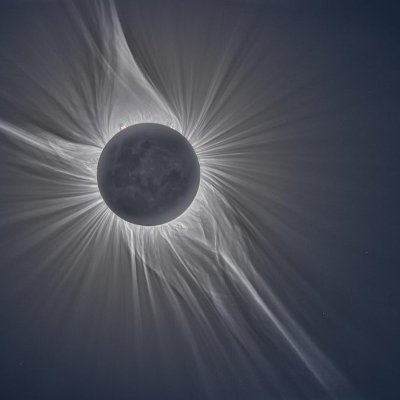
May 3, 1715 (311 years ago), A total solar eclipse was visible across northern Europe and Russia, as predicted by Edmond Halley to within four minutes accuracy. Halley used Newtonian mechanics to predict the eclipse’s path and urged observers to record the times and durations of the eclipse as it passed over them, promoting rational understanding of eclipses rather than superstition.


47 Million Galaxies in One Jaw-Dropping Cosmic Map Astronomers just pulled off something extraordinary.The DESI instrument has finished its five-year mission a year early, and the result is the largest, most detailed 3D map of the Universe ever made. Instead of the planned 34 million galaxies and quasars, it bagged more than 47 million — plus another 20 million stars. That’s six times more data than every previous cosmological survey combined. A true game-changer.A Marvel of EngineeringSitting on the 4-meter Mayall Telescope in Arizona, DESI is like a cosmic vacuum cleaner with superpowers. Every 20 minutes, 5,000 robotic fiber-optic “eyes” swivel into position with mind-blowing precision — accurate to just 10 microns, thinner than a human hair. These fibers capture faint light from distant objects, which ten powerful spectrographs then tear apart into rainbows of color. From that light, scientists read each galaxy’s distance, speed, and chemical DNA.It’s precision engineering meeting the edge of the observable Universe.The Big Question: Is Dark Energy Changing?All this data is aimed at the biggest mystery in cosmology: dark energy — the invisible force that’s speeding up the expansion of the Universe.We used to think it was constant. But early DESI results already suggest it might be evolving over time. If the full dataset confirms this, everything we thought we knew about the ultimate fate of the cosmos could be upended. Will the Universe keep expanding forever? Rip itself apart in a “Big Rip”? Or head toward something even weirder?This single map reaches back 11 billion years — more than three-quarters of the entire history of the Universe. And yet, the real work is just beginning. Years of analysis lie ahead as scientists dig through this unprecedented treasure chest of data.The night sky just got a whole lot more mysterious — and a whole lot more exciting.


Rockets don't and never will work in a vacuum.