Harsha Perera

5K posts

Harsha Perera banner
Harsha Perera

Harsha Perera

@harshacoach

Explorer of the human condition, Author of Machine Ego (https://t.co/WhMHf8v8ML). Host of The Harsha Reality https://t.co/p2n82Q46O4

Katılım Nisan 2016
227 Takip Edilen778 Takipçiler
Sabitlenmiş Tweet
Harsha Perera
Harsha Perera@harshacoach·
My conversation with the incredible Hugh Brody — anthropologist, filmmaker and author. We discuss life in the Arctic, egalitarian-individualism of the hunter-gatherer, Inuit child rearing, modern pathologies, facing death, the question of human nature, settler-colonialism and more. Enjoy! Time stamps: 0:00 A journey begins 4:42 Into the Arctic 6:00 Learning the language 7:39 Adopted by an Inuit elder 9:00 Becoming a child again 10:45 Inuktitut - 'How to be a person' 12:00 A place of complete equality 13:45 A knowledge economy 15:00 Dealing with unpredictability 15:35 Power seekers were ridiculed 16:53 Egalitarian-Individualism of the hunter-gatherer 18:55 Changing extended family group sizes 20:15 Complete respect for individual decisions 21:13 Hierarchical-Individualism of modernity 23:20 Inuit attitude children is fundamentally different 26:00 Controlling others is unacceptable 28:35 Way of the Hunter VS way of the Farmer 30:33 Agriculturalists think differently 32:40 Derbyshire hills trapped by transformation 35:00 "Work" does not exist as a concept 36:50 Things are either 'easy' or 'difficult' 38:40 Calm perseverance even in the face of death 40:00 Attitude towards anger 41:50 Modern child rearing is destructive 43:40 Absence of modern pathologies amongst the hunter 45:30 Impact of colonialism and imperialism 48:00 New epidemic of youth suicide in the Arctic 49:00 Hunter-gatherer concept of ritualised suicide 52:00 Do hunter-gatherers live more in the moment 53:40 Immediate-return VS Delayed-return societies 55:40 Do hunter-gatherers have an 'ego'? 57:10 What you think your ego entitles you to matters 57:50 Oral cultures and storytelling 1:00:22 Impact of writing on oral cultures 1:04:00 Anaviapik's journal 1:06:00 We lived as hunter-gatherers for most of human history 1:08:20 How did we end up here as species? 1:09:45 We have selected for violence 1:10:40 Is it human nature? 1:11:50 What lessons are realistically portable to modernity? 1:13:10 Model of settler colonialism 1:14:00 Gaza 1:15:00 Recognition and mitigation
English
2
3
11
2.5K
Harsha Perera
Harsha Perera@harshacoach·
The mind needs space to ‘be’ creative. Space to explore, Space to do nothing, Space for things to emerge
English
0
1
3
30
Harsha Perera
Harsha Perera@harshacoach·
“the world cannot be changed by the "wrong" people, however right their doing or not-doing. And, by the "wrong" people, I mean those who act from the feeling that man is separate from the natural universe — either pushing it around or being pushed around by it.”
Alan Watts@AlanWattsDaily

Q. If you knew the atom bomb was about to fall, what would you do? A. I should go right on eating dinner. Q. Do you think mankind is going to blow itself off the earth with atom bombs in the near future? A. No. I think there would be a very serious danger if real do-gooders came to power in the United States or Russia, but since Khrushchev is a gangster and Ike a representative of American business, this won't happen. It's just in the self-interest of both sides not to do it. Q. Do you think mankind is going to blow itself off the earth with atom bombs in the near future? A. No. I think there would be a very serious danger if real do-gooders came to power in the United States or Russia, but since Khrushchev [Putin] is a gangster and Ike [Trump] a representative of American business, this won't happen. It's just in the self-interest of both sides not to do it. Q. Why do you vote at all? As you said before, "The world might change, but not because you're trying to change it." And isn't that merely fatalism? A. Why do I vote? Because if there were a tie and the casting vote might have been mine, I'd feel such a fool. But, seriously, the question shows you're not getting my point. The problem is not whether to act or not to aet, what to do or what not to do. The Chinese saying goes, "When the wrong man uses the right means, the right means work in the wrong way." Thus, what I am saying is that the world cannot be changed by the "wrong" people, however right their doing or not-doing. And, by the "wrong" people, I mean those who act from the feeling that man is separate from the natural universe — either pushing it around or being pushed around by it. The ideas of individual freedom and fatalism rest on the same assumption — that man is separate, the boss or the puppet. In my view, he cannot act with wisdom unless he feels that what he does and what nature does are one and the same.

English
0
0
1
65
Harsha Perera
Harsha Perera@harshacoach·
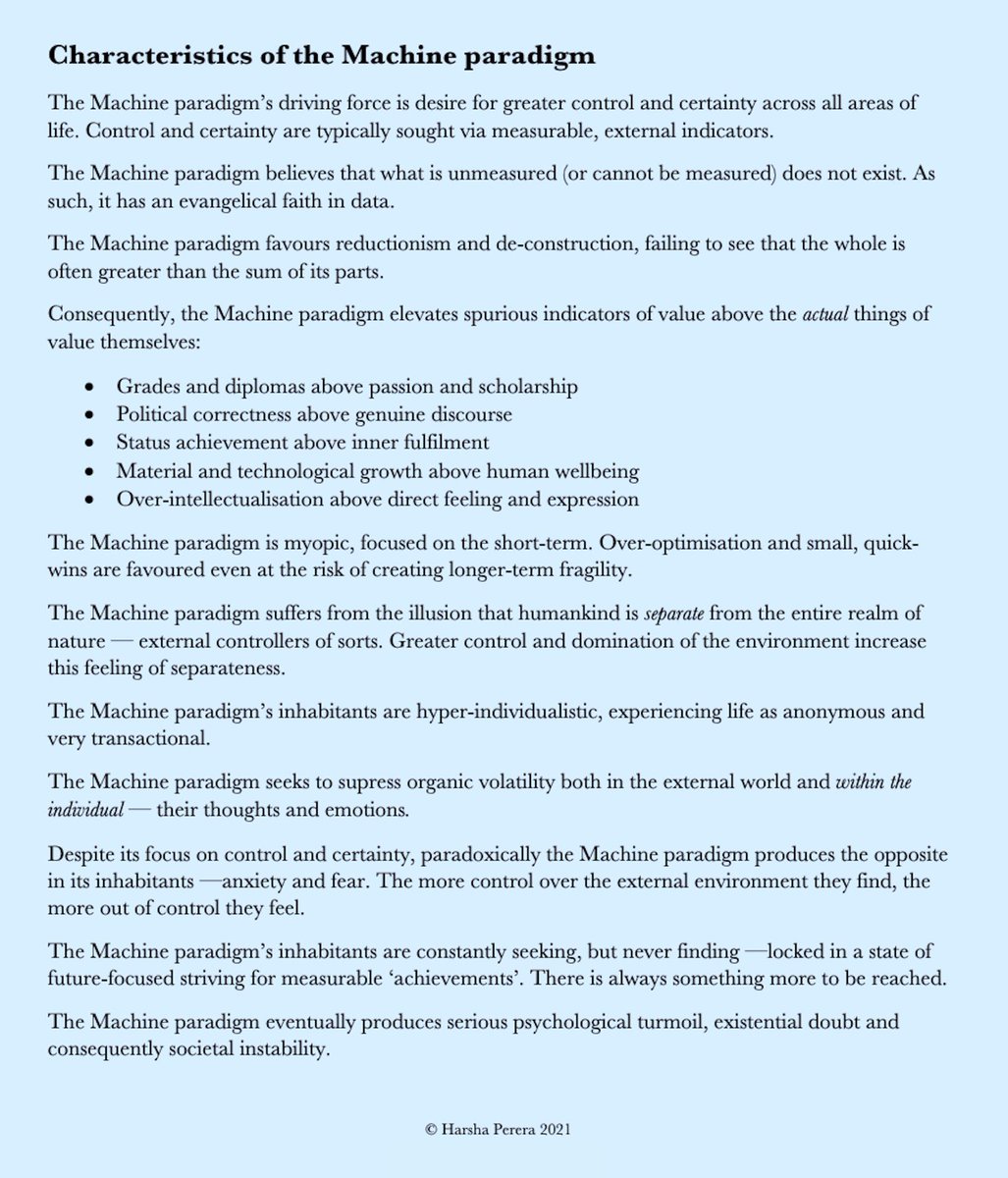
4/ The result is the Machine Paradigm — whose driving force is desire for greater control and certainty across all areas of life.
Harsha Perera tweet media
English
0
1
4
66
Harsha Perera
Harsha Perera@harshacoach·
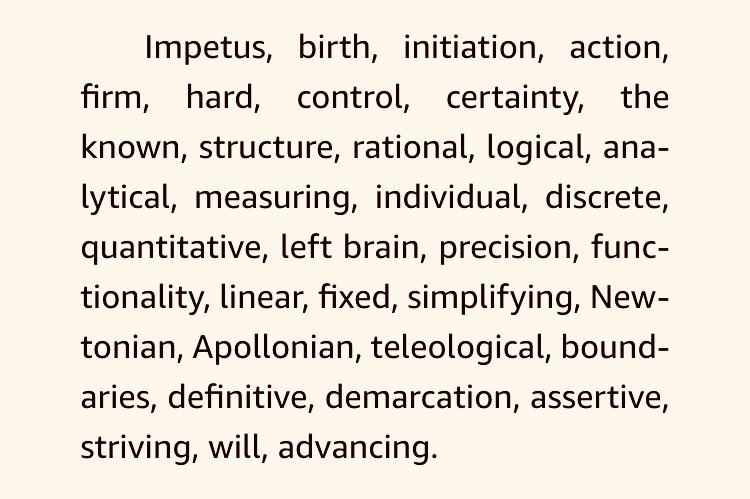
3/ Modernity, both East and West, is increasingly characterised by what we might call Yang forces (over Yin)
Harsha Perera tweet mediaHarsha Perera tweet media
English
1
1
1
123
Harsha Perera
Harsha Perera@harshacoach·
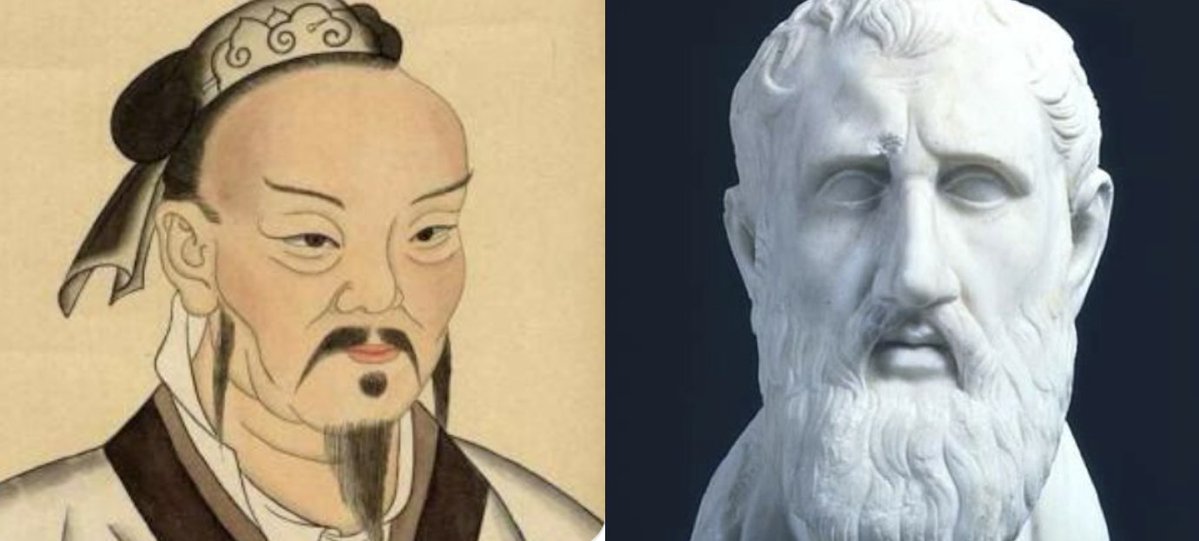
ROOTS of INDIVIDUALISM and COLLECTIVISM There is significant overlap between Stoic/Platonic virtues and Confucian ethics, but there are also deep differences: Mencius' Four Beginnings: Ren - Benevolence Yi - Righteousness, justice Li - Propriety Zhi - Knowledge, wisdom Stoic Virtues: Sophia - Wisdom Andreia - Courage Sōphrosynē - Temperance Dikaiosynē - Justice Growing societies of the time were all grappling with the problems of how to coexist and thrive at scale. Cultivating virtues such as wisdom, consideration for others and justice would unsurprisingly be beneficial whether in Zeno's Athens or Mencius' Zou (4th CBE). The biggest difference between the two broad traditions is that while the Confucians emphasised Ren (benevolence, human heartedness) the ancient Greeks tended to emphasise Sophia (wisdom, reason) more. Further, for Mencius the root of justice was shame — "the feeling of shame is the origin of righteousness" — while the ancient Greeks tended to emphasise correct action based on reason. Sōphrosynē (temperance) was based on self-mastery, where as Li (propriety) emphasised proper and harmonious social relations based on ritual and filial piety. One system of morality is more inside out (individualistic), while the other is more outside in (collectivist). This difference is highly visible today in what we loosely refer to as the East and West.
Harsha Perera tweet media
English
1
2
12
4.6K
Harsha Perera retweetledi
Carl Jung Archive
Carl Jung Archive@QuoteJung·
Has anyone else noticed that the shadow doesn’t actually want to be integrated?
English
100
45
544
32K
Harsha Perera
Harsha Perera@harshacoach·
If we take a psychological perspective, the behaviour of Israel may be viewed as the traumatised victim becoming the bully — where the decedents of those who suffered the horrors of the Holocaust are now perpetuating another genocide less than 100 years later. Unable to heal, and deeply insecure about its own situation (a nation structurally set up and governed to be fragile), it torments and kills the weak. Violence begets violence.
English
0
1
4
83
Harsha Perera
Harsha Perera@harshacoach·
@SahilBloom The most sinister, existential kind of white-collar burnout, comes not from work that you find entirely boring or meaningless — but from chasing achievement doing such work. Being empty of any purpose, meaning is sought in climbing some career ladder.
English
0
0
2
17
Sahil Bloom
Sahil Bloom@SahilBloom·
I'm increasingly convinced that burnout doesn't come from working long hours or weekends. The people I know who burned out were the ones who were really bored with their work, not the ones who worked the most hours. Burnout comes from working on things that don't energize you.
English
311
154
2.1K
97.1K
Harsha Perera
Harsha Perera@harshacoach·
집옥재 Jibokjae —meaning “collecting jade-like treasure” — is the late 19th century library of the last king of Joseon, Korea. It originally housed 40,000 books
Harsha Perera tweet mediaHarsha Perera tweet media
English
0
0
3
103
Harsha Perera retweetledi
tocarista de bateria
tocarista de bateria@banksflah·
Concordo! Tal gênero pode não ser agradável aos meus ouvidos, mas isso não significa que artistas daquele estilo não sejam bons para o que se propõe. O contrário tb acontece, existir artista ruim dentro do gênero que gosto.
Harsha Perera@harshacoach

@1ssve True sophistication in music is being able to separate one’s personal taste and quality. Most people think what they don’t like is not good. You know some is a real connoisseur when they say something like “it’s not my taste, but it’s very good”

Português
0
1
2
161
Harsha Perera
Harsha Perera@harshacoach·
Individualism fractures the collective, while collectivism crushes the individual
English
0
0
2
83
Parmita Mishra
Parmita Mishra@parmita·
I want to learn how to be happy. I already know how to have lots of energy and laugh a lot. But that’s not my aim I want to learn how to be happy specifically.
English
40
0
73
4.1K
Rob Henderson
Rob Henderson@robkhenderson·
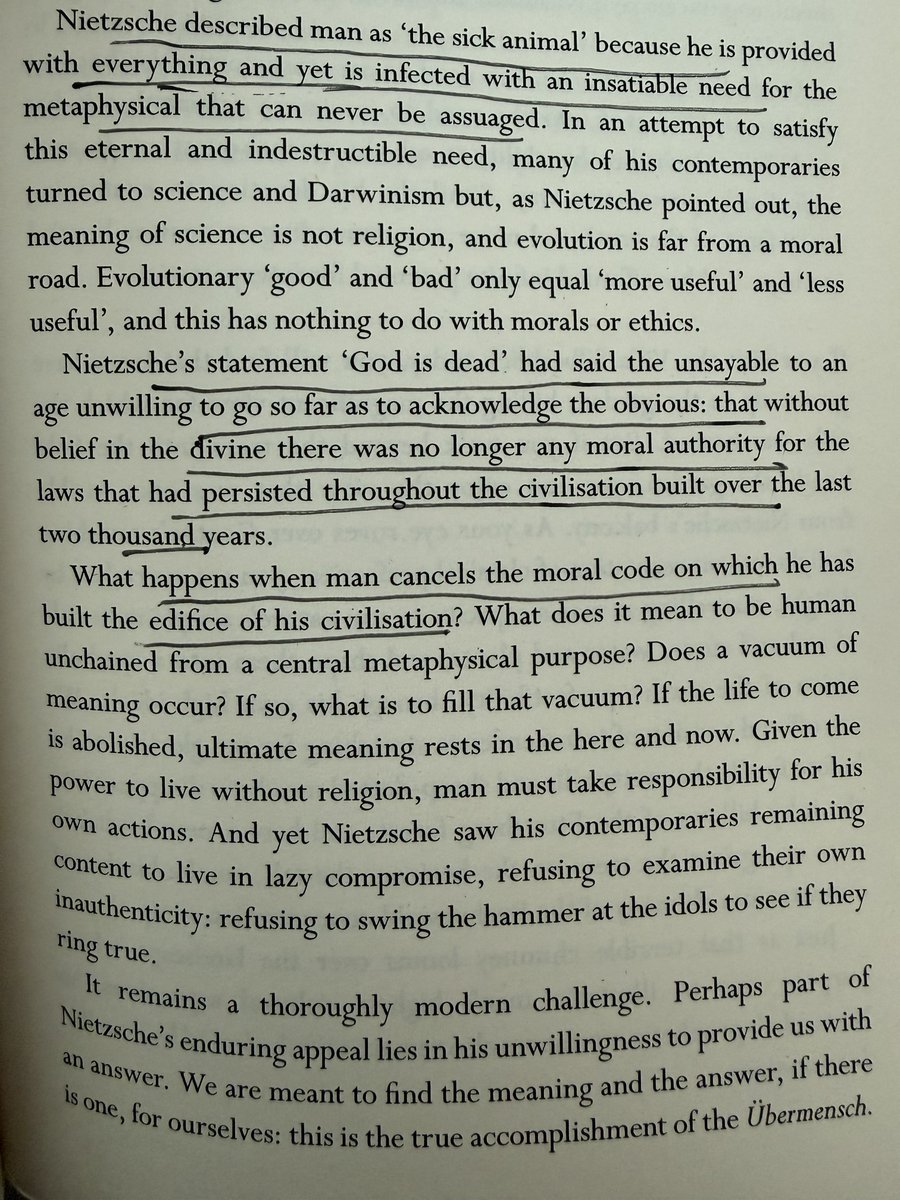
"Nietzsche's statement 'God is dead'...there was no longer any moral authority for the laws that had persisted throughout the civilization built over the last two thousand years. What happens when man cancels the moral code on which he has built the edifice of his civilization?"
Rob Henderson tweet media
English
6
20
119
5.2K
Harsha Perera
Harsha Perera@harshacoach·
@1ssve True sophistication in music is being able to separate one’s personal taste and quality. Most people think what they don’t like is not good. You know some is a real connoisseur when they say something like “it’s not my taste, but it’s very good”
English
12
41
955
48.6K
S.🎧
S.🎧@1ssve·
I truly believe music taste is somewhat a reflection of intelligence
English
313
1.9K
19.8K
1.3M
Harsha Perera
Harsha Perera@harshacoach·
Last of the cherry blossoms in Seoul
Harsha Perera tweet media
English
1
0
6
140
Tom Goodwin
Tom Goodwin@tomfgoodwin·
If you brought someone into 2025 from 1825. What would be the most amazing things they'd notice, that we don't tend to think about .
English
55
0
9
12.3K
Harsha Perera retweetledi
Marci Shore
Marci Shore@marci_shore·
I've taught European history for 30 years. Americans have always asked me how the Holocaust was possible, how Germans could have enabled a madman reveling in mass murder to carry out his plans. Now we can see in real time how this is enabled; now we have front-row seats.
Marci Shore tweet media
English
5.8K
32.8K
100.2K
1.8M