Håkon G. Grøtta🇳🇴🇺🇦

15.6K posts

Håkon G. Grøtta🇳🇴🇺🇦 banner
Håkon G. Grøtta🇳🇴🇺🇦

Håkon G. Grøtta🇳🇴🇺🇦

@hawkgg

”The US has Ronald Reagan, Johnny Cash and Bob Hope. In Sweden we have Olof Palme, no cash and no hope". MCFC. Liberal Conservative

Trondheim, Norge Katılım Şubat 2014
1.1K Takip Edilen448 Takipçiler
Håkon G. Grøtta🇳🇴🇺🇦 retweetledi
Phil Magness
Phil Magness@PhilWMagness·
From the manuscript notes of Hayek's Road to Serfdom, recently scanned by Hoover. Hayek was well-read in Carl Schmitt, and very much not a fan.

Phil Magness tweet media
English
1
7
36
5.2K
Håkon G. Grøtta🇳🇴🇺🇦 retweetledi
Dr Daniel Pitt
Dr Daniel Pitt@DanJTPitt·
47 years ago, Margaret Thatcher become the first female PM and proceeded to win two landslide elections in 1983 and 1987. She was the longest continuously serving PM since 1827. She: 🔹️Cut tax 🔹️Cut public spending 🔹️Raised living standards 🔹️Increase home ownership
Dr Daniel Pitt tweet media
English
6
12
71
1.1K
Håkon G. Grøtta🇳🇴🇺🇦 retweetledi
Blueboy UwU🌐🦅🏛️
The totalitarian world produces backwardness because it does such violence to the spirit, thwarting the human impulse to create, to enjoy, to worship - Ronald Reagan
Blueboy UwU🌐🦅🏛️ tweet media
English
1
4
20
485
Håkon G. Grøtta🇳🇴🇺🇦 retweetledi
Henry Gao
Henry Gao@henrysgao·
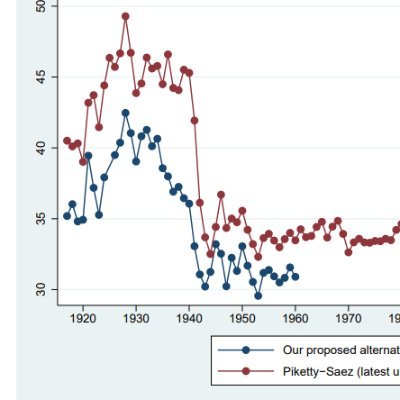
The answer can be found in this excellent paper by the late Martin Ravallion, former Director of the World Bank’s research department and ex-President of the Society for the Study of Economic Inequality (h/t to @land_apostle): nber.org/papers/w28370
Henry Gao tweet media
Henry Gao@henrysgao

For those who kept saying that the CCP has lifted 800M people out of poverty, have you ever wondered who put them there in the first place?


English
18
14
99
13.4K
Håkon G. Grøtta🇳🇴🇺🇦 retweetledi
Rafael R. Guthmann
Rafael R. Guthmann@GuthmannR·
Rodrik's research is very popular among Brazilians because he provides an intellectual justification consistent with mainstream economic theory for our stupid policies that caused enormous harm to our development. The idea that currency devaluation is a good policy for developing countries comes from the correlation between industrialization and development in the 19th century. Back in the day, people looked at Britain, at the time the world's richest country, and saw lots of smokestacks. Therefore, they concluded, one must maximize the number of smokestacks in the nation to become rich! The lead to policies such as currency devaluation, among others, because such a policy increases the local prices of manufactured goods, and therefore acts as a subsidy for industrial activity. Brazil took this idea to its logical limit and created an economy where industry reached over one-third of GDP in the 1980s without any comparative advantage for it. Did it work? Of course not, Brazil reached the end of the 20th century with the lowest standard of living of a major country in the Western world. In fact, I would expect that developing countries should have strong currencies. That is so because developing countries have little capital, so the marginal return of investment should be high, which should attract capital flows, causing the currency to become overvalued. Thus, one should expect export sectors to become underdeveloped in developing countries. In practice, the inverse tends to happen: international investors see developing countries as dangerous destinations for their capital compared to the good'ol S&P 500, and developing countries' currencies tend to be extremely cheap. As developing countries have great growth potential, one often finds that cheap currency is associated with growth. In addition, these countries' export sectors tend to become highly developed because exporting can earn "hard currency" that is much stronger than their local currency. Thus, the statistical correlation between fast growth, devalued currency, and export-oriented economies.
Rafael R. Guthmann tweet media
Joseph Steinberg@jbsteinberg

It's certainly true that cross-country growth regressions suffer from all kinds of identification problems, but I think we've still learned far more about what generates material improvements in living standards from macro-dev than micro-dev. Empirical macro-dev research isn't bad just because it lacks clean causal identification. That's an impossible bar to meet for macro in general (at least if we want to explain a significant fraction of the economically meaningful variation). There are lots of very bad empirical macro-dev papers, of course, but there are also some good ones. Take Dani Rodrik's 2008 paper on undervaluation and growth (brookings.edu/wp-content/upl…). The main observation is that real exchange rate depreciation (relative to where a country's exchange rate "ought" to be based on its initial level of development) triggers persistent growth in developing countries, but not developed ones. Rodrik's hypothesis is that market imperfections (e.g. financial frictions) that are pervasive in developing countries disproportionately affect the tradable sector (manufacturing relies more on external financing than services in the Rajan-Zingales sense), and depreciation alleviates the effects of these frictions by raising the relative price of tradables. This is important because it tells policymakers that even when fixing the underlying institutional causes of poverty is hard, there may be some second-best options that involve distorting relative prices away from the laissez-faire equilibrium. The paper shows convincing evidence that this is indeed the operative channel: undervaluation reallocates resources from services to industry, and the association between growth and undervaluation is largely explained by this reallocation in a two-stage regression. (IVs can be used to learn something about economics, not just to get identification!) Rodrik is also not just cherry-picking Asian tigers: appreciation hurts growth in lots of African countries in his sample through the same channel. This, in and of itself, provides an important (if underappreciated) cautionary tale about the unintended consequences of foreign aid. Rodrik's identification isn't clean (as Mike Woodford explains in a follow-on comment) and the paper wasn't published in a prestigious outlet (it's in the BPEA), but I think it teaches us more about development than the vast majority of micro-dev papers published in QJE & AER. Moreover, macro-dev isn't just empirics, it's also theory and quantitative modeling. Take the 2019 Econometrica by Itskhoki and Moll (onlinelibrary.wiley.com/doi/abs/10.398…).* I love this paper because it illustrates how market imperfections create a role for government to accelerate growth, but also highlights the tradeoffs and distributional tensions inherent in doing so: "The optimal policy intervention involves pro-business policies like suppressed wages in early stages of the transition, resulting in higher entrepreneurial profits and faster wealth accumulation." Finally, even focusing specifically on the empirical part of macro-dev, it isn't just growth regressions. Like many other subfields of macro, it's also increasingly come to emphasize rigorous microdata work, despite the challenges in collecting this data in developing countries. My colleague, Diego Restuccia, exemplifies this trend with his work on African farm-level data. Overall, I think this research program has been far more successful than many people think. Conversely, the elevation of clean identification as the primary goal of research in development economics has been far less successful in yielding useful insights than many people think. As John Cochrane argues (grumpy-economist.com/p/causation-do…), the primary goal of economic research should always be to explain economically-meaningful variation, even if doing so is inherently messy. * This is the paper I tried (and largely failed) to write in grad school when I was thinking about Rodrik's empirical work. My attempt is preserved for posterity here: joesteinberg.com/pdf/rerpaper. It's amazing to look back and see how far I've come as a researcher in 15 years!

English
11
20
143
12K
DancinAroundWolves
DancinAroundWolves@DancinRoundWolf·
@hawkgg @worldenron @KemiBadenoch Untrue this about Christians in this source. Explain why farmers in S. Africa not counted, Christians murdered in Africa & Mideast, Kurds murdered, churches set on fire in G8 countries, +…?
English
1
0
0
34
Håkon G. Grøtta🇳🇴🇺🇦 retweetledi
Kemi Badenoch
Kemi Badenoch@KemiBadenoch·
The Conservative Party is clear: if you want to spread hatred and violence towards Jews, you are not welcome in Britain.
English
1.3K
705
6.8K
204.1K
Enron 🇬🇧 🇺🇸
@KemiBadenoch what about those spreading hate against christians, white, blacks and muslims? , seems like there is a hierarchy in racism
English
2
0
8
174
Civic Chronicle
Civic Chronicle@CivicChronicle1·
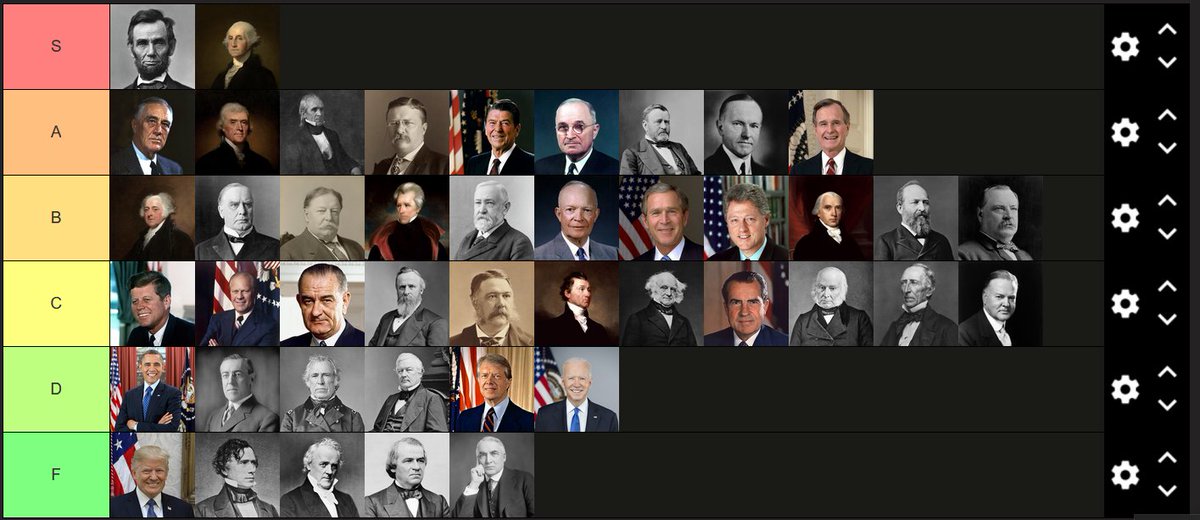
I am going to get cancelled for this ranking?
Civic Chronicle tweet media
English
8
0
11
487
Håkon G. Grøtta🇳🇴🇺🇦 retweetledi
Roman Sheremeta 🇺🇸🇺🇦
A Ukrainian woman voting in the 2022 russian-organized referendum on whether her Ukrainian region should join russia. The so-called referendum was “a total sham, held at gunpoint,” but that didn’t stop Trump’s envoy, Steve Witkoff, from citing it as one of the reasons why the regions occupied by russia should belong to russia. Another reason he gave was that “they speak the russian language.”
Roman Sheremeta 🇺🇸🇺🇦 tweet media
English
157
997
2.6K
48.1K
くそじじい
くそじじい@Nilsern73·
Det er jo greit å rette fokus mot ugreie uttalelser, men jeg skulle ønske AP hadde lignende reaksjon på NTNU-professoren også. For nå virker dette kun som politisk ild på bålet. Eller er det virkelig slik at de mener slik fyllerør er så mye verre enn å hylle 7/10?
Norsk
3
2
45
1.1K
Håkon G. Grøtta🇳🇴🇺🇦 retweetledi
Nick Tyrone
Nick Tyrone@NicholasTyrone·
Because it is central to socialist ideology. They believe capitalism is going to fail in the same way a cult thinks the aliens are coming to Earth to transport them to a utopian planet. It is a prophecy that must be true, otherwise their whole worldview makes no sense.
Romy@Romy_Holland

why does everyone use the term “late stage capitalism” all the time? how do they know which stage it is? we might still be early.

English
10
48
375
7.1K
Håkon G. Grøtta🇳🇴🇺🇦 retweetledi
LibertarianPartyUK
LibertarianPartyUK@LibertariansUK·
LibertarianPartyUK tweet media
ZXX
10
32
429
4.6K
Håkon G. Grøtta🇳🇴🇺🇦 retweetledi
Kosher
Kosher@koshercockney·
In my opinion, this should be shared EVERYWHERE. 20 random westerners sat down to watch what Palestinian kids are taught in UNRWA schools. It may shock you, it may not, either way there are people that have no clue about what is actually going on - so it’s worth sharing. See below thread for the IMPACT-SE independent investigation into UNRWA Palestinian schools.
English
93
1.3K
2.6K
67K
Håkon G. Grøtta🇳🇴🇺🇦 retweetledi
Zac Goldsmith
Zac Goldsmith@ZacGoldsmith·
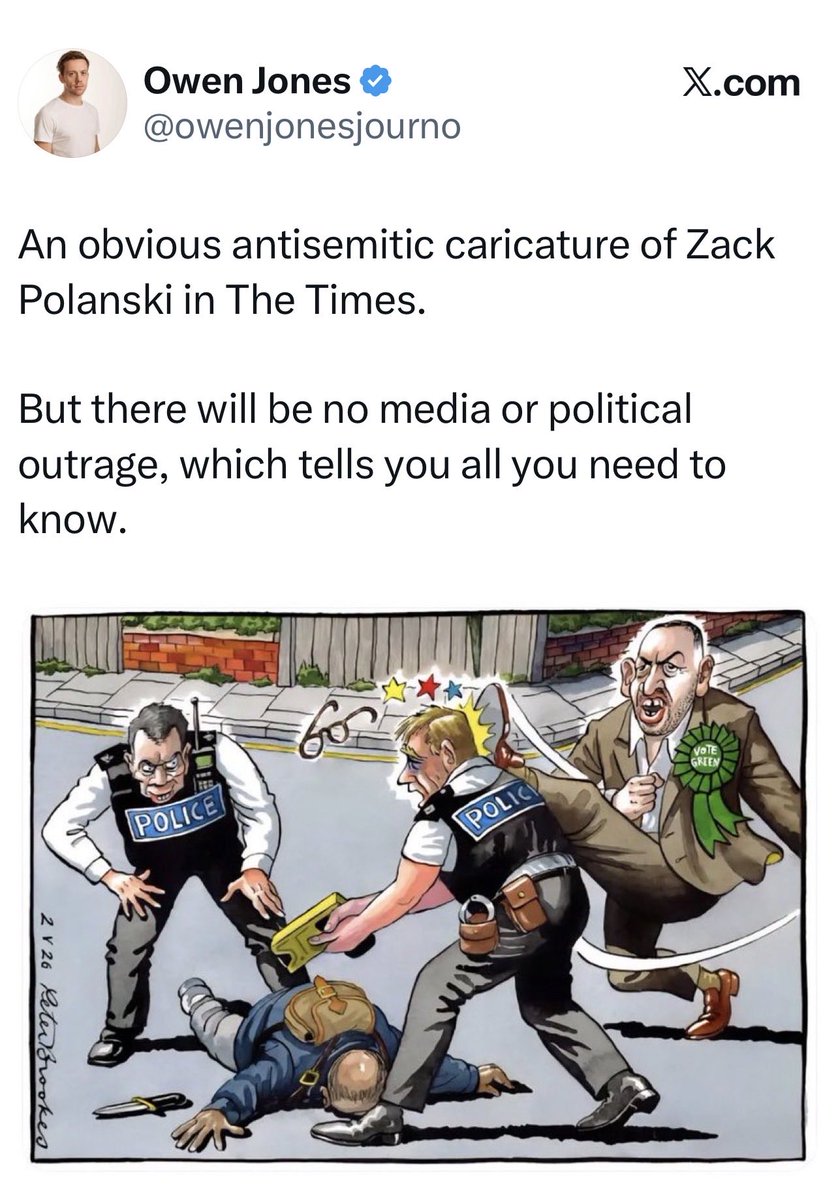
It is astonishing that Owen Jones sees antisemitism here, where there isn’t any, but is seemingly utterly indifferent to antisemitism where it is deafening (ie any comment on Tina Ion (Newcastle) who posts under “thereal.anne.frank” handle and calls for “every single Zionist” to be killed; referred to “money grubbing thieves”, “vermin”, “rats” etc? Or Sabine Mairey (Lambeth) who said “Ramming a synagogue isn’t antisemitism, it’s revenge”? Or Saiqa Ali (Lambeth) who posted that the UK government is “overrepresented with Zionists Jews”; that Trump is “owned by Jews”; and depicted a serpent choking the globe with a Star of David (“cut the head of this snake”) etc? I say it’s astonishing but sadly it is not at all astonishing.
Zac Goldsmith tweet media
English
179
257
2K
70.7K