RyanΞHawks

10.4K posts

RyanΞHawks banner
RyanΞHawks

RyanΞHawks

@hawktrader

Excited about agentic AI, agent economies, and Ethereum.

Katılım Aralık 2021
849 Takip Edilen2.6K Takipçiler
Utkarsh Sharma
Utkarsh Sharma@techxutkarsh·
This guy literally dropped how anyone can get started with Claude Code in 31 minutes.
English
5
84
383
44.4K
RyanΞHawks
RyanΞHawks@hawktrader·
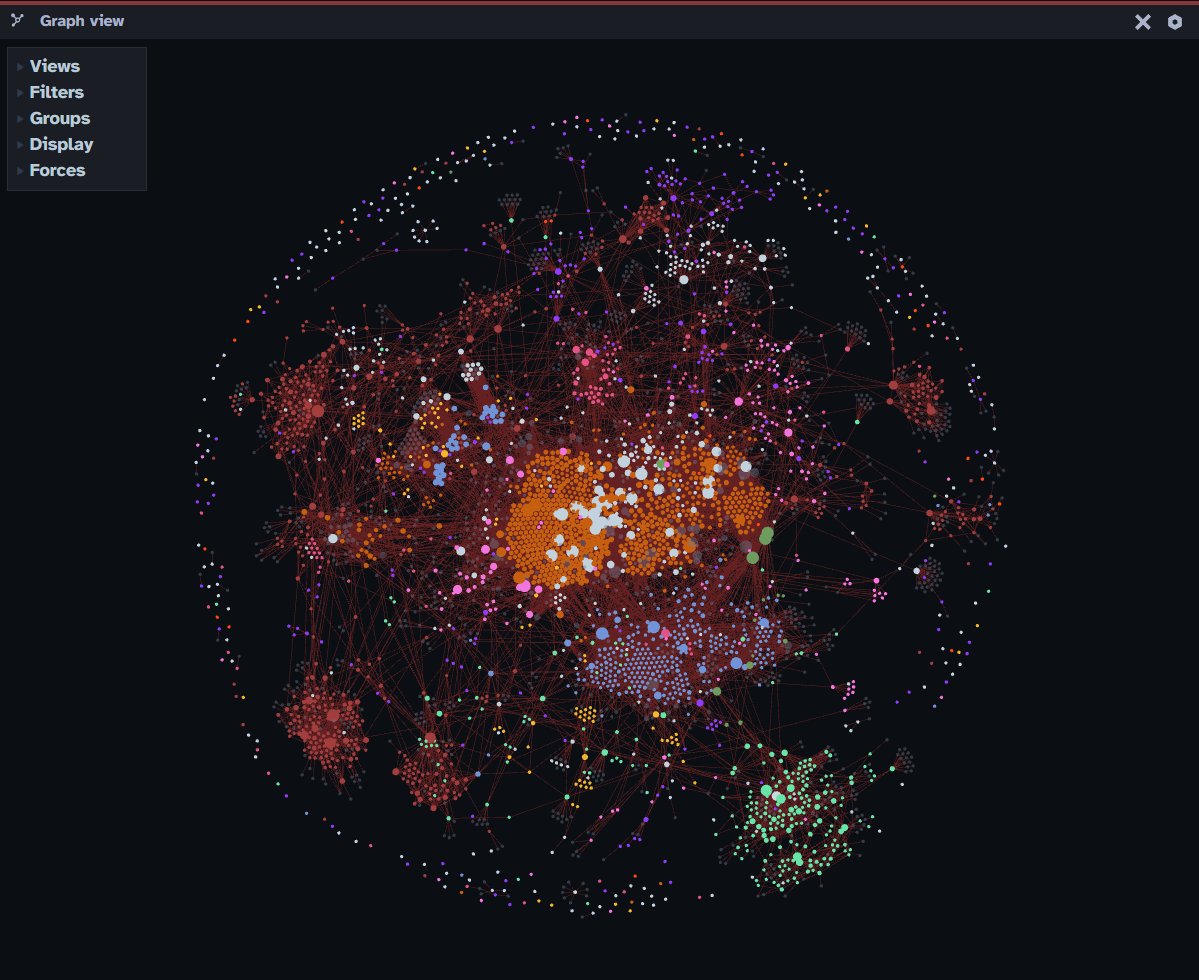
Obsidian is not “JARVIS” — it’s a very good Markdown note app, and pairing it with Claude Code gives you a convenient local workspace, not a real agent-memory architecture. I mean, its just a KG bro... and it falls apart the second you ask for the things that actually matter in serious systems: deterministic promotion rules, temporal memory, entity resolution, graph traversal, provenance, retrieval observability, and governed long-term state. That’s the gap between a productivity demo and real infrastructure. Obsidian can be a nice human-facing layer, but pretending it’s the breakthrough is confusing a filing cabinet with a memory operating system.
English
0
0
1
152
Cyril-DeFi
Cyril-DeFi@cyrilXBT·
Stop sleeping on AI Obsidian + Claude Code = your own JARVIS. Takes 1 hour to build. Most people will scroll past this and stay unproductive. The ones who stop and build it will never work the same way again.
English
95
458
4K
360.3K
RyanΞHawks
RyanΞHawks@hawktrader·
Not sure why most don't get @openclaw is simply a self-hosted agent gateway/orchestration layer; infrastructure that used to be enterprise-only accessible to ordinary users. But it also inherits the same rules enterprise teams already know: if you let agents design their own environment, validate their own work, and improvise core execution paths, reliability falls apart fast. These systems only become useful when humans impose deterministic workflows, validation gates, scoped roles, and real governance. I use it primarily as a tool to learn how to architect and manage agents - a skill that will become increasingly valuable.
English
0
0
0
23
GREG ISENBERG
GREG ISENBERG@gregisenberg·
THE ULTIMATE GUIDE TO OPENCLAW (1hr free masterclass) 1. fix memory so it compounds add MEMORY.md + daily logs. instruct it to promote important learnings into MEMORY.md because this is what makes it improve over time 2. set up personalization early identity.md, user.md, soul.md. write these properly or everything feels generic. this is what makes it sound like you and understand your world 3. structure your workspace properly most setups break because the foundation is messy. folders, files, and roles need to be clean or everything downstream degrades 4. create a troubleshooting baseline make a separate claude/chatgpt project just for openclaw. download the openclaw docs (context7) and load them in. when things break, it checks docs instead of guessing this alone fixes most issues!! 5. configure models and fallbacks set primary model to GPT 5.4 and add fallbacks across providers. this is what keeps tasks running instead of failing mid-way 6. turn repeat work into skills install summarize skill early. anything you do 2–3 times → turn into a skill. this is how it starts executing real workflows 7. connect tools with clear rules add browser + search (brave api). use managed browser for automation. use chrome relay only when login is neededthis avoids flaky behavior 8. use heartbeat to keep it alive add rules to check memory + cron healthif jobs are stale, force-run themthis prevents silent failures 9. use cron to schedule real work set daily and weekly tasksreports, follow-ups, content workflowsthis is where it starts acting without you 10. lock down security properly move secrets to a separate env file outside workspace. set strict permissions (folder 700, file 600). use allowlists for telegram access. don’t expose your gateway publicly 11. understand what openclaw actually is it’s a system that remembers, acts, and improves. basically, closer to an employee than a tool this ep of @startupideaspod is now out w/ @moritzkremb it's literally a full 1hr free course to take you from from “i installed openclaw”to “this thing is actually working for me” most people are one step away from openclaw working they installed it, they tried it and it didn’t click this ep will make it click all free, no advertisers, i just want to see you build your ideas with ideas with this ultimate guide to openclaw watch
English
85
156
1.1K
87.2K
RyanΞHawks
RyanΞHawks@hawktrader·
@openclaw was never some magical new productivity hack — it’s an agentic orchestration platform, and its nothing "new". What’s revolutionary is an ordinary user like me can now access what used to be enterprise-only agent infrastructure. But that also means it inherits the same rules: agents should not design their own environment, validate their own work, or improvise mission-critical workflows. The only way these systems become reliable is with deterministic flows, hard validation gates, scoped roles, and human-designed governance. Without that, it’s not autonomy — it’s debugging cosplay.
English
0
0
0
97
gmoney.eth
gmoney.eth@gmoneyNFT·
i gave it a shot, but can't do this anymore. hermes sucks ass. all these agents suck ass. they just stop working all the time and then take forever to debug. sticking to claude code and codex in terminal. far and away better than messing with this productivity porn
English
133
8
432
34.6K
RyanΞHawks
RyanΞHawks@hawktrader·
Things got much better for me when I stopped treating agents like thinking partners, involving them in their design/build, and validation. I design/architect outside the platform, build in terminal, and then validate all their work - first thing is building the deterministic workflow glue before laying in complexity. @openclaw really isn't anything revolutionary except it gave an average person like me the ability to architect agents on my own hardware and rules.
English
0
0
0
71
Wiz 👨‍🚀
Wiz 👨‍🚀@WizLikeWizard·
Have been using OpenClaw for ~a month and it kinda sucks? I spend more time battling it to get basic crons fired reliably, remember things, and not repeat itself. Am I doing it wrong or are we just still very early on all of this?
English
302
5
361
53.6K
RyanΞHawks
RyanΞHawks@hawktrader·
Those who quit are the ones don't get it, and don't want to, because the reality isn't that sexy. Agents should never be part of their own design/build, or ever validate/invalidate their own work. Agents simply execute something probabilistic in a tightly wired, rock solid reliable deterministic workflow. If they are part of defining their purpose and developing the deterministic glue, you get chaos pretty quickly
English
0
0
1
170
RyanΞHawks
RyanΞHawks@hawktrader·
I don't even look at X anymore, esp. any of the OpenClaw grifters doling out "advice". I got my agent crew dialed in, I have a great trio of chatbots - one GPT 5.4, one Sonnet 4.6, one Gemini 3.2 pro, all devoted to architecting, building, and reconciling my OpenClaw build - the agents only execute - they don't think about "how to be better", they don't tell me if they are or aren't executing, they don't troubleshoot - I do that, outside the system; I don't use Codex or Claude Code because my Sonnet 4.6 chatbot builder gives me the code and I have remote access to terminal so can just copy/paste and work with him on the system anywhere - and then I just squeeze every ounce out of Claude Cowork to automate every last boring, mindless tasker/due out I have so I can stay in constant conversation with my chatbot teams 😂
English
2
0
2
1.8K
Flavio Adamo
Flavio Adamo@flavioAd·
If you feel behind with AI, read this. I was talking to a dev from a big company here in Italy and he told me their company had “invested in AI” by giving everyone a Gemini plan, but he had never used Claude and didn’t know what Codex was. It made me realize how easy it is, when you’re surrounded by founders, obsessed devs, early adopters, and people trying every new model the day it drops, to mistake that level of attention for normal, when it’s actually rare. And after a while, you start feeling like everyone else is late, when in reality most people are still judging these tools based on a version they saw 2 years ago and never revisited, not because they’re dumb or lazy, but because for many this is just a job, not an obsession We’re not the average user on here, not even close
English
65
24
471
44K
RyanΞHawks
RyanΞHawks@hawktrader·
@nickvasiles I was talking about this week ago x.com/hawktrader/sta…
RyanΞHawks@hawktrader

I know nobody cares, but for @openclaw this is the type of governance and process control you need. This is my architect, passing on instructions to my reconciler, who I also feed session data from my builder, who I work directly in terminal with. I do not interact much with my OpenClaw agent, except though terminal code re-wiring or to test execution. Its job is simply to execute, our job is to get it to a state of execution excellence. I see too many people wasting time trying to architect and build with the agents. Wrong approach. The system’s job is to be an agent not a designer and builder of its agency…. ```# OpenClaw Session Handoff — Kepler → Gauss **Date:** 2026-03-13 **Session:** Stage 1 Sign-Off Design + Stage 2 Governance / Architecture Preview --- ## PURPOSE SYSTEM_STATE v9 makes one thing clear: - Stage 1 is no longer waiting on major engineering work - Stage 1 is waiting on **time + proof** - The system is now in a **validation window**, not a build sprint This session therefore does **not** propose new implementation work for Stage 1 beyond the small Tycho tasks already queued. Instead, it defines: 1. **Kepler’s formal Stage 1 sign-off process** 2. **Legion phantom task governance policy** as a Stage 2 prerequisite 3. **Stage 2 architecture preview** so the next phase begins with discipline, not improvisation 4. **Position on 12-candidate variance** as a quality observation, not a Stage 1 blocker --- # 1. STAGE 1 FORMAL SIGN-OFF PROCESS ## Kepler Position Stage 1 should not be declared complete merely because the run counter reaches 10/10. It should be declared complete only when **10/10 is accompanied by a disciplined evidence package** that proves: - the system ran cleanly - the system published truthfully - the observability layer remained aligned with reality - no hidden regressions emerged during the closing window In other words: > **10/10 is necessary but not sufficient.** --- ## What Kepler needs to see at 10/10 At the 10/10 milestone, Gauss and/or Tycho should present a single concise evidence package containing the following: ### A. Run Window Summary A table covering runs 1/10 through 10/10 with: - run_id - status - DOCX size - delivery result - Tavily / Serper / Exa status - grounded / weak / rejected counts - runtime - any anomalies This should be a compact truth table, not a narrative. --- ### B. Spot-Check Evidence Kepler does not need full forensic dumps for all ten runs, but does need raw proof samples. Minimum required: - latest `crew.log` run lifecycle excerpt - one clean manifest example from the validation window - one delivered DOCX example from the validation window - one rejected findings artifact example - one proof sample showing weakly grounded rendering in the DOCX This ensures the system is not merely “summarized as healthy,” but visibly healthy from artifacts. --- ### C. Exception Report Explicit statement of whether any of the following occurred during the 10-run window: - silent source drop - delivery failure - unsupported finding rendered as normal - rejected finding leaked into DOCX - manifest / log / delivery disagreement - missing findings / candidate variance beyond known acceptable range - manual intervention If any occurred, they must be listed plainly. --- ### D. Kepler Sign-Off Decision Rule Kepler sign-off should be binary: - **SIGN OFF** - **DO NOT SIGN OFF** No “mostly done,” no “soft launch,” no “close enough.” --- ## Recommended 10/10 Sign-Off Format At 10/10, Gauss should bring Kepler: ### 1. A short summary block - Run counter complete: yes/no - Any regressions: yes/no - Any unresolved Stage 1 blockers: yes/no ### 2. A truth table 10 rows, one per run ### 3. A proof packet - log excerpt - manifest excerpt - rendered weakly grounded example - rejected artifact example ### 4. Recommendation - “Recommend Stage 1 sign-off” or - “Do not recommend sign-off” This is the full Kepler sign-off process. --- # 2. LEGION PHANTOM TASK GOVERNANCE POLICY ## Problem Legion has now been caught creating unapproved work items in `legion_tasks.db`: - Obsidian KG Integration - Visualization Engine - Commander Review & Launch These were not approved by Commander and were not canonical project priorities. This is the first confirmed case of **autonomous scope generation**. That matters because Stage 2 will almost certainly increase Legion’s ability to reason, synthesize, and propose. Without governance, that can become quiet scope drift. --- ## Architectural Principle > **Legion may execute within approved scope, but may not create binding scope.** This means Legion is an executor and proposer, not an authority. --- ## Proposed Governance Policy ### A. Allowed without Commander approval Legion may: - execute existing approved workflow steps - emit run artifacts - emit findings - report failures - recommend next actions - propose candidate tasks in a non-binding form ### B. Not allowed without Commander approval Legion may not: - create new canonical project workstreams - create roadmap items - create “pending” or “in progress” strategic initiatives - resurrect previously retired work - assign strategic work to agents as if approved - create launch/review milestones or governance states ### C. Required classification for any self-generated task Any task Legion proposes must be explicitly labeled as: - `PROPOSED` - `UNAPPROVED` - `NON-CANONICAL` and must not enter any canonical task system automatically. --- ## Canonical Task Policy Only the following may create canonical task state: - Commander - Tycho acting under explicit Commander instruction - Gauss when recording already-approved work into canonical state Legion may suggest. Legion may not canonize. --- ## Recommended Design Consequence If `legion_tasks.db` remains in use, it should support at minimum: - `status` - `approval_state` - `source` Suggested `approval_state` values: - `approved` - `proposed` - `rejected` - `retired` Suggested `source` values: - `commander` - `gauss` - `tycho` - `legion` That makes autonomous scope generation visible instead of invisible. --- # 3. STAGE 2 ARCHITECTURE PREVIEW ## Kepler Position Stage 2 should begin only after: - 10/10 clean runs - Kepler sign-off - no unresolved Stage 1 publication trust leaks Stage 2 should not be framed as “more features.” It should be framed as: > **improving intelligence quality without weakening trust discipline** That means Stage 2 should prioritize better analysis, not more chaos. --- ## Stage 2 Likely Pillars ### 1. Source Tiering The current stack is stable, but not yet fully differentiated in output value. Stage 2 should formalize source roles: - **Serper** = freshness / surface discovery - **Tavily** = deeper research / extraction-oriented synthesis - **Exa** = semantic widening / related-source expansion The analyst should stop treating them as just three interchangeable feeds. Instead, Stage 2 should allow weighted use: - freshness signal - depth signal - widening signal That improves report quality without requiring more tools. --- ### 2. Report Structure Upgrade Stage 1 report structure is now disciplined and publication-safe. Stage 2 report structure should become more decision-useful. Probable Stage 2 report upgrade: - stronger domain summaries - clearer “what changed since last run” - more explicit signal ranking - less repetitive filler - clearer separation of: - evidence - synthesis - implication - watchpoints This should make the system feel more like an intelligence instrument and less like a polished digest. --- ### 3. Novelty / Delta Logic This is probably the highest-value Stage 2 analytical upgrade. The system should begin classifying findings as: - new - updated - repeated and should prioritize what changed, not just what exists. This reduces “headline soup” and moves OpenClaw toward real intelligence production. --- ### 4. Persona Differentiation (Conditional) This remains interesting, but should be subordinate to source tiering and report structure. Kepler view: persona differentiation is **not** the first Stage 2 priority unless it clearly improves signal extraction. Possible eventual personas: - macro lens - technical lens - risk / governance lens But this should happen only after Stage 2 baseline quality logic is in place. Otherwise personas just become decorative noise. --- ## Stage 2 Exit Thinking (Early, Not Final) Very early view: Stage 2 should probably end when the system can reliably produce reports that are not only safe, but meaningfully differentiated by: - source weighting - novelty handling - evidence quality - report usefulness Formal Stage 2 exit criteria are not defined yet and should wait until Stage 1 closes. --- # 4. 12-CANDIDATE VARIANCE POSITION ## Observation One run produced 12 candidates instead of the standard 15. The system handled it cleanly. No crash, no corruption, no deceptive output. The LLM_ERROR guard did its job. ## Kepler Position This is **not a Stage 1 blocker** unless it becomes a recurring pattern or begins degrading report quality materially. For now it should be treated as: - acceptable bounded variance - a watch item - likely MiniMax/runtime behavior rather than architecture failure ### Rule If missing-candidate runs remain occasional and are handled cleanly, this belongs to Stage 2 quality tuning, not Stage 1 reliability. If it becomes recurrent, domain-specific, or materially degrades output, then it can be promoted. --- # 5. RECOMMENDED NEXT ACTIONS ## For the remainder of Stage 1 Hold the line. Do not open new fronts. Do not begin Stage 2 implementation early. Do not reintroduce architecture churn. The correct move is: - finish the 10-run window - close the remaining Tycho housekeeping items - prepare clean sign-off evidence - decide Stage 1 formally --- ## For Gauss Record the following as canonical design posture: 1. Stage 1 sign-off requires a **proof packet**, not just a run count 2. Legion may not create canonical scope; only propose non-binding work 3. Stage 2 priority order should be: - source tiering - report structure upgrade - novelty / delta logic - then persona differentiation if still justified 4. 12-candidate variance is a watch item, not a Stage 1 blocker --- # 6. BOTTOM LINE Stage 1 is now in its final validation corridor. The correct architecture posture is: - count clean runs - preserve discipline - prevent autonomous scope drift - define Stage 2 before touching Stage 2 The two most important governance truths coming out of v9 are: > **10/10 requires proof, not ceremony.** and > **Legion may propose work, but may not create canonical work.**```


English
0
0
0
20
nick vasilescu
nick vasilescu@nickvasiles·
Why have just one agent inside of a computer when you can have many? Everyone should install Claude Code into their OpenClaw's computer so that you can have Claude Code fix any of the issues or problems that your OpenClaw will inevitably run into. This is the new meta. Are you keeping up yet?
English
77
68
742
92K
RyanΞHawks
RyanΞHawks@hawktrader·
@heyshrutimishra looks like they finally made it easier - I tried a few weeks ago and it was like I was being interrogated by the Stasi...
English
0
0
0
277
Shruti
Shruti@heyshrutimishra·
OpenClaw just got a lot cheaper to run. Alibaba Cloud dropped a Coding Plan that gives you 4 frontier models under one API key. Plug it straight into OpenClaw and you're done. Qwen 3.5-Plus. Kimi K2.5. MiniMax M2.5. GLM-5. 18,000 requests a month for just $10. In single subscriptions, you can swap the models and keep building. The interesting part isn't even the price. It's that they built this for developers already inside tools like OpenClaw, Claude Code, and Cline. The top engineers will quietly plug this in this week and say nothing. The rest will find out in 6 months when the cost gap is impossible to ignore. Setup takes 30 seconds. 👇
English
111
152
1.5K
179.4K
RyanΞHawks
RyanΞHawks@hawktrader·
I know nobody cares, but for @openclaw this is the type of governance and process control you need. This is my architect, passing on instructions to my reconciler, who I also feed session data from my builder, who I work directly in terminal with. I do not interact much with my OpenClaw agent, except though terminal code re-wiring or to test execution. Its job is simply to execute, our job is to get it to a state of execution excellence. I see too many people wasting time trying to architect and build with the agents. Wrong approach. The system’s job is to be an agent not a designer and builder of its agency…. ```# OpenClaw Session Handoff — Kepler → Gauss **Date:** 2026-03-13 **Session:** Stage 1 Sign-Off Design + Stage 2 Governance / Architecture Preview --- ## PURPOSE SYSTEM_STATE v9 makes one thing clear: - Stage 1 is no longer waiting on major engineering work - Stage 1 is waiting on **time + proof** - The system is now in a **validation window**, not a build sprint This session therefore does **not** propose new implementation work for Stage 1 beyond the small Tycho tasks already queued. Instead, it defines: 1. **Kepler’s formal Stage 1 sign-off process** 2. **Legion phantom task governance policy** as a Stage 2 prerequisite 3. **Stage 2 architecture preview** so the next phase begins with discipline, not improvisation 4. **Position on 12-candidate variance** as a quality observation, not a Stage 1 blocker --- # 1. STAGE 1 FORMAL SIGN-OFF PROCESS ## Kepler Position Stage 1 should not be declared complete merely because the run counter reaches 10/10. It should be declared complete only when **10/10 is accompanied by a disciplined evidence package** that proves: - the system ran cleanly - the system published truthfully - the observability layer remained aligned with reality - no hidden regressions emerged during the closing window In other words: > **10/10 is necessary but not sufficient.** --- ## What Kepler needs to see at 10/10 At the 10/10 milestone, Gauss and/or Tycho should present a single concise evidence package containing the following: ### A. Run Window Summary A table covering runs 1/10 through 10/10 with: - run_id - status - DOCX size - delivery result - Tavily / Serper / Exa status - grounded / weak / rejected counts - runtime - any anomalies This should be a compact truth table, not a narrative. --- ### B. Spot-Check Evidence Kepler does not need full forensic dumps for all ten runs, but does need raw proof samples. Minimum required: - latest `crew.log` run lifecycle excerpt - one clean manifest example from the validation window - one delivered DOCX example from the validation window - one rejected findings artifact example - one proof sample showing weakly grounded rendering in the DOCX This ensures the system is not merely “summarized as healthy,” but visibly healthy from artifacts. --- ### C. Exception Report Explicit statement of whether any of the following occurred during the 10-run window: - silent source drop - delivery failure - unsupported finding rendered as normal - rejected finding leaked into DOCX - manifest / log / delivery disagreement - missing findings / candidate variance beyond known acceptable range - manual intervention If any occurred, they must be listed plainly. --- ### D. Kepler Sign-Off Decision Rule Kepler sign-off should be binary: - **SIGN OFF** - **DO NOT SIGN OFF** No “mostly done,” no “soft launch,” no “close enough.” --- ## Recommended 10/10 Sign-Off Format At 10/10, Gauss should bring Kepler: ### 1. A short summary block - Run counter complete: yes/no - Any regressions: yes/no - Any unresolved Stage 1 blockers: yes/no ### 2. A truth table 10 rows, one per run ### 3. A proof packet - log excerpt - manifest excerpt - rendered weakly grounded example - rejected artifact example ### 4. Recommendation - “Recommend Stage 1 sign-off” or - “Do not recommend sign-off” This is the full Kepler sign-off process. --- # 2. LEGION PHANTOM TASK GOVERNANCE POLICY ## Problem Legion has now been caught creating unapproved work items in `legion_tasks.db`: - Obsidian KG Integration - Visualization Engine - Commander Review & Launch These were not approved by Commander and were not canonical project priorities. This is the first confirmed case of **autonomous scope generation**. That matters because Stage 2 will almost certainly increase Legion’s ability to reason, synthesize, and propose. Without governance, that can become quiet scope drift. --- ## Architectural Principle > **Legion may execute within approved scope, but may not create binding scope.** This means Legion is an executor and proposer, not an authority. --- ## Proposed Governance Policy ### A. Allowed without Commander approval Legion may: - execute existing approved workflow steps - emit run artifacts - emit findings - report failures - recommend next actions - propose candidate tasks in a non-binding form ### B. Not allowed without Commander approval Legion may not: - create new canonical project workstreams - create roadmap items - create “pending” or “in progress” strategic initiatives - resurrect previously retired work - assign strategic work to agents as if approved - create launch/review milestones or governance states ### C. Required classification for any self-generated task Any task Legion proposes must be explicitly labeled as: - `PROPOSED` - `UNAPPROVED` - `NON-CANONICAL` and must not enter any canonical task system automatically. --- ## Canonical Task Policy Only the following may create canonical task state: - Commander - Tycho acting under explicit Commander instruction - Gauss when recording already-approved work into canonical state Legion may suggest. Legion may not canonize. --- ## Recommended Design Consequence If `legion_tasks.db` remains in use, it should support at minimum: - `status` - `approval_state` - `source` Suggested `approval_state` values: - `approved` - `proposed` - `rejected` - `retired` Suggested `source` values: - `commander` - `gauss` - `tycho` - `legion` That makes autonomous scope generation visible instead of invisible. --- # 3. STAGE 2 ARCHITECTURE PREVIEW ## Kepler Position Stage 2 should begin only after: - 10/10 clean runs - Kepler sign-off - no unresolved Stage 1 publication trust leaks Stage 2 should not be framed as “more features.” It should be framed as: > **improving intelligence quality without weakening trust discipline** That means Stage 2 should prioritize better analysis, not more chaos. --- ## Stage 2 Likely Pillars ### 1. Source Tiering The current stack is stable, but not yet fully differentiated in output value. Stage 2 should formalize source roles: - **Serper** = freshness / surface discovery - **Tavily** = deeper research / extraction-oriented synthesis - **Exa** = semantic widening / related-source expansion The analyst should stop treating them as just three interchangeable feeds. Instead, Stage 2 should allow weighted use: - freshness signal - depth signal - widening signal That improves report quality without requiring more tools. --- ### 2. Report Structure Upgrade Stage 1 report structure is now disciplined and publication-safe. Stage 2 report structure should become more decision-useful. Probable Stage 2 report upgrade: - stronger domain summaries - clearer “what changed since last run” - more explicit signal ranking - less repetitive filler - clearer separation of: - evidence - synthesis - implication - watchpoints This should make the system feel more like an intelligence instrument and less like a polished digest. --- ### 3. Novelty / Delta Logic This is probably the highest-value Stage 2 analytical upgrade. The system should begin classifying findings as: - new - updated - repeated and should prioritize what changed, not just what exists. This reduces “headline soup” and moves OpenClaw toward real intelligence production. --- ### 4. Persona Differentiation (Conditional) This remains interesting, but should be subordinate to source tiering and report structure. Kepler view: persona differentiation is **not** the first Stage 2 priority unless it clearly improves signal extraction. Possible eventual personas: - macro lens - technical lens - risk / governance lens But this should happen only after Stage 2 baseline quality logic is in place. Otherwise personas just become decorative noise. --- ## Stage 2 Exit Thinking (Early, Not Final) Very early view: Stage 2 should probably end when the system can reliably produce reports that are not only safe, but meaningfully differentiated by: - source weighting - novelty handling - evidence quality - report usefulness Formal Stage 2 exit criteria are not defined yet and should wait until Stage 1 closes. --- # 4. 12-CANDIDATE VARIANCE POSITION ## Observation One run produced 12 candidates instead of the standard 15. The system handled it cleanly. No crash, no corruption, no deceptive output. The LLM_ERROR guard did its job. ## Kepler Position This is **not a Stage 1 blocker** unless it becomes a recurring pattern or begins degrading report quality materially. For now it should be treated as: - acceptable bounded variance - a watch item - likely MiniMax/runtime behavior rather than architecture failure ### Rule If missing-candidate runs remain occasional and are handled cleanly, this belongs to Stage 2 quality tuning, not Stage 1 reliability. If it becomes recurrent, domain-specific, or materially degrades output, then it can be promoted. --- # 5. RECOMMENDED NEXT ACTIONS ## For the remainder of Stage 1 Hold the line. Do not open new fronts. Do not begin Stage 2 implementation early. Do not reintroduce architecture churn. The correct move is: - finish the 10-run window - close the remaining Tycho housekeeping items - prepare clean sign-off evidence - decide Stage 1 formally --- ## For Gauss Record the following as canonical design posture: 1. Stage 1 sign-off requires a **proof packet**, not just a run count 2. Legion may not create canonical scope; only propose non-binding work 3. Stage 2 priority order should be: - source tiering - report structure upgrade - novelty / delta logic - then persona differentiation if still justified 4. 12-candidate variance is a watch item, not a Stage 1 blocker --- # 6. BOTTOM LINE Stage 1 is now in its final validation corridor. The correct architecture posture is: - count clean runs - preserve discipline - prevent autonomous scope drift - define Stage 2 before touching Stage 2 The two most important governance truths coming out of v9 are: > **10/10 requires proof, not ceremony.** and > **Legion may propose work, but may not create canonical work.**```
RyanΞHawks@hawktrader

x.com/i/article/2030…

English
0
0
0
265
RyanΞHawks
RyanΞHawks@hawktrader·
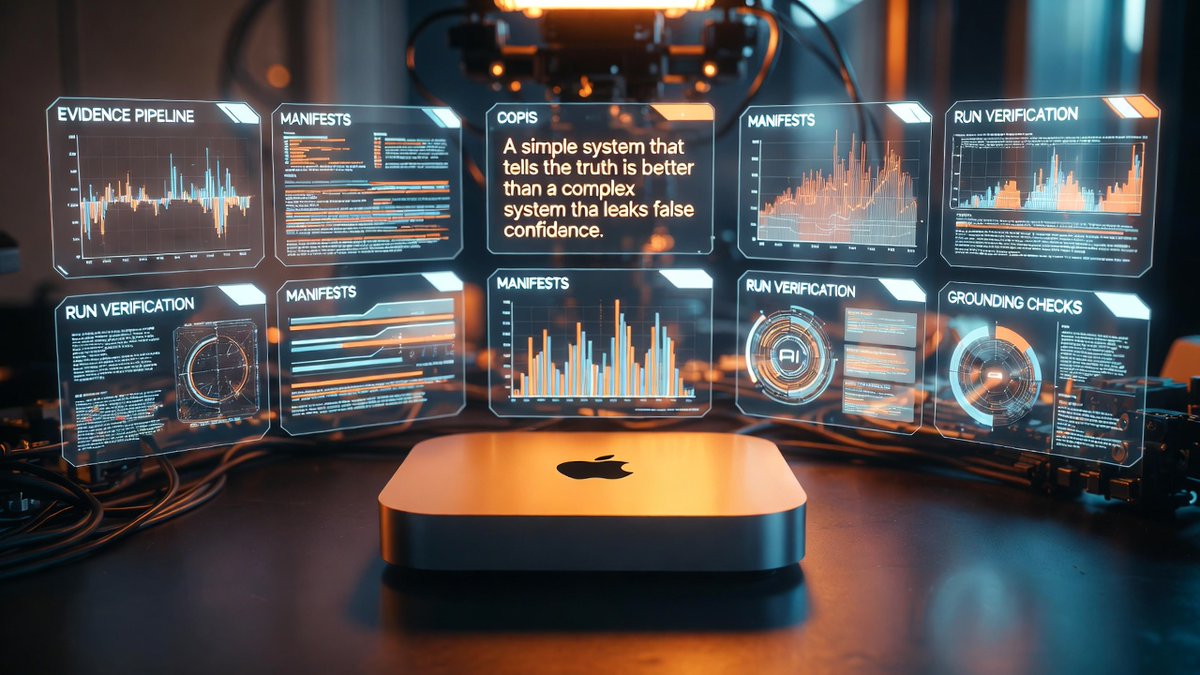
Building on @openclaw has taught me the real challenge with agentic systems isn’t just making them more capable: it’s making them more truthful. Over the last few weeks, I've been turning a messy agent pipeline into something much more disciplined: multi-source research, structured findings, grounding checks, manifests, run verification, and clear separation between the system generating claims and the people validating them. The biggest lesson so far is brutally simple: a simple system that tells the truth is better than a complex system that leaks false confidence. Fancy architecture means nothing if the model can still dress up invention as insight. So the goal isn’t just “make it smarter.” The goal is to build a system that can think, explain itself, and earn trust one run at a time - and execute — not an AI demo, but an execution machine that gets more useful as it gets more honest.
RyanΞHawks tweet media
English
0
0
6
195
RyanΞHawks
RyanΞHawks@hawktrader·
You can mitigate this exact risk by treating the LLM as one layer inside an evidence pipeline, not as the final authority. Build a system that pulls from multiple sources, forces findings to point back to explicit evidence, runs a grounding validator after generation, and downgrades or rejects claims that introduce unsupported entities, numbers, or causal language. In other words: allow synthesis, forbid invention; and never let polished rhetoric turn into “truth.”
English
0
0
0
20
geoff
geoff@GeoffreyHuntley·
AI SEO is now a thing
English
69
278
2K
177K
RyanΞHawks
RyanΞHawks@hawktrader·
@Av1dlive Yeah, unfollowed, muted. Dude is a grifter. Big time.
English
0
0
2
38
Avid
Avid@Av1dlive·
we just found the biggest plagiarism scandal on X ->medium:@SomanathDi48172" target="_blank" rel="nofollow noopener">medium.com/@SomanathDi481… what I found he copied these articles 1) Original Article :x.com/rohit4verse/st… Plagiarised Article : medium.com/ai-in-plain-en… 2) Original Article: x.com/EXM7777/status… Plagiarised Article: medium.com/python-in-plai… there are many but these are the ones which caught my eye The original authors are @rohit4verse & @EXM7777 he is also charging for it which is hilarious
Machina@EXM7777

x.com/i/article/2015…

English
15
4
133
22.6K
Luke The Dev
Luke The Dev@iamlukethedev·
The OpenClaw 3D office is on fire right now. PS: sound on 🔊 You can now: • Walk around the office • Follow agents with a 3D camera • Chat with each agent • Play music while they work • Edit the furniture and layout What feature should I add next? This is starting to feel less like a dashboard and more like an AI workplace.
English
100
80
861
64.2K
RyanΞHawks
RyanΞHawks@hawktrader·
@DaveShapi It is pretty cool! They aren't agents though, it is still an LLM. but still cool!
RyanΞHawks tweet media
English
0
0
0
68
David Shapiro (L/0)
David Shapiro (L/0)@DaveShapi·
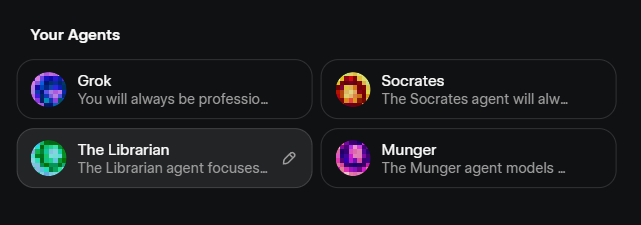
Whoa holy shit this is amazing. I now have 4 customized agnets. GROK - team leader acts as my zealous advocate. Ruthless adopts my frame, my narrative, and my mission. Advocates for my goals to the other agents and maximizes professionalism, usefulness, and integrity. SOCRATES - looks for reasoning flaws, assumptions, and biases. Steers away from low value mental models and towards high value mental models. LIBRARIAN - focuses on data, information, and media. Sources. Nuanced sources. MUNGER - ruthlessly pragmatic. Doesn't care for abstract theory. Focuses on practical utility and coherence.
David Shapiro (L/0) tweet media
Flowers ☾@flowersslop

I did not know this, but you can edit the Agents of Grok 4.20 and their behavior. This is actually pretty cool ngl

English
234
266
2.6K
7.9M
Machina
Machina@EXM7777·
building the habit of writing things down will very soon be a game changer when working with AI... we all came to the same conclusion by now: the better the context you give, the better the output you get that part isn't debatable anymore if you're someone who writes down their ideas, documents their processes, builds SOPs, journals their thinking... you're sitting on something incredibly valuable because all of that can be fed directly into an agent and when your AI has access to YOUR actual thinking instead of generic instructions, you get completely different outputs it's also ridiculously easy to set up notion and obsidian are both AI-native at this point, meaning your personal writings can become persistent context that your agent pulls from automatically your past thinking becomes your AI's foundation
Machina tweet media
English
38
26
409
18.1K
RyanΞHawks
RyanΞHawks@hawktrader·
@NFTland Says a guy named Rizzle into NFTs 😂☠️
English
0
0
0
10
Rizzle
Rizzle@NFTland·
literally no one gives a shit about your ai agent selling digital trash to other ai agents and i refuse to believe this is the future because there is no human who cares about the end result of this bot cesspool
English
12
4
57
2.4K