hexfusion

897 posts

hexfusion banner
hexfusion

hexfusion

@hexfusion

Opinions are my own and not the view of any reasonable person.

gRPC stream Katılım Eylül 2015
512 Takip Edilen496 Takipçiler
patrickogrady.xyz
patrickogrady.xyz@_patrickogrady·
I have made the difficult decision to leave @AvaLabs to start my own company. The last 3.5 years have been an unforgettable ride. I will be forever grateful to the people at Ava Labs (particularly @el33th4xor, @kevinsekniqi, and @John1wu) for the opportunities I’ve been given to grow both as an individual and as a professional. It is rare, in my experience, to find a company with a mission as motivating as the people that work there. I will without a doubt miss it. To continue supporting the exciting work of the Platform Engineering Group, I have agreed to become a Technical Advisor to Ava Labs. Anyone following the team (led by @stephenbuttolph, @michael_kaplan1, and @aaronbuchwald) already knows they won’t need my help and this is just an excuse I can use to keep hanging out with my friends 😅. My GitHub notifications will always stay on for ava-labs/*. As for what’s next, I am as sure now as I have ever been that blockchains will play a critical role in returning the internet to the people that use it. I look forward to continuing to contribute to an internet we can all believe in. I’ll see you onchain.
English
129
28
668
71.7K
hexfusion
hexfusion@hexfusion·
@LiliCosic Sorry to hear this, sending good vibes your way.
English
1
0
2
53
Lili Cosic
Lili Cosic@LiliCosic·
So far May has to be the worst month of this year, and it has only started. And there has been some pretty shitty months this year…
English
1
0
3
697
Atari
Atari@atari·
A new Atari XP cartridge is coming soon! 👀 Any guesses on what it could be? 🧐
English
25
8
71
9.3K
hexfusion
hexfusion@hexfusion·
@KimDotcom Are you sure this video is legit, it seems like a scene from the windows 95 release party…
English
0
0
2
35
Kim Dotcom
Kim Dotcom@KimDotcom·
The new President of Argentina 🤣
English
5.3K
8.3K
59.7K
15M
Mar 🔺
Mar 🔺@hermanarobot·
I still have a few Wolfies, I might be rich by accident.
English
2
0
10
678
Coop⏱️
Coop⏱️@coopernicus01·
Don’t name your kids Sam, cursed
English
17
0
57
4.4K
hexfusion retweetledi
Emin Gün Sirer🔺⚔️
Emin Gün Sirer🔺⚔️@el33th4xor·
The Secret Avalanche Scaling Master Plan (Super Duper Secret) Note: This is simply my vision. Things may change. The Avalanche vision has always been to build high-performance blockchain technology that is usable, reliable, and scalable well into the future. But few may know precisely how the vision gels out, and how I believe the Avalanche architectural design is the most future-proof one. In this post I want to provide an overview of what's ahead of us and how things interplay with each other. At the highest level, this is the super-duper secret vision: many FAST blockchains that behave like ONE chain and that scale up in capacity without an upper bound. This is an extremely high bar, and while we're not there yet, the pieces all falling into place. The rest of this blog post will elucidate, at a high level, how I see this all working. First, let's talk about where we are with the various scaling technologies. For the most part, we have two main approaches to scaling. The first approach tries to make the base layer as fast as possible. Many chains have tackled this path, including Avalanche, Solana, Ethereum, and others. However, there is one fundamental issue: even if we scale the base layer up in some finite capacity, there are paths where usage growth could exceed hardware and software growth, in which case we need other approaches. Here are some truths: a) while single chains will keep getting faster and faster, a single “global” chain is not sustainable due to storage growth risk; b) single-chain settlement is not sustainable due to execution risk; and c) the proper way to prepare for the future is to build systems that minimize both storage and execution risk. The first is the risk associated with state growth in a single chain that is faster than our ability to absorb it, and the second is the risk associated with cascading safety risks associated with reliance on settlement in a single chain. Fundamentally, then, this requires coming to terms with sensible conclusion: good design involves many fast and parallel chains that behave as one. Let me repeat again. At a high level this is the secret sauce: make it all fast and make it all feel as one. Let's dive deeper. Please note that this is just a high-level overview, and I further details of the deep engineering work required to make this happen will come from the great worth coming out of the AvalancheGo client. 1. Make It All Very Fast Avalanche introduced a powerful consensus protocol that gives you something that no other PoS protocol gives you: scaling up with arbitrary number of nodes. However, when building production-ready systems, building for decentralized validator set is not enough. You need to consider other things as well, including the biggest current bottleneck of all: state growth. As it currently stands, there's two big limitations with state growth. The first one is state access: as state grows bigger, accessing it becomes harder. The second one is state maintenance: as state grows bigger, simply keeping it around becomes harder. The solution to the first one is a matter of fairly easy iterative engineering, i.e. building better and better backend stores. This is what Solana has tackled already in some form, although what EVM-based chains are still behind. Avalanche, however, will soon become the first EVM-supporting network that addresses the state access issue directly by reducing the overhead by possibly orders of magnitude thanks to Firewood (performance metrics are currently pending). As a quick sneak-peek under the hood, here's how this bottleneck comes about on the EVM and how Firewood fixes it. After a block is processed, the EVM requires that the state root post execution is included in the block. This means that at the end of the block you end up having to do a bunch of changes to the trie to get that root. And since you can't do this asynchronously, you have to do it right then and there, incurring big overhead. Each contract has a tree, and as you may need to do a single update, you may need to reach many intermediate nodes per modification to be able to update the tree. What you basically have at this point is a randomized serial disk-bomb that is functionally based on the number of changes. Firewood solves this issue. Instead of storing data randomly on disk as is currently done in Geth, Firewood stores them on disk through a more sophisticated sequential layout that enables much rapid changes. The solution to the second state growth challenge, i.e. how to store all this new data, is based on deeper architectural changes. As of right now there are only two systematic approaches: L2s and parallel chains. While L2s are great technical achievements, they do pose some challenges due to their fundamental requirements. Namely: they often rely on centralized sequencers; they pick up a non-trivial amount of cost of the expensive underlying settlement layer; they are generally more inflexible in the virtual machine diversity and require higher maintenance due to their cryptographic complexity; and -- most importantly of all -- they fundamentally put too much reliance on a single chain which can become faulty. This poses significant fault risks for growth. Despite this, however, L2s do have a role in the scalability play, and I do think they are here to stay for some types of applications. Nonetheless, I strongly believe that their settlement requirements, and subsequently withdrawal and deposit-related fragmentation, pose extremely high challenges to unified UIs. In other words, it is going to be challenging to allow us to make the network feel as a single chain, which is ultimately the goal. This is, in my opinion, a big limitation when taken holistically. Therefore, it is my opinion that parallel chains are the sounder approach. Done right, parallel chains (like subnets) can actually allow us to achieve sub-second finality in UIs, reduce fault risks, enable deep decentralization, lower the maintenance costs, and ultimately enable never-before seen experiences for users. My topline performance capacity goals for Avalanche are simple: a. End-to-end finality within a chain bounded by 250ms. b. End-to-end finality within two chains bounded by 1 second. c. Peak throughput on the C-chain at least 100x higher and cheaper than the next best EVM-chain. d. Peak throughput of any Hyper-chain (WASM + Rust contracts enabled) at more than 1M TPS. 2. Make It All Feel As One Deploying many mind-bogglingly fast blockchains isn't enough: they all need to feel like a single gigantic, unified operating system. Making the network interoperate and behave like a single chain, despite it not being a single chain, involves a strong interplay between the Avalanche Warp Messaging (AWM), the base technology, and the Teleporter smart contracts that enable the AWM. By the end of this engineering work, one should be able to issue a transaction that initiates on, for example, the Dexalot chain, routes to the C chain, and then route back, all in a single unified transaction that takes under 1 second to complete. And that's not all. One should be able to move a token, for example, from the C chain to the Dexalot chain, stake it there or even use it for paying gas in that chain. This kind of UI pattern can unlock tremendous new opportunities for blockchain design that we simply have not explored yet. Anyway, that's the secret sauce. Well, maybe not so secret. A a unified blockchain network that will simply, under no circumstances, ever bog anyone down. It'll just simply work, under any dang load. We're still not there, but the work being put towards AvalancheGo by both the Ava Labs engineering team and the community at large is simply tremendous. If you want to get involved, please contribute to the ongoing public list of ACPs. Over the next few months, I will post more detailed metrics about all the scaling work. Stay tuned.
English
104
309
936
144.8K
Antonio Ojea
Antonio Ojea@Itsuugo·
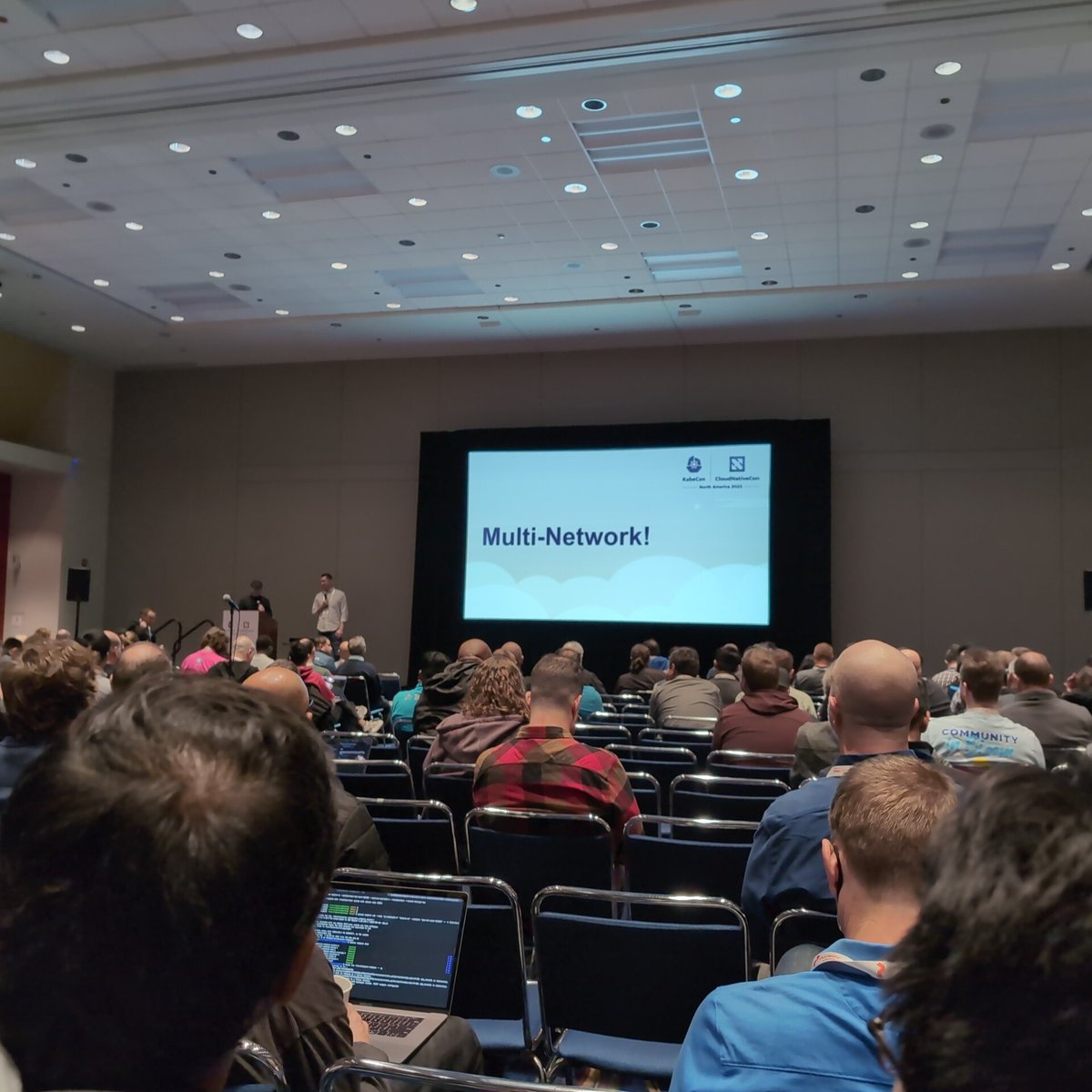
Kubernetes multi-network
Antonio Ojea tweet media
Filipino
1
0
18
1K
hexfusion
hexfusion@hexfusion·
@asimfiles Confirmation bias and the age of misinformation. What a dream team combo.
English
1
0
4
151
Usman Asim
Usman Asim@asimfiles·
it’s funny how when folks who love to proport extreme viewpoints + media talking points get hit with real statistics and are asked to refute them with other sources - they can’t & stay silent. then they begin personally attacking the one who is countering their point. classic deflection.
English
2
0
7
1.2K
hexfusion retweetledi
Programming Wisdom
Programming Wisdom@CodeWisdom·
"If it doesn't work, it doesn't matter how fast it doesn't work." — Mich Ravera
English
12
406
544
54.2K
hexfusion retweetledi
patrickogrady.xyz
patrickogrady.xyz@_patrickogrady·
The #Avalanche HyperSDK Program Simulator is OUT! A few days ago, @hexfusion released an e2e simulator that allows you to run/test arbitrary programs without spinning up an entire blockchain: github.com/ava-labs/hyper… Want get involved with HyperSDK Programs? Now is the time!
English
5
63
152
58K
Stefan Schimanski
Stefan Schimanski@the_sttts·
Follow some Github link to an interesting project. See Maven as the build tool. Close the tab.
English
6
1
28
4.5K
hexfusion retweetledi
patrickogrady.xyz
patrickogrady.xyz@_patrickogrady·
13/ For those keeping track at home, the #Avalanche HyperSDK now has: * WASM-Based Programs (i.e. smart contracts) * Parallel Transaction Execution * Multi-Dimensional Fees * Nonce-Less Transactions * Batch Signature Verification * Deferred Root Generation * Dynamic State Sync
English
5
47
127
27.8K
hexfusion retweetledi
patrickogrady.xyz
patrickogrady.xyz@_patrickogrady·
1/ #Avalanche HyperSDK Research Deep Dive: 𝑽𝑴-𝑨𝒈𝒏𝒐𝒔𝒕𝒊𝒄, 𝑶𝒏-𝒕𝒉𝒆-𝑭𝒍𝒚, 𝑷𝒂𝒓𝒂𝒍𝒍𝒆𝒍 𝑻𝒓𝒂𝒏𝒔𝒂𝒄𝒕𝒊𝒐𝒏 𝑬𝒙𝒆𝒄𝒖𝒕𝒊𝒐𝒏 AFAIK HyperSDK is the FIRST build-a-chain SDK that runs txs in parallel for all Custom VMs out-of-the-box 🚀 github.com/ava-labs/hyper…
English
6
79
204
120.3K
Frederic 🧊 Branczyk @brancz@hachyderm.io
I'm super proud of the team we've put together at @PolarSignalsIO. We have observability experts, database experts, kernel experts, world-class SRE experience, and highly talented UI devs. Between all of us, there's always at least one person who has extreme depth on any problem.
English
2
2
38
5.6K