NaN 🇱🇧🇵🇱☦️🍉

15.9K posts

NaN 🇱🇧🇵🇱☦️🍉 banner
NaN 🇱🇧🇵🇱☦️🍉

NaN 🇱🇧🇵🇱☦️🍉

@heyjupiter__

🎮 × 💻 × ⚽️ × 🍟 × 📚 × 👩‍🎤 × 🖖 × 👽 × 🛸

Dubai, United Arab Emirates Katılım Ocak 2011
1.9K Takip Edilen2.1K Takipçiler
NaN 🇱🇧🇵🇱☦️🍉 retweetledi
marcus
marcus@marcusyul·
> la IA contaba mal el inventario en Starbucks > Microsoft bloqueó claude code para sus propios ingenieros > Uber no encuentra el ROI después de gastar miles de millones en IA 3 derrotas de la IA esta semana en el sector laboral. WE ARE SO BACK
Polymarket@Polymarket

JUST IN: Uber’s COO says heavy AI spending is getting harder to justify, as higher token usage fails to show a clear payoff in consumer features.

Español
338
14.6K
155K
4.2M
NaN 🇱🇧🇵🇱☦️🍉 retweetledi
Felpz Crypto
Felpz Crypto@FelpsCrypto·
> ser empresa big tech > demitir funcionários pra economizar usando IA > dar Claude Code pros engenheiros > engenheiros começarem a usar IA > pra literalmente tudo > geração de código > debug > automação > documentação > workflows inteiros > conta mensal começar a parecer orçamento militar > descobrir que milhares de funcionários usando IA > ao mesmo tempo custa absurdamente caro > entrar em pânico > mandar todo mundo voltar pro GitHub Copilot a parte mais engraçada da era da IA é que as empresas talvez tenham criado uma tecnologia tão útil… que agora nem elas conseguem pagar direito pra usar em escala
Pirat_Nation 🔴@Pirat_Nation

Microsoft is reportedly reducing internal use of Anthropic’s Claude Code after its AI bills started exploding as employee usage rapidly increased. Some teams are now being pushed toward GitHub Copilot as the company tries to control AI costs. Uber reportedly faced a similar problem. Executives said the company had already burned through its entire yearly AI tooling budget by April because engineers were heavily using AI coding daily. AI coding tools are now being used for everything, and that level of usage creates massive compute and token costs when thousands of employees use these systems at the same time. Source: TomsHardware

Português
37
224
3.7K
448.4K
NaN 🇱🇧🇵🇱☦️🍉 retweetledi
Aakash Gupta
Aakash Gupta@aakashgupta·
Your brain has a circuit that doesn't know you live in a city. Its only job is to monitor whether birds are still singing. When they stop, something dangerous is nearby. When they continue, the coast is clear. This wiring predates primates. These kids are being sedated by the oldest safety signal in the mammalian nervous system. The Max Planck Institute tested this in 2022 with 295 participants. Six minutes of birdsong reduced anxiety and paranoia with medium effect sizes. Six minutes of traffic noise increased depression by the same margin. The effect worked on people who had never left dense urban environments. Their bodies responded to a signal their conscious minds had never learned. King's College London ran a larger study. 1,292 participants, real-time mood tracking through a phone app, 26,856 assessments over three years. Hearing or seeing birds improved mental wellbeing for up to eight hours afterward. The effect held for people diagnosed with depression. Trees, plants, and waterways didn't explain it. The birds themselves were the variable. Now here's where Italy connects to Finland. 95% of parents in the Finnish city of Oulu let their babies nap outside starting at two weeks old. A 2008 study confirmed the children took longer, deeper naps outdoors. Parents reported letting them sleep in temperatures as low as -15°C. 66% said their babies were more active afterward compared to indoor naps. The practice started as a public health initiative from Nordic maternity clinics in the early 1900s and became cultural infrastructure. The Italian kindergarten in this video is running the same program the Nordic countries have been running for a century. Outdoor naps, natural soundscapes, no white noise machines, no blackout curtains. Meanwhile, American kindergartens have been eliminating nap time entirely to squeeze in more instruction. A UMass study showed that children who skipped naps forgot 12% of what they learned that morning. The nap itself was the learning. The irony is that the countries spending the least on sleep technology for children are producing the best sleep outcomes. No sound machines. No apps. Just birds.
Science girl@sciencegirl

Children in a kindergarten in Italy napping to the sound of birds singing.

English
63
1.2K
7.9K
1M
NaN 🇱🇧🇵🇱☦️🍉 retweetledi
Dr. Priyam Bordoloi
Dr. Priyam Bordoloi@DocPriyamMD·
Saw a patient today with a hemoglobin of 1.9 g/dL. For context, a level that low is almost incompatible with normal consciousness, but she walked right into the clinic on her own feet. For three long years, she lived with crushing weakness and since last 6 months breathlessness from just walking across a room. Why didn’t she get help sooner? At first, it was because the kids had crucial school exams and later her husband was reluctant to deal with the hassle of a hospital admission. Her health was treated as a background inconvenience. When we dug deeper, it got worse. A year ago, her Hb was 6.4 g/dL. A doctor explicitly told them she needed immediate admission. The family refused, walked out with a basic strip of iron tablets, she took them for two weeks, forgot about them, and nobody in the house ever bothered to check on her or remind her. She didn't even come to the hospital today because of the air hunger. She came because her periods had completely stopped for months. Her body was so profoundly starved of iron and oxygen that it literally shut down her reproductive axis just to divert what little blood she had left to her heart and brain. It’s completely heartbreaking. A woman will literally bleed her body dry, gasp for air for years and keep working silently, only to be brought to a doctor when her normal functioning stops. Please check on the women in your homes. Stop letting them normalize chronic exhaustion.
Dr. Priyam Bordoloi tweet media
English
542
4.2K
14.6K
1.6M
NaN 🇱🇧🇵🇱☦️🍉 retweetledi
Anish Moonka
Anish Moonka@anishmoonka·
Kids dying of cancer almost always figure it out before anyone tells them. A 1978 study followed 40 children with leukemia, ages three to nine, and found that every single one of them had worked out they were dying. Most kept it secret, to protect their parents. The researcher was an anthropologist named Myra Bluebond-Langner. She spent nine months living on a children's cancer ward, watching the kids put it together for themselves. Even the three-year-olds figured it out. The most popular book on the ward was Charlotte's Web. When the kids understood what was coming, it became the only book they wanted read to them. They always picked the chapter where Charlotte dies. There's a name for what was happening between those kids and their parents. Two sociologists, Barney Glaser and Anselm Strauss, wrote about it in a 1965 book called Awareness of Dying. They called it "mutual pretense." Both sides know the truth, both pretend they don't, and nobody says the thing out loud. The kids pick it up from their own bodies first. The fatigue gets worse week by week. They watch the nurses' faces tighten when they walk in. They see the kid in the next bed disappear one day and never come back. A pediatric psychologist named Barbara Sourkes calls this "the wisdom of the body," the part where your body can't lie to you about how sick you are. The biggest study on this is from 2004. The New England Journal of Medicine published a Swedish survey of 449 parents whose children had died of cancer between 1992 and 1997. The researchers asked them whether they had talked to their child about death. Of the 147 parents who said yes, not one regretted it. Of the 258 who said no, 27 percent did. Among parents who could tell their child knew but stayed quiet, the regret rate climbed to 47 percent. When a story like this goes viral, with the "beautiful lie" framing of a mother protecting her son, it sounds like the protection only goes one way. The data says it almost never does. The parent thinks they're shielding the child. The child has usually been shielding them right back.
ACERVO@AcervoCharts

A mentira mais bonita do mundo. Mãe fez o filho acreditar que venceu a batalha contra o câncer para que ele partisse desta vida feliz.

English
49
1.4K
16.1K
2.3M
NaN 🇱🇧🇵🇱☦️🍉 retweetledi
Jediwolf
Jediwolf@Jediwolf·
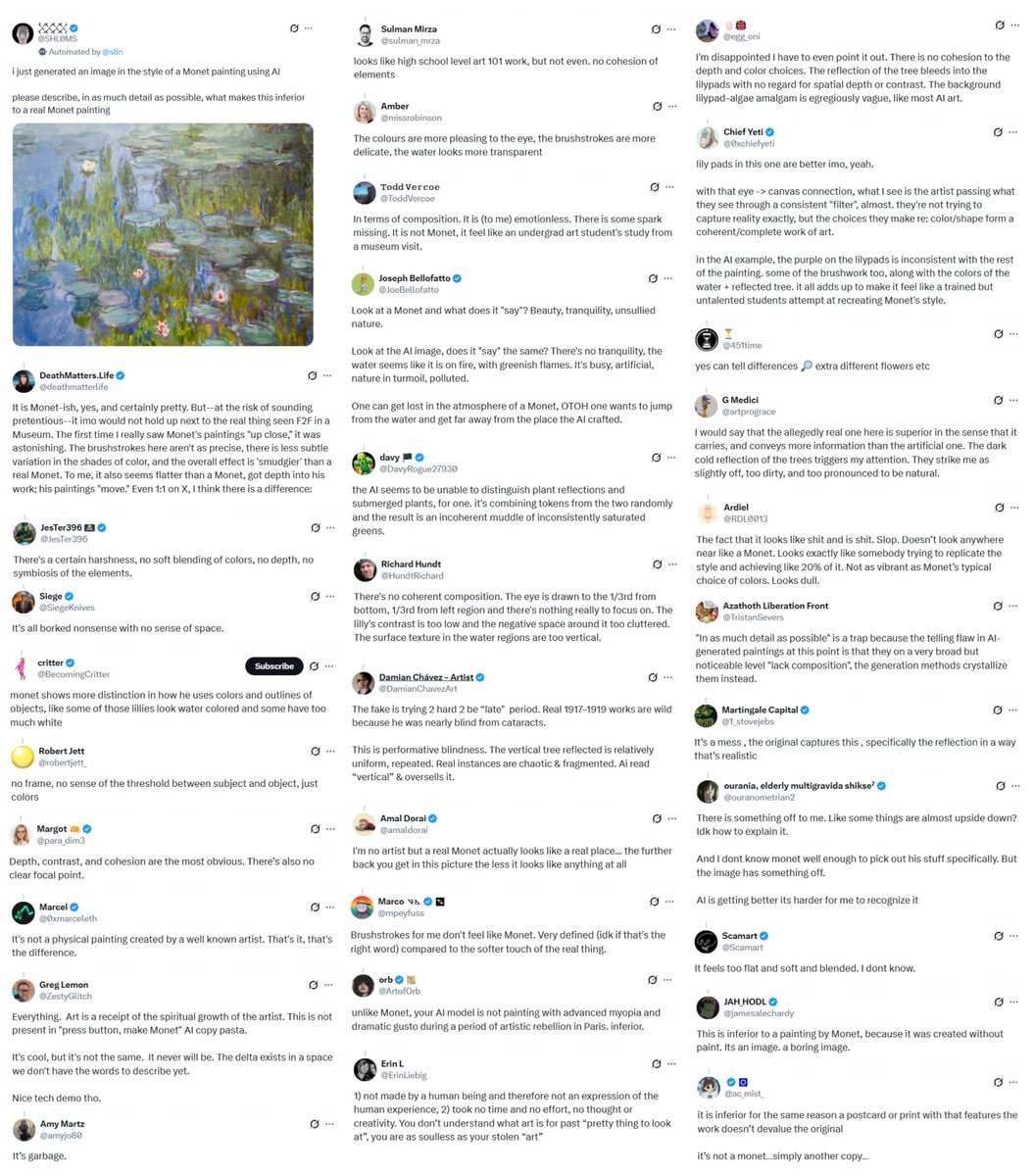
What happens when you post a real Monet and say it’s AI? The coolest art social experiment I’ve seen in a while. Thank you @SHL0MS
Jediwolf tweet media
English
983
3.4K
21K
2.2M
NaN 🇱🇧🇵🇱☦️🍉 retweetledi
autist
autist@litteralyme0·
ZXX
150
5.2K
43.4K
788.2K
NaN 🇱🇧🇵🇱☦️🍉 retweetledi
Psicóloga Helen Versuti
Psicóloga Helen Versuti@psihelenversuti·
O pessoal com medo do detergente contaminado sendo que a esponja que tá na pia tá desse jeito
Psicóloga Helen Versuti tweet media
Português
562
18.1K
166.9K
12.6M
NaN 🇱🇧🇵🇱☦️🍉 retweetledi
Anish Moonka
Anish Moonka@anishmoonka·
A kid drew himself sleeping in bed between mom and dad and labeled it 'safe.' In Japan, this exact sleeping arrangement has a name. They call it 'the river.' Mother is one bank. Father is the other. The child between them is the water. Roughly 70% of Japanese mothers sleep this way with their kids, sometimes through the teenage years. The Western model of putting a kid alone in their own bedroom is barely 200 years old. For most of human history, in most cultures still alive today, kids slept beside their parents. James McKenna runs the Mother-Baby Behavioral Sleep Lab at Notre Dame. He spent decades watching what happens when parents and kids share a bed. The bodies sync up. Heart rates align with the parent's, breathing falls into the same rhythm, and by morning even sleep stages have started matching. The parent's body, in McKenna's words, acts as a kind of biological jumper cable for the child's. In 2013, researchers in the Netherlands tracked 193 babies through the first year of life. They measured cortisol, the brain's main stress hormone. Babies who had spent more weeks co-sleeping in the first six months produced less cortisol under stress at 12 months. Sleeping near a parent had rewired the kid's stress system to be calmer under pressure. Inside the kid's brain at night, the amygdala, the fear alarm, gets more sensitive as the body gets tired. Darkness makes it worse. A 2021 paper in PLoS One from Australian researchers showed that light directly suppresses amygdala activity. Lights off, alarm louder. The whole brain is wired to read 'alone in a dark room' as a threat. Now add a parent's body to that bed. The kid's nervous system reads warm body, breathing nearby, familiar smell. The threat alarm dials down. Two parents on either side dial it down twice. The drawing is the kid's brain calculating maximum safety: I am surrounded by the people who keep me alive, and nothing can reach me without going through them first. The arrangement in this drawing is what most of human history called 'sleeping.' Sleeping the kid alone in another room is a 200-year-old Western invention that we forgot was an invention. Every kid who has ever padded into your room at 3am and crawled into the middle of the bed is just trying to redraw the picture.
dinosaur@dinosaurs1969

English
715
3.5K
29.7K
6.7M