TheGSTLedger

239 posts

TheGSTLedger banner
TheGSTLedger

TheGSTLedger

@himaniamrin

IDT Expert | Speaker | Mistry & Shah | 12+ yrs in GST, Customs & legacy tax laws | Ex-KPMG | Litigator + Advisor | Breaking down complex tax issues with Clarity

Ahmadabad City, India Katılım Mayıs 2016
239 Takip Edilen646 Takipçiler
Sabitlenmiş Tweet
TheGSTLedger
TheGSTLedger@himaniamrin·
#TaxTalkThursday | Reflecting on 2025, Preparing for 2026 As we step into the new year, I would like to thank all the readers of Tax Talk Thursday for their valuable views, comments, and engagement throughout the year. Tax Talk Thursday was one of the initiatives I started in 2025, and the consistent interaction from readers has been both encouraging and motivating. As we look back at 2025, it is worthwhile to pause and note some of the important tax reforms introduced during the year. These reforms reflect a clear policy direction towards simplification of laws, reduction of ambiguity, improved compliance experience, and increased reliance on technology driven administration. On the indirect tax front, continued progress towards Next Generation GST remained one of the key positives of the year. Rationalisation of rate structures, improved refund mechanisms, and strengthening of digital compliance systems have gradually reduced friction in GST administration. The steady growth in the GST taxpayer base also indicates deeper formalisation of the economy and improved system maturity. On the income-tax front, one of the most significant developments was the introduction of the Income Tax Act, 2025, replacing the long-standing 1961 legislation. The new law places strong emphasis on clarity of language and structure. The shift to a single “Tax Year”, aligned with the financial year, is a positive step that removes long-standing confusion around assessment years and simplifies compliance for taxpayers and professionals alike. From the perspective of individual taxpayers, the enhancement of exemption limits under the new tax regime provided meaningful relief to the middle class. Stability in tax rates, coupled with higher exemption thresholds, has helped improve predictability and disposable income, both critical for voluntary compliance and economic confidence. As we look forward to 2026, expectations remain high. Stakeholders are hopeful for further GST rate rationalisation, simplification of annual return and audit requirements, smoother system integrations across tax laws, and more effective dispute-resolution mechanisms to reduce litigation. In a nutshell, 2025 laid a strong foundation for a simpler, more transparent, and technology oriented tax framework. The year ahead presents an opportunity to build on this momentum through consistent implementation and practical reforms. Wishing all readers a very Happy New Year, and looking forward to continuing these discussions every Thursday in 2026 as well. Happy reading! @cbic_india @IncomeTaxIndia @FinMinIndia #TaxTalkThursday #TTT #TaxUpdates #TaxReforms #NextGenGST #IncomeTax #TaxProfessionals #CharteredAccountants #TaxCompliance #EaseOfDoingBusiness #NewYear2026

TheGSTLedger tweet media
English
0
0
7
716
TheGSTLedger
TheGSTLedger@himaniamrin·
#TaxTalkThursday | The e-Way Bill Just Got Smarter !! Its been almost 9 years to GST and for years, the e-Way Bill has been a one-way street, generate, transport, expire. There has been no formal way to tell the system that the goods have actually been delivered. And in classic Bill-To/Ship-To transactions, the "Ship-To GSTIN" was an optional field, often skipped, frequently mismatched, and a recurring trigger for departmental queries. GSTN's advisory dated 20.05.2026 changes both of these. What is changing? Check the attached image to get a glance! The practitioner's lens: A mandatory "Ship-To GSTIN" tightens the audit trail in three and four party transactions especially in situations where Bill-To is in one State and Ship-To in another. Mismatches here have historically been the cause of place-of-supply disputes and ITC reversals at the recipient's end. The closure facility, though voluntary for now is a clear signal that the Department now wants the EWB to mirror the actual delivery cycle and not just the dispatch event. Closed EWBs become harder to misuse for circular trading, recycled vehicle numbers, or bogus movement claims. It is also a quiet pre-cursor to deeper EWB-GSTR-1-e-Invoice reconciliation that GSTN's analytics wing has been building. Author's view: - Update ERP and EWB generation templates to make "Ship-To GSTIN" a mandatory entry well before the 15.06.2026 API cut-off. - Capture a delivery-staff or transporter mobile number at the EWB generation stage itself, it unlocks OTP-based closure without portal login. - Make EWB closure a standard SOP step in the dispatch-to-delivery workflow, even though it is voluntary. Voluntary today often becomes mandatory tomorrow! A small change in a field. But it move the EWB system one decisive step closer to a closed-loop. Stay compliant! Stay ahead! #TaxTalkThursday #GST #EWayBill #EWBClosure #BillToShipTo #ShipToGSTIN #GSTN #GSTCompliance #IndirectTax #CharteredAccountants #TaxUpdates #Logistics #SupplyChain #MistryAndShah #TaxAdvisory
TheGSTLedger tweet media
English
0
0
3
130
TheGSTLedger
TheGSTLedger@himaniamrin·
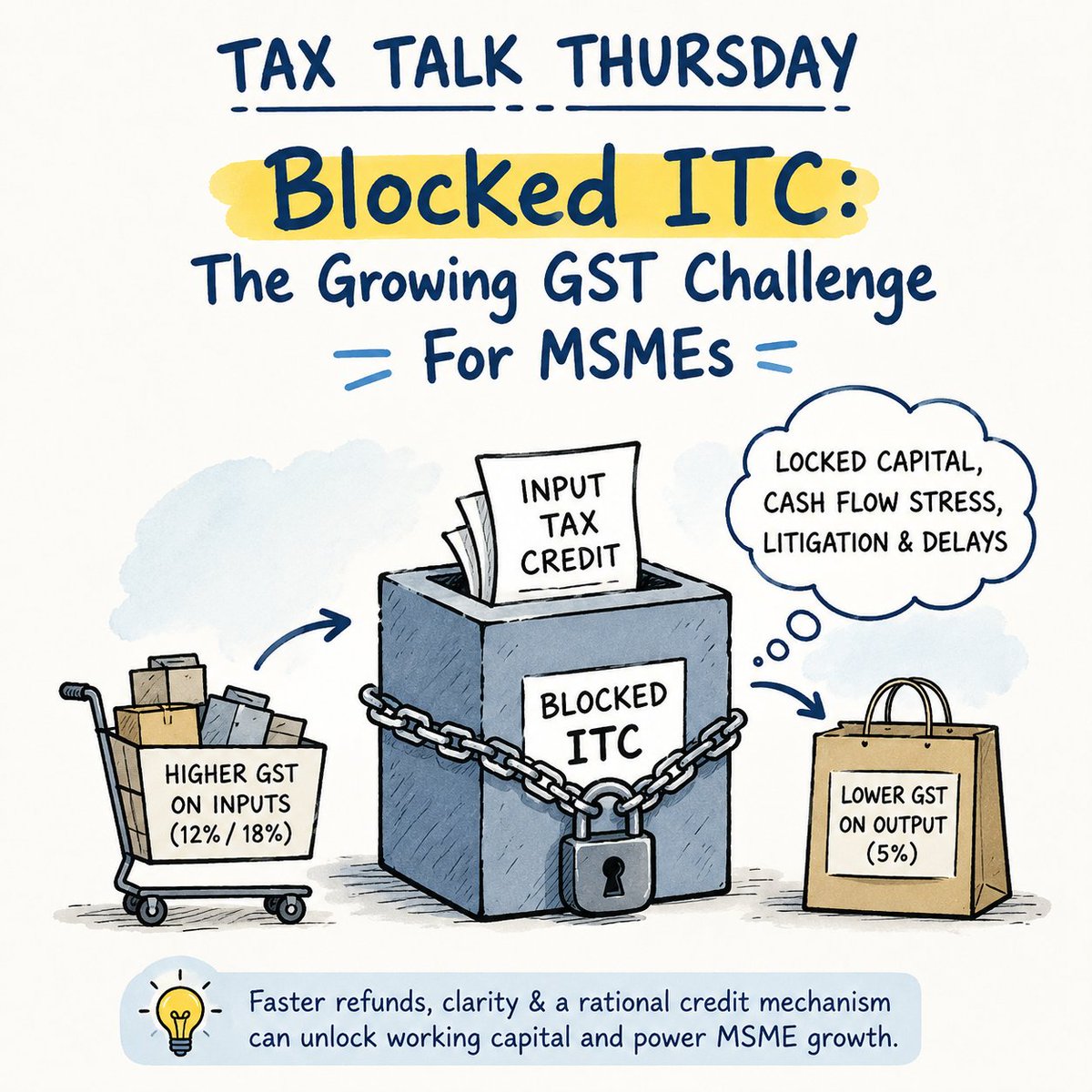
📢Tax Talk Thursday | Blocked ITC: The Growing GST Challenge For MSMEs Accumulation of ITC has always remained a key concern for MSMEs under the slab-based GST structure. In domestic transactions, the primary remedy available is refund under the inverted duty structure (IDS). However, the recent GST rate rationalisation exercise “GST 2.0”, has further intensified concerns around growing ITC accumulation across several sectors. With reduction in GST rates on various finished products, many businesses continue to procure raw materials, packaging, logistics and other input services at higher GST rates than the rate applicable on outward supplies. This mismatch is leading to continuous accumulation of unutilized ITC and blockage of working capital, particularly in sectors such as food processing, FMCG, pharmaceuticals, renewable energy and e-commerce. Further, refund eligibility in inverted duty cases continues to remain largely restricted to input goods, while input services and capital goods remain outside the refund framework. Increasing litigation, varying interpretations at adjudication levels and lack of clarity in refund processing are adding further uncertainty for taxpayers. Even the proposed automatic provisional refund mechanism is yet to see effective implementation on the ground. Author's comment: From an industry perspective, unlocking accumulated ITC is not merely a refund issue, but also a competitiveness concern for Indian businesses. A more rational credit mechanism, faster refund processing and a broader refund framework could significantly improve liquidity for MSMEs and strengthen the larger “Make in India” objective by enabling domestic industries to compete more efficiently in global markets. Views are welcome! Happy reading! #TaxTalkThursday #GST #InputTaxCredit #BlockedITC #InvertedDutyStructure #MSME #GSTRefund #WorkingCapital #GST2_0 #IndirectTax #MakeInIndia #TaxUpdates #IndianEconomy #GSTLitigation #BusinessCompliance
TheGSTLedger tweet media
English
0
0
2
170
TheGSTLedger
TheGSTLedger@himaniamrin·
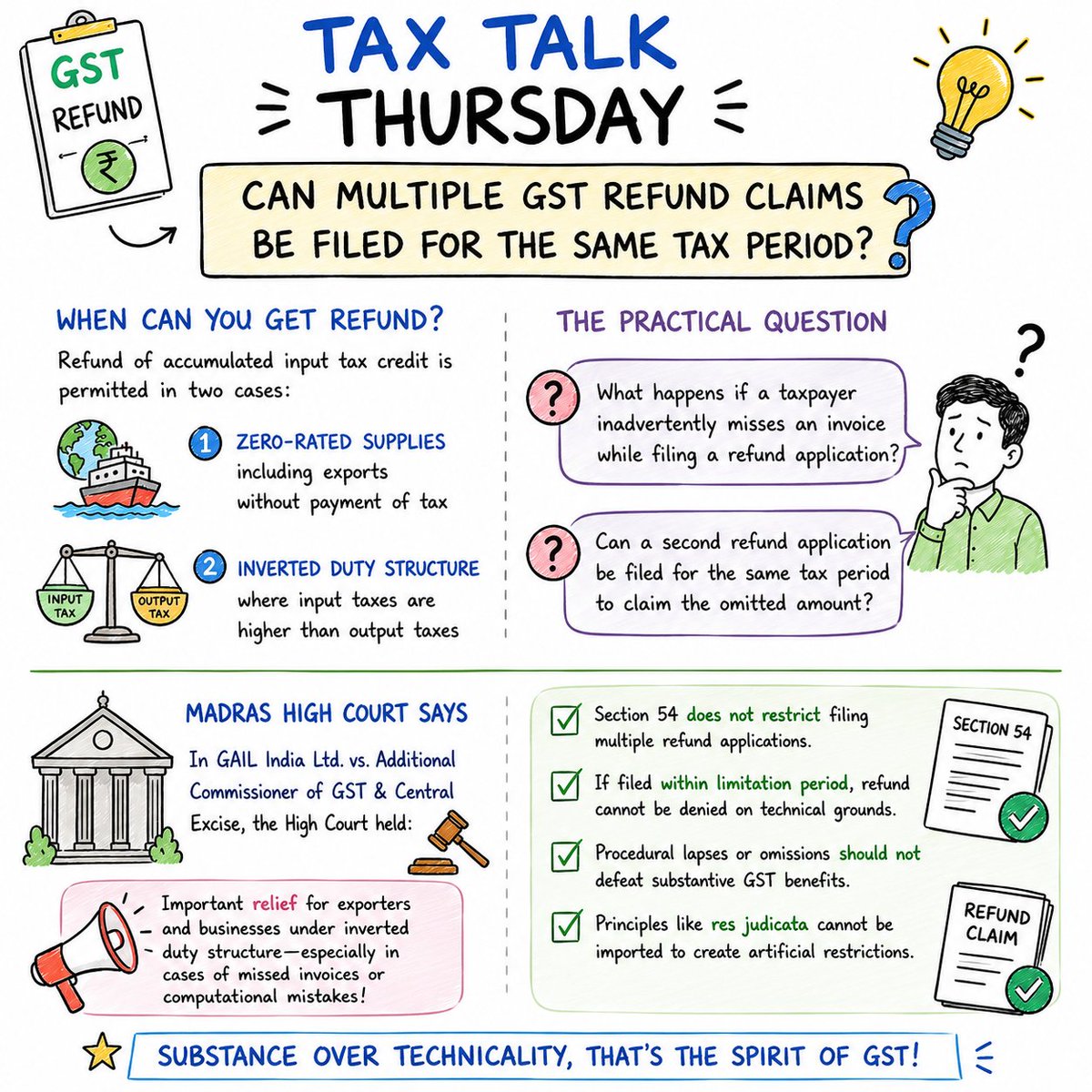
📢 Tax Talk Thursday | Can Multiple GST Refund Claims Be Filed for the Same Tax Period? Under GST law, refund of accumulated input tax credit is permitted in two situations: • Zero-rated supplies including exports without payment of tax • Inverted duty structure where input taxes are higher than output taxes Section 54 of the CGST Act provides the statutory framework for claiming such refunds within the prescribed limitation period. However, a practical issue often arises: - What happens if a taxpayer inadvertently misses an invoice while filing a refund application? - Can a second refund application be filed for the same tax period to claim the omitted amount? If we read the provisions of Section 54 and understand the intent of the law, nowhere does it prohibit filing multiple refund applications for the same tax period. There is also no upper limit prescribed on the number of refund applications that may be filed for a particular period. This effectively means that a taxpayer may file another refund application for the same tax period where any invoice or eligible credit was inadvertently missed while filing the original refund claim. This issue was recently examined by the Madras High Court in the case of GAIL India Ltd. vs. Additional Commissioner of GST & Central Excise, where the department rejected the refund claim primarily on the ground that a refund application had already been filed for the same period. The High Court, however, held in favour of the taxpayer and observed: ✔ Section 54 does not contain any restriction on filing multiple refund applications. ✔ If the claim is filed within the limitation period, refund cannot be denied merely on technical grounds. ✔ Procedural lapses or inadvertent omissions should not defeat substantive benefits available under GST law. This ruling provides important relief to exporters and businesses claiming refund under GST, especially in situations involving missed invoices, computational mistakes, or partial omissions in earlier refund applications. Happy reading! #TaxTalkThursday #GST #GSTRefund #ExportRefund #InvertedDutyStructure #InputTaxCredit #IndirectTax #GSTLitigation #MadrasHighCourt #TaxUpdates
TheGSTLedger tweet media
English
0
1
4
213
TheGSTLedger
TheGSTLedger@himaniamrin·
📢 RoDTEP Update | Notification No. 15/2026-27 DGFT has notified key amendments to RoDTEP Schedules (4R & 4RE) to align with changes in the Customs Tariff Act, effective 01.05.2026. 🔹 142 tariff lines added at 8-digit level 🔹 50 tariff lines deleted 🔹 Revised RoDTEP rates & caps notified 🔹 Certain product descriptions updated What this means: Exporters need to carefully revisit their product classification and RoDTEP eligibility. With addition and deletion of tariff lines, earlier claimed benefits may change or may no longer be available under the same HS code. It is advisable to update internal systems, validate mappings of HS codes with RoDTEP schedules, and ensure compliance before filing export documents post 01.05.2026. Link for document: dgft.gov.in/CP/ Happy reading! @dgftindia @CimGOI @DoC_GoI #RoDTEP #DGFT #Exports #Customs #TaxUpdates #TheGSTLedger
English
0
3
7
2.4K
TheGSTLedger
TheGSTLedger@himaniamrin·
#TaxTalkThursday | Statutory Limitation vs Constitutional Remedies Under indirect tax laws, including GST, limitation provisions for filing appeals are strictly codified. For instance, under Section 128 of the Customs Act, an appeal must be filed within 60 days, extendable by a further 30 days, beyond which the appellate authority becomes functus officio and lacks jurisdiction to condone delay. The Telangana High Court, in M/s Spice Jet Ltd. vs Additional Commissioner of Customs, reaffirmed this settled position, holding that appellate authorities are bound by statutory timelines and cannot travel beyond the prescribed condonable period. However, the Court made an important distinction between statutory limitation and constitutional remedies. While upholding the rejection of appeal by appellate authorities as legally correct, it exercised its writ jurisdiction under Article 226 to condone the delay, emphasizing that procedural limitations should not defeat substantive rights where sufficient cause exists. The Court reiterated that although special statutes restrict condonation powers, constitutional courts retain inherent authority to intervene in appropriate cases. This ruling serves as a positive precedent and offers a practical takeaway for GST as well. In cases where appeals are rejected at the first appellate stage purely on account of delay beyond condonable limits, taxpayers may still explore writ remedies before the High Court. Where genuine hardship, absence of mala fide intent, and substantive issues on merits are demonstrated, courts may consider restoring such appeals in exercise of constitutional powers. Happy reading! #GST #GSTIndia #IndirectTax #TaxLitigation #TaxUpdates #TaxProfessionals #Appeals #GSTAppeals #LimitationLaw #CondonationOfDelay #TaxCompliance #HighCourt #WritJurisdiction #Article226 #JudicialPrecedent #CustomsLaw #TaxLawIndia #LegalUpdate #TaxAdvisory #SubstantiveJustice #ProceduralLaw #TaxRelief #TaxTalkThursday #TheGSTLedger
TheGSTLedger tweet media
English
0
1
2
136
TheGSTLedger
TheGSTLedger@himaniamrin·
Important Customs Update on Handling Export Cargo Returned to India In light of disruptions in maritime routes due to the closure of the Strait of Hormuz, the CBIC has issued Circular No. 21/2026-Customs dated 15.04.2026, providing much-needed procedural clarity for export cargo that is offloaded at foreign ports and subsequently returned to India. The circular aims to balance trade facilitation with revenue safeguards, and prescribes a simplified process for such scenarios. Also, on account of such return of cargo, any IGST refund, drawback, etc., to be recovered where already disbursed. Attached a detailed table to showcase proposed clarification. Notably, the relaxation is temporary and valid till 30.04.2026. This circular is a practical step towards addressing real-time logistics disruptions while ensuring compliance discipline remains intact. Happy reading! @cbic_india @FinMinIndia #Customs #Export #TradeFacilitation #CBIC #Logistics #IndirectTax #GST #Shipping #IndiaTrade #TheGSTLedger
TheGSTLedger tweet media
English
0
0
2
85
TheGSTLedger
TheGSTLedger@himaniamrin·
Tax Talk Thursday | Self-Sealing Permission, Without Expiry! In the export ecosystem, procedural efficiencies play a critical role in ensuring timely shipments and reducing transaction costs. One such facilitation provided to exporters is the concept of factory stuffing or self-sealing permission, which allows goods meant for export to be sealed at the exporter’s premises instead of requiring physical supervision at ports or ICDs. This facility was originally introduced to simplify export procedures, reduce congestion at ports, and promote ease of doing business. Under earlier circulars, eligible exporters and merchant exporters were permitted to undertake self-sealing of containers at their premises, subject to prescribed safeguards and compliance conditions. However, in practice, a lack of explicit clarity on the validity period of such permissions led to divergent approaches by field formations. In several instances, authorities treated the permission as time-bound, requiring exporters to seek periodic renewals or revalidation. This resulted in avoidable administrative burden and uncertainty for businesses relying on seamless export operations. The position has recently been settled by CBIC through Circular No. 14/2026-Customs dated 27th March 2026. It has been categorically clarified that once self-sealing permission is granted to an eligible exporter, there is no prescribed validity period. The permission will continue indefinitely unless it is specifically withdrawn, suspended, or cancelled by the jurisdictional Customs authority. At the same time, the Board has retained necessary safeguards by empowering authorities to take action in cases of non-compliance, misuse, or any other valid reason. Though this brings much-needed certainty and aligns with the broader objective of trust-based governance. Exporters should ideally look into the compliance aspect of the can now operate with continuity and predictability, without the concern of periodic renewals. Overall, the move strikes a balanced approach, easing business processes while reinforcing regulatory discipline and is a welcome step towards improving India’s export competitiveness. Happy reading! #TaxTalkThursday #CBIC #Customs #IndirectTax #GSTIndia #ExportCompliance #EaseOfDoingBusiness #TradeFacilitation #SelfSealing #FactoryStuffing #Exporters #Logistics #SupplyChain #RegulatoryUpdate #TaxUpdates #IndianExports #Compliance #CustomsLaw #BusinessIndia #TheGSTLedger @cbic_india @FinMinIndia
TheGSTLedger tweet media
English
0
0
2
82
TheGSTLedger
TheGSTLedger@himaniamrin·
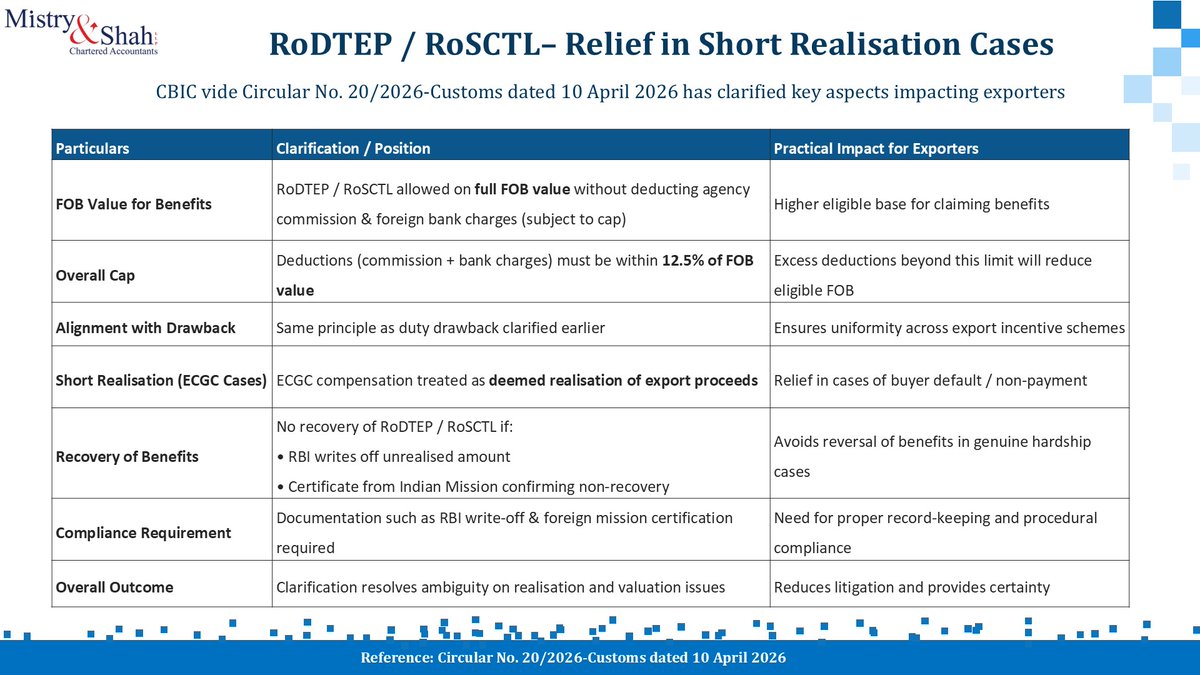
DGFT UPDATE | RoDTEP / RoSCTL Clarification | Relief in Short Realisation Cases CBIC vide Circular No. 20/2026-Customs dated 10 April 2026 has clarified key aspects impacting exporters: 🔹 Benefits available on full FOB value (no deduction for commission/bank charges), subject to 12.5% cap 🔹 @ecgclimited compensation treated as deemed realisation of export proceeds 🔹 No recovery of benefits where RBI permits write-off and certification is obtained This brings much-needed clarity and aligns incentives with commercial realities, especially in cases of payment defaults. A positive step towards reducing disputes and strengthening export confidence. Happy reading! @dgftindia #RoDTEP #RoSCTL #Exports #Customs #TaxUpdate #IndirectTax
TheGSTLedger tweet media
English
0
1
3
246
TheGSTLedger
TheGSTLedger@himaniamrin·
Tax Talk Thursday | Does IGST Refund Block Inverted Duty Structure Refund? Section 54(3) allows refund of accumulated ITC in cases of zero-rated supplies and inverted duty structure. The proviso, however, restricts refund where the taxpayer has claimed drawback of central tax or refund of IGST on such supplies. A closer reading suggests that the intent is specific, to prevent double benefit on the same stream of tax, and not to restrict refunds altogether. The proviso acts as a safeguard to ensure that the same tax component is not claimed twice through different routes. It does not imply that choosing one refund mechanism (like export with payment of IGST) automatically blocks other legitimate refund claims arising from a different cause, such as accumulation due to inverted duty structure. This understanding is also supported in VSM Weavess India Private Limited case law where the Hon’ble Madras Court observed that refund of IGST on exports and refund of accumulated ITC under inverted duty structure operate in different fields. They are based on distinct triggers and do not overlap. Author’s comment: The proviso should be read in line with its intent to block double benefit and not genuine refund. Where ITC accumulation exists due to inverted duty structure, that entitlement continues independently, and should not be denied merely because exports are made with payment of IGST. Views are welcome! Happy reading #TaxTalkThursday #GSTIndia #InvertedDutyStructure #GSTRefund #InputTaxCredit #ZeroRatedSupply #IndirectTax #GSTLitigation #TaxInsights #GSTUpdates #TaxProfessionals #GSTAdvisory #ITC #RefundClaims #GSTLaw #TaxPractice #TheGSTLedger
TheGSTLedger tweet media
English
0
3
10
2.1K
TheGSTLedger
TheGSTLedger@himaniamrin·
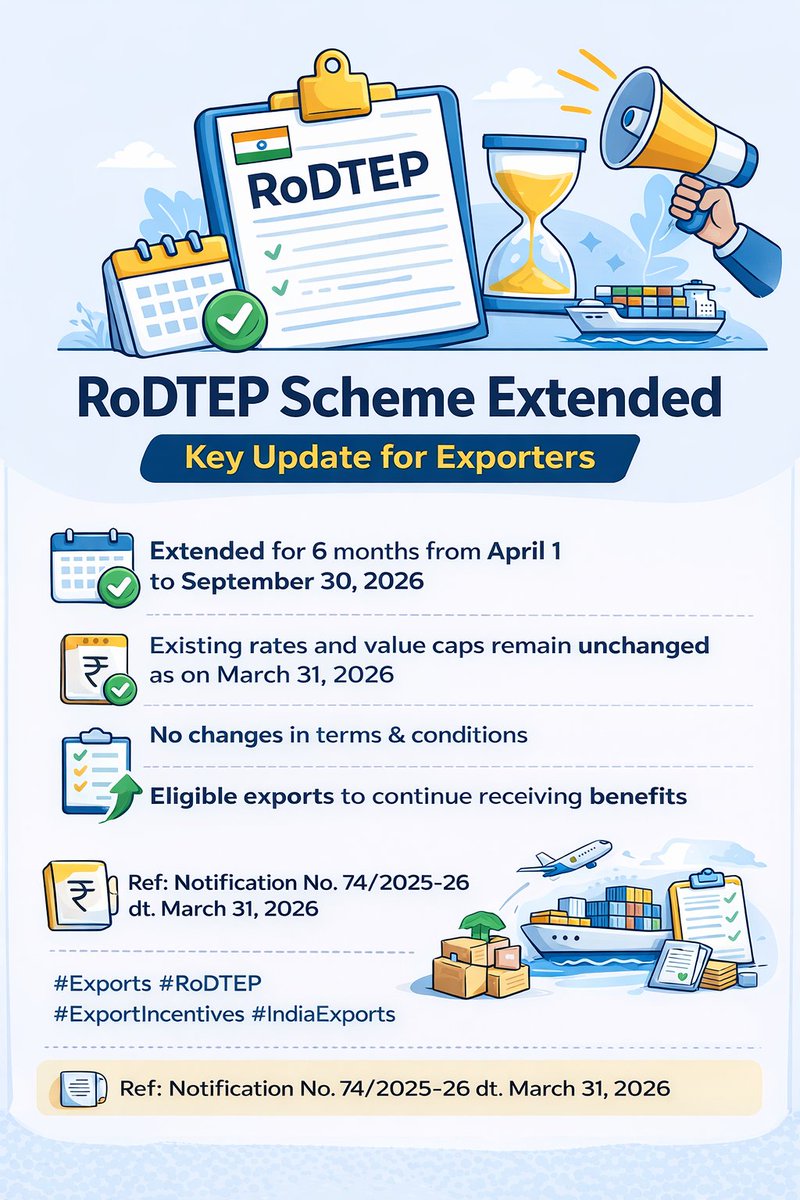
DGFT Update | RoDTEP Scheme Extended The Government has issued Notification No. 74/2025-26 dated March 31, 2026, providing clarity on the continuity of export incentives under the RoDTEP Scheme. Key Highlights: • The RoDTEP Scheme has been extended for a further period of 6 months, from April 1, 2026 to September 30, 2026 • Existing rates and value caps remain unchanged as applicable on March 31, 2026 • No changes in terms and conditions of the scheme • Eligible exports during this period will continue to receive benefits as per current structure This extension provides short-term certainty to exporters, especially in planning pricing, contracts, and working capital. However, the limited extension horizon also indicates the need for businesses to closely track policy developments for the period beyond September 2026. Way Forward for Industry: • Align export pricing considering continued RoDTEP benefits • Monitor future announcements for long-term continuity • Ensure proper documentation to avoid benefit disruptions Happy reading! #RoDTEP #ExportIncentives #ForeignTradePolicy #DGFT #Exports #TradeUpdate #IndirectTax #IndiaExports @dgftindia @CimGOI @DoC_GoI
TheGSTLedger tweet media
English
0
0
2
122
TheGSTLedger
TheGSTLedger@himaniamrin·
Tax Talk Thursday | Can Refund Be Denied by Treating ITC as Ineligible? Under the GST framework, refund claims (in cases such as zero-rated supplies or inverted duty structure) are linked to the availability of ITC. While Section 54 of the CGST Act governs refunds, the eligibility of ITC itself flows from Sections 16 and 17. A key question that often arises is whether the department can deny refund by re-characterising ITC as “ineligible” at the stage of refund processing, without following the due process for ITC denial. Legally, refund proceedings are not meant to become a substitute for adjudication on ITC eligibility. If the ITC has already been availed and reflected in returns, the same cannot be summarily treated as ineligible during refund scrutiny unless the department initiates proper proceedings under Sections 73 or 74 for reversal of such ITC. Denial of refund on the ground of ineligible ITC, without adjudication, effectively amounts to indirect recovery of ITC. This brings a very practical and often overlooked question: once the refund is rejected on the ground of “ineligible ITC”, what exactly is being challenged in appeal? Is the taxpayer appealing against rejection of refund, or effectively contesting the denial of ITC itself? In substance, such cases go beyond refund, they involve a dispute on ITC eligibility, which ideally should have been adjudicated separately. While there is direct shortcut answer towards this issue while you claim refund or litigate matter, its important that taxpayer be cautious on ITC availed and considered while filing of refund claim! Happy reading! #TaxTalkThursday #GSTIndia #InputTaxCredit #GSTRefund #IndirectTax #GSTLitigation #TaxInsights #GSTUpdates #TaxProfessionals #GSTAdvisory #ITC #RefundClaims #GSTLaw #TaxPractice #TheGSTLedger
TheGSTLedger tweet media
English
0
0
2
168
TheGSTLedger
TheGSTLedger@himaniamrin·
RELIEF Scheme for Exporters: Government’s Strategic Response to Global Trade Disruptions Global geopolitical tensions, particularly in West Asia, have significantly disrupted maritime trade leading to increased freight costs, insurance premiums, and heightened risk exposure for exporters. In response, the Government has introduced the RELIEF (Resilience & Logistics Intervention for Export Facilitation) Scheme vide Notification No. 65/2025-26. 🔍 What does the RELIEF Scheme offer? • Up to 100% credit risk coverage for existing ECGC policyholders • Up to 95% coverage for new ECGC-supported shipments • Up to 50% reimbursement of freight & insurance costs for MSMEs The scheme is time-bound, documentation-intensive, and operates on a first-come-first-served basis making preparedness critical for exporters. Read our detailed blog which breakdowns of all three components, eligibility conditions, and practical steps industry should take to maximise benefits. 👉 mistryandshah.com/best-exim-cons… Happy reading! @cbic_india @CimGOI @ecgclimited #Exports #InternationalTrade #ECGC #RELIEFScheme #MSME #Logistics #SupplyChain #TradeDisruption #IndiaExports #IndirectTax #GlobalTrade #TheGSTLedger
TheGSTLedger tweet mediaTheGSTLedger tweet media
English
0
1
1
81
TheGSTLedger
TheGSTLedger@himaniamrin·
Tax Talk Thursday | When demand is deposited, but not recognised! Investigation stage payments have always been a grey area and perhaps a discussion for another day. In practice, SCN or orders arising out of such investigations are issued after 1 – 2 years, by which time amounts deposited through DRC-03 remain unaligned with any demand. The real challenge surfaces at the appeal stage, despite sufficient payments already made, taxpayers often end up paying pre-deposit again due to system limitations. In many cases, the amount already deposited is far higher than the required pre-deposit, yet remains unadjusted. This recurring issue has now been addressed through a recent advisory. The advisory essentially clarifies how the system works. Once a demand order is issued, a Demand ID gets created in the Electronic Liability Register, and the portal recognises payments only if they are tagged against this ID. Payments made during investigation through DRC-03 do not get auto-linked. The solution prescribed is filing Form DRC-03A to link such payments with the relevant demand, post which the amount gets reflected appropriately and is considered for pre-deposit, avoiding any duplicate payment requirement. IMPORTANT: That said, one important distinction must not be missed, amounts deposited during investigation are not automatically admitted liabilities. If any portion is actually admitted, it must first be adjusted against such admitted tax and not towards pre-deposit, which is computed only on the disputed portion. Practically, it becomes important to maintain a reconciliation of unadjusted DRC-03 challans and track their utilisation across pending adjudication or appeals to avoid duplication and cash flow impact. Happy reading! #TaxTalkThursday #GSTAppeals #PreDeposit #GSTAdvisory #DRC03 #DRC03A #GSTLitigation #IndirectTax #GSTIndia #TheGSTLedger
TheGSTLedger tweet media
English
0
0
3
116
TheGSTLedger
TheGSTLedger@himaniamrin·
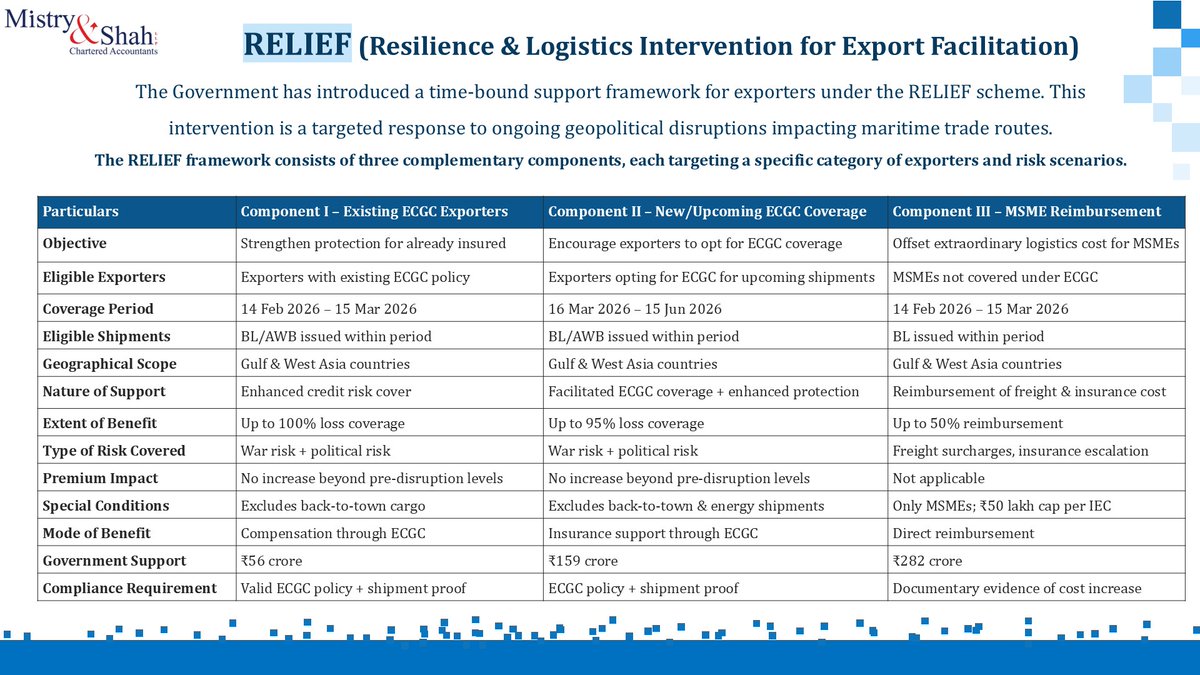
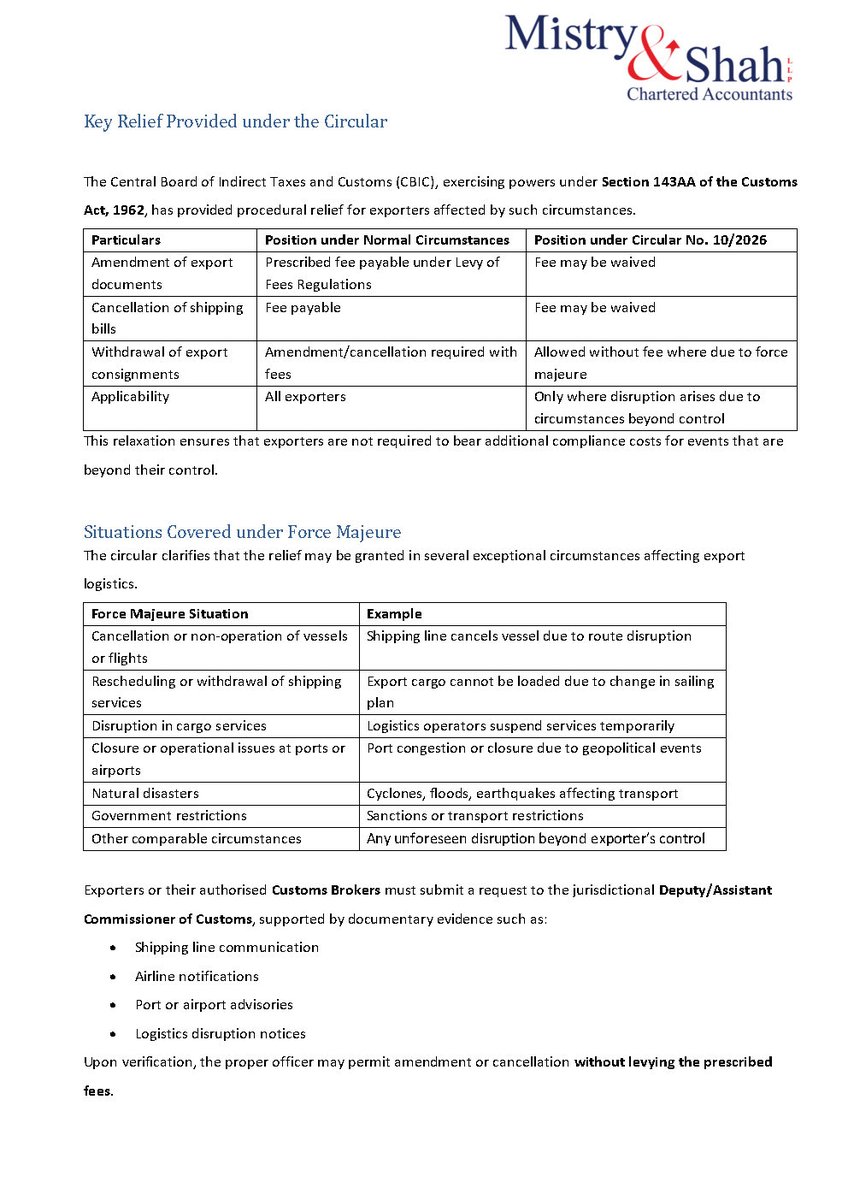
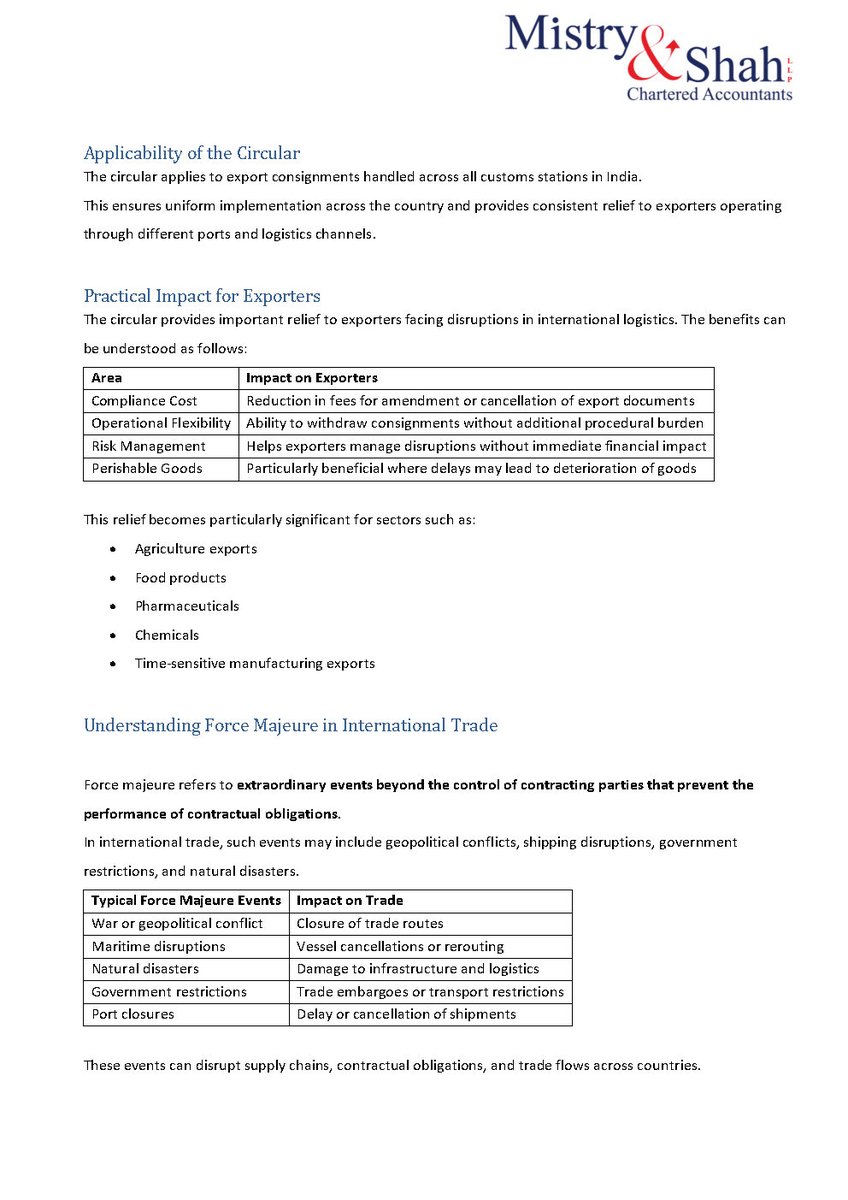
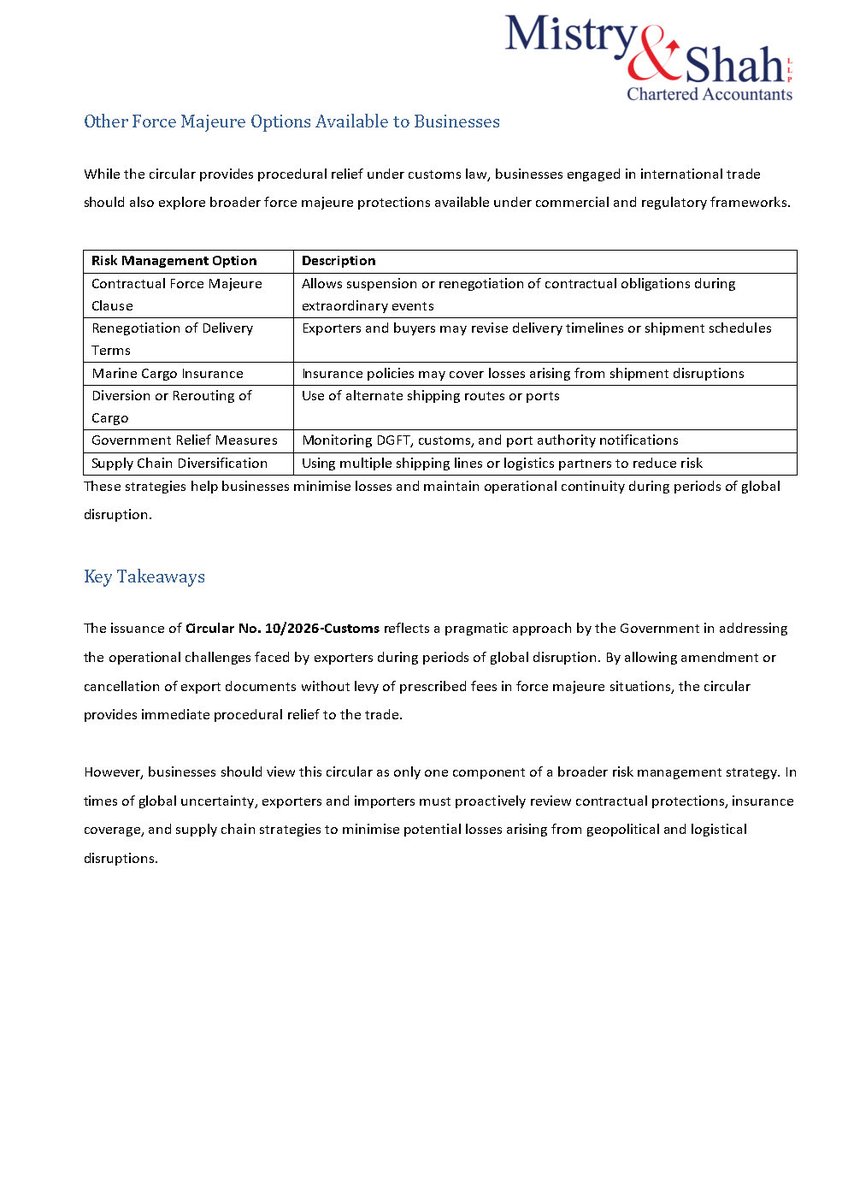
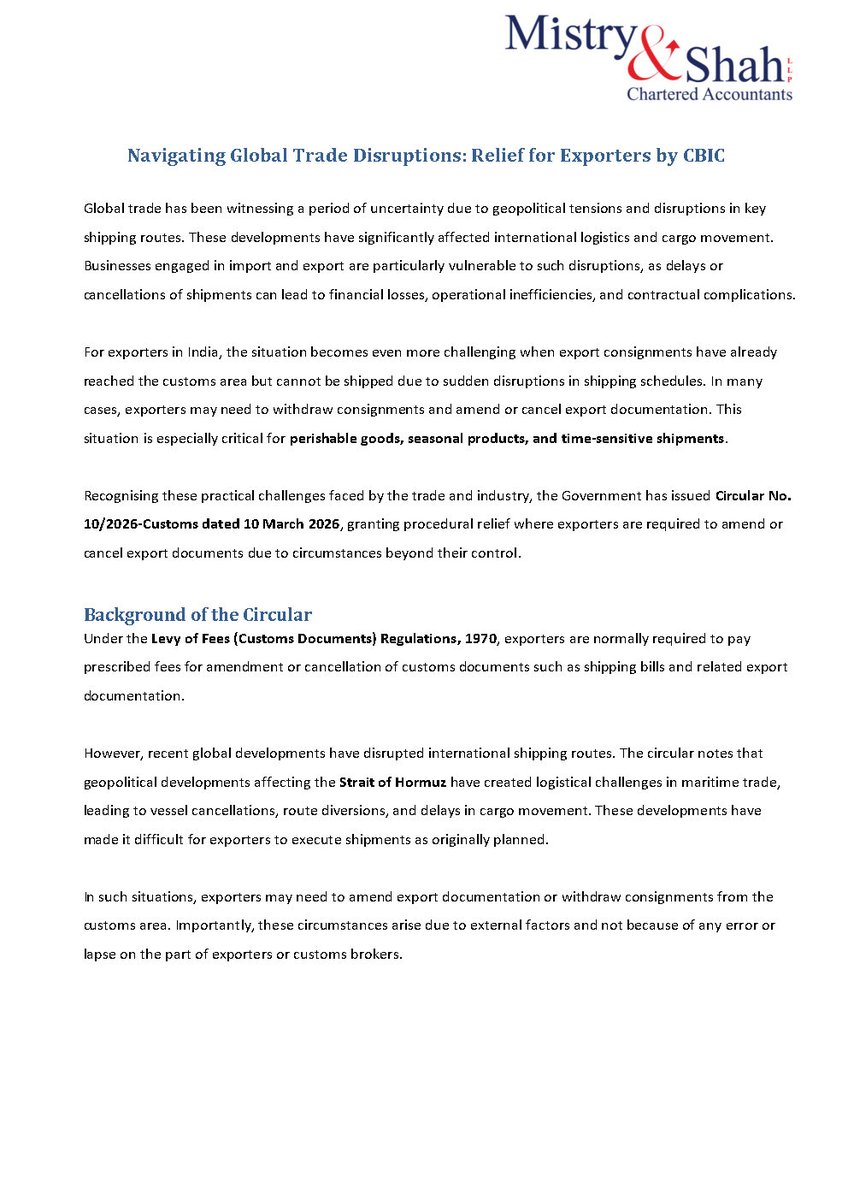
Important Update !! Global uncertainties and disruptions in international shipping routes are increasingly impacting export logistics and trade operations. Situations such as cancellation or rescheduling of vessels, disruption in cargo services, or operational issues at ports may force exporters to withdraw consignments that have already reached the customs area, creating compliance and cost challenges, particularly for time-sensitive or perishable goods. Recognising these challenges, @cbic_india has issued a Circular clarifying that where amendment or cancellation of export documents becomes necessary solely due to force majeure circumstances, the proper officer may allow such changes without insisting on payment of the prescribed fees. This is a practical relief for exporters facing unexpected disruptions in global logistics. However, businesses should also evaluate other force majeure protections available under commercial contracts, insurance coverage, and supply chain arrangements to minimise potential losses during periods of geopolitical or logistical uncertainty. Sharing our detailed blog explaining the circular and key force majeure considerations for businesses engaged in import and export. lnkd.in/d3EcwKnx Happy reading! #TaxTalkThursday #Customs #ExportCompliance #InternationalTrade #ForceMajeure #IndianExports #GlobalTrade #TradeCompliance @DoC_GoI @CimGOI
TheGSTLedger tweet mediaTheGSTLedger tweet mediaTheGSTLedger tweet mediaTheGSTLedger tweet media
English
0
0
2
67
TheGSTLedger
TheGSTLedger@himaniamrin·
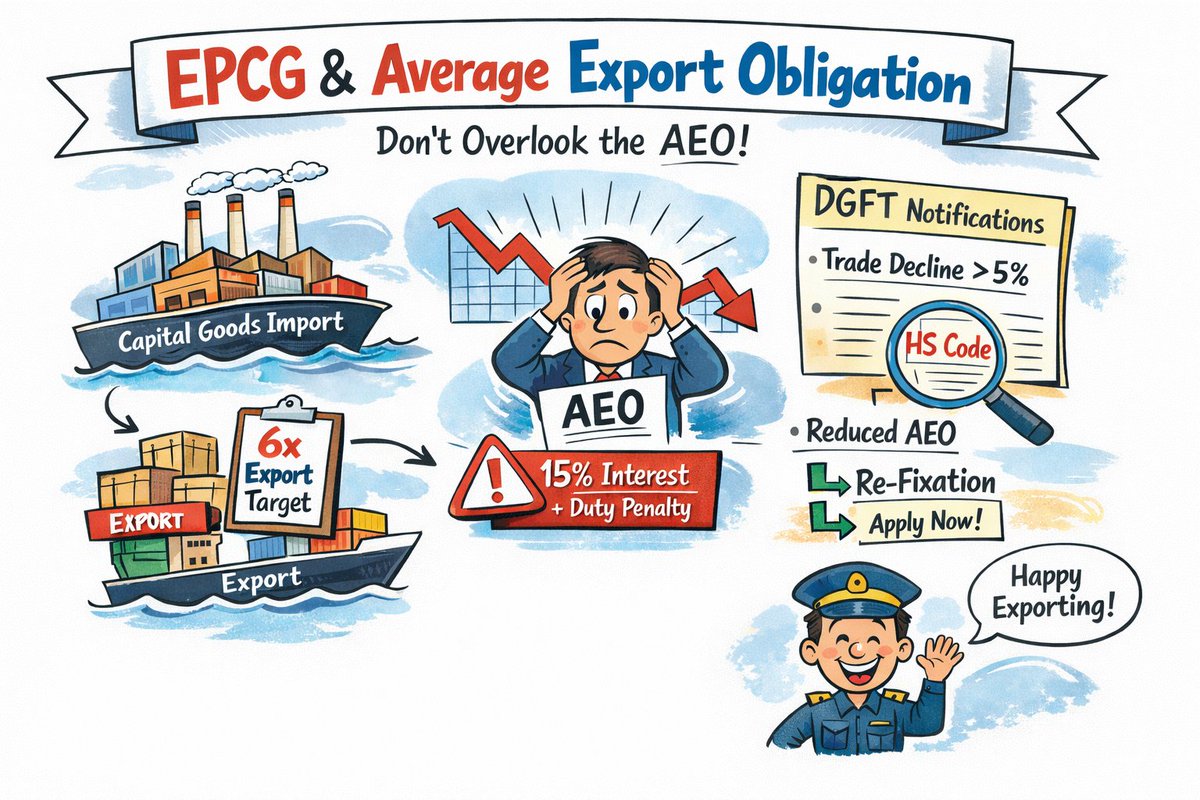
#TaxTalkThursday | EPCG for Capital Goods Imports: Don’t Overlook the Average Export Obligation When manufacturers plan to import capital goods, the Export Promotion Capital Goods (EPCG) Scheme is often the preferred route as it allows imports at concessional or even zero customs duty. Most businesses focus on the requirement of achieving exports equal to six times the duty saved, but an equally important condition that often goes unnoticed is the Average Export Obligation (AEO). Under the FTP, the license holder must maintain the average export level of the preceding three financial years during the export obligation period. Which means, the exporter must continue to maintain the historical average exports while also achieving the additional exports required under EPCG. If the AEO is not maintained, it can be treated as non-fulfilment of EPCG conditions, which can lead to recovery of the duty saved along with interest. Therefore, before opting for EPCG, businesses should carefully review their past export performance and realistically assess whether maintaining this level of exports is feasible. Is there any relief if AEO is not maintained? In certain cases, DGFT issues annual notifications identifying sectors where global trade has declined by more than 5%. If the exporter’s HS Code falls within such list, the AEO may be reduced proportionately for that particular year, and the licence holder can apply for re-fixation of the Annual AEO. Thursday Thought: Such re-fixation is not automatic, and it will not be considered automatically during the EODC application. Exporters must proactively verify whether their HS Code falls under the notified list and apply accordingly. Happy reading. Happy exporting! #TaxTalkThursday #EPCG #ForeignTradePolicy #DGFT #ExportCompliance #Customs #InternationalTrade #IndirectTax @dgftindia
TheGSTLedger tweet media
English
0
1
4
93