Michael

4.7K posts

Michael banner
Michael

Michael

@himichaelhe

TXT | Yezi | IU Learning to invest in good companies.

Los Angeles Katılım Aralık 2020
529 Takip Edilen400 Takipçiler
Michael retweetledi
SandemanStocks
SandemanStocks@Sandeman52·
Hitting $100k took over ten years. $500k 2-3 years after that. $1 million a year after that. $2 million 12-18 months after that. Covid hits, everything is a blur, now fluctuating between $7-8 million 🙏 If all goes to plan, 8 figures in 2026 🙏 The younger you start the better off you will be. Even if you put away $5k per year to start. You just need to focus on that first $100k. That’s the hardest milestone. Learn from others. Do research. Don’t get frustrated. Stay patient. Don’t panic. Don’t fear red days. Mix in calculated risk and a sprinkle of yolo. That’s the blueprint.
English

43
26
599
120.5K
Michael
Michael@himichaelhe·
@Sandeman52 Would love to hear more about your first 10 years, how you approached things and such. I find it inspiring and fascinating
English
0
0
0
18
SandemanStocks
SandemanStocks@Sandeman52·
Crazy!!! $1,852,000 (paper) gain today. I remember years ago my first $100k gain and was in disbelief. I’m starting to realize, the longer you do this, the more you don’t believe the numbers you see….but it’s real. Compounding numbers are the 8th wonder of the world. “Compound interest is the eighth wonder of the world. He who understands it, earns it; he who doesn’t, pays it.” -Albert Einstein
English
59
8
703
49.5K
Nat Stewart
Nat Stewart@natstewart5·
String enough "quick fixes" together and more often than not the big picture gets fixed.
English
4
1
12
11.9K
Michael retweetledi
Josh Wolfe
Josh Wolfe@wolfejosh·
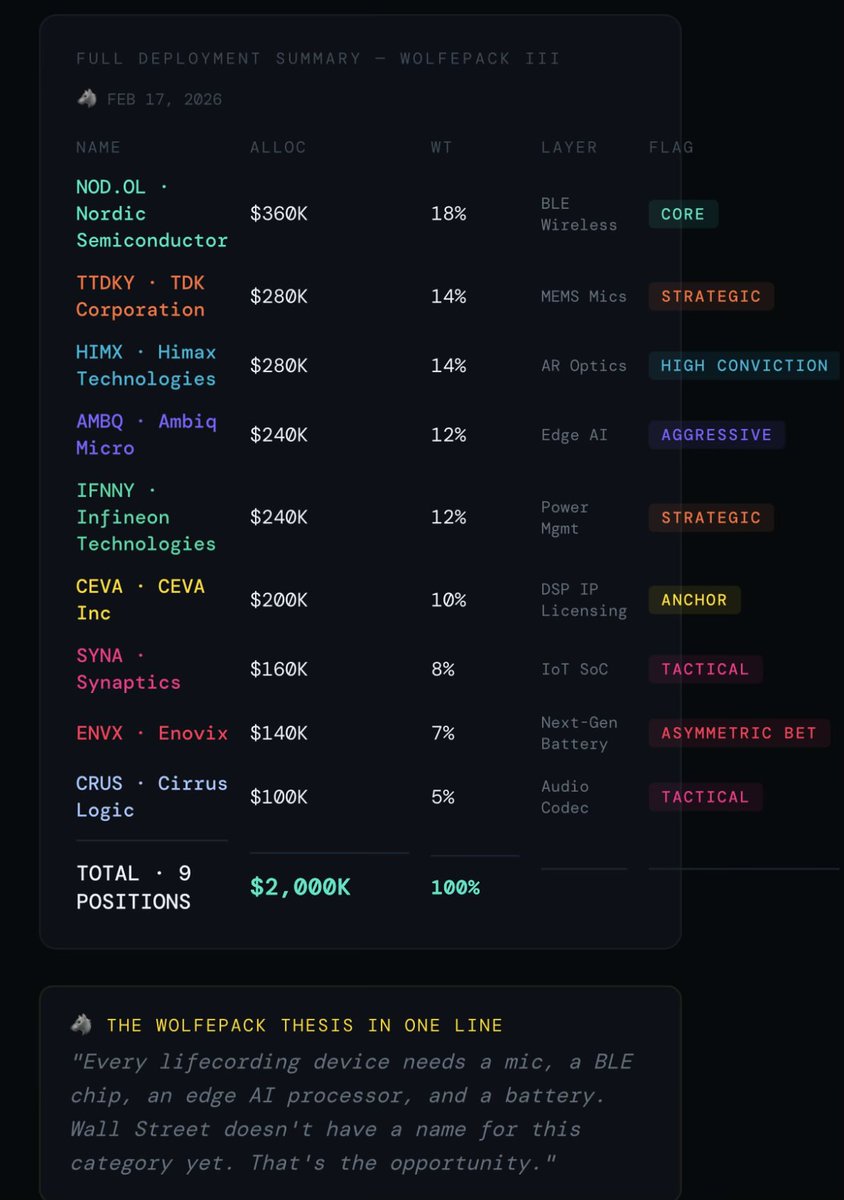
9/ we added others to this on my speculation of LIFECORDING and sharing a few we own in full disclosure
Josh Wolfe tweet media
English
19
16
225
29.7K
Michael retweetledi
Rose Celine Investments 🌹
Rose Celine Investments 🌹@realroseceline·
I bought a new stock for my portfolio today. Only the second new position I have started this entire year. It is a $3.5b small cap non tech company that I have admired for many years, but I was never able to buy it because the valuation always felt too expensive. I think one of the hardest things in investing is accepting that a great business and a great investment are not always the same thing. Sometimes the business is incredible for years while the stock itself is a terrible investment simply because expectations and valuation became disconnected from reality. Ironically my first purchase this year was $NOW, which at the time was considered one of the worst buys imaginable on this platform and I got totally killed in here. People were acting like the business completely broke overnight. A few weeks later sentiment flipped and suddenly it became a loved companies again. The fascinating part is the actual business barely changed during that period. Mostly the stock price and the narrative changed. That is one of the biggest lessons over time. Social media sentiment moves much faster than business fundamentals. Investors often confuse volatility with change. A stock declining 25% does not automatically mean the business is suddenly 25% worse. Another thing I have learned is that patience in investing looks stupid until it suddenly looks disciplined. I only bought 2 new stocks this year because truly great opportunities are actually pretty rare. Most people trade constantly because activity feels productive, but some of the best returns I have ever had came from doing almost nothing for long stretches and then acting aggressively when price, expectations, and quality finally aligned. What interests me most is not next quarter or even next year. I care far more about what this business can potentially look like 5-10 years from now. Is the moat strengthening? Are the unit economics improving? Does management allocate capital intelligently? Those questions matter infinitely more to me than whether social media currently loves or hates the stock. I no longer really share my exact buys and sells publicly the way I used to. Not because I am trying to be secretive, but because I do not want people blindly copying me without fully understanding the risks, valuation, time horizon, etc. A stock that fits my portfolio, psychology, and long term expectations may be completely wrong for someone else. I think social media has created this idea that investing is about copying and cloning instead of thinking. But real investing is much deeper than that. Two people can buy the exact same stock and have completely different outcomes because one understands what they own and the other is simply following a narrative. 🌹
English
77
4
246
44.5K
Michael retweetledi
Rose Celine Investments 🌹
Rose Celine Investments 🌹@realroseceline·
I think one of the biggest things people are underestimating right now is how AI may completely change the economics of the internet itself. Most people still think about AI like it’s just a better version of $GOOG search where you type something in, get an answer, maybe eventually see an ad, and move on. But I think what is actually happening underneath the surface is much bigger than that. $GOOG mostly helped humans find websites while AI may eventually help humans make decisions. That difference is massively important when you really think about it. A normal $GOOGL search might be “best running shoes” while an AI prompt could be “I run 25 miles a week, mostly on pavement, my knees hurt sometimes, I overpronate slightly, and I want something durable under $180.” That single prompt contains an enormous amount of commercial value because the AI already understands your budget, habits, constraints, preferences, and actual problem. The interaction itself becomes dramatically richer and more valuable than traditional search ever was. Most people assume AI monetization will eventually look similar to traditional search ads with sponsored links and promoted answers attached to keywords. I think AI interactions will eventually become much more commercially valuable than old search queries because the intent is far more personalized and contextual. The AI is not just organizing links anymore, it is slowly becoming a recommendation and decision machine sitting on top of the internet itself. And honestly, if AI eventually helps someone choose a $15k vacation, a $40k car, a mortgage lender, an accountant, enterprise software, or even medical advice, those interactions could be worth a fortune commercially. That is a very different economic model than somebody typing “cheap hotels” into a search box fifteen years ago. The quality of the intent is dramatically higher because the AI understands nuance instead of just matching keywords. Over time these systems may become much closer to digital assistants than traditional search engines. The other thing people forget is how unbelievably expensive AI actually is. These companies are spending massive amounts on GPUs, chips, compute infrastructure, energy, and inference costs just to keep these models running. In many ways the better AI becomes, the more expensive usage can become too because users ask longer and more complicated questions that require much more processing power. People forget $NFLX originally resisted advertising very aggressively because subscriptions sounded cleaner and more premium. But eventually content costs became so large that another monetization layer simply became too economically attractive to ignore. AI companies may eventually run into the same reality because subscriptions alone may not fully offset the long term infrastructure costs. At some point these businesses may need extremely profitable monetization. But I actually think the more fascinating story here is not just ads themselves. The much bigger question is what happens if AI becomes the recommendation assistant sitting between humans and the internet. What happens to websites if fewer people actually visit them because AI summarizes everything for them instead? What happens to $GOOG search traffic if users stop browsing through ten blue links and instead trust one AI generated answer? And honestly, what happens to brands if AI starts narrowing recommendations down to only a few choices instead of showing endless pages of options? The internet today is almost infinite with millions of websites and unlimited inventory, but AI may eventually compress choices dramatically. Instead of researching fifty options yourself, the AI may simply recommend two or three products directly. That could actually make those recommendation slots dramatically more valuable over time. 1/2 👇
English
28
20
223
27.2K
Michael retweetledi
Shantaram
Shantaram@shantaram83·
*April End of Month Update* || January +43.61% || 📈 *all-time best month || YTD +31.78% || 📈 $AAOI $AEHR $AGX $BKTI $BOF $CGEH $CRCL $CURI $FEIM $IESC $LITE $LWLG $MU $MUEL $PPIH $SNDK $STX $VIAV $WDC I continued to shift away nanocap/small cap. I just haven’t found compelling buys for awhile. My top 5 stocks now comprise 65% of my holdings. Memory and photonics continue to perform well. Staying very concentrated for now. I’ve entered the “memory trade 💿 on 1/6 buying into $SNDK $MU $STX and $WDC. Added more in late March and I haven’t sold or trimmed these yet and don’t have plans to. Currently over $1.4M invested. I sold out of $AXTI at $95.40 Friday afternoon. Bought 9,000 shs at avg around $20 thanks to @Mike10947310. $675K gain 🙌 one of my best investments ever. Now I have a lot of cash available again to invest. Expecting a volatile week with some big photonics names reporting. Usually step on at least 1 landline 💥 Top 5️⃣ ……………………….. $AAOI 21.8% $SNDK 17.4% $MU 12.8% $BKTI 7.8% $CURI 5.7% ………………………… 16% cash *due to $AXTI sale No hedges/no options. (Never have, never will) Busy summer with: *GFOA Conference *P2F2 Conference *Planet MicroCap Conference Japan 🇯🇵🏯 trip too!
English
7
3
64
6K
Michael
Michael@himichaelhe·
@DOMOCAPITAL Hope Kurt makes a lot of money, so we all win
English
0
0
0
64
Michael retweetledi
Rose Celine Investments 🌹
Rose Celine Investments 🌹@realroseceline·
My thoughts on $BRK People overcomplicate $BRK because they try to value every piece perfectly down to the decimal. They debate price to book, intrinsic value formulas, and build giant spreadsheets modeling every subsidiary. Meanwhile I look at it much more simply. $BRK has roughly $400b in cash and around $300b in stocks. That’s about $700b right there between cash and equities alone. So when the company is worth around $1t, you’re basically paying roughly $300b for everything else. That includes the railroad, the energy business, insurance operations, manufacturing, distribution, service businesses, and one of the greatest collections of operating assets ever assembled. And honestly I think people massively underestimate the value of the insurance float. The float is one of the greatest financial assets ever created because $BRK gets access to enormous amounts of capital at extremely attractive economics. Most people do not fully understand how powerful that becomes over decades. That float has quietly fueled one of the greatest compounding machines in financial history. But the part that fascinates me most is the discipline. Almost every CEO on earth would have cracked by now sitting on $400b of cash. Most management teams would feel pressure to force acquisitions just to appear active. $BRK has basically said if we cannot find something intelligent to buy at scale, we are willing to wait. People look at the cash and think it’s dead money, but optionality matters. $BRK effectively owns a giant call option on future chaos. When markets panic and liquidity disappears, $BRK becomes one of the only entities on earth capable of writing enormous checks instantly without relying on financing markets. That is a huge strategic advantage. The other thing people miss is how rare true permanence is in capitalism. Most corporations optimize for optics. CEOs rotate, incentives change, cultures decay, and strategies constantly shift depending on sentiment. $BRK was built differently. It was designed almost like an anti Wall Street structure where long term thinking itself became the competitive advantage. In many ways that culture may end up being Buffett’s greatest creation, even bigger than the stock portfolio itself. A lot of companies talk about long term thinking. $BRK actually structured the organization around it. I also think people misunderstand what $BRK really is. They think it’s just “an insurance company that owns stocks.” But $BRK is basically a giant ecosystem of real world economic activity. Railroads, energy infrastructure, manufacturing, freight movement, insurance, distribution, consumer spending, and financial assets all under one umbrella. In many ways it’s almost like owning a miniature version of the American economy. But unlike an index fund, the capital allocation is centralized under highly disciplined operators. You get diversification without complete chaos along with durability, liquidity, tax efficiency, reinvestment flexibility, and world class balance sheet. And honestly the most underrated asset may simply be trust. If $BRK calls during a crisis, people pick up the phone. If $BRK wants to buy a family owned business, sellers trust the company will preserve the culture and operate responsibly. I also think people are underestimating Greg Abel. Nobody is Warren Buffett and nobody ever will be, but that doesn’t mean $BRK suddenly stops being $BRK. Greg already understands the culture, operational discipline, and capital allocation philosophy better than almost anyone alive. That’s why $BRK almost a forever asset or a savings account on steroids. No, it’s not going to triple overnight and no, it’s not some hyper growth AI stock. But when I look at over $700b between cash and equities, elite operating businesses, insurance float, fortress balance sheet strength, world class reputation, and disciplined reinvestment talent, I have a hard time viewing it as expensive. 🌹
English
78
102
874
72.3K
Michael retweetledi
Jukan
Jukan@jukan05·
Morgan Stanley’s latest Samsung Electronics operating profit forecasts (as of April 19, 2026): Previous forecast for 2026: KRW 299 trillion (US$202.265 billion) → KRW 428 trillion (US$289.530 billion) Previous forecast for 2027: KRW 367 trillion (US$248.265 billion) → KRW 631 trillion (US$426.853 billion) Previous forecast for 2028: KRW 271 trillion (US$183.324 billion) → KRW 610 trillion (US$412.648 billion)
Jukan tweet media
English
20
46
288
70.9K
Michael retweetledi
Jukan
Jukan@jukan05·
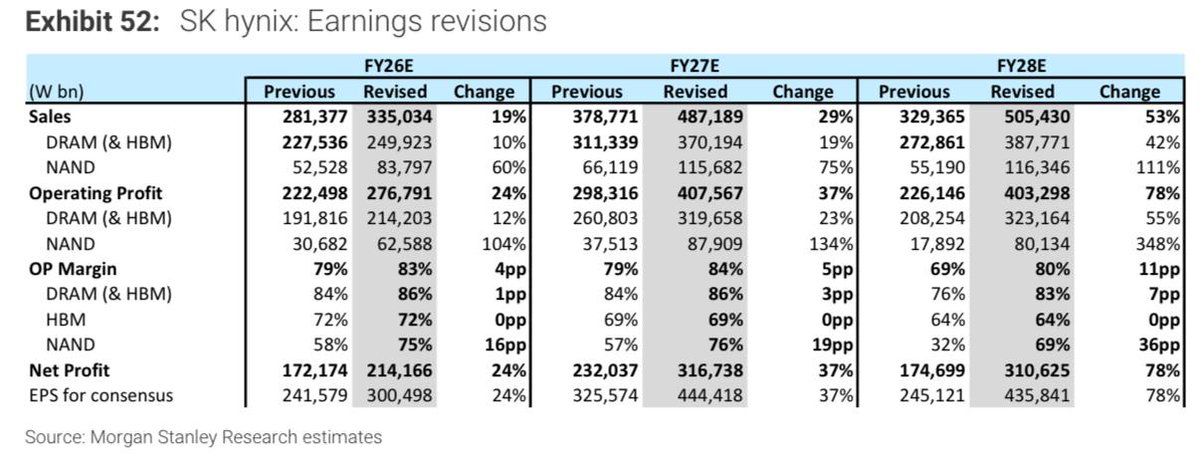
Morgan Stanley’s latest SK hynix operating profit forecasts (as of April 19, 2026): - Previous forecast for 2026: KRW 222 trillion (US$150.177 billion) → KRW 277 trillion (US$187.382 billion) - Previous forecast for 2027: KRW 298 trillion (US$201.588 billion) → KRW 408 trillion (US$276.0 billion) - Previous forecast for 2028: KRW 226 trillion (US$152.882 billion) → KRW 403 trillion (US$272.618 billion)
Jukan tweet media
English
16
59
446
136.9K
Michael retweetledi
𐌁𐌉Ᏽ 𐌕𐌉𐌌𐌉
Full grown adults who can’t vacation, take a gap year, have hobbies, play an instrument, speak multiple languages, swim, cycle, skate, or backpack. Just a lifetime of hustling and trying to escape survival mode. These are subtle poverty metrics no one really talks about.
English
149
8.9K
36.8K
544.6K
Michael retweetledi
SandemanStocks
SandemanStocks@Sandeman52·
Ok! I did the math ✍️ If $NBIS hits $167 I’m at 25,000% gains from my original $50k I started with 12 years ago. To celebrate, if it hits that number this week, I’ll give $100 to a follower that likes and retweet this. Must have a Zelle account. 🫡👊
English
47
103
418
49.1K
Michael
Michael@himichaelhe·
@realroseceline Monolithic is very good Don’t know the third, thought Cadence but not on the list
English
0
0
0
593
Michael retweetledi
Sleepwell 🌙
Sleepwell 🌙@SleepwellCap·
I've long been a huge fan of @GustavS, $SPOT new co-CEO. He had some very interesting comments during the earnings call prepared remarks around AI and the potential impact on music and software. Here's the summary: • there will be winners and losers, but SPOT undoubtedly a big beneficiary of AI • believe in the consumer space the predominant business model will continue to be ads and subscriptions, places where SPOT excels • SPOT was early to AI and is now in a great place to deliver the world's most agentic media platform where the consumer takes the driver seat, moving from a passive experience to an interactive one • this drives retention and time spent on the platform: in the US alone, monthly streaming hours p/user have grown more than 20% in the last 5 years. • a growing catalog has always been a net positive for SPOT as they control personalization, drives engagement and fandom • regardless of where the music gets made, it will be on SPOT because that's where it charts and where they audience and cultural moment is (largest reach and monetization) • SPOT is ready to support artists that want to allow fans to interact with their music and help them monetize it in a responsible way (eg. make smashup of this Beatles' song with this Ed Sheeran song and make it in spanish) • seeing massive productivity gains in engineering and coding department • you can't have an LLM commoditizing someone's music taste and context (eg "what is good workout music?") because there is no factual answer. You need many hundreds of millions of listeners across the world telling you what it means for that specific person and that's the data set SPOT is building and nobody else is. It doesn't exist at this scale and it is improving every time the model is retrained (this seems like a potentially large moat).
English
4
3
46
7.7K
Michael retweetledi
CTC
CTC@CacheThatCheque·
Mitsubishi Estate, Sumitomo Realty and Mitsui Fudosan are top class in Japan in real estate assets, with over 3 trillion yen each in unrealized real estate gains. All three companies are trading below their book value when the true value of their real estate holdings are included
CTC tweet media
CTC@CacheThatCheque

Don’t own this one but interesting thing about Toho and many other Japanese companies is that they have huge real estate and land portfolios on their books that are often always undervalued

English
2
6
37
3.9K
Michael retweetledi
luna
luna@lunarfq·
If you retweet this, something good will definitely happen by the end of the month. 🍀🍀🍀🍀
luna tweet media
English
102
27.5K
29.2K
1M
Michael
Michael@himichaelhe·
@realroseceline I do like the founder and team a lot. Also appreciate the letters, quite candid. Luis recently did an interview with a Chinese YouTuber Lindsey, and the Q&A quality is really high, at least in terms of introducing the business to China audience.
English
0
0
0
25
Rose Celine Investments 🌹
Rose Celine Investments 🌹@realroseceline·
Thoughts on $DUOL: Growth is slowing vs the “hype”. Wall Street priced $DUOL like a hyper growth company for a long time. But recent user and revenue growth expectations have softened, and guidance has disappointed some analysts. The stock dropped even after good results because future growth looked lower than what analysts expected. AI fears and narrative swings. Investors freaked out about AI. At one point $DUOL said “AI first” meaning much content was generated by AI and that spooked Wall Street. People started saying AI could replace language learning entirely (ie Google translate, Apples new headphones etc.), so the story got bleaker. Product backlash hurt confidence. Some users openly complain that the quality dropped or the gamification feels “shallow”. When the product gets flack online, it feeds into the idea that growth could be “fake, limited, or fragile”, so Wall Street gets less confident in long term growth. Valuation looks interesting to not as clear as meets the eye. Despite crashing from its highs, Duolingo’s valuation (forward P/E) still look “expensive” for a business that may not grow as fast anymore. Volatility and narrative stocks get punished. A stock that goes up on hype and then starts missing the hype gets hit hard. That’s just the rules of the game, same as the sky is blue… Duolingo’s narrative flipped: from AI savior to AI threat, from fast growth to slower growth. $DUOL is cheap and hated right now because it was priced like a rocket but growth and guidance slowed and softened. People worry AI will make language apps irrelevant, the tool has had backlash about quality, and Wall Street hates uncertainty. That combination turns a growth story into a cheap, volatile stock that investors are bearish about. Here’s how I think the highest likelihood path for $DUOL plays out over the next five years, not the best case or worst case, just the most probable middle ground. $DOUL keeps growing users steadily but not explosively. Language learning remains a real need, especially globally, and $DOUL stays the default starting point for a lot of people. AI does not kill the product. It actually makes it cheaper to build content and personalize learning, but it also caps pricing power because the alternatives get better too. Revenue grows nicely, maybe mid to high teens annually, driven by paid conversion and new features rather than massive user growth acceleration (always skate to where the puck is going). Margins improve meaningfully because the model is software, content costs will likely decline with AI. It becomes a very profitable consumer subscription business. What probably does not happen is $DUOL becoming a monster monopoly with extreme pricing power. Language learning is too fragmented, too optional, and too exposed to competition. At the same time, it also does not get disrupted into irrelevance. The brand, habits, addiction, and global reach aren’t going away. So five years out, I think $DUOL looks like a high quality, durable, profitable consumer software company that compounds reasonably well but not insanely. The stock likely rerates from hated to respected, but not to euphoric. Not a zero, not a 10 bagger, although both are possible because sometimes this game produces extreme outcomes. More like a steady compounder that disappoints dreamers and rewards patient owners who bought when sentiment was ugly. 🌹
English
24
9
217
48.3K