Saf

1.7K posts

Saf banner
Saf

Saf

@htx_ventures

$Saf maxi

Sweden Katılım Kasım 2020
4.9K Takip Edilen1.2K Takipçiler
Saf
Saf@htx_ventures·
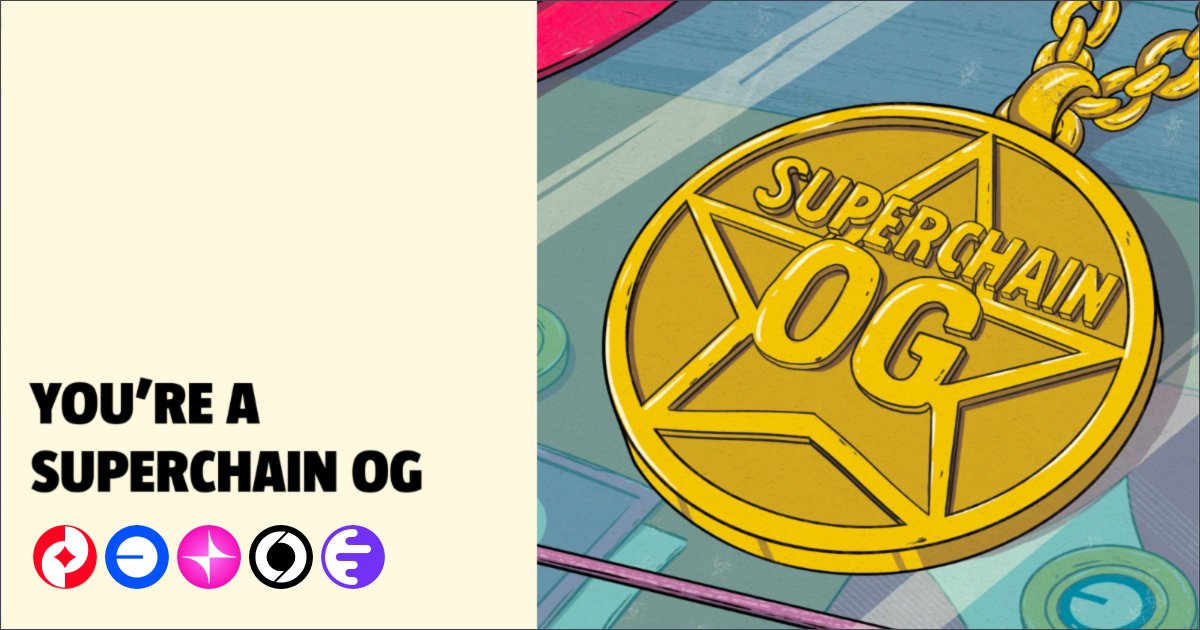
I'm an OG of the Superchain through OP Mainnet, Base, Unichain, Soneium & Ink! Check your OG status here: app.optimism.io/superstacks
Saf tweet media
English
0
0
2
80
hieu
hieu@hieu06730313·
Gprove !! Wish everyone a lucky and favorable start to the new week. Not Bad , 7000 Stars ,im comming @SuccinctLabs @0xCRASHOUT
hieu tweet media
English
7
0
14
253
Saf
Saf@htx_ventures·
<3 zkj
QST
0
0
1
103
Saf
Saf@htx_ventures·
Saf tweet media
ZXX
0
0
1
89
Saf retweetledi
LayerZero
LayerZero@LayerZero_Core·
The best teams in crypto Build Omnichain.
English
129
264
1.5K
445.2K
Saf retweetledi
Layer3
Layer3@layer3·
Exciting update: we've secured $21M in total funding. Led by @paraficapital and @Greenfield1One, we recently closed a $15M Series A round. The new raise follows a previously unannounced strategic round of $3.7M in 2022 and $2.5M round in 2021.
Layer3 tweet media
English
175
419
1.7K
338.8K
Layer3
Layer3@layer3·
tag a friend, maybe i'll give some away
Layer3 tweet mediaLayer3 tweet mediaLayer3 tweet mediaLayer3 tweet media
English
156
41
213
28.4K
Saf retweetledi
krak/
krak/@unkrakable·
I often get asked why I work at @LayerZero_Labs. To me, LayerZero is the most scalable, secure, and efficient cross-chain smart contract protocol currently available. First some context. Before LayerZero, to send anything to a new chain, most dApps used some type of monolithic bridge: - Centralized Provider: a centralized entity, manually delivering messages to the destination chain. - Collection of Signers: a collection of different signers which verify the message before delivering. - Middlechain Bridge: a blockchain which routes all messages through the hub chain, inheriting the security of the middlechain. (Note: I'll define each of these "security mechanisms" as verifier networks). While each verifier network came with trade-offs, all suffered from one common problem: a single verifier network determined which messages would be delivered on the destination chain. If that security ever failed, due to centralization, a backdoor in the signer software, the middlechain lacking node client diversity, or upgradeable contracts, every application built on top of that verifier network suddenly had their security fail too. No matter which verifier network you pick, the reality is that you now depend entirely on that sole network to verify your messages correctly. Being locked into a single verifier network means that in the best case, your application needs to fully redeploy to avoid being exposed to a security vulnerability. In the worst case, not just your application, but every application and user interacting with that verifier network faces cataclysmic losses (source: the rekt leaderboard and the socket hack just a few months ago). How does LayerZero solve this? LayerZero is an immutable, censorship-resistant, and permissionless smart contract protocol that enables anyone on a blockchain to send, verify, and execute messages on a supported destination network. Reason 1: Immutable Contracts To send and receive messages on a target blockchain, a non-upgradeable LayerZero Endpoint contract must be deployed to that chain. This Endpoint contract acts as the entry and exit point for the protocol, enabling applications and users to: - Send messages from the source blockchain (Endpoint.send). - Configure application security (Endpoint.setConfig). - Configure execution settings (Endpoint.setConfig). - Quote cross-chain transaction gas costs (Endpoint.quote). - Receive messages on the destination chain (Endpoint.lzReceive). - Debug and retry failed messages (Endpoint.lzReceive). and a handful of other utilities. The LayerZero Endpoint provides users a predictable, immutable interface for sending arbitrary data, external function calls, and tokens. Anytime you need to send or receive messages, all you need to do is interact with the LayerZero Endpoint contract on that chain. Reason 2: Modular Security LayerZero allows applications to configure any number and type of decentralized verifier networks (DVNs) to verify their cross-chain messages. Instead of every application depending on the same verifier network, each application now has a unique verifier configuration called a Security Stack, allowing developers to maintain access controls on arguably the most important part of their application. New verifier networks can be added at anytime using these access controls, future-proofing cross-chain applications to the latest and greatest verification techniques (for example, @PolyhedraZK's zkLightClient). This means that dApps don't need to accept a one-size-fits-all model for cross-chain messaging, and instead actually can control how messages are verified on the destination chain. Teams are starting to realize that this means they can build omnichain dApps with variable security based on their use cases, message volume, domains, etc. In terms of cross-chain messaging, it's a new frontier for devs to explore. Reason 3: Permissionless Execution Because anyone can interact with the LayerZero Endpoint on the destination chain, LayerZero offers permissionless message execution. Once a message has been verified by an application's chosen decentralized verifier networks (DVNs), that message can be executed by calling the Endpoint's lzReceive method. In most cases, this execution is done automatically by an application's configured Executor, a production asset run in the ecosystem which automatically delivers messages after verification. This Executor fully abstracts gas on the destination chain, allowing users to pay for gas only using the source chain's gas token, and add specific execution options for the cross-chain message. Anyone can develop and run their own Executor, and should a configured Executor ever disappear, these messages can still be permissionlessly executed at anytime. The Big Picture When LayerZero talks about the idea of an omnichain application, we refer to this idea where your smart contracts can control how their messages are sent, verified, and executed on any blockchain in the network. It's a fundamentally better system, where developers don't have to hand the keys away to the most critical component of their decentralized application. Instead, use a smart contract protocol that gives you an easy, secure, and future-proof interface to send anything between blockchains. Want to get started? Head to our docs (link in bio), or leave a comment / DM! And remember, LayerZero is permissionless, censorship-resistant, and immutable.
krak/ tweet mediakrak/ tweet mediakrak/ tweet mediakrak/ tweet media
English
14
23
190
49.5K
Saf retweetledi
ether.fi
ether.fi@ether_fi·
We are happy to announce that the ETHFI token claim is open! Go to claim.ether.fi to check your eligibility and claim✔️ The ETHFI token contract address is 0xFe0c30065B384F05761f15d0CC899D4F9F9Cc0eB
English
9.9K
5.5K
6.6K
420.9K
Saf retweetledi
Dan Reecer
Dan Reecer@danreecer_·
Wormhole Wednesday
English
482
237
1.8K
377.5K
jkhan 🐝
jkhan 🐝@jkhan_htx·
my crypto life
jkhan 🐝 tweet media
English
2
0
6
188
Saf retweetledi
LayerZero
LayerZero@LayerZero_Core·
⚡ V2 Deep Dive ⚡ What is LayerZero? How does V2 work? Why build on V2? This deep dive covers it all (and more): – Core principles – V2 architecture – Trust assumptions – LZ and the market Read 👇 medium.com/layerzero-offi…
English
60
233
1.3K
194.7K