krak/

2.1K posts

krak/ banner
krak/

krak/

@unkrakable

Services @LayerZero_Core ◼️ | "if you feel like giving up, know you're close" @santandave1 | opinions == my own

Katılım Aralık 2020
2.2K Takip Edilen3.1K Takipçiler
Sabitlenmiş Tweet
krak/
krak/@unkrakable·
I often get asked why I work at @LayerZero_Labs. To me, LayerZero is the most scalable, secure, and efficient cross-chain smart contract protocol currently available. First some context. Before LayerZero, to send anything to a new chain, most dApps used some type of monolithic bridge: - Centralized Provider: a centralized entity, manually delivering messages to the destination chain. - Collection of Signers: a collection of different signers which verify the message before delivering. - Middlechain Bridge: a blockchain which routes all messages through the hub chain, inheriting the security of the middlechain. (Note: I'll define each of these "security mechanisms" as verifier networks). While each verifier network came with trade-offs, all suffered from one common problem: a single verifier network determined which messages would be delivered on the destination chain. If that security ever failed, due to centralization, a backdoor in the signer software, the middlechain lacking node client diversity, or upgradeable contracts, every application built on top of that verifier network suddenly had their security fail too. No matter which verifier network you pick, the reality is that you now depend entirely on that sole network to verify your messages correctly. Being locked into a single verifier network means that in the best case, your application needs to fully redeploy to avoid being exposed to a security vulnerability. In the worst case, not just your application, but every application and user interacting with that verifier network faces cataclysmic losses (source: the rekt leaderboard and the socket hack just a few months ago). How does LayerZero solve this? LayerZero is an immutable, censorship-resistant, and permissionless smart contract protocol that enables anyone on a blockchain to send, verify, and execute messages on a supported destination network. Reason 1: Immutable Contracts To send and receive messages on a target blockchain, a non-upgradeable LayerZero Endpoint contract must be deployed to that chain. This Endpoint contract acts as the entry and exit point for the protocol, enabling applications and users to: - Send messages from the source blockchain (Endpoint.send). - Configure application security (Endpoint.setConfig). - Configure execution settings (Endpoint.setConfig). - Quote cross-chain transaction gas costs (Endpoint.quote). - Receive messages on the destination chain (Endpoint.lzReceive). - Debug and retry failed messages (Endpoint.lzReceive). and a handful of other utilities. The LayerZero Endpoint provides users a predictable, immutable interface for sending arbitrary data, external function calls, and tokens. Anytime you need to send or receive messages, all you need to do is interact with the LayerZero Endpoint contract on that chain. Reason 2: Modular Security LayerZero allows applications to configure any number and type of decentralized verifier networks (DVNs) to verify their cross-chain messages. Instead of every application depending on the same verifier network, each application now has a unique verifier configuration called a Security Stack, allowing developers to maintain access controls on arguably the most important part of their application. New verifier networks can be added at anytime using these access controls, future-proofing cross-chain applications to the latest and greatest verification techniques (for example, @PolyhedraZK's zkLightClient). This means that dApps don't need to accept a one-size-fits-all model for cross-chain messaging, and instead actually can control how messages are verified on the destination chain. Teams are starting to realize that this means they can build omnichain dApps with variable security based on their use cases, message volume, domains, etc. In terms of cross-chain messaging, it's a new frontier for devs to explore. Reason 3: Permissionless Execution Because anyone can interact with the LayerZero Endpoint on the destination chain, LayerZero offers permissionless message execution. Once a message has been verified by an application's chosen decentralized verifier networks (DVNs), that message can be executed by calling the Endpoint's lzReceive method. In most cases, this execution is done automatically by an application's configured Executor, a production asset run in the ecosystem which automatically delivers messages after verification. This Executor fully abstracts gas on the destination chain, allowing users to pay for gas only using the source chain's gas token, and add specific execution options for the cross-chain message. Anyone can develop and run their own Executor, and should a configured Executor ever disappear, these messages can still be permissionlessly executed at anytime. The Big Picture When LayerZero talks about the idea of an omnichain application, we refer to this idea where your smart contracts can control how their messages are sent, verified, and executed on any blockchain in the network. It's a fundamentally better system, where developers don't have to hand the keys away to the most critical component of their decentralized application. Instead, use a smart contract protocol that gives you an easy, secure, and future-proof interface to send anything between blockchains. Want to get started? Head to our docs (link in bio), or leave a comment / DM! And remember, LayerZero is permissionless, censorship-resistant, and immutable.
krak/ tweet mediakrak/ tweet mediakrak/ tweet mediakrak/ tweet media
English
14
23
191
49.7K
krak/ retweetledi
LayerZero
LayerZero@LayerZero_Core·
We’re sharing our completed post-mortem on the April 18th incident, prepared with @Mandiant and @CrowdStrike. We are publishing both an executive summary and the full report at the link below. Over the past four weeks, we’ve worked with hundreds of partners to help them understand their current security posture, and harden it where appropriate. We’ll continue this work, alongside taking additional proactive steps for the benefit of not only our partners, but also the ecosystem as a whole. We want to extend our thanks to our partners for their support and patience this past month. There’s a reason that over $12 billion has moved across the network in the past four weeks, and why the world’s most valuable asset issuers have stood by our side: they believe in us, in what the LayerZero protocol has to offer, and in the value of modular, isolated, application-controlled security. The work continues. And we look forward to continue showing up for the applications that trust us with their business, as well as the broader ecosystem. layerzero.network/blog/layerzero…
LayerZero tweet media
English
365
119
500
193.3K
krak/
krak/@unkrakable·
Those admins don’t have any control over signer properties nor do they have the ability to change security properties of the DVN. They’re specifically a gas abstraction service to deliver signed hex data from the DVN quorum, and the admin role is superseded by the signers at any time.
English
0
0
0
70
jfab.eth
jfab.eth@josefabregab·
Many things can be true regarding the Kelp & LayerZero exploit. 1. The LZ DVN got compromised. 2. LZ's default configuration is multi DVN, not a 1/1. 3. rsETH originally used LZ’s default multiDVN config (LayerZero Labs + Google) 4. Kelp manually changed its config from default to 1/1. 5. Kelp later deployed all configs as 1/1 setups. 6. Many LZ users still run 1/1 configs, but LZ discourages it for production code. 7. The 2/2 DVN setup of LZ + Nethermind processed the most volume among LZ security configs. 16/17 Nethermind admins are also admins on the LZ Labs DVN (94% overlap). 8. LZ comms should've been better after the incident. 9. There are still important questions that need answers from @LayerZero_Core, like those highlighted by @ChainLinkGod under Bryan's reply. I believe that Kelp transitioning rsETH from LayerZero's OFT standard to @Chainlink's CCT standard is the safest and most logical alternative here. But, for the sake of objectiveness, I'd also recommend reading @PrimordialAA's post underneath.
Bryan Pellegrino (臭企鹅)@PrimordialAA

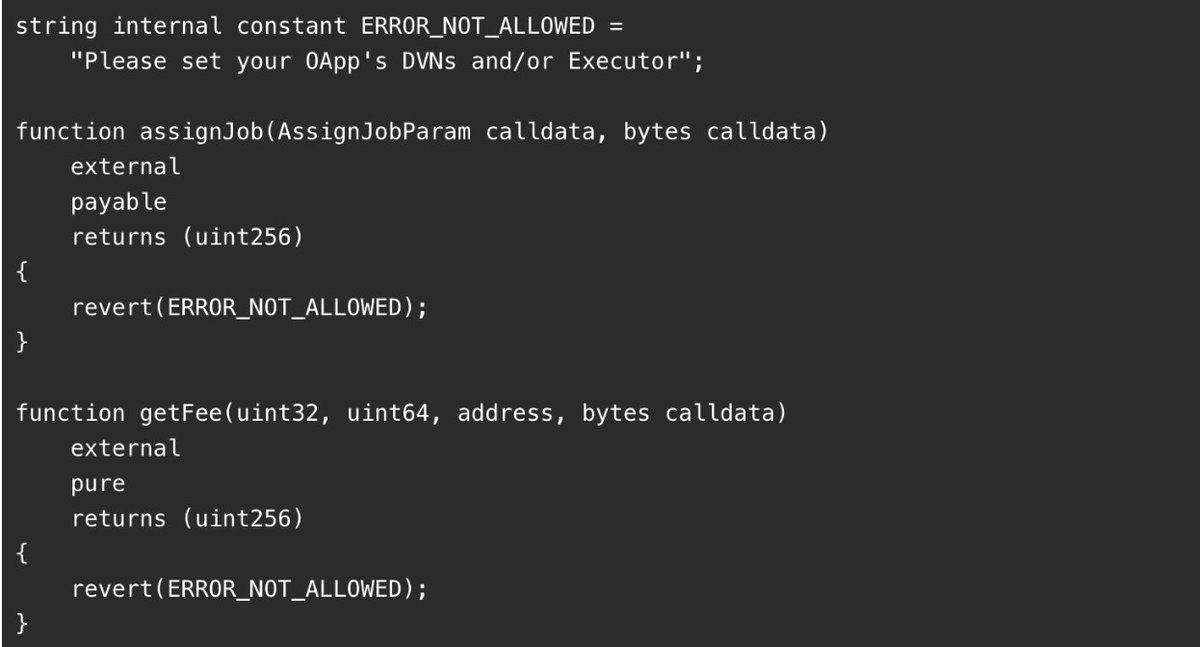
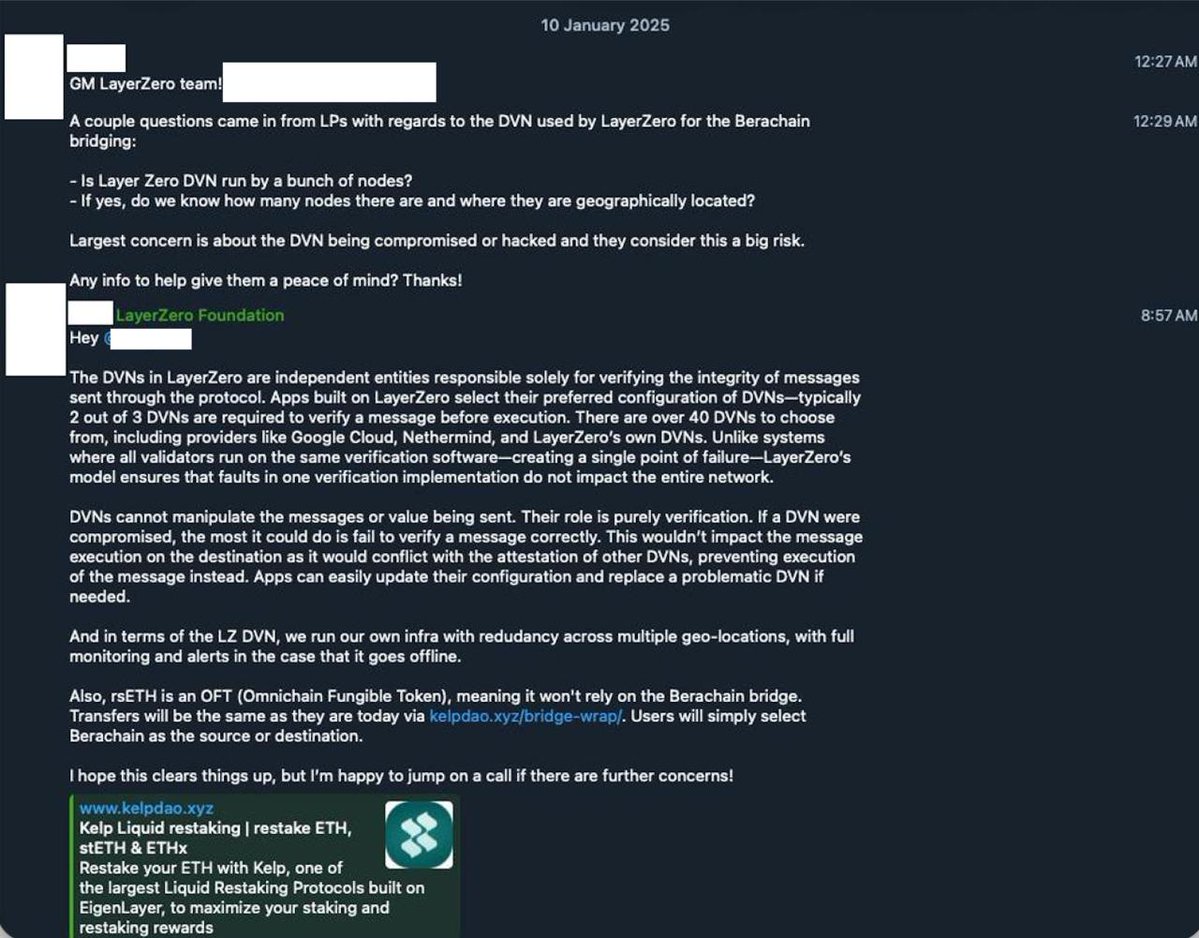
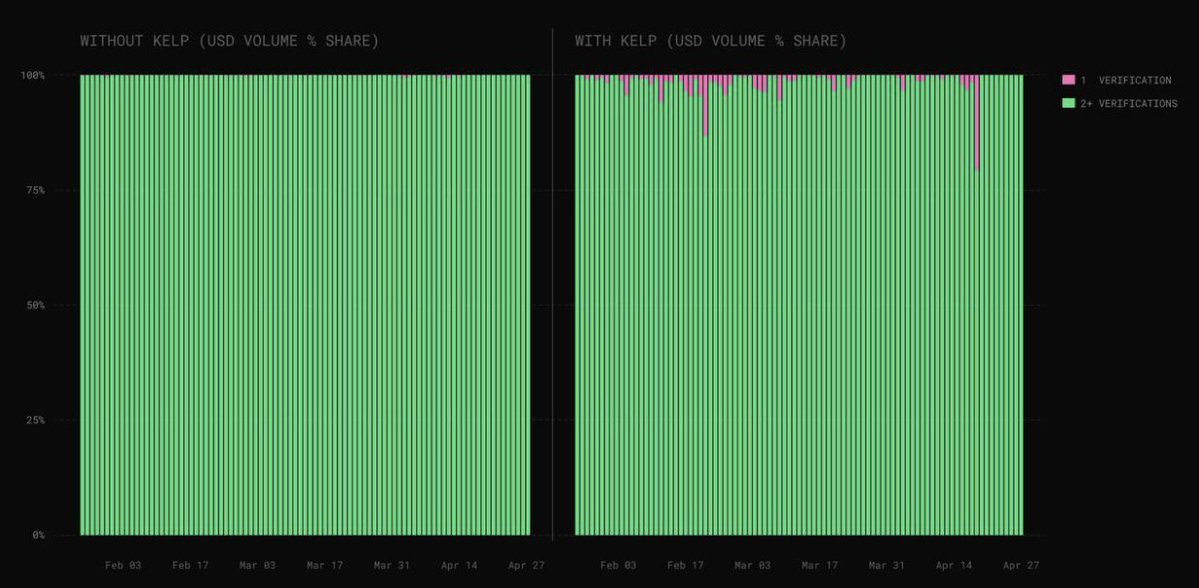
A ton of this is just completely untrue. 1) Kelp originally used the defaults which were MultiDVN or DeadDVN and manually migrated to a 1/1 config later 2) Almost 100% of the volume on a 1/1 config was rsETH 3) Not using a 1/1 for production applications is mentioned many times in the documentation. The defaults Kelp is referencing in their screenshot were multiDVN or DeadDVN, which force-rejects an application using the defaults at all and requires them to manually set configuration. rsETH was originally configured to use the default LayerZero configuration of a multiDVN setup of LayerZero Labs + Google: Here are the exact transactions where that happens Ethereum → Arbitrum: etherscan.io/tx/0xd7c864adb… at 2024-02-06 03:09:47 UTC Ethereum → Optimism: etherscan.io/tx/0x7075bfe9a… at 2024-02-06 03:09:59 UTC KelpDAO then manually changed these to 1/1 configs: For the original Feb 6 Ethereum routes to Arbitrum/Optimism, KelpDAO’s Ethereum contract switched from defaults to manual OApp-scoped config on 2024-04-01: Send-side manual config: etherscan.io/tx/0x7485c16c9… 2024-04-01 07:12:11 UTC Receive-side manual config: etherscan.io/tx/0x21e967c99… 2024-04-01 07:12:23 UTC From this point on, Kelp began deploying all of their configurations as 1/1 configs. Here is Kelp’s deployment on Unichain: Unichain → Ethereum was opened on 2025-04-01 18:55:41 UTC. Pathway-open / setPeer tx: uniscan.xyz/tx/0x31ea2b10a… The manual ULN config followed 6 seconds later in uniscan.xyz/tx/0xd8ef5416a…. During this time the Unichain -> Ethereum and Ethereum -> Unichain defaults were set to DeadDVN which is a contract which makes it impossible for any application to transact without manually configuring their DVNs, this was not possible on the defaults of this pathway. Here is the code in the DeadDVN (#code" target="_blank" rel="nofollow noopener">etherscan.io/address/0x747C…) that specifically prohibits this. (Screenshot 1) This is called out many many times in the docs: 1. Integration Checklist — "Do" list - Last edited: 2025-11-26 (Nazreen) - Content: "Do: … Use more than one DVN for each production pathway instead of relying on a single DVN." - File: v2/tools/integration-checklist.mdx:244 - URL: #set-security-and-executor-configurations-on-every-pathway" target="_blank" rel="nofollow noopener">docs.layerzero.network/v2/tools/integ… 2. Integration Checklist — "Don't" list - Last edited: 2025-11-26 (Nazreen) - Content: "Don't: … Configure only one DVN for a pathway and treat it as production‑ready." - File: v2/tools/integration-checklist.mdx:251 - URL: #set-security-and-executor-configurations-on-every-pathway" target="_blank" rel="nofollow noopener">docs.layerzero.network/v2/tools/integ… 3. Integration Checklist — Defaults are not safe - Last edited: 2025-09-25 (Tino Martínez Molina) - Content: "Do not assume defaults are safe for production. Always check explicitly: getSendLibrary, getReceiveLibrary, and getConfig. If these resolve to defaults, confirm whether the defaults are valid for the intended pathway. Unintentional fallbacks to defaults are a common cause of blocked or failing pathways." - File: v2/tools/integration-checklist.mdx:126-128 - URL: #explicitly-set-message-libraries" target="_blank" rel="nofollow noopener">docs.layerzero.network/v2/tools/integ… 4. Integration Checklist — Default fallback warning - Last edited: 2026-02-26 (migration; same wording predates it) - Content: "Warning: If no configuration is set, the OApp will fallback to the default settings set by LayerZero Labs." - File: v2/tools/integration-checklist.mdx:222-238 - URL: #set-security-and-executor-configurations-on-every-pathway" target="_blank" rel="nofollow noopener">docs.layerzero.network/v2/tools/integ… 5. ONFT Quickstart — Production guidance - Last edited: 2025-02-20 (Radek Sienkiewicz) - Content: "DVN Settings: Use multiple DVNs in production to ensure message verification is robust." - File: v2/developers/evm/onft/quickstart.mdx:700 - URL: #security-considerations" target="_blank" rel="nofollow noopener">docs.layerzero.network/v2/developers/… 6. ONFT Quickstart — Strong recommendation to configure - Last edited: 2025-03-10 (Radek Sienkiewicz) - Content: "We strongly recommend reviewing these settings carefully and configuring your security stack according to your needs and preferences." - File: v2/developers/evm/onft/quickstart.mdx:366 - URL: #configure-the-onft" target="_blank" rel="nofollow noopener">docs.layerzero.network/v2/developers/… 7. Starknet FAQ — "Should I use multiple DVNs?" - Last edited: 2026-01-21 (Nazreen) - Content: ▎ Should I use multiple DVNs? ▎ Recommended for production. Multiple DVNs provide: ▎ - Increased security (multiple independent verifiers) ▎ - Resilience (no single point of failure) ▎ - Trust minimization - File: v2/developers/starknet/troubleshooting/faq.mdx:290-296 - URL: #should-i-use-multiple-dvns" target="_blank" rel="nofollow noopener">docs.layerzero.network/v2/developers/… Here are the exact recommendations we gave KelpDAO when asked about DVNs (typically 2/3) (Screenshot 2) Other LayerZero applications speaking on exactly what is advised by the team x.com/mitchellftracy… x.com/jasperflux/sta… For how much volume was actually configured on 1/1 here is the exact data. (Screenshot 3) We will publish a complete post-mortem as soon as the external security firms have completed it.

English
6
0
21
2.4K
krak/ retweetledi
Bryan Pellegrino (臭企鹅)
Bryan Pellegrino (臭企鹅)@PrimordialAA·
A ton of this is just completely untrue. 1) Kelp originally used the defaults which were MultiDVN or DeadDVN and manually migrated to a 1/1 config later 2) Almost 100% of the volume on a 1/1 config was rsETH 3) Not using a 1/1 for production applications is mentioned many times in the documentation. The defaults Kelp is referencing in their screenshot were multiDVN or DeadDVN, which force-rejects an application using the defaults at all and requires them to manually set configuration. rsETH was originally configured to use the default LayerZero configuration of a multiDVN setup of LayerZero Labs + Google: Here are the exact transactions where that happens Ethereum → Arbitrum: etherscan.io/tx/0xd7c864adb… at 2024-02-06 03:09:47 UTC Ethereum → Optimism: etherscan.io/tx/0x7075bfe9a… at 2024-02-06 03:09:59 UTC KelpDAO then manually changed these to 1/1 configs: For the original Feb 6 Ethereum routes to Arbitrum/Optimism, KelpDAO’s Ethereum contract switched from defaults to manual OApp-scoped config on 2024-04-01: Send-side manual config: etherscan.io/tx/0x7485c16c9… 2024-04-01 07:12:11 UTC Receive-side manual config: etherscan.io/tx/0x21e967c99… 2024-04-01 07:12:23 UTC From this point on, Kelp began deploying all of their configurations as 1/1 configs. Here is Kelp’s deployment on Unichain: Unichain → Ethereum was opened on 2025-04-01 18:55:41 UTC. Pathway-open / setPeer tx: uniscan.xyz/tx/0x31ea2b10a… The manual ULN config followed 6 seconds later in uniscan.xyz/tx/0xd8ef5416a…. During this time the Unichain -> Ethereum and Ethereum -> Unichain defaults were set to DeadDVN which is a contract which makes it impossible for any application to transact without manually configuring their DVNs, this was not possible on the defaults of this pathway. Here is the code in the DeadDVN (#code" target="_blank" rel="nofollow noopener">etherscan.io/address/0x747C…) that specifically prohibits this. (Screenshot 1) This is called out many many times in the docs: 1. Integration Checklist — "Do" list - Last edited: 2025-11-26 (Nazreen) - Content: "Do: … Use more than one DVN for each production pathway instead of relying on a single DVN." - File: v2/tools/integration-checklist.mdx:244 - URL: #set-security-and-executor-configurations-on-every-pathway" target="_blank" rel="nofollow noopener">docs.layerzero.network/v2/tools/integ… 2. Integration Checklist — "Don't" list - Last edited: 2025-11-26 (Nazreen) - Content: "Don't: … Configure only one DVN for a pathway and treat it as production‑ready." - File: v2/tools/integration-checklist.mdx:251 - URL: #set-security-and-executor-configurations-on-every-pathway" target="_blank" rel="nofollow noopener">docs.layerzero.network/v2/tools/integ… 3. Integration Checklist — Defaults are not safe - Last edited: 2025-09-25 (Tino Martínez Molina) - Content: "Do not assume defaults are safe for production. Always check explicitly: getSendLibrary, getReceiveLibrary, and getConfig. If these resolve to defaults, confirm whether the defaults are valid for the intended pathway. Unintentional fallbacks to defaults are a common cause of blocked or failing pathways." - File: v2/tools/integration-checklist.mdx:126-128 - URL: #explicitly-set-message-libraries" target="_blank" rel="nofollow noopener">docs.layerzero.network/v2/tools/integ… 4. Integration Checklist — Default fallback warning - Last edited: 2026-02-26 (migration; same wording predates it) - Content: "Warning: If no configuration is set, the OApp will fallback to the default settings set by LayerZero Labs." - File: v2/tools/integration-checklist.mdx:222-238 - URL: #set-security-and-executor-configurations-on-every-pathway" target="_blank" rel="nofollow noopener">docs.layerzero.network/v2/tools/integ… 5. ONFT Quickstart — Production guidance - Last edited: 2025-02-20 (Radek Sienkiewicz) - Content: "DVN Settings: Use multiple DVNs in production to ensure message verification is robust." - File: v2/developers/evm/onft/quickstart.mdx:700 - URL: #security-considerations" target="_blank" rel="nofollow noopener">docs.layerzero.network/v2/developers/… 6. ONFT Quickstart — Strong recommendation to configure - Last edited: 2025-03-10 (Radek Sienkiewicz) - Content: "We strongly recommend reviewing these settings carefully and configuring your security stack according to your needs and preferences." - File: v2/developers/evm/onft/quickstart.mdx:366 - URL: #configure-the-onft" target="_blank" rel="nofollow noopener">docs.layerzero.network/v2/developers/… 7. Starknet FAQ — "Should I use multiple DVNs?" - Last edited: 2026-01-21 (Nazreen) - Content: ▎ Should I use multiple DVNs? ▎ Recommended for production. Multiple DVNs provide: ▎ - Increased security (multiple independent verifiers) ▎ - Resilience (no single point of failure) ▎ - Trust minimization - File: v2/developers/starknet/troubleshooting/faq.mdx:290-296 - URL: #should-i-use-multiple-dvns" target="_blank" rel="nofollow noopener">docs.layerzero.network/v2/developers/… Here are the exact recommendations we gave KelpDAO when asked about DVNs (typically 2/3) (Screenshot 2) Other LayerZero applications speaking on exactly what is advised by the team x.com/mitchellftracy… x.com/jasperflux/sta… For how much volume was actually configured on 1/1 here is the exact data. (Screenshot 3) We will publish a complete post-mortem as soon as the external security firms have completed it.
Bryan Pellegrino (臭企鹅) tweet mediaBryan Pellegrino (臭企鹅) tweet mediaBryan Pellegrino (臭企鹅) tweet media
English
79
63
409
118.3K
krak/ retweetledi
Aave
Aave@aave·
Thanks to @LayerZero_Core, who has been actively engaging with Aave and the broader DeFi United movement since the moment the rsETH incident occurred. Their contribution advances our plan to restore rsETH's backing and normalize market conditions.
LayerZero@LayerZero_Core

LayerZero Labs is pledging more than 10,000 ETH to @Aave-led DeFi United efforts. We are: • Donating 5,000 ETH to DeFi United • Depositing an additional 5,000 ETH to strengthen Aave markets liquidity • Strategically deepening GHO liquidity

English
77
152
743
88.7K
krak/ retweetledi
krak/ retweetledi
Bryan Pellegrino (臭企鹅)
Bryan Pellegrino (臭企鹅)@PrimordialAA·
There is so much )!@($ happening in the background at the moment. @arbitrum very likely just widely expanded the aperture of positive outcomes
English
49
18
334
28.1K
krak/ retweetledi
Bryan Pellegrino (臭企鹅)
Bryan Pellegrino (臭企鹅)@PrimordialAA·
What’s happening right now on our side - Working with industry recovery group - Working with external security groups - Working with all relevant external law enforcement agencies - DVN is live, Stargate just went through additional hardening pass - Spending 100% of cycles hardening security across every possible vector for applications. We will be able to say a lot more on here but right now security is the #1 priority across the board - Expect more updates on all fronts, will start streaming more steady state of information now that initial investigations are largely resolved
English
94
45
506
48.6K
krak/ retweetledi
foobar/
foobar/@0xfoobar·
layerzero is the best bridge in the space offering true decentralization lets users make bad config decisions but decentralization is the only thing that matters. all the thoughtless multisig bridges died long ago primo & co are among the few good guys shipping infra left
English
30
5
108
12.2K
krak/
krak/@unkrakable·
@AlexanderTw33ts can my AI rent a friend to go to the onsen with me?
English
1
0
1
55
Alex
Alex@AlexanderTw33ts·
never forget that your japan trip was not as cool as my japan trip no matter how cool you think your japan trip was, mine was at least twice as cool as that
English
13
0
41
3.6K
krak/ retweetledi
Bryan Pellegrino (臭企鹅)
Bryan Pellegrino (臭企鹅)@PrimordialAA·
.@LayerZero_Core the first and only interop live on Canton. Excited to bring the world to Canton, and Canton assets to the world
LayerZero@LayerZero_Core

Canton Network is the home for onchain capital markets, processing $8T+ in RWAs monthly, $350B in daily U.S. Treasury repo volume, and adopted by 800+ firms. LayerZero connects @CantonNetwork to every blockchain. The Era of Interoperable Institutions has begun.

English
24
27
202
21K
krak/ retweetledi
Khairallah AL-Awady
Khairallah AL-Awady@eng_khairallah1·
Rate my current setup I just vibe coding and writing tweets
Khairallah AL-Awady tweet media
English
216
33
392
20.9K
kram
kram@kramnotmark·
Global permisisonless markets prove to be too attractive to everyone: fast, cheap, programmable, borderless, 24/7, and internet-native. The convergence of crypto and finance has moved a decade ahead of schedule in just the last month.
LayerZero@LayerZero_Core

"So we certainly think about something like Zero as having the potential to enable onchain high-performance, low-latency, massive-throughput operations that we currently have to perform off-chain." - Michael Blaugrund (@mblaugrund), VP of Strategic Initiatives at Intercontinental Exchange Source: @fiftyonexyz podcast

English
3
1
7
800
vibhu
vibhu@vibhu·
@naruto11eth I read this thinking about how you lost 6 games of pickleball in a row to me on Wednesday
English
3
0
22
1K
Naruto11.eth
Naruto11.eth@naruto11eth·
i actually dislike the statement when people say: "your only competition is you. try to be better only than yourself" no fck you dude. everyone who is building in the same space as i am is my competition. everyone who is doing remotely what i am doing is my competition. because they are my competition, i need to be better than them, no matter what. it is really live or die. if i cant be stronger against them, outcompete them, and win, then it doenst mean shit if im better than myself from yesterday or not. my win against myself from yesterday means so much less as compared to my win against top 20 people i admire. iykyk
English
20
1
83
4K
krak/ retweetledi
kram
kram@kramnotmark·
The big difference between previous "institutional adoption" of blockchains and Zero: At 2M TPS, companies can start replatforming all business operations to the chain itself. Previously, companies were only slicing small portions of biz ops (like tokenizing equities or batch settlement). Highly recommend listening to the DTCC and ICE Markets portion of this conversation.
LayerZero@LayerZero_Core

Why Zero? A conversation with @citsecurities, @The_DTCC, and @ICE_Markets. Speakers: - Dan Doney, CTO of DTCC Digital Assets - Marcin Sablik, Partner at Citadel Securities - Michael Blaugrund, VP of Strategic Initiatives at Intercontinental Exchange

English
0
1
25
2.4K