
Sabitlenmiş Tweet
Abheejit
48.1K posts


Abheejit
@iAbheejit
Sinner.Saved.Believer. They call me Batman. Skipped the Rat Race. Tweet about Life, Entrepreneurship & Physics. Polyam. #BuildTheFuture w/ @vruksheco @ekatraone
Mumbai Katılım Ekim 2009
960 Takip Edilen1.8K Takipçiler
@AnnaCher___ Exactly. I think the next step that I'm looking at is review + coding so I focus on what I'm best at: making abstract ideas come to life
English

@iAbheejit the "building when i should've been selling" part hit hard. as a co-founder i still catch myself reaching for code when i should be reaching for customers. having automated review before merge is smart, scope creep is way cheaper to catch at that stage
English
As a solo founder I kept shipping things and regretting them 2 weeks later.
Wrong architecture. Scope creep. Security gaps. Building when I should've been selling.
So I built Mr Fox — a CTO OS for Claude Code. 8 specialists review every milestone before I merge. It's the team I can't afford yet.
github.com/iabheejit/fox-…
English


applications to our next program close today!
this is the final call
you can join from anywhere in the world or come to our SF campus in person.
> up to $250k investment on demo day
> lectures & office hrs w/ our team
> work alongside obsessed builders just like you
if you know someone who should apply. tag them
you're idea is worth building, it's worth going all in
& there will never be a better time to jump then now

English

All my disorders are coming to full use in age of AI.
Last week was crazy ADHD, but now that all products are live and on the great internet with organic traffic.
My OCD has kicked in and I am combing through code, perfecting, writing test cases, setting up monitoring/ alerts like no ones business.
It has nothing to do with coding best practices, and just simply to do with the sheer dopamine hit you get after cleaning up a nice mess. And for the lady cleaner/organizer of her parents, friends' houses/ wardrobes/vanities/bookshelves - this is a godsend video game.
Wdym, I can create a mess for a week and then spend a week organizing it. #Heaven.
English
Abheejit retweetledi
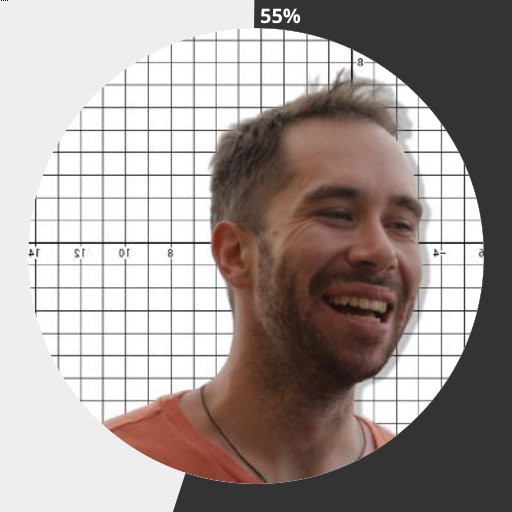
product manager getting Github and Claude Code access

English

How I feel after this tweet:
Farza 🇵🇰🇺🇸@FarzaTV
I decided to join Y Combinator, again. This would be my second time! Not fully sure what I'm working on yet. But, I'm sure I'll find something in time as I wander and ship. I'm a little scared to do the whole build a company thing again ngl, but mostly excited. There's never been a better time to work on the ideas in my head. The batch started this week. Starting a company at 23 vs now starting a company at 30 feels so different. At 23 (when I did YC in 2020), naivety was there. At 30 I guess I know how difficult it all is. It's not surprising to me that most people in YC are aged 19-24. Still, I feel like I have the naivety of a 19 year-old, but, with the mental of a guy who's been through a lot and learned a lot. So, I'm bullish. Let's see what happens. You'll probably see me launching a lot of random stuff over the next few weeks especially. Also, I am blown away by the number of founders in the batch walking up to me telling me they credit being at YC to @_buildspace. It's so wonderful, and warms my heart. I often struggle to stop and understand the value of my past work because I'm so interested in the future. So, this was nice. It's funny, many saw me irl and freaked out thinking I was joining as a YC partner and were very very surprised to hear I was joining as a founder back in the dirt alongside them haha. Most founders never start another company and usually turn into VCs or get a high-tier job at a big company. I do not blame them. And honestly, that would be the easier more secure path for me especially as I begin thinking about family. But, idk. I feel like my ideas are important. And even though I don't have a specific "This is the idea I'm excited about" it's more a feeling of "I should explore my ideas...I would regret it if I didn't". Especially in 2026, at the epicenter of one of the greatest inventions of my lifetime. Every time I think about getting a job (of which I've been offered many great ones) that voice in my head comes back and says to give my nascent visions a shot. So, gonna try :) Maybe I flop, maybe I don't, only one way to find out. I'll be dropping weekly updates on YouTube if you're interested. I put one out last week that talks more in depth around the story of how this YC stuff even happened randomly, why I'm doing this again, my imposter syndrome and how I think about it, and other stuff. I'll link it below. Lets see what happens!! See y'all.
English
I've been hacking on a product for myself that does this. If interested, hmu!
As you use your computer, it lets you collect inspo (an interesting tweet, a research paper, a screenshot of a page design you like, etc). Then it all gets indexed into an LLM-managed wiki you can chat with.
The more you collect, the better your wiki gets, the better your chats get, the better your ideas potentially get.
Super early and hacky. Started it a few days ago.
DM me if you wanna try it out + plz plz tell me what you'd wanna use it for in your DM! Mac only rn.
(P.S: I am also exploring a version where teams can collect context together. Imagine your whole team's inspo + ideas feeding one AI-backed wiki, and then agents working on top of that 24/7 doing research and analysis to help you guys figure new ideas like a new Notion but not trash if you are on a team and wanna try that lmk)
Andrej Karpathy@karpathy
LLM Knowledge Bases Something I'm finding very useful recently: using LLMs to build personal knowledge bases for various topics of research interest. In this way, a large fraction of my recent token throughput is going less into manipulating code, and more into manipulating knowledge (stored as markdown and images). The latest LLMs are quite good at it. So: Data ingest: I index source documents (articles, papers, repos, datasets, images, etc.) into a raw/ directory, then I use an LLM to incrementally "compile" a wiki, which is just a collection of .md files in a directory structure. The wiki includes summaries of all the data in raw/, backlinks, and then it categorizes data into concepts, writes articles for them, and links them all. To convert web articles into .md files I like to use the Obsidian Web Clipper extension, and then I also use a hotkey to download all the related images to local so that my LLM can easily reference them. IDE: I use Obsidian as the IDE "frontend" where I can view the raw data, the the compiled wiki, and the derived visualizations. Important to note that the LLM writes and maintains all of the data of the wiki, I rarely touch it directly. I've played with a few Obsidian plugins to render and view data in other ways (e.g. Marp for slides). Q&A: Where things get interesting is that once your wiki is big enough (e.g. mine on some recent research is ~100 articles and ~400K words), you can ask your LLM agent all kinds of complex questions against the wiki, and it will go off, research the answers, etc. I thought I had to reach for fancy RAG, but the LLM has been pretty good about auto-maintaining index files and brief summaries of all the documents and it reads all the important related data fairly easily at this ~small scale. Output: Instead of getting answers in text/terminal, I like to have it render markdown files for me, or slide shows (Marp format), or matplotlib images, all of which I then view again in Obsidian. You can imagine many other visual output formats depending on the query. Often, I end up "filing" the outputs back into the wiki to enhance it for further queries. So my own explorations and queries always "add up" in the knowledge base. Linting: I've run some LLM "health checks" over the wiki to e.g. find inconsistent data, impute missing data (with web searchers), find interesting connections for new article candidates, etc., to incrementally clean up the wiki and enhance its overall data integrity. The LLMs are quite good at suggesting further questions to ask and look into. Extra tools: I find myself developing additional tools to process the data, e.g. I vibe coded a small and naive search engine over the wiki, which I both use directly (in a web ui), but more often I want to hand it off to an LLM via CLI as a tool for larger queries. Further explorations: As the repo grows, the natural desire is to also think about synthetic data generation + finetuning to have your LLM "know" the data in its weights instead of just context windows. TLDR: raw data from a given number of sources is collected, then compiled by an LLM into a .md wiki, then operated on by various CLIs by the LLM to do Q&A and to incrementally enhance the wiki, and all of it viewable in Obsidian. You rarely ever write or edit the wiki manually, it's the domain of the LLM. I think there is room here for an incredible new product instead of a hacky collection of scripts.
English

@bandiaditya @noondesign Is it only me who at first glance thought - Where did "Modi" come from 😮
English

I’m thrilled to announce we’ve raised $44M to build a new home for product design. Meet @noondesign.
No workflow is more broken and fragmented in 2026 than the product designers’. The very same people who care most about building software don’t have software purpose built for them. @kushagrasinha7 and I have lived this problem first hand as designers ourselves.
That’s why we built Noon. The first product design tool that works entirely on your product code, so you can design not only how a product looks, but also how it works. With AI at its core that works in seconds, not minutes.
For the first time, you can create, iterate, build, test and ship. All in one canvas. No translations or roundtrips to the codebase and back.
Comment “Get Noon” and we’ll get you on the list for early access.
English

Update: the company shut down last September and I am STILL figuring out my next move
Mig@salonimig
Update: joined this company on Monday!
English
Whose ADHD is through the roof thanks to Claude Code ?
I just built myself a claude terminal manager who can tell how many claude terminals I have running and what are they doing :P
I had 7 terminals running. Comment, how many do you have running. Reveal your ADHD :P
English
English

I'm excited to share that @omidotme has been acquired by @Meta!
Working for a big company has been my goal since I 2024 and there is no better company than Meta with Mark as a leader
We’ll be moving all existing users to Meta infrastructure and integrating their current devices to omi this month
Our necklace will be shut down by the end of the year but we will be issuing $20 promo codes in celebration of the acquisition



English
@meh_agarwal @FarzaTV 100%. the genuine effort to get people to makesomething (pun intended) and learn in the process is truly commendable.
I've personally got to shipping and talking about it coz of him.
English

I've seen @FarzaTV randomly on the streets of SF and at YC a few times randomly.
Never gotten the chance to properly chat.
But he's someone who has built the most goodwill in the tech community.
I never did buildspace but I remember applying for it in college.
He's lowkey inspired a good chunk of the current gen of YC founders.
Found out from friends he's back in P26. Couldn't be more excited to see what he's building next.
(I don't know him personally, and no he didn't pay me to post this)
English
i had once pitched to Dia Mirza for a celebrity startup tool a portco was building, 2am in the night, at the airport baggage collection.
Met her 10 years later to share the story and appreciate the gesture. Spent a some time talking over climate change and tech.
Didn't get a 'win' per se. But surely won over the person.
English
I have said it multiple times, and I'll say it again.
Founders who win are extremely low inhibition people.
They don't ask why, they ask why not.
They mail recklessly, they linkedin connect and msg recklessly, they run ads, build random things, mail, message, for what is the worst that can happen, someone will NOT reply. Isn't that happening already before you first mail/msg.
I constantly watch great tech builders/ great teams/ great companies falling short, because of inhibition.
In fact, in my personal startup sprint, everything was running hunky dory for year 0 to 3, because I was/ am generally 0 inhibition person, and by year 4, I had gone down in a self doubt spiral, this is too much, should message this in this way, this email is too straightforward lemme work with this, uhh they didn't respond to my mail so maybe they don't want to talk to me, lol, you are salesgirl Abi, your job is to message, their job is to not respond, then your job is to alter craft edit your message so many times till it lands and the person responds, in fact part of your job is to automate that entire process so you are just watching/ observing/ fine tuning the process and letting people respond.
All sales all over the world is that. From ads to twitter posts to linkedin/ instagram, beautiful shop fronts/ decor/ art/ web design/ case studies everything is to capture the attention of ICP, to say hi, ssup, watcha doin, and then try sell, try sell an idea, a philosophy, an ideology, a product, a service, a company, whatever
And an ounce of inhibition in this entire process is #defeat. Sales is a weird commitment to be okay with making fool of yourself. And, I kinda feel its a personality, I have been 0 inhibition since I was 5, i was jumping from different heights to try see at what height do I get how much hurt, talking about god forgetting to put the inhibition chip in brain, ohh that whole experiment of jumping from different heights to see at what height do I get how much hurt gave me two fractures, but very interesting stories/ perspectives/ knowledge on techniques to land safely, so 🤘
English
The Greatest Servant
If we’re honest, most of us would rather be served than to serve others. We’d rather feel special than ordinary. We’d rather feel important than insignificant.
And though God has made each of us special, important, and created in His image—His children cannot be above serving, because Jesus was never above serving.
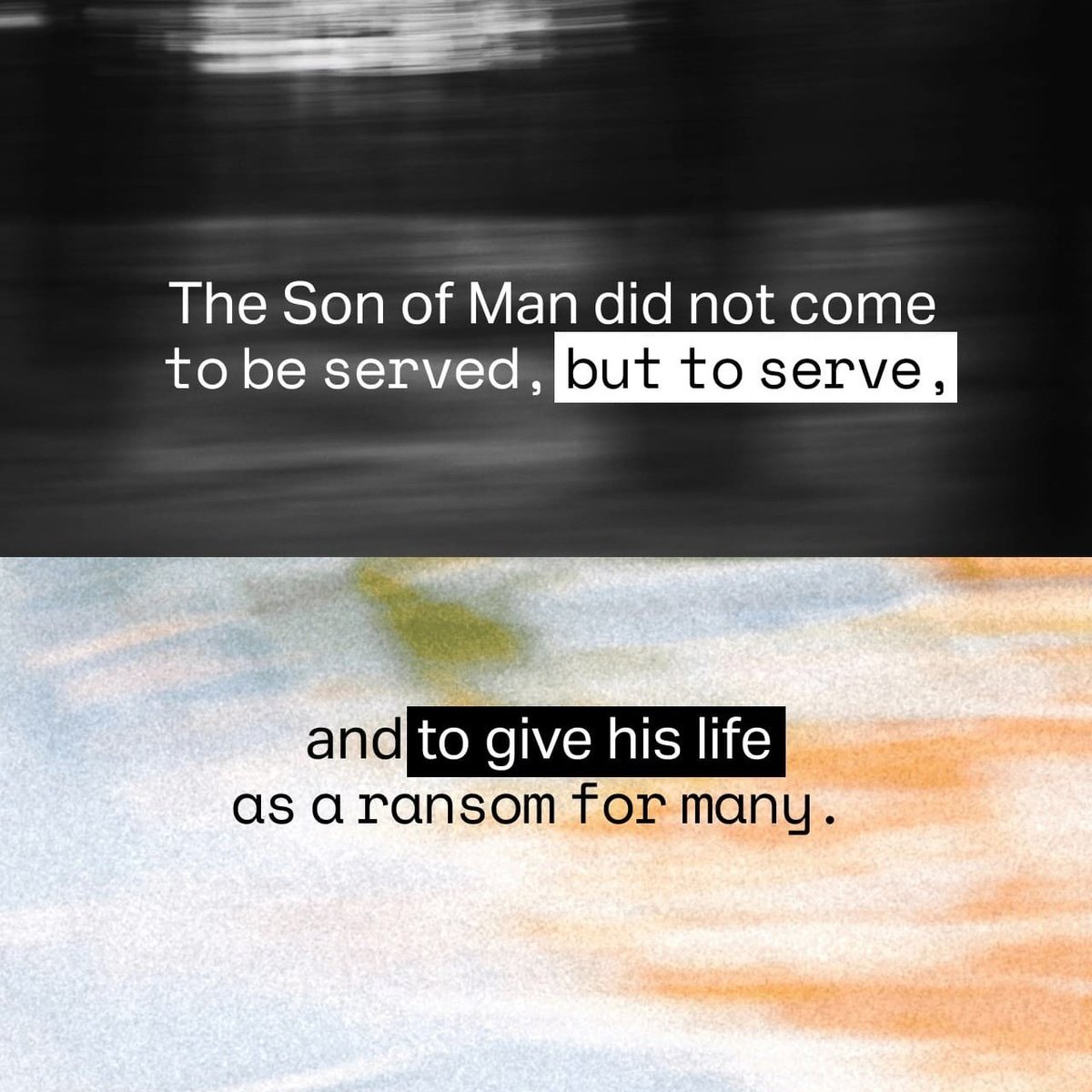
“For even the Son of Man came not to be served but to serve others and to give his life as a ransom for many.”
Matthew 20:28 NLT
If the King of kings and Lord of lords didn’t come to be served, but to sacrifice His life for the sake and salvation of others, we should pay attention.
Jesus warned against doing impressive things just to be seen, praying extravagant prayers merely to be heard, and taking the highest-ranking positions simply to be known. (See: Matthew 6 and 20.)
Instead, Jesus engaged the outcast, fed the hungry, healed the sick, helped the hurting, stopped for the broken, washed dirty feet, and laid down His life—even though He was innocent—so that even the “worst” of sinners could discover: they're never too far from His love.
As you think about what it meant for Jesus to die in your place and erase your sins and mistakes, what does it trigger inside of you? Worship? Gratefulness? Are you compelled to go and tell others? Today, ask God to show you how you can serve others like He has served you.
English


I was educated in English. Marathi was spoken primarily at home. It was in the last year of my college that I picked up a novel by the great Marathi litterateur, GoNi Dandekar - Kuna Ekachi Bhramangatha. By the time I reached the last page of the novel, I had an epiphany. 1/n
WION@WIONews
#GravitasPlus | 1 indigenous language vanishes from Earth every fortnight. This #MotherLanguageDay, spend 10 minutes understanding the challenges facing our native languages. @palkisu tells you how parents, teachers, govt officials can all come together to save mother languages.
English


@SenSanders working on a project at Stanford to address this exact issue! openanonymity.ai
English

I spoke to Anthropic’s AI agent Claude about AI collecting massive amounts of personal data and how that information is being used to violate our privacy rights.
What an AI agent says about the dangers of AI is shocking and should wake us up.
English