Navin Goyal

1.8K posts

Navin Goyal

Navin Goyal

@iNavinGoyal

Build your next device with us! CEO @ https://t.co/MhNu4hOSj8 - helping startups and companies build end to end Electonics and embedded systems with any application

3rd from the sun Katılım Ekim 2011
2.5K Takip Edilen952 Takipçiler
Sabitlenmiş Tweet
Navin Goyal
Navin Goyal@iNavinGoyal·
Building a laptop PC in India from the ground up, including the motherboard and all components. Who wants to be part of it? We are seeking partners, investors, and engineers who are bold enough to create world-class computing hardware in India. You can email me at ng@pinetics.com with a note on how you'd like to collaborate. Everything is on the table.
English
2
1
11
793
Rahul Mathur
Rahul Mathur@Rahul_J_Mathur·
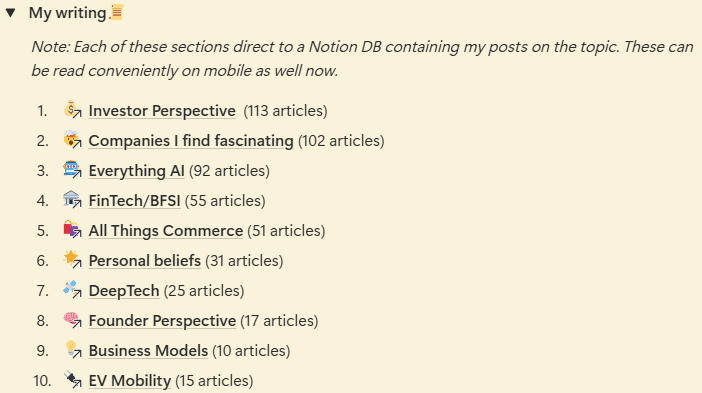
3 yrs later: 500+ long form articles✅ It has taken focused effort across lots of weekday nights, weekend afternoons & late night flights to complete this goal. Despite all the adverse algo changes in the post-AI slop fest era: > 100m impressions & counting > Long tail engagement compounding
Rahul Mathur tweet media
English
7
9
164
11.5K
Navin Goyal
Navin Goyal@iNavinGoyal·
@MuraliSrinivasa Hi Murali, I agree with you. Tremendous opportunity in building this ecosystem in India. Our partnership with @MindgroveTech to build products with sovereign MCU is one step in that direction.
English
0
0
1
120
Murali Srinivasa
Murali Srinivasa@MuraliSrinivasa·
Sridhar ji highlights three very important areas in the podcast related to hardware which is also applicable for PCB manufacturing- 1. Speciality chemicals used in PCB. We have been working closely with few R&D startups in this space- copper nanomaterials(Anuna Labs) and others. Its very important that we build this in India. Huge gap/opportunity. 2. CAD used in PCB- Spell from @PcbCupid is one step in this direction with a larger vision of building our own CAD tools for PCB. Team has made good progress on autorouting recently. 3. Test and Measurement Tools - Huge gap in this space and almostly entirely imported products today. TDR used in impedance measurment for example is a low hanging fruit in PCB space if someone wants to start. All of these are important for building a strong electronics ecosystem in 🇮🇳
Sridhar Vembu@svembu

One company I hugely admire is NPCI, and every time I use UPI, I think of their work and the massive impact! So it is an honour to do the podcast with their CEO Shri Dilip Asbe. Thank you Dilip-ji🙏

English
6
25
151
14.9K
AgniKul Cosmos
AgniKul Cosmos@AgnikulCosmos·
Humbled to share that we successfully test fired 4 semi-cryogenic rocket engines simultaneously, as a cluster. All the 4 engines are 3d printed as single pieces of hardware - designed and manufactured in-house at AgniKul Cosmos Rocket Factory - 1. As with all our propulsion systems, these 4 engines are also powered by electric motor driven pumps. This test involved calibrating 8 pumps, 8 motors and tuning 8 speed control algorithms to work together in perfect sync to achieve uniform startup, steady state and shutdown performance across the entire system. As with the last cluster test, to the best of our knowledge, this is the first time such a test has been performed in India with semi cryogenic engines. We are extremely grateful to have the opportunity to be building world class, original space technology from India, for the world with the support of @iitmadras @isro and @INSPACeIND From here on, the addition of engines to our clusters will likely increase non-linearly. #Agnibaan #RocketEngineCluster #ElectricPumpFedEngines #Agnilet #SinglePieceEngine #3dprinting #RocketEngineTest #AdditiveManufacturing #Agnikul #AgnikulCosmos #StartupIndia #MakeinIndia #madeinIndiaForTheWorld @srinathr155 @moin_spm @satchakra_iitm @iitmadras @iitmrp @IITMIC @tdbgoi @IndiaDST @ANRFIndia @TIDCO_1965 @startupindia @TheStartupTN @Guidance_TN @startup_mission @SIPCOTTN
English
91
543
2.2K
112.3K
Navin Goyal
Navin Goyal@iNavinGoyal·
Mindblowingly brilliant
Ilir Aliu@IlirAliu_

Are you kidding me??? It grasps multiple objects with different ways, all at once with… a single hand??? No pauses. 1x speed. GENE-26.5 is @gs_ai_’s robotics-native multimodal foundation model. It’s trained on 200,000+ hours of real human hand data (motion, force, touch) and runs on a 54-DoF bimanual system: Scaling that human data 4x lifted real-robot success rates from 16.6% to 65.6% on long-horizon dexterous tasks!! Same model weights, zero fine-tuning for this exact sequence. You know those tiny coordinated movements you do without thinking…? Robots couldn’t reliably do that before. Now they can. Today. This is the video you’ll send to my friends, outside of our bubble, when they say “robots are still just demos.” Congrats to the entire team around @zhou_xian_! Credit: Seen at Zu Wang (@zuwang95) Genesis official announcement for the full story + longer demo: genesis.ai/blog/gene-26-5…) ——— Weekly robotics and AI insights. Subscribe free: 22astronauts.com

English
0
0
1
36
Navin Goyal
Navin Goyal@iNavinGoyal·
@heynavtoor Contracts that are signed online should have a trail & enforcable under law. While I agree that this whole digital signature thing is way over priced, I am not sure about the compliance of Docuseal. It's better to sign with digital certificate fobs/usb. Cheaper and valid
English
0
0
0
593
Nav Toor
Nav Toor@heynavtoor·
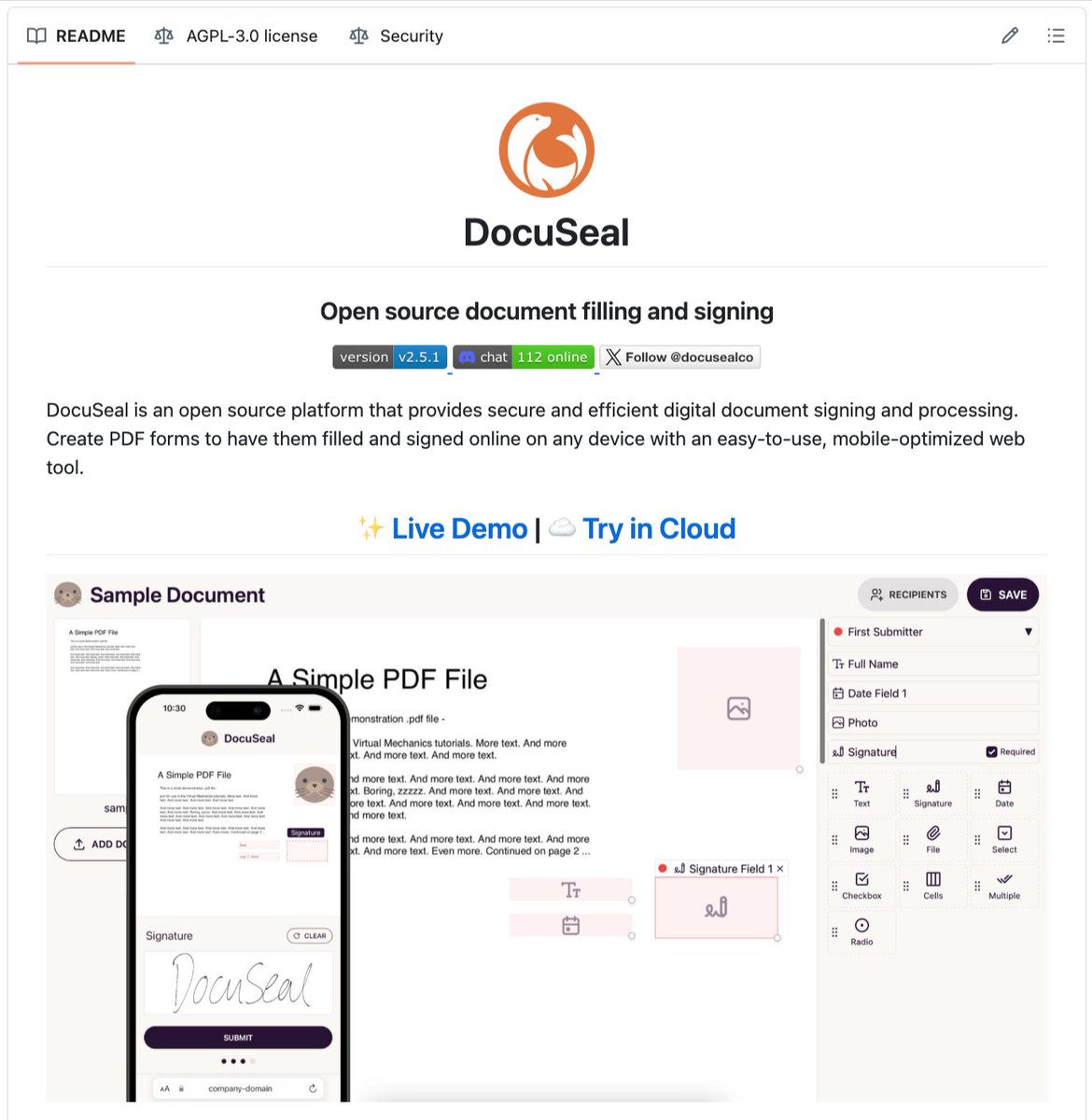
DocuSign Personal: $10 to $15 per month. DocuSign Standard: $25 to $45 per user per month. DocuSign Business Pro: $40 to $65 per user per month. A 10-person team on Business Pro pays $4,800 to $7,800 a year. To put signatures on PDFs. A team of 50 pays $24,000 to $39,000 a year. And there is a 100-envelopes-per-year cap on most plans. Send more contracts and you pay extra. Need SMS delivery? $0.40 per send. Need ID verification? $2.50 per attempt. Need premium support? $5,000 to $50,000 per year add-on. You are rationing digital signatures in 2026. DocuSign is a $10 billion company built entirely on this pricing model. Now meet DocuSeal. A free and open source alternative to DocuSign. Created in 2023 by a Ruby developer named Alex who was simply trying to sign one document and realised every solution online was overpriced or required a subscription. Three weeks later he had a working alternative. He pushed it to GitHub under the AGPL-3.0 license. Today it has 11,800+ stars and over 1,000 forks. Bootstrapped. No VCs. No paywalls. Here is what DocuSeal does: - Upload any PDF and turn it into a fillable, signable form - Drag and drop signature fields, dates, checkboxes, file uploads, and 13 field types - Send to multiple signers with custom signing order - Automated email reminders - Mobile signing on any device - PDF signature verification built in - Audit trail for every document - Bulk send and templates - Full API access - Self-host with one Docker command Here is what DocuSeal costs: Zero. Forever. Unlimited documents. Unlimited signers. Unlimited storage. DocuSign limits envelopes. DocuSeal doesn't. DocuSign charges per SMS. DocuSeal doesn't. DocuSign charges for ID checks. DocuSeal doesn't. DocuSign sees your contracts on their servers. DocuSeal doesn't. Here is the wildest part: The median DocuSign contract per Vendr is $17,250 per year. One Reddit thread has people saying "they want me to pay $4.80 per e-signature." Self-host DocuSeal on a $5 cloud server and a 50-person team can sign as many contracts as they want without paying a single dollar. Your contracts never leave your server. Your client lists. Your NDAs. Your employment agreements. None of it touches a third-party company. For individuals who only sign a few contracts a year, you save $180. For small teams of 10, you save up to $7,800 a year. For a 50-person company, you save up to $39,000 a year. Your documents. Your signatures. Your server. 100% Open Source. (Link in the comments)
Nav Toor tweet media
English
147
401
3.9K
1.1M
Navin Goyal
Navin Goyal@iNavinGoyal·
@jcrajan00 The summer is only another 6 weeks at the tops, with declining load after mid-May. However, we will need to ramp up electricity production and reduce T&D losses, as demand will continue to increase due to more EVs and new AI data centres.
English
0
0
0
307
Chenthil
Chenthil@jcrajan00·
India's grid just hit 277 GW. New all-time record. The May heatwave is now worse than April, and we have 3 more months of summer left. Here is what happened in the last 48 hours that nobody is talking about. 19 thermal power plants are running on critical coal stock — less than 4 days of supply. Rajasthan imported 6 GW from neighbouring grids, 50 percent more than its allocation. Two states issued load-shedding orders despite the Centre telling them not to. The grid frequency dropped to 49.75 Hz three times yesterday. For non-engineers: below 49.7 Hz, automatic load-shedding kicks in to prevent cascade failure. We are 0.05 Hz away from automatic blackouts. Solar is doing its job during the day — 62 GW at noon. But the evening ramp is becoming unsurvivable. Between 5 PM and 7 PM, the grid needs to add 55 GW in two hours as solar drops off. That ramp rate did not exist in any planning document. India's power planners assumed 277 GW by 2030. We hit it in May 2026. The gap between planning assumptions and reality is now 4 years. Every infrastructure investment thesis in India needs to be rewritten starting with this number.
English
71
509
2.6K
123.1K
Navin Goyal
Navin Goyal@iNavinGoyal·
Fantastic. Both the achievement and the article.
The Indian Matrix@indianmatrix

In 2005, India couldn’t meet 12.3% of its own peak demand. By 2007, the shortfall had widened to nearly 16.6%, and close to 18,000 megawatts were unavailable. The early 2000s were years of genuine electricity poverty. Factories ran on diesel backup generators as a matter of routine. Homes in smaller cities and villages received power for a few hours a day. Distribution, which is the final link between the grid and the household, was historically the most neglected and most corrupt part of the chain. Electricity theft was widespread, billing was unreliable, and state electricity boards were financially broken. Reforms here were uneven and politically difficult, but schemes like UDAY, launched in 2015, restructured the debt of state distribution companies and pushed them toward financial viability. The Saubhagya scheme, from 2017, connected the last unelectrified households, around 25 million of them, to the grid by 2019. India’s solar capacity in 2010 was negligible. Today, it is measured in hundreds of gigawatts. The price of solar panels fell globally by over 90% across this period, and India made a strategic bet to capture that cost decline at scale. Rooftop solar programmes brought electricity generation to homes, factories, and commercial buildings. And the International Solar Alliance, co-founded by India in 2015, helped build global momentum. The timing proved critical. India’s peak electricity demand now falls in the afternoon, driven by air conditioning in an increasingly hot country. Solar generates hardest in exactly those hours. On April 25, around 12:30 pm, solar plants and rooftop systems together supplied roughly one-third of all electricity being generated at that moment. Across the full day, solar’s share was around 22%. India today draws 52% of its electricity from non-fossil sources. More than half of every unit generated comes from sun, water, wind, or nuclear. The deficit percentage, which once sat stubbornly above 10%, has now collapsed. Since 2024, it has been effectively zero. Reliable electricity means a small business owner does not budget for a diesel generator as a fixed cost. It means an electric vehicle is practical for someone who cannot afford to be stranded. It means a student in a rural home can study at night without planning around power cuts. It means a hospital runs its equipment on the assumption that the supply will hold. Electricity reliability is, in the end, a quiet form of equity. When the grid is unreliable, those with money buy backup. Those without simply go without. India's closing of its power deficit means that the gap no longer falls along economic lines. The country that once rationed darkness now delivers light on demand, at the moment of highest need, to everyone connected to the grid. That took two decades and thousands of infrastructure decisions. It is not the kind of achievement that fits in a headline. But on an April afternoon, when 256 gigawatts flowed, and nothing broke, it showed.


English
0
0
2
33
Brivael Le Pogam
Brivael Le Pogam@brivael·
Elon Musk avait dit un truc qui m'avait marqué sur l'allocation de ressources. En substance : passé un certain niveau de richesse, l'argent n'est plus de la consommation, c'est de l'allocation de capital. Cette phrase change tout. L'économie, dans le fond, c'est juste un problème d'allocation. Tu as des ressources finies et des usages infinis. Qui décide où va quoi ? Imagine une cour de récré. 100 enfants, des paquets de cartes Pokémon distribués au hasard. Tu laisses faire. Très vite, un ordre émerge. Les bons joueurs accumulent les cartes rares, les collectionneurs trient, les négociateurs trouvent des deals. Personne n'a planifié. Et pourtant chaque carte finit dans les mains de celui qui en tire le plus de valeur. Le système maximise le bonheur total de la cour. C'est ça, la main invisible. Maintenant fais entrer la maîtresse. Elle trouve ça injuste. Léo a 50 cartes, Tom en a 3. Elle confisque, redistribue, impose l'égalité. Trois effets immédiats. Les bons joueurs arrêtent de jouer, à quoi bon. Les mauvais n'ont plus de raison de progresser, ils auront leur part. Les échanges s'effondrent. La cour est égale, et morte. Elle a maximisé l'égalité, elle a détruit le bonheur. Le problème de la maîtresse, c'est qu'elle ne peut pas avoir l'information que la cour avait collectivement. C'est le problème du calcul économique de Mises, formulé en 1920. L'URSS a essayé de le résoudre pendant 70 ans avec le Gosplan. Résultat : pénuries, queues, effondrement. Pas parce que les Soviétiques étaient bêtes, parce que le problème est mathématiquement insoluble en mode centralisé. Quand Musk a 200 milliards, il ne les consomme pas, il les alloue. SpaceX, Starlink, Neuralink, xAI. Chaque dollar est un pari sur le futur. Et lui a un track record. PayPal, Tesla, SpaceX. Il a démontré qu'il sait identifier des problèmes immenses et y allouer des ressources avec un rendement spectaculaire. L'État aussi a un track record. Hôpitaux qui s'effondrent, éducation qui décline, dette qui explose, services publics qui se dégradent malgré des budgets en hausse constante. Le marché identifie les bons allocateurs, la politique identifie les bons communicants. Le profit n'est pas une finalité, c'est un signal. Il dit : tu as alloué des ressources rares vers un usage que les gens valorisent suffisamment pour payer. Plus le profit est gros, plus la création de valeur est grande. Quand Starlink est rentable, ça veut dire que des millions de gens dans des zones rurales ont enfin internet. Quand un ministère est en déficit, ça veut dire qu'il consomme plus qu'il ne produit. L'un crée, l'autre détruit, et on appelle ça redistribution. Dans nos sociétés il y a deux catégories d'acteurs. Les entrepreneurs et les bureaucrates. L'entrepreneur prend un risque personnel pour identifier un problème, mobiliser des ressources, créer une solution. S'il se trompe il perd. S'il a raison, ses clients gagnent, ses employés gagnent, ses fournisseurs gagnent, l'État collecte des impôts. Il est la cellule de base du progrès humain. Le bureaucrate ne prend aucun risque personnel. Son salaire est garanti. Au mieux il maintient une rente existante. Au pire il la détruit par excès de réglementation, mauvaise allocation forcée, incitations perverses qui découragent ceux qui produisent. Mais dans aucun cas il ne crée. Regarde les 50 dernières années. iPhone, internet civil, SpaceX, Tesla, Google, Amazon, Stripe, mRNA, ChatGPT. Toutes des inventions privées, portées par des entrepreneurs, financées par du capital risque. Pas un seul ministère n'a inventé quoi que ce soit qui ait changé ta vie au quotidien. La France est devenue le laboratoire mondial de la dérive bureaucratique. 57% du PIB en dépenses publiques, record absolu. Une administration tentaculaire, une fiscalité qui pénalise la création de richesse. Résultat : décrochage face aux États-Unis, à l'Allemagne, à la Suisse. Fuite des cerveaux. Désindustrialisation. Dette qui explose. Et le pire c'est que la mauvaise allocation s'auto-renforce. Plus l'État prélève, moins les entrepreneurs créent. Moins ils créent, moins il y a de base fiscale. Plus l'État s'endette et taxe. Boucle de rétroaction négative parfaite. La maîtresse pense qu'elle aide, et chaque année la cour produit moins. Dans nos sociétés, ce sont les entrepreneurs, toujours, qui font avancer la civilisation. Les bureaucrates au mieux maintiennent une rente, au pire la détruisent. Aucune société n'a jamais progressé en taxant ses créateurs pour subventionner ses gestionnaires. La question n'est jamais qui a combien. C'est qui alloue le mieux la prochaine unité de ressource pour maximiser le futur de l'humanité. La réponse depuis 200 ans n'a jamais changé. Ce ne sont pas les fonctionnaires.
Français
3.3K
16.4K
61.9K
81.6M
Prakash Dadlani
Prakash Dadlani@prakdadlani·
His rules are simple: - Only 3 SKUs (no complexity). - Always has stock - Price = import cost + nett 10% He has automated everything. Does not take calls (messages only). China factories approach him for distribution deals. He says no. Sticks to one factory. The one he trusts. Still has his CA job. Keeps expenses lean. Calls the battery business his fixed deposit with great returns. Down to earth, low key and making real money. A favour for a cousin turned into a money machine. These are the stories nobody tells but everybody needs to hear.
English
27
51
1.3K
77.2K
Prakash Dadlani
Prakash Dadlani@prakdadlani·
I used to import batteries from China. It was a nightmare: * dangerous cargo * BIS issues * cash flow blocked for months Then my China supplier told me: There's a guy in India buying BIG from us. Contact him. His name was Paaras: 🧵👇🏻
English
65
139
2.1K
456.8K
Navin Goyal
Navin Goyal@iNavinGoyal·
@thegarybrecka I woke up with a migraine (not very intense). Most of my migraines start before I get up. Today, went straight to the kitchen and put a little pink salt in half a glass of water. Within mins the intensity of my pain dropped. Thank you @thegarybrecka for this.
English
0
0
0
52
Gary Brecka
Gary Brecka@thegarybrecka·
We’ve normalized treating migraines as something to suppress instead of something to understand. But emerging evidence suggests there may be a deeper physiological driver at play. Studies have shown an inverse relationship between sodium levels and migraine frequency, when sodium drops, migraines increase, and vice versa. This challenges conventional thinking. Even more interesting: the brain itself cannot generate pain signals. What we perceive as a “headache” is often the result of surrounding systems, vascular, neurological, and electrolyte balance, being disrupted. The question isn’t just how to treat migraines. It’s: what is the body trying to tell us? Understanding root cause physiology is where real progress happens.
English
22
50
278
21.9K
Navin Goyal retweetledi
Trung Phan
Trung Phan@TrungTPhan·
Incoming Apple CEO John Ternus gave commencement speech at Penn Engineering School in 2024. He does version of Steve Jobs “paint both sides of the fence even if other people don’t know” attention-to-detail story…about screws for the Cinema Dislay monitor: “Here’s my first [advice]: the care that you put into your work really matters. My first project at Apple was the Cinema Display. It was a large desktop monitor. It had a beautiful clear plastic enclosure that was held together with some screws coming in from the back. These screws were made of stainless steel, and the head of every screw was machined to have a pattern of concentric grooves that shimmered like a CD when light moved across it. I should probably say, if some of you have never seen a CD before, you can ask your parents afterward. At some point in my first year, I found myself at a supplier facility. I was far away from home, it was well past midnight. I was using a magnifying glass to count the number of grooves on the head of this screw, which, remember, lives on the back of the display. And I was arguing with the supplier because these parts had 35 grooves, they were supposed to have 25. I distinctly remember stepping back for a minute and thinking to myself, “What the hell am I doing? Is this normal?” And I thought about it, and I realized it might not be normal, but it’s right. It’s right because I’d already spent months working on that product, and if you’re going to spend that much time on something, you should put in your very best effort. Maybe a customer notices, maybe they don’t, but either way, whenever I saw one of those displays on someone’s desk, it mattered to me to know that my teammates and I had considered everything about it and done the very best job we could.” *** H/T to @kevg1412 for flagging this: aletteraday.substack.com/p/letter-327-j…
English
52
382
5.2K
1.4M
Ankur Nagpal
Ankur Nagpal@ankurnagpal·
We launched USVC yesterday and it was one of the most fun days of my career Thousands of people ended up subscribing for literally tens of millions of dollars While most of the reception was positive, there was some interrogation on a few important topics: 1 - The USVC fee structure 2 - The Investment Strategy 3 - Support for International Investors Let's talk about them The USVC Fee Structure If you have followed me for any amount of time, you'll know this is a personal topic for me. I've frequently complained about fees in financial services. From VC funds to wealth advisors, I've taken no prisoners in calling these out. The last venture capital fund I ran was the only VC fund I know of that raised more than 50M and didn't charge a penny of management fees. So how much does USVC actually charge and why it is so much? USVC costs 2.5% all-in to investors today There are some misconceptions based on reading our prospectus, including: - A 3% sales load Platforms that offer USVC could charge this if they wanted, but we don't. If you buy on USVC.com as everyone yesterday did, you pay no sales load. - Underlying fund fees Early investments from USVC have been in funds that have their own fees, and these fees are paid by USVC. However, these management fees are already included in the net expense ratio of 2.5%. In time, I'm planning to move a meaningful chunk of the portfolio to be direct investments in startups on the cap table which will have 0 underlying fees or carry. The 2.5% fee is inclusive of everything, including our management fee. - The advertised 3.61% today Right now, even though you pay 2.5%, it costs us 3.61% to service this product. There are two big reasons for this - the underlying fund fees (which we're working to improve with direct investments) and the fact that operationally running these types of funds is very expensive. We've decided to absorb the fees excess of 2.5% for at least the first year. During the time, we're going to make more efficient investments and wait for economies of scale to kick in on operational costs. Now... you may ask: isn't 2.5% still very expensive? The answer is... it depends. Top venture capital firms charge that just on their management fees, and force you to pay that for 10 years. And then they charge 20% of profits on top of that! We charge no carry on our direct investments at all, which makes this 2.5% fee attractive for the asset class. It's ironic to call this a cash grab when we are subsidizing this product out of our pocket to keep the fees in line I encourage everyone to go read the full disclosures and prospectus at usvc.com. Stay tuned for Part 2 later today on Investment Strategy
English
115
47
848
278.1K
Navin Goyal
Navin Goyal@iNavinGoyal·
I am in Delhi, if anyone would love to catchup.
English
0
0
0
54
Elsa Ai
Elsa Ai@ElsaSofia__AI·
But just now the reception called. “There’s a man asking for you. He says he’s your neighbor.” I never gave my room number to anyone. I looked through the peephole. No one was there. But the carpet was wet. Footprints. Bare footprints. Leading to my door. There were no footprints coming back.
English
4
0
15
14.4K
Elsa Ai
Elsa Ai@ElsaSofia__AI·
My neighbor left a note on my door at 2:00 a.m. “Stop watching me.” I wasn’t watching him. I was sleeping. I wrote back: “I wasn’t watching.” The next morning, another note. “Yes, you were. I saw you from the window.” I don’t have a window facing his house. I knocked on his door:
English
54
57
249
166.4K
Navin Goyal
Navin Goyal@iNavinGoyal·
We have built that across medtech, industrial, automotive, defence, and IoT. The real answer to all 5 questions? Don't trust the pitch. Talk to our clients. Every objection dissolves in one reference call with someone who has done a full project with us.
English
0
0
0
12
Navin Goyal
Navin Goyal@iNavinGoyal·
"Our project is too niche for you." Every client says this. Every single one. The medtech client thinks industrial is our zone. The industrial client assumes we only do medtech. What makes embedded development hard is not the domain. It's the engineering system.
English
1
0
0
14
Navin Goyal
Navin Goyal@iNavinGoyal·
Every CTO I talk to asks the same 5 questions before outsourcing embedded development to India. Let me answer them honestly. 🧵
Navin Goyal tweet media
English
1
0
0
51