Kerick

7.1K posts

Kerick banner
Kerick

Kerick

@iamselfcustody

Founder @investwclarity | I help people invest in the best cryptocurrencies using strategies proven to deliver long-term profits | Also building @onetaptools

Let’s get YOU started 👉 Katılım Mart 2024
97 Takip Edilen1.2K Takipçiler
Sabitlenmiş Tweet
Kerick
Kerick@iamselfcustody·
Most people buy crypto without ever checking how it performed in the past. That's why they panic sell, chase pumps, and underperform. Clarity shows you real performance data: • Lump sum vs DCA • Best years and worst drawdowns • Side-by-side comparisons • What's actually working right now No hype. No predictions. Just facts. Comment CLARITY and I'll send you the tool.
English
5
4
14
60.9K
Kerick
Kerick@iamselfcustody·
Clarity quietly surpassed 1000 active users 🙃 It took us 5 months to get here since the release. A whole lot of learning happening on our end including understanding what users really need, establishing trust with users, and knowing what sticks. You’re welcome to try it 🍊
Kerick tweet media
Kerick@iamselfcustody

Yayyy!!! Clarity just crossed 700 active users 😡

English
0
4
8
121
Kerick
Kerick@iamselfcustody·
🚨 Clarity Weekly Crypto Update Here's what actually moved in the market this week. Top 5 Gainers: 🟩 $CTSI: $0.0453 (+100.91%) 🟩 $ABT: $0.3644 (+83.54%) 🟩 $ONG: $0.1099 (+77.68%) 🟩 $FIDA: $0.0214 (+63.95%) 🟩 $SWAP: $0.1016 (+59.47%) Top 5 Losers: 🟥 $FTN: $1.09 (-85.32%) 🟥 $SIREN: $0.2449 (-85.32%) 🟥 $CORE: $0.0264 (-59.87%) 🟥 $DRIFT: $0.0382 (-42.06%) 🟥 $FAI: $0.0039 (-29.22%) 🏔️ ATH Monitor New ATHs This Week: 🟦 $STO: $1.71 Closest to ATH This Week: 🟧 $GREAT: $12.15 | ATH $12.16 (99.92%) 🟧 $LEO: $10.03 | ATH $10.14 (98.92%) 🟧 $ZCHF: $1.26 | ATH $1.33 (94.74%) 🟧 $CGO: $166.76 | ATH $178.71 (93.31%) 🟧 $XAUT: $4,643.84 | ATH $5,504.62 (84.36%) 🟧 $XAUM: $4,619.41 | ATH $5,574.96 (82.86%) 🟧 $PAXG: $4,654.75 | ATH $5,619.09 (82.84%) 💡 Tracking ATHs shows momentum and potential breakout candidates. 🕰️ Historical Insight of the Week * $10,000 invested in CTSI 6 years ago → -20.16% * $7,775 invested ($25 weekly) in CTSI → -52.02% * Bitcoin outperformed Cartesi investing $25 weekly over the last 6 years → +164.28% 💡 Historical performance highlights the compounding power of DCA vs lumpsum and identifies standout performers. . I post these updates every Saturday. Let me know what other interesting insights you want to see. h/t to @investwclarity for the data and visuals.
English
1
4
7
2K
Kerick retweetledi
Benjamin Cowen
Benjamin Cowen@benjamincowen·
Being bearish on shitcoins doesn’t make you a doomer. Being bearish on science and technology makes you a doomer. The people that call others doomers are in fact the ones who are doomers.
English
80
18
873
54.7K
Kerick retweetledi
mert
mert@mert·
think this is marc's meta point about why introspection is bad which went viral most people misinterpret why something worked or didn't in the past, often through 2nd or 3rd hand information, and then overfit on it for future decisions "this thing has been tried before and didn't work, therefore it can't work" is an extremely deceptive error of thought
Marc Andreessen 🇺🇸@pmarca

Almost everything you think you know about the history of technology and capitalism was warped by communist/luddite propaganda of the era. That's happening this time too.

English
25
6
97
19.1K
Kerick retweetledi
Benjamin Cowen
Benjamin Cowen@benjamincowen·
Midterm years are always bearish for Bitcoin. You can try and find plenty of reasons why, but narrative follows price.
English
126
54
1.4K
73K
Kerick
Kerick@iamselfcustody·
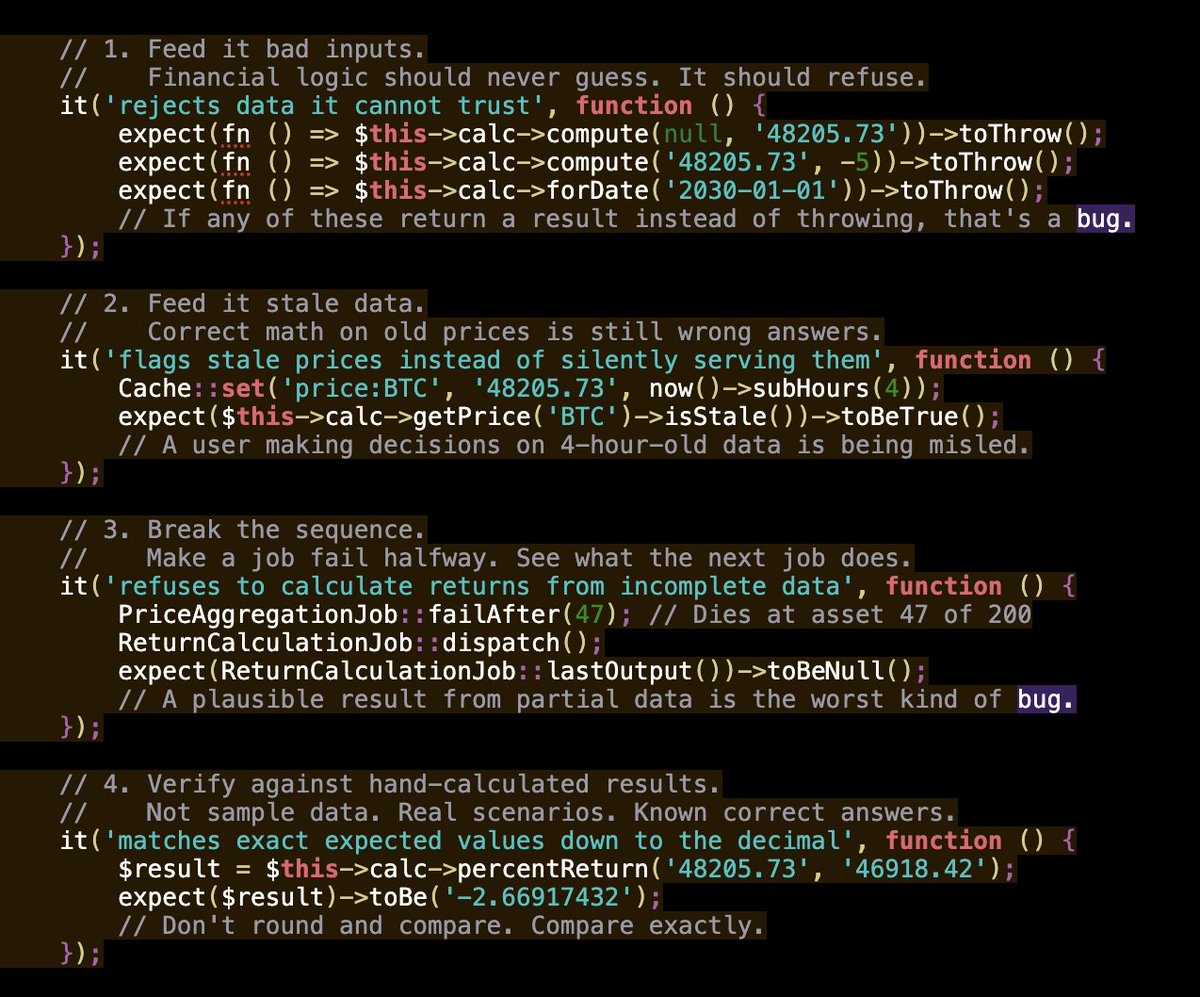
Before I ship anything that touches money, I break it on purpose. Here's how. Every feature I build at Clarity that touches financial data goes through the same process before it reaches production. I try to make it produce wrong results. Deliberately. Systematically. Before any user ever sees it. This isn't about unit tests. Unit tests verify that your code does what you told it to do. What I'm talking about is verifying that your code does the right thing when everything around it misbehaves. The first thing I do is feed it bad inputs. Null values where prices should be. Negative numbers in quantity fields. Timestamps from the future. Strings where numbers should be. If the calculation produces a result instead of rejecting the input, that's a bug. Financial logic should never guess. It should refuse to operate on data it doesn't trust. Then I mess with the data sources. I simulate a third-party API returning stale prices by freezing the cache and running calculations against data that's hours old. If the system doesn't notice that the data is stale and flag it, that's a bug. A user making investment decisions based on prices from four hours ago is being misled, even if the math on those prices is technically correct. Next I break the sequence. I trigger a background job that depends on another job's output, but I make the first job fail halfway through. Does the second job use incomplete data? Does it wait? Does it skip? If it proceeds with partial data and produces a plausible-looking result, that's the most dangerous kind of bug. A calculation that's wrong but looks right. Then I test the boundaries. What happens when a portfolio has a single asset? What about zero assets? What about an asset that was added and immediately removed? What about a calculation that spans a time window where the asset didn't exist yet? Edge cases in financial software aren't rare. They're where most of the real bugs hide. Finally, I verify the output against hand-calculated results. Not sample data. Real scenarios with known correct answers that I've worked out manually. If the system's output doesn't match to the decimal, something is wrong. I don't round and compare. I compare exactly. None of this is glamorous. Nobody builds a career talking about input validation and stale data checks. But this is the work that separates financial software people trust from financial software that quietly gets things wrong. I'd rather spend two days breaking my own code than spend one hour explaining to a user why their portfolio returns were incorrect.
Kerick tweet media
English
0
3
8
50
Kerick retweetledi
Bitcoin Archive
Bitcoin Archive@BitcoinArchive·
CATHIE WOOD says Bitcoin will outperform gold as the global monetary system shifts. “We expect the Bitcoin to gold ratio to turn around, with Bitcoin rising and gold falling.”
English
91
163
1.1K
103.5K
Kerick
Kerick@iamselfcustody·
Everyone asked how many users we could handle. Nobody asked what happens when a transaction fails mid-process. When I was building the backend for a platform that processed over a million pounds monthly, the question I heard most was about scale. How many concurrent users? How many requests per second? What's the maximum throughput? Not once did anyone ask: what happens if the server crashes after we charge a customer but before we update their subscription? That's the question that actually matters in financial systems. And it's the one most teams discover the hard way. Here's the scenario. A user upgrades their subscription. The system does three things in sequence: calculate the prorated amount, charge the customer through Stripe, and update the subscription record in the database. Three steps. Simple enough. Now imagine Stripe successfully processes the charge, but the database update fails. Network blip. Timeout. Deadlock. Doesn't matter why. The customer has been charged. Their card statement shows the payment. But the system still thinks they're on the old plan. They paid for an upgrade they never received. Or the reverse. The database updates first, the user gets access to the new plan, but the Stripe charge fails afterward. Now they have the upgraded plan without paying for it. And depending on how the code is structured, there might be no record that a charge was even attempted. These aren't hypothetical edge cases. These are the gaps that appear between any two systems that don't share a single atomic transaction. Your database and Stripe are not in the same transaction. They can't be. Which means there's always a window where one has succeeded and the other hasn't. The answer isn't to prevent failures. Failures between distributed systems are inevitable. The answer is to design for the gap. At Clarity, every operation that touches an external service follows a pattern. Record the intent before executing it. Execute the external call. Confirm the result. If any step fails, the intent record tells the system exactly where it stopped and what needs to be retried or reversed. A scheduled job runs every few minutes and scans for intents that were recorded but never confirmed. It either retries the incomplete step or flags it for manual review. No charge goes unmatched. No update happens without a corresponding payment confirmation. Scaling to ten thousand users is an infrastructure problem. Handling what happens when step two of three fails is a design problem. One of them gets all the attention. The other one determines whether people trust your system with their money.
Kerick tweet mediaKerick tweet mediaKerick tweet mediaKerick tweet media
English
0
3
7
82
Kerick retweetledi
Kerick
Kerick@iamselfcustody·
Clarity has been averaging ~50 new users daily lately and most of traffic is from organic search. What does this mean? 🤔
Kerick tweet media
English
5
4
11
182
Kerick retweetledi
Kerick
Kerick@iamselfcustody·
🚨 Clarity Weekly Crypto Update Here's what actually moved in the market this week. Top 5 Gainers: 🟩 $NKN: $0.0124 (+146.08%) 🟩 $BR: $0.1251 (+122.55%) 🟩 $ANON: $0.8642 (+88.55%) 🟩 $SIREN: $1.31 (+42.78%) 🟩 $BANANAS31: $0.0129 (+40.08%) Top 5 Losers: 🟥 $CATX: $0.04121 (-96.37%) 🟥 $USR: $0.2675 (-79.70%) 🟥 $PIPPIN: $0.0578 (-44.77%) 🟥 $RLP: $0.7381 (-42.02%) 🟥 $NIL: $0.0307 (-37.18%) 🏔️ ATH Monitor Closest to ATH This Week: 🟧 $GREAT: $12.15 | ATH $12.16 (99.92%) 🟧 $ZCHF: $1.27 | ATH $1.33 (95.49%) 🟧 $CGO: $166.76 | ATH $178.71 (93.31%) 🟧 $LEO: $9.20 | ATH $10.14 (90.73%) 🟧 $XAUT: $4,482.61 | ATH $5,504.62 (81.43%) 💡 Tracking ATHs shows momentum and potential breakout candidates. 🕰️ Historical Insight of the Week * $6,000 invested in NKN 8 years ago → -97.02% * $9,400 invested ($100 monthly) in NKN → -68.64% * Bitcoin outperformed NKN investing $100 monthly over the last 8 years → +406.87% 💡 Historical performance highlights the compounding power of DCA vs lumpsum and identifies standout performers. . I post these updates every Saturday. Let me know what other interesting insights you want to see. h/t to @investwclarity for the data and visuals.
English
1
4
6
2.2K
Kerick retweetledi
Web3 Philosopher
Web3 Philosopher@seunlanlege·
I'm calling bullshit on Google's post quantum circuit. If the prover's source code isn't open-source then it's all smoke & mirrors. "Oh look here's some groth16 proof of some arbitrary program" It's almost like they think we're goycattle or something.
English
5
6
34
2.7K
Kerick retweetledi
Haseeb >|<
Haseeb >|<@hosseeb·
After a few weeks in SF, one thing stands out: AI people are more bullish on crypto than crypto people are on themselves. There's this narrative forming in crypto that AI people think crypto is a joke. It's just not true. I keep hearing this over and over from AI people who remain bullish crypto. Hell, Sama, Jensen, Elon, Zuck, the biggest names in AI have all been publicly bullish on crypto and its convergence with AI. Crypto's problem right now isn't that outsiders don't believe. It's that insiders are playing scared.
English
165
118
1.3K
154.3K
Kerick
Kerick@iamselfcustody·
I’m currently learning Golang. Is there any good resource out there? The official docs are not so explicit except for references
English
1
0
1
46
Kerick
Kerick@iamselfcustody·
who that? 👀🇸🇬
Kerick tweet media
English
0
4
9
186