Christos

1.2K posts

Christos banner
Christos

Christos

@idiosego

My opinions are my own, do not endorse!

Katılım Aralık 2012
1.2K Takip Edilen165 Takipçiler
Christos retweetledi
Ihtesham Ali
Ihtesham Ali@ihtesham2005·
A 100-page book written by an MIT professor in 2006 has been translated into 14 languages and quietly become the rulebook that designers at Apple, Google, and Airbnb still reference today. His name is John Maeda, and before he wrote it he spent 12 years at the MIT Media Lab trying to figure out why the products that get loved are almost never the products with the most features. The book is called The Laws of Simplicity. The following year, he walked onto the TED stage and compressed the entire thing into few minutes. That talk has been played over million times and is still passed around every time a design team gets into a fight about what to cut. Here is the framework inside it that changed how I think about every product I touch. Maeda's first law is Reduce, and it is the one everyone thinks they already understand. They don't. He argues that the simplest way to achieve simplicity is through thoughtful reduction, but the word that matters in that sentence is thoughtful. Removing the wrong things makes a product feel broken. Removing the right things makes it feel magical. The difference is not taste. It is a method. The method he teaches is an acronym he calls SHE (Shrink. Hide. Embody). Shrink means making the product feel smaller, lighter, and more humble than it actually is, because when a small unassuming object exceeds expectations, the brain registers it as delight. The iPod's mirrored back was not a finish decision, it was a shrinking trick. The reflection made the device blend into its surroundings so the eye only registered the thin plastic front. You felt like you were holding something impossibly thin because half of it was optically erased. Hide means taking the complexity that cannot be removed and putting it somewhere the user will never see it unless they go looking. The Swiss Army knife is the oldest version of this idea. A cell phone's clamshell was the modern one. Today it is every settings menu buried three taps deep in every app on your phone. The complexity is still there. The user just never has to carry it. Embody is the one that almost nobody applies correctly. Maeda argues that once you shrink and hide, you create a vacuum where the user starts to wonder whether the smaller, simpler thing is actually worth more than the bigger, feature-rich thing. So you have to put the lost value back in through materials, weight, craftsmanship, or story. The Bang and Olufsen remote control is intentionally made heavier than it needs to be because weight in the hand signals quality. The same remote in plastic would feel cheap. Same functions. Completely different product. The deepest insight in the talk is the one Maeda buries near the end, and almost nobody quotes it back. He says simplicity is not a feature you bolt on. It is a consequence of being willing to defend fewer things more fiercely than your competitors are willing to defend more things. Every product eventually faces a moment where adding one more feature feels harmless and subtracting one feels expensive, and the companies that win that moment are the ones that understand the cost of adding is almost always higher than the cost of cutting. His final law is the one he calls The One. Simplicity is about subtracting the obvious and adding the meaningful. Read that sentence twice. It is the entire design philosophy of every product you currently love, compressed into a single line. Maeda grew up working 3am shifts in his father's tofu factory in Seattle before MIT, before RISD, before Kleiner Perkins, before Microsoft. He has said more than once that what he learned in that factory shaped everything he wrote in that book. Craftsmanship is not about doing more. It is about doing the right things and refusing to do anything else. The book is 100 pages. Read it and learn the laws of simplicity.
Ihtesham Ali tweet media
English
12
371
1.8K
76.8K
Christos retweetledi
Phosphen
Phosphen@phosphenq·
This 2 hour video by Andrej Karpathy (co-founder of OpenAI) will teach you more about using LLMs than every AI tutorial you've watched this year combined. Bookmark & watch tonight, it will change the way you use AI forever.
English
15
254
1.7K
135.5K
Christos retweetledi
Aakash Gupta
Aakash Gupta@aakashgupta·
Everyone's looking at this as a Claude Code tutorial. The real story is bigger. What you're watching is the first version of how engineering teams will be structured in 18 months. The org chart stops mattering when a 4-person team with a mature Team OS ships faster than a 40-person team using AI individually. Think about what's inside a Team OS. Shared skills that encode how your specific codebase works. Shared automations that enforce your team's quality bar without code review bottlenecks. A learning flywheel where every bug fix, every deploy, every PR review makes the system smarter for everyone. This is the Spotify model, the squad model, the two-pizza team concept, except the constraint that killed all of those was knowledge transfer. Senior engineers left and took half the team's context with them. A Team OS on GitHub means the context stays even when people don't. The companies running these systems are going to look at hiring completely differently. You stop asking "how many engineers do we need" and start asking "how good is our Team OS." A team of 5 with 50 shared skills will outship a team of 20 with none, every single quarter. The early movers have maybe a 6 month window before this becomes obvious to everyone. After that, recruiting without a Team OS will feel like recruiting without a tech stack.
Aakash Gupta@aakashgupta

Every team at your company should be creating their own 'Team OS' in Claude Code on Github. Here's how: 1:45 - What is a Team OS 13:37 - Shared skills and commands 25:24 - Shared team automations 59:50 - The learning flywheel

English
3
6
45
10.4K
Christos retweetledi
Allen Braden
Allen Braden@allen_explains·
Skip Netflix tonight and spend an hour on this complete Claude course. You’ll be glad you did.
English
28
531
4K
381.3K
Christos retweetledi
Nav Toor
Nav Toor@heynavtoor·
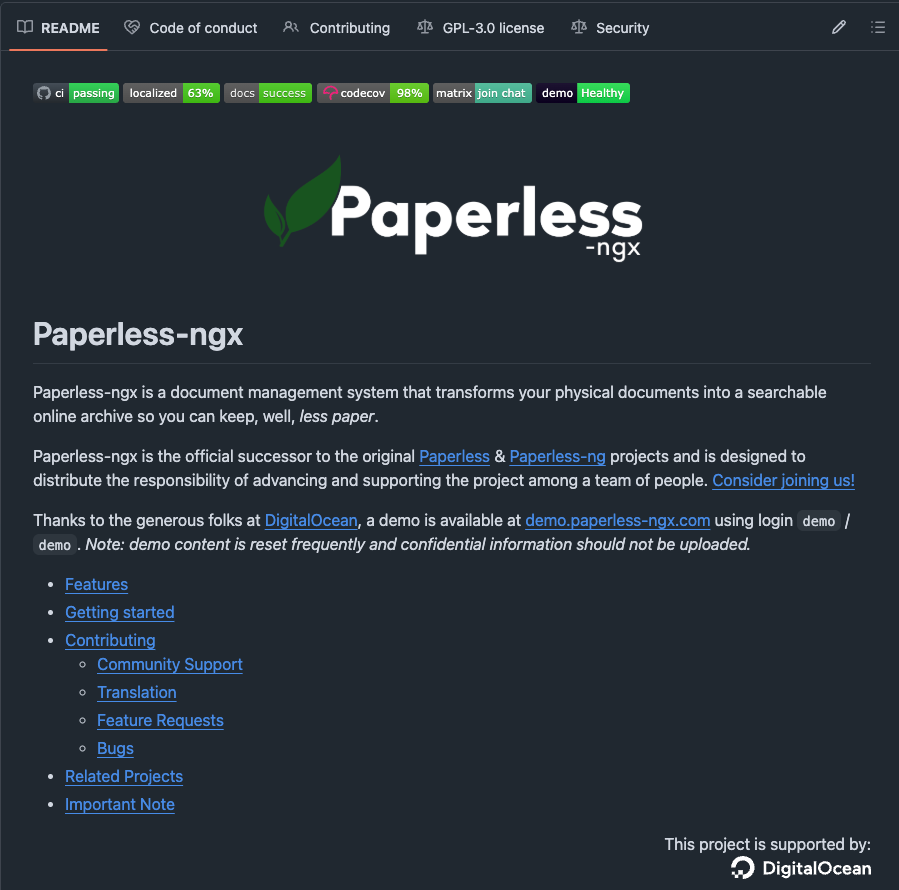
You have a shoebox full of receipts. A folder of tax documents you have not touched since 2021. An insurance policy buried somewhere in a drawer. A rental agreement you spent 45 minutes looking for last time you needed it. Someone built a tool that scans every document you own, reads it, and makes it searchable forever. On your own server. For free. It is called Paperless-ngx. 35,500+ stars on GitHub. You scan a document. Or photograph it with your phone. Or forward an email attachment. Paperless-ngx does the rest. Here is what happens automatically: - OCR reads every word on the page. 100+ languages. Powered by Tesseract. - Machine learning identifies what the document is. Invoice. Tax form. Medical record. Contract. - Auto-tags it. "Utilities." "Insurance." "Amazon." "Tax 2024." No manual sorting. - Auto-assigns the sender. It knows this letter is from your bank, not your landlord. - Stores it as PDF/A. The format designed to last decades. Your originals are kept untouched. - Full-text search across everything. Type "dentist receipt March" and find it in seconds. Here is what else it does: - Email ingestion. Connect your inbox. Every attachment gets scanned and filed automatically. - Custom workflows. Trigger actions when specific documents arrive. - Web dashboard with drag-and-drop uploading from any browser. - Multi-user support with per-document permissions. Share with your family or team. - Runs on a Raspberry Pi. Here's the wildest part: DocuWare charges $300-1,200 per user per year. M-Files charges up to $2,400 per user per year. Adobe Acrobat Pro for teams costs $23.99 per license per month. A 10-person team on DocuWare pays $3,000-12,000 a year. On M-Files, up to $24,000 a year. Paperless-ngx on a $5 VPS: $60 a year. Unlimited users. Unlimited documents. Forever. Your documents stay on YOUR server. Not Adobe's cloud. Not DocuWare's servers. Not Google Drive. Yours. 384 contributors. 136 releases. 2,200+ forks. Battle-tested for years. GPL-3.0 licensed. Self-hosted. Free forever. 100% Open Source. (Link in the comments)
Nav Toor tweet media
English
24
204
1.9K
131.8K
Christos retweetledi
AI Edge
AI Edge@aiedge_·
Someone just made an ENTIRE Skill repo of Karpathy's viral Obsidian wiki knowledge database. Deploy these skills, and you'll be able to have full control over Obsidian using AI. Build a second brain, edit . MD files, create databases, and more. github.com/kepano/obsidia…
AI Edge tweet media
English
9
59
599
40.3K
Christos retweetledi
Vaidehi
Vaidehi@Ai_Vaidehi·
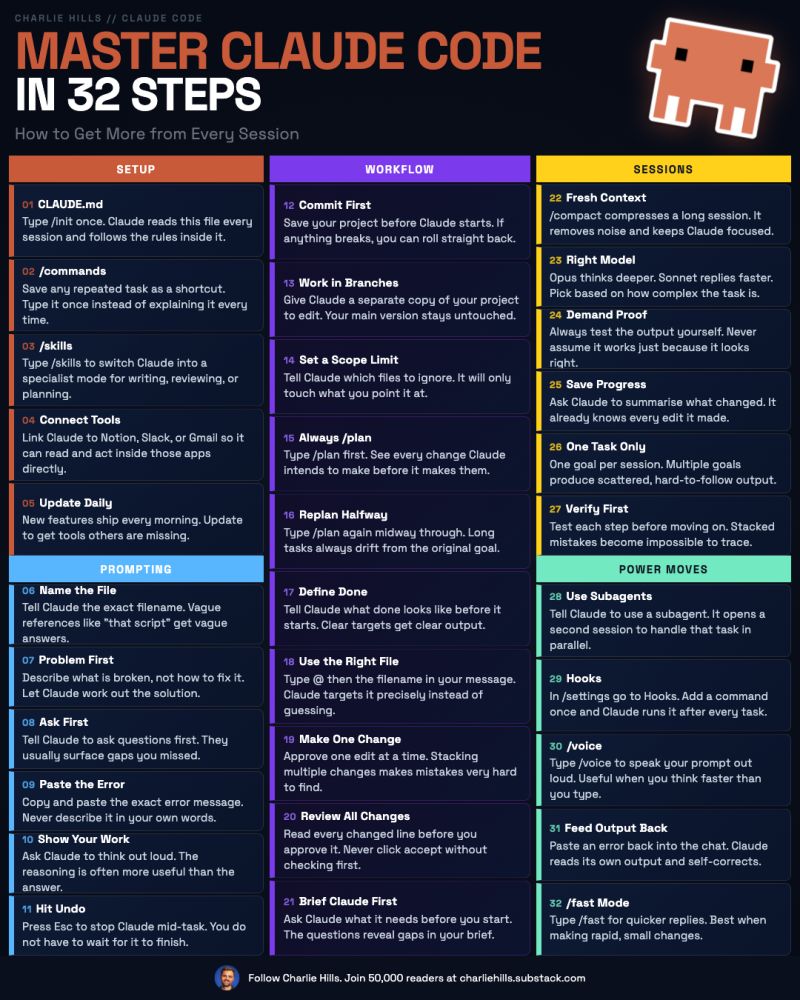
Master Claude Code in 32 Steps 📚📘 Save it for later 💯 Cc : author
Vaidehi tweet media
English
2
20
103
2.3K
Christos retweetledi
Jason Zhou
Jason Zhou@jasonzhou1993·
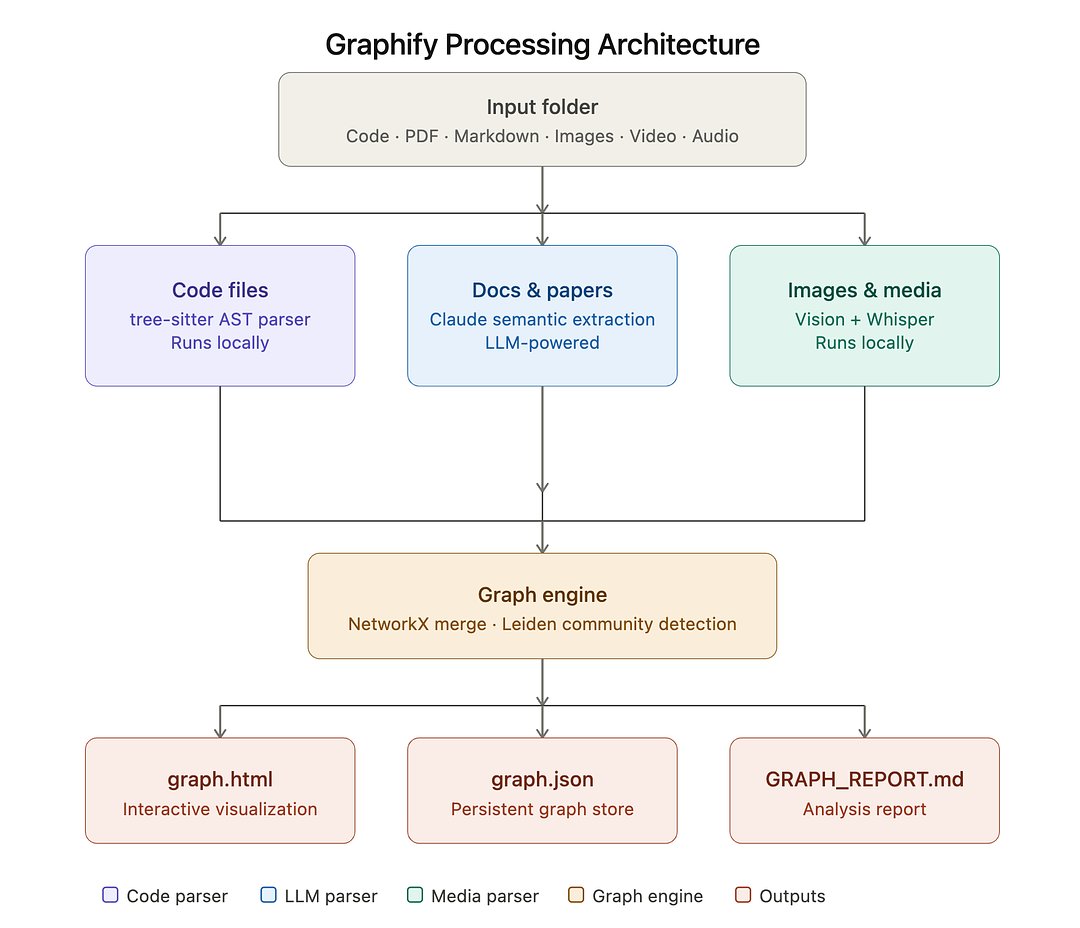
Karpathy said on X a few days ago, "AI should build persistent knowledge graphs instead of re-fetching RAG chunks every time." Within 48 hours, someone shipped Graphify on GitHub and turned that into a working tool. One command - any folder becomes a navigable knowledge graph. Very cool
Jason Zhou tweet media
AI Builder Club@aibuilderclub_

1/ Karpathy mentioned on X recently: AI should maintain persistent knowledge instead of re-reading files every time. 48 hours later, someone shipped it on GitHub. One command turns any folder into this. Code, papers, screenshots, audio, whatever. Open-source project called Graphify. More on how it works 🧵

English
32
89
882
121.5K
Christos retweetledi
brenz.
brenz.@brenzhills·
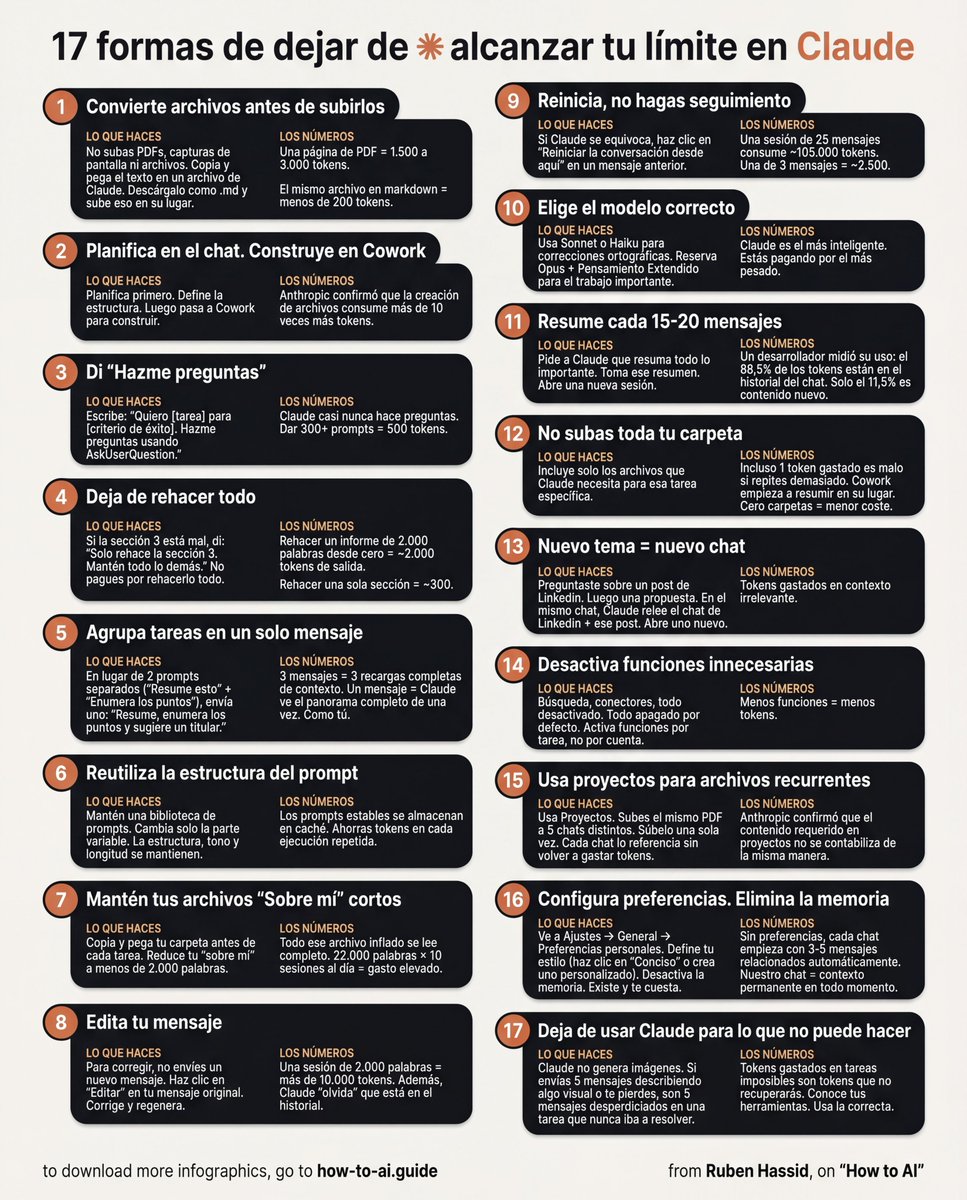
Con el plan de Claude por 20 $/mes ya tienes TODO lo que necesitas. Solo evita estos 17 errores que comete el 99% de la gente: 1. Subes PDFs tal cual → 1 página = 3.000 tokens Solución: Pega el texto en Google Doc → descarga como .md (menos de 200 tokens) 2. Creas archivos en Cowork demasiado pronto Solución: Primero planea todo en el chat normal. Solo pásalo a Cowork cuando lo tengas clarísimo. 3. Escribes prompts de 500 palabras Solución: 29 palabras bastan: “Quiero [tarea] para conseguir [objetivo]. Hazme preguntas con AskUserQuestion.” 4. Dices “rehaz todo” por corregir una parte Solución: “Solo rehaz la sección 3. Mantén todo lo demás igual. Sin comentarios. Solo la salida.” 5. Mandas 3 mensajes separados para 3 tareas Solución: Un solo mensaje: “Resume esto, lista los puntos y sugiere un titular.” 6. Escribes “No, quería decir…” y acumulas historial Solución: Edita el mensaje original → corrígelo → regenera. 7. Usas Opus hasta para corregir gramática Solución: Sonnet o Haiku para tareas rápidas. Guarda Opus + Extended Thinking para lo importante. 8. Metes 50 archivos en Cowork “por si acaso” Solución: Solo lo que necesita esta tarea. Para emails ni uses carpetas. 9. Nunca reinicias el chat y lo dejas eterno. Solución: Cada 15-20 mensajes → resume + copia el brief → sesión nueva. 10. Mezclas 3 temas en un mismo chat. Solución: Tema nuevo = chat nuevo. Siempre. El contexto muerto = tokens muertos. 11. Tu “about me” tiene 22.000 palabras. Solución: Redúcelo a menos de 2.000. Al final de cada sesión pídele: “Escribe un session-notes.md” y usa este prompt: ruben.substack.com/p/how-to-stop-… 12. Dejas búsqueda y conectores siempre activados Solución: Desactívalo todo por defecto. Activa solo cuando la tarea lo necesite. 13. Subes el mismo PDF a 5 chats distintos Solución: Usa Projects. Súbelo una sola vez y todos los chats lo usan sin gastar tokens extra. 14. Te saltas las Preferencias Personales Solución: Ajustes → Preferencias Personales. Define tu tono y estilo UNA vez. Se queda para siempre. 15. Reescribes los prompts desde cero cada vez Solución: Crea tu biblioteca de prompts. Misma estructura, solo cambias la variable. 16. Ejecutas manualmente el mismo informe cada semana Solución: Usa /schedule → “Todos los lunes a las 7 am crea mi briefing semanal.” 17. Usas Claude para cosas que no puede hacer bien Solución: Conoce tus herramientas. Imágenes → Gemini. Búsqueda en tiempo real → Grok. CC @rubenhassid
brenz. tweet media
Ruben Hassid@rubenhassid

x.com/i/article/2044…

Español
17
417
2.8K
244.2K
Christos retweetledi
Aakash Gupta
Aakash Gupta@aakashgupta·
Karpathy's LLM wiki generated 400,000 words on a single research topic without him writing any of it directly. The PM use case is actually more valuable than his. Here's the mechanism. Engineers have a persistent knowledge artifact: the codebase. Every architecture decision, every tradeoff, every constraint lives in the code and the commit history. A new engineer can reconstruct the reasoning. The knowledge survives turnover. PMs have nothing like this. The competitive analysis you ran in Q1 lives in a Google Doc that three people bookmarked. The user interview insights are buried in a Confluence page nobody will open again. The stakeholder context that took you four months to build evaporates the day you switch teams. Product teams turn over every 18-24 months. Each transition, the incoming PM spends their first 2-3 months rebuilding context that already existed somewhere. That's 10-15% of their entire tenure just getting back to zero. Karpathy's insight was that LLMs don't get bored maintaining wikis. Humans abandon them because the maintenance burden grows faster than the value. But PM work generates exactly the kind of unstructured, high-context research that compounds when you finally give it structure: customer conversations, market signals, internal decision logs, competitive moves. A self-maintaining wiki means the PM who inherits your product gets a queryable knowledge base instead of a Notion graveyard. The research compounds instead of resetting. Six workflows adapted for PM-specific problems is the right call. The system was designed for technical research. PM work is research that nobody's been treating like research.
Aakash Gupta@aakashgupta

Karpathy's most viral post ever (19.7M views) solved a problem I've hit in every PM job I've had. I adapted his system for PM work. 6 workflows, a CLAUDE.md template, and the honest limitations: news.aakashg.com/p/pm-karpathy-…

English
4
9
28
6K
Christos retweetledi
Aakash Gupta
Aakash Gupta@aakashgupta·
Karpathy's most viral post ever is a Github gist. I've been running his second brain system and it's... somehow still underrated. So I wrote a complete guide and Claude Skill to help you set it up yourself: aibyaakash.com/p/karpathy-sec…
Aakash Gupta tweet media
English
5
18
165
135.9K
Christos retweetledi
Aakash Gupta
Aakash Gupta@aakashgupta·
In 1945, a physicist named Vannevar Bush wrote an essay called "As We May Think" for The Atlantic. He described a hypothetical device called the Memex: a mechanical desk that would store all of a person's books, records, and communications, then let you build "trails" of associative links between related items. The Memex was never built. The reason was always the same: maintenance. Every cross-reference had to be created by hand. Every link had to be manually maintained. Bush imagined operators spending hours building trails through their knowledge, but nobody actually does this at scale. The cognitive overhead always wins. 81 years later, Karpathy built the Memex with a folder and an LLM. His gist explicitly references Bush's essay. The architecture is almost identical to what Bush described: raw sources go in, a structured web of interlinked documents comes out, and you navigate by following associative trails between related concepts. The only difference is who maintains it. Bush assumed a human operator. Karpathy delegated it to an LLM that can touch 15 files in a single pass without getting tired, distracted, or bored. Karpathy's framing is precise: "Obsidian is the IDE. The LLM is the programmer. The wiki is the codebase." The entire history of personal knowledge management, from the Memex to Evernote to Notion to Roam, was a series of attempts to make humans better at maintenance. Every one collapsed under its own weight. The solution that actually works is the one that removes the human from the maintenance loop entirely. Bush was right about the architecture. He was wrong about who'd build the trails. I wrote a complete guide to setting it up.
Aakash Gupta@aakashgupta

Karpathy's most viral post ever is a Github gist. I've been running his second brain system and it's... somehow still underrated. So I wrote a complete guide and Claude Skill to help you set it up yourself: aibyaakash.com/p/karpathy-sec…

English
1
12
51
9.2K
Christos retweetledi
Rony
Rony@Ronycoder·
Instead of watching an hour of Netflix, watch this 2 hour hour Stanford lecture will teach you more about how LLMs like ChatGPT and Claude are built than most people working at top AI companies learn in their entire careers.
English
46
1.1K
6.6K
1.1M
Christos retweetledi
Vaishnavi
Vaishnavi@_vmlops·
14-YEAR PRINCIPAL ENGINEER... 100 HOURS IN CLAUDE CODE...20 HOURS IN CODEX.... HERE'S WHAT NOBODY TELLS YOU His stack: 80k LOC python/typescript 2800 tests, real architecture, not vibed together claude code felt like a senior dev on a deadline rushing to ship...patching instead of refactoring...spewing helper functions when the real fix was deeper...ignoring the CLAUDE.md... almost every single session 1M context window? he called it a noob trap keeps it under 25% on purpose the workflow that actually worked for him: plan mode first → 8 subagents reviewing architecture, coding standards, performance, ui design. each one grounded in reference docs he built over time postgres_performance.md python_threading.md. real guardrails then code... then commit per phase.. then code review runs again on each commit even with all that claude still moved too fast...too much babysitting codex felt different... slower...more deliberate 20 hours in, different vibe entirely the takeaway: these tools don't replace engineering judgment..they amplify it good or bad your CLAUDE.md, your architecture docs, your review loops that's the actual product...the AI is just execution
Vaishnavi tweet media
English
14
25
237
32K
Christos retweetledi
Aakash Gupta
Aakash Gupta@aakashgupta·
Anthropic just walked into the two fastest-growing product categories in AI and said "we'll take it from here." Prototypes. Lovable hit $400M ARR with 146 employees. Cursor is valued at $29.3B. Bolt, v0, Replit Agent. A $48B+ vibe-coding category built entirely on foundation model inference. Slides and one-pagers. Gamma hit $100M ARR with 52 employees at a $2.1B valuation, 70 million users, profitable. Tome, Beautiful.ai, Canva's AI slide generator all sitting in the same surface area. Claude Design ships prototypes, slides, and one-pagers in one product, powered natively by Opus 4.7. The economics of being an AI app wrapper worked because foundation labs were focused on model quality and left the UX layer open. That gap is the entire business model. Buy tokens at list price. Wrap them in a workflow. Charge 10x. When the supplier becomes the competitor, three levers remain. Brand distribution built before the lab shipped. Workflow depth the lab won't prioritize for years. Enterprise relationships the lab can't move fast enough to service. Everything else compresses. Gamma's 70 million users and cash-profitable operation is a real moat. Lovable's Fortune 500 deployments are a real moat. New entrants pitching a "better Gamma" or "better Lovable" as a seed round just lost the only arbitrage they had. The pattern rhymes with Microsoft and AWS. Own the horizontal intelligence layer. Pick off the verticals one by one. Code last year. Design today. Whatever ships in six months is already on the roadmap.
Claude@claudeai

Introducing Claude Design by Anthropic Labs: make prototypes, slides, and one-pagers by talking to Claude. Powered by Claude Opus 4.7, our most capable vision model. Available in research preview on the Pro, Max, Team, and Enterprise plans, rolling out throughout the day.

English
24
31
348
56.8K
Christos retweetledi
Josh Kale
Josh Kale@JoshKale·
Today Perplexity shipped everything Siri was supposed to be 💻 Personal computer now has access to: → iMessage → Every folder on your Mac → 400+ connected apps → Apple Mail, Calendars, Browsers etc... Underneath, Claude Opus 4.7 is the brain. It breaks your goal into subtasks and routes each one to whichever of 20 models wins at it. GPT for long context. Gemini for deep research. Grok for speed. Nano Banana for images. Veo for video. Codex for code. It runs 24/7. You can trigger it from your phone. Pretty sweet design too
Perplexity@perplexity_ai

Today we're releasing Personal Computer. Personal Computer integrates with the Perplexity Mac App for secure orchestration across your local files, native apps, and browser. We’re rolling this out to all Perplexity Max subscribers and everyone on the waitlist starting today.

English
115
236
3.5K
658.5K
Christos retweetledi
Jaynit
Jaynit@jaynitx·
In the 1920s, a Stanford psychologist tracked genius children for 50 years. Malcolm Gladwell breaks down what he discovered: Rich families → successful. Poor families → failures. Not average. Failures. Genius-level IQs that produced nothing. He spent 60 minutes at Microsoft explaining why we're wrong about success: The psychologist was named Terman. He gave IQ tests to 250,000 California schoolchildren. He identified the top 0.1%. Kids with IQs of 140 and above. His hypothesis: these children would become the leaders of academia, industry, and politics. He tracked them. And tracked them. For decades. The results split into three groups. The top 15% achieved real prominence. The middle group had average, moderately successful professional lives. And the bottom group? By any measure, failures. The difference wasn't personality. Wasn't habits. Wasn't work ethic. It was simple: the successful geniuses came from wealthy households. The failures came from poor families. Poverty is such a powerful constraint that it can reduce a one-in-a-billion brain to a lifetime of worse than mediocrity. There's a concept called "capitalization rate." It asks a simple question: what percentage of people who are capable of doing something actually end up doing that thing? In inner city Memphis, only 1 in 6 kids with athletic scholarships actually go to college. If our capitalization rate for sports in the inner city is 16%, imagine how low it must be for everything else. Here's something stranger. Gladwell read the birth dates of the 2007 Czech Junior Hockey Team: January 3rd. January 3rd. January 12th. February 8th. February 10th. February 17th. February 20th. February 24th. March 5th. March 10th. March 26th... 11 of the 20 players were born in January, February, or March. This isn't unique to the Czechs. Every elite hockey team in the world shows the same pattern. Every elite soccer team too. Why? The eligibility cutoff for youth leagues is January 1st. When you're 10 years old, a kid born in January has 10 months of maturity on a kid born in October. That's 3 or 4 inches of height. The difference between clumsy and coordinated. So we look at a group of 10 year olds, pick the "best" ones, give them special coaching, extra practice, more games. We think we're identifying talent. We're just identifying the oldest. Then we give the oldest more opportunities, and 10 years later they really are the best. Self-fulfilling prophecy. The capitalization rate for hockey talent born in the second half of the year? Close to zero. We're leaving half of all potential hockey players on the table because of an arbitrary date on a calendar. Kids born in the youngest cohort of their school class are 11% less likely to go to college. 11% of human potential squandered because we organize elementary school without reference to biological maturity. Now here's the part about math. Asian kids dramatically outperform Western kids in mathematics. The gap is enormous and consistent across decades of testing. Some people say it's genetic. It's not. It's attitudinal. When Asian kids face a math problem, they believe effort will solve it. When Western kids face a math problem, they believe the answer depends on innate ability they either have or don't. Here's the proof. The international math tests include a 120-question survey. It asks about study habits, parental support, attitudes. It's so long most kids don't finish it. A researcher named Erling Boe decided to rank countries by what percentage of survey questions their kids completed. Then he compared it to the ranking of countries by math performance. The correlation was 0.98. In the history of social science, there has never been a correlation that high. If you want to know how good a country is at math, you don't need to ask any math questions. Just make kids sit down and focus on a task for an extended period of time. If they can do it, they're good at math. Why do Asian cultures have this attitude? Gladwell's theory: rice farming. His European ancestors in medieval England worked about 1,000 hours a year. Dawn to noon, five days a week. Winters off. Lots of holidays. A peasant in South China or Japan in the same period worked 3,000 hours a year. Rice farming isn't just harder than wheat farming. It's a completely different relationship with work. There's a Chinese proverb: "A man who works dawn to dusk 360 days a year will not go hungry." His English ancestors would have said: "A man who works 175 days a year, dawn to 11, may or may not be hungry." If your culture does that for a thousand years, it becomes part of your makeup. When your kids sit down to face a calculus problem, that legacy of persistence translates perfectly. Now consider distance running. In Kenya, there are roughly a million schoolboys between 10 and 17 running 10 to 12 miles a day. In the United States, that number is probably 5,000. Our capitalization rate for distance running is less than 1%. Kenya's is probably 95%. The difference isn't genetic. The difference is what the culture values and where it spends its attention. Here's the most fascinating finding. 30% of American entrepreneurs have been diagnosed with a profound learning disability. Richard Branson is dyslexic. Charles Schwab is dyslexic. John Chambers can barely read his own email. This isn't coincidence. Their entrepreneurialism is a direct function of their disability. How do you succeed if you can't read or write from early childhood? You learn to delegate. You become a great oral communicator. You become a problem solver because your entire life is one big problem. You learn to lead. 80% of dyslexic entrepreneurs were captain of a high school sports team. Versus 30% of non-dyslexic entrepreneurs. By the time they enter the real world, they've spent their whole life practicing the four skills at the core of entrepreneurial success: delegation, oral communication, problem solving, and leadership. Ask them what role dyslexia played in their success and they don't say it was an obstacle. They say it's the reason they succeeded. A disadvantage that became an advantage. Here's what Gladwell wants you to understand: When we see differences in success, our default explanation is differences in ability. We forget how much poverty, stupidity, and attitude constrain what people can become. We refuse to admit that our own arbitrary rules are leaving talent on the table. We cling to naive beliefs that our meritocracies are fair. The capitalization argument is liberating. It says you don't look at a struggling group and conclude they're incapable. It says problems that look genetic or innate are often just failures of exploitation. It says we can make a profound difference in how well people turn out. If we choose to pay attention. This 60 minute Microsoft talk will teach you more about success than every self-help book you've ever read combined. Bookmark this & give it an hour today, no matter what.
English
404
2.1K
7.8K
1.6M
Christos retweetledi
Aakash Gupta
Aakash Gupta@aakashgupta·
Evernote had 250 million users in 2018. They sold for $185 million in 2023. That's 74 cents per user. Notion hit $10 billion in valuation. Roam Research raised $9 million on the promise of bidirectional linking. Obsidian has 5 million users. Tiago Forte sold 100,000 copies of "Building a Second Brain." Every single one of these solved the wrong problem. They all made it easier to capture information. Better editors, better organization, better search. And every single user eventually abandoned the system because the maintenance burden compounds faster than the value. You clip 200 articles, tag them meticulously for three months, then life gets busy and the whole thing rots into a guilt-inducing archive you never open again. Karpathy identified the actual bottleneck in one sentence: "Humans abandon wikis because the maintenance burden grows faster than the value. LLMs don't get bored." That's the entire product insight the note-taking industry missed for 15 years. The problem was never capture. It was never organization. It was never search. The problem was that a human had to maintain the system, and humans are terrible at sustained, low-reward maintenance tasks. The LLM does exactly the work humans refuse to do: update cross-references when new information arrives, flag contradictions between sources, maintain an index across 100+ pages, and keep doing it on the 200th day with the same quality as the first. Evernote spent a decade adding features. The answer was removing the human from maintenance entirely. I wrote the full guide on how to set this up.
Aakash Gupta@aakashgupta

Karpathy's most viral post ever is a Github gist. I've been running his second brain system and it's... somehow still underrated. So I wrote a complete guide and Claude Skill to help you set it up yourself: aibyaakash.com/p/karpathy-sec…

English
13
19
270
46.7K
Christos retweetledi
Corey Ganim
Corey Ganim@coreyganim·
People confuse skills and plugins. Here's the difference: Skill = single-purpose instruction (write in my voice) Plugin = bundled workflow with connectors (pull projects from Notion, write status updates, drop in Gmail) Skills are Lego blocks. Plugins are the assembled set. One command triggers the whole thing. Hands you back finished work.
Corey Ganim tweet media
Corey Ganim@coreyganim

x.com/i/article/2034…

English
11
15
156
22.1K