ilmoi

15.9K posts

ilmoi

ilmoi

@ilmoi

serial founder, exits to @coinbase @f5

sf Katılım Ağustos 2019
2.7K Takip Edilen30.2K Takipçiler
Sabitlenmiş Tweet
ilmoi
ilmoi@ilmoi·
I'm entirely self taught all kinds of smart people told me not to learn to code (I'd "waste my time" and "at best become a mediocre engineer") good thing I didn't listen nor should you. follow your curiosity.
ilmoi tweet media
English
207
16
708
44.9K
ilmoi retweetledi
meltz
meltz@itszach·
Every day, the internet feels less human. AI, bots, and deepfakes are making it harder to know who or what is real. @VeryAI was born to solve that. Today, I’m excited to share that we’ve raised $10M to build the first Proof of Reality for the new internet. ↓
English
113
44
394
106.1K
ilmoi retweetledi
VeryAI
VeryAI@VeryAI·
VeryAI has raised $10M to build human verification for the age of AI. We are building the infrastructure to distinguish real humans from bots, deepfakes, and synthetic identities at internet scale. Why does proving you’re real online matter more than ever? 🧵
VeryAI tweet media
English
286
211
1.6K
190.8K
ilmoi retweetledi
Jaynit
Jaynit@jaynitx·
Naval Ravikant: "You're going to die. It's all going to zero. What's there to stress about?" "Stress is when your mind has two conflicting desires at once. You want to be liked, but you want to do something selfish. You don't want to go to work, but you want to make money. You have two conflicting desires, and that's stress." Naval explains the difference between stress and anxiety: "Anxiety is this pervasive, unidentifiable stress where you're stressed out all the time and you're not even sure why. The reason is you have so many unresolved problems that have piled up in your life, you can no longer identify what the problems are. There's this mountain of garbage in your mind. A little bit is poking out the top like an iceberg; that's anxiety. But underneath, there's a lot of unresolved things." He shares his personal anxiety resolver: "One big anxiety resolver for me is just ruminating on death. You're going to die. It's all going to zero. You cannot take anything with you. If you can keep that idea in front of you at all times, what's there to stress about?" Naval reframes what "wasted time" really means: "What is wasted time? Everything is wasted time in a sense because nothing matters in the ultimate. But in each moment, it's the only thing that matters. So if you're doing something you want to do and you're fully there for it it's not wasted time. If your mind is running away, wishing you were somewhere else, anticipating the future, regretting the past, that's wasted time. That's time you're not present for." He concludes: "People get worried about dying and no longer being here. But they don't realize that so much of their life is spent not being here in any case."
English
79
954
5.6K
661.1K
ilmoi
ilmoi@ilmoi·
if you read his post he basically analyzed layers in LLM and added the ones that did most work an agent could do this together with karpathy's post yesterday it's pretty clear the future of AI is agents recursively optimizing models
ilmoi tweet media
English
3
0
10
662
ilmoi
ilmoi@ilmoi·
@0xrwu bro this is my hack
English
0
0
2
132
Richard Wu
Richard Wu@0xrwu·
Couldn’t fall asleep for 3 hours in bed after some jet lag. Then I turned on a Lex episode and I fell asleep within 5 minutes.
English
3
0
27
2K
ilmoi
ilmoi@ilmoi·
@buffalu__ in some ways but not in others: the cost is your (founder) time, and that's arguably the most precious resource in the company
English
1
0
1
103
buffalu
buffalu@buffalu__·
@ilmoi the cost of tinkering is so low right now
English
1
0
4
276
ilmoi
ilmoi@ilmoi·
best ideas come from tinkering but if you're ambitious you feel urgent and at war feels wrong to tinker at war yet this is the only way. must hold 2 contradicting ideas in your head at the same time
English
9
0
37
1.1K
ilmoi
ilmoi@ilmoi·
@RamanshuSharan took me 15 years to put it in words, so don't feel bad
English
1
0
1
62
Nils
Nils@broodsugar·
@Melt_Dem Happy to show you a demo of collaborative mapping allowing multi-robot orchestration
English
1
0
6
157
Meltem Demirors
Meltem Demirors@Melt_Dem·
1/ mapping the physical world is such an interesting challenge roads are rule driven and largely 2d, cars have limited range of motion, so making roads machine readable and usable is feasible the real fun begins with complex 3d space with no rules and more expressive motion
English
11
1
49
9.1K
ilmoi
ilmoi@ilmoi·
"this is our second priority" haha there is no second priority it's either first, or it never gets done
English
4
1
11
680
ilmoi
ilmoi@ilmoi·
i think every founder suffers from same disease "the overoptimistic underestimating brain" i have never yet in my founder journey woken up and thought "oh wow that took less than I thought and was as easy as I thought" it's always: "we planned too much, we can do 1/10th maybe if we get lucky and really try" which is why focus is so important radical focus means you choose the 1/10th that actually matters so stay focused
English
3
0
17
1.2K
ilmoi
ilmoi@ilmoi·
@chris_j_paxton isnt the problem manufacturing >at scale< that drives down cost? aka if humanoid can do everything > becomes hyper cheap > nothing else can compete, even if could be built more custom
English
0
0
0
40
Chris Paxton
Chris Paxton@chris_j_paxton·
If youre truly ai pilled how could you square that with humanoid robots? I feel like ai-assisted cad + manufacturing + cross embodiment learning + high fidelity simulation would allow for an infinite profusion of diverse robots for different ecological niches
English
31
4
122
11.2K
ilmoi
ilmoi@ilmoi·
Duopolies are everywhere, not just crypto Apple (nice but closed) - Android (open but less ncie) Windows (functional but sucks) - Mac (designery but eg cant play games) Solana (fast, trades off decentralization) - Eth (decentralized but slow) This makes sense because you can take any product category and draw a line of preferences from A to B, and duopolies occupy the extremes
Joel John@joeljohn

We have been crunching numbers around revenue and valuations within the industry. Last day, I shipped a long-form observing how and where crypto generates its revenue. Here are four charts that explain the state of the industry. 1. Crypto is indeed a game of extreme power laws Since 2020, crypto has generated ±$74.8B in verifiable revenue. This is a mix of t-bills income, trading fees and protocol revenue. The vast majority of it in the past year, came through stablecoins. Circle and tether account for ±98% of all stablecoin revenue. $0.34 of every dollar made (from defillama's data set) goes to a stablecoin firm. It is fairly apparent that there is latent demand for on-chain dollars and that is why we see an entire economy of VCs and founders flocking to the payments and fintech angle for blockchains. I am not entirely sold on what down-stream monetisation for neobanks look like, esp with Meta coming into the stablecoins game, but there is demand is what is apparent. The 18 months between Jan of 2024 and June of 2025, saw half of all crypto revenue being generated. We were in an upward trajectory for revenue for a good while before the temporary cooling that has come in the past few quarters. 2. Duopolies are the norm The lack of latent competition in multiple sectors have made an industry of duopolies. Across the top 15 sectors, combining the top two in terms of revenue, would quickly reveal that close to 80% of most revenue generating sectors are taken up by two firms. We may not see more competition unless there are two factors playing - more venture enables small, nimble teams to pursue large opportunities (like telegram bots) without tokens - tokenised ventures bring fresh energy to established sectors and pursue latent leaders (like in perpetual dex) Most founders presume there is no competition, when entrenched leaders are eating up $0.8 of every dollar produced. The long-tail is a scary place to be at. 3. More firms generate revenue than ever before There are close to 100 protocols/projects making over $1million in revenue. Many of these are small, nimble teams making trading interfaces or bots. Some of them are protocols that coordinate capital. It now takes shorter spurts of time to hit $1mil in revenue than ever before. Part of the reason is the underlying stack evolving. Players like Solana, Privy and the network of on-ramps for stables make it considerably easier for founders to build, distribute and develop applications. The surface area for what small, mimble, privately held projects can do through retaining bulk of the revenue is barely explored. I have a hunch sectors like prediction markets will continue to help teams turn profitable faster. Which tbf puts the role of a crypto VC into question. What do you do when teams don't need your capital? I have views, but perhaps best shared later. 4. Decentralised Exchanges are considerably discounted compared to L1/L2 If you study the numbers, it quickly becomes apparent that there are DeFi primitives that do more in economic activity than most L2s but are considerably discounted. I think the market will reprice this entirely. There is a lot more bloodbath in L2-land. There is a lot of repricing to be had in DeFi. With institutional capital entering the arena, there are good grounds for financial primitives to be valued higher. Most teams do not get an "integrity' premium but I have a hunch that this part of the cycle is where teams that were building since 2021, with treasury managed well begin dominating over random L2s that were grossly overvalued. Two key reasons for that. L2s were overvalued to begin with due to excess dry powder in '23/24 flowing towards them. In the two years since, many of them have sub $100 in daily revenue. Eventually markets will price that more aggressively. Whole piece linked below if you'd like to follow the money

English
2
0
8
1.2K
ilmoi retweetledi
Nils
Nils@broodsugar·
The robot is navigating the world previously mapped and reconstructed by phones.
English
10
28
204
12.3K
ilmoi
ilmoi@ilmoi·
humanoid will be the winning form factor for the same reason bitcoin follows a 4 year cycle it's a shelling point for minds who believe in it
English
3
0
4
390
ilmoi retweetledi
Quanting Xie
Quanting Xie@DanielXieee·
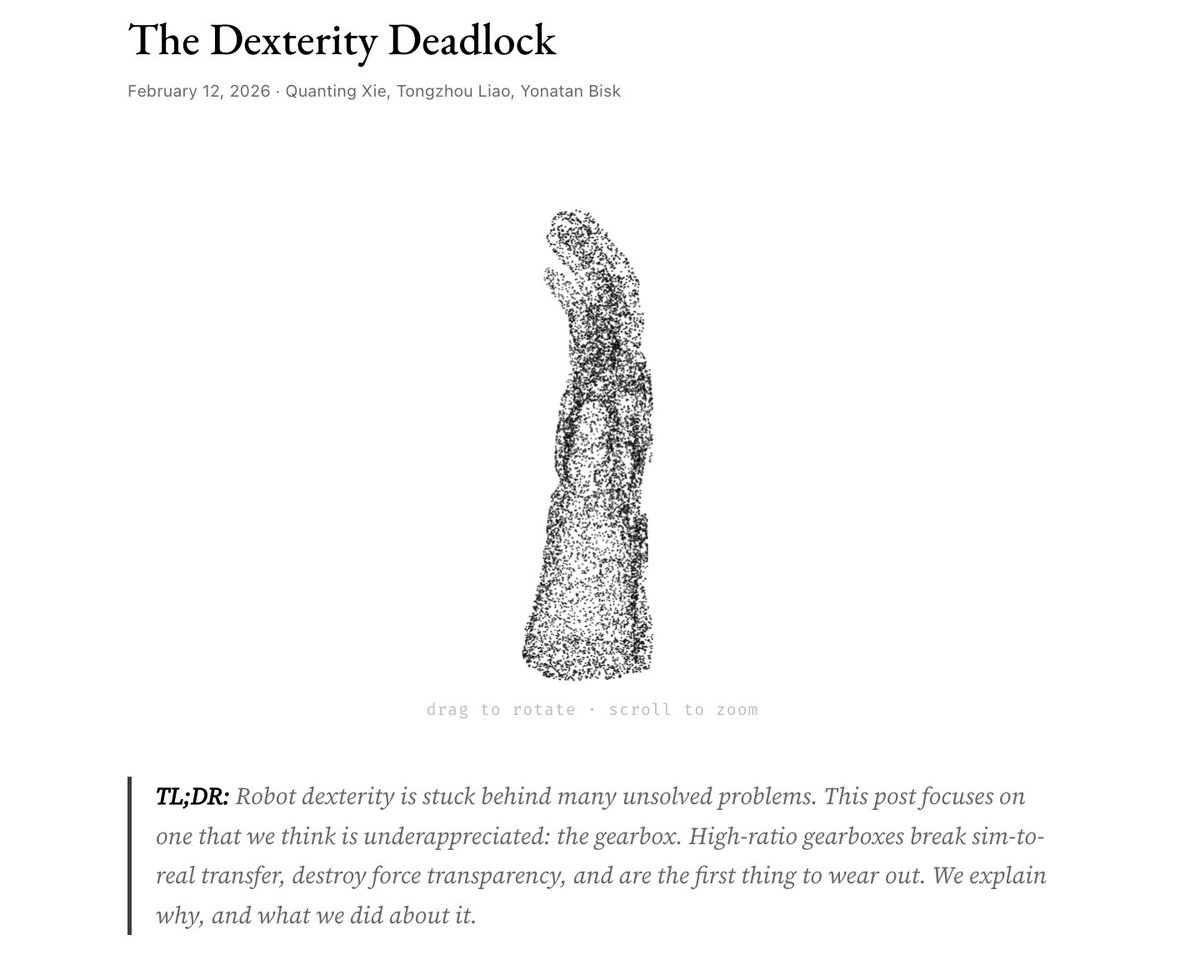
Why does manipulation lag so far behind locomotion? New post on one piece we don't talk about enough: The gearbox. The Gap You've probably seen those dancing humanoid robots from Chinese New Year. Locomotion isn't entirely solved; but clearly it's on a trajectory. But we haven't seen anything close for manipulation. 𝗪𝗵𝘆? When sim-to-real transfer fails, the instinct is to blame the algorithm. Train bigger networks. Crank up domain randomization. Those approaches have made real progress; we don't deny that. But we started wondering: are we treating the symptom or the disease? The Hardware Bottleneck: Fingers are too small for powerful motors. So most hands use massive gearboxes (200:1, 288:1) to get enough torque. But those gearboxes break everything manipulation needs:   • Stiction and backlash are complex to simulate. Policies trained on smooth physics hallucinate when they hit that reality.   • Reflected inertia scales as N². At large gear ratio, the finger hits with sledgehammer momentum.   • Friction blocks force information. The hand becomes blind. And they're the first thing to break. What we are trying to build at Origami, we cut the gear ratio from 288:1 to 15:1 using axial flux motors and thermal optimization. The transmission becomes more transparent: backdrivable, low friction, forces propagate to motor current. Early signs are encouraging. Still running quantitative benchmarks. Why Interactive? I love how Science Center uses interactive devices to explain complex ideas. I want to borrow this concept and help people understand the hard problems in robotics better visually. The post has demos where you can toggle friction, slide gear ratios, watch the sim-to-real gap widen in real-time. What's inside:   • Interactive demos (friction curves, N² scaling, contact patterns)   • Comparison table: 14 robot hands by sim-to-real gap and force transparency   • The math behind why low-ratio matters Read it here: origami-robotics.com/blog/dexterity… We're not claiming we've solved dexterity. The deadlock has many pieces. But we think this one's foundational. Curious what you think.
Quanting Xie tweet media
English
24
100
655
143K