Emmanuel Godwin

1.8K posts

Emmanuel Godwin

Emmanuel Godwin

@imjustnuel

Katılım Aralık 2021
73 Takip Edilen68 Takipçiler
Emmanuel Godwin retweetledi
ekko0x
ekko0x@ekkosaviour·
Eugene Ludwig served as the 27th Comptroller of the Currency. That office regulates all national banks in the United States. Ludwig knows exactly how the system works, where it breaks down, and what it costs the institutions that operate inside it. He is now building Cari Network on ZKsync. That single fact is worth more than any theoretical argument about the future of finance. A former top U.S. banking regulator, with five regional banks and over $600 billion in combined deposits behind him, chose to build on this infrastructure rather than anywhere else. That is not a bet on blockchain in the abstract. It is a specific architectural decision made by people who have spent careers inside the system they are now rebuilding. The problem those institutions are solving is concrete. Correspondent banking requires banks to pre-fund settlement positions in advance across every corridor they operate in. Globally, that figure sits at $27 trillion in capital held idle, not invested, not deployed, simply parked to guarantee that settlement will clear when needed. Global deposits exceed $100 trillion and annual transaction volumes cross $3.7 quadrillion. The infrastructure underneath all of that activity was built before the internet existed and has never been replaced, only patched. The reason regulated institutions have not moved to blockchain infrastructure is not unfamiliarity. It is that the available architectures could not meet the minimum requirements for institutional operation. Transaction flows between banks carry commercially sensitive information that cannot be visible on a shared public ledger. Execution environments must be controllable and configurable to meet compliance obligations that vary by jurisdiction and counterparty. Settlement must be self-verifying, meaning the correctness of every transaction must be provable without relying on any third party to attest to it. And institutions cannot operate in isolation. They need the counterparties and liquidity that make the network useful in the first place. Public blockchains resolve some of these. They fail others. A purpose-built architecture was the only path forward. This is what @ZKsync built with Prividium, and it is why Cari Network chose it. On Prividium, each institution runs an entirely separate environment. Nothing about one institution's activity is visible to another. The proof that settlement occurred correctly, generated through zero-knowledge cryptography, is what posts to Ethereum. The underlying transaction never leaves the institution's environment. Regulators get scoped access to what they are entitled to examine. The settlement record on Ethereum is cryptographically final and requires no trusted party to validate it. Cari Network is not alone. Deutsche Bank is building Memento ZK Chain on the same infrastructure. First Abu Dhabi Bank is live on ADI Chain. BitGo has integrated institutional custody with Prividium. More than 35 institutions are in active evaluation. The adoption list reads like a directory of institutions that have done the technical and compliance work and reached the same conclusion independently. Each institution that joins does not simply add its own volume. It creates direct settlement corridors with every other institution already on the network. The coordination capacity of the system expands with every addition in a way that a fragmented correspondent banking model structurally cannot. $ZK is the only native asset of the ZKsync network. Its supply is fixed at 21 billion with no inflation. Governance operates through the Token Assembly, where holders vote on protocol decisions, the Security Council, which conducts technical review, and the Guardians, who hold emergency authority. $ZK is also the gas token for ZKsync Gateway, the layer that aggregates all ZKsync Network transactions before they settle on Ethereum L1. When the former top regulator of the U.S. national banking system builds on a network, the question of whether institutional finance is moving onchain is already answered. The remaining question is which infrastructure carries it. @ZKsync is building that infrastructure. $ZK is its only native asset.

ekko0x tweet media
English
4
23
26
115
Emmanuel Godwin retweetledi
Silva Júnior✴️
Silva Júnior✴️@Heisenberg907·
@tomoland_app isn’t just building another platform —it’s creating Trustless Open Market Ownership (TOMO). An open ecosystem where creators, players, builders, and communities don’t just participate.they own and shape the experience. This isn’t just a game. It’s a full ecosystem
Silva Júnior✴️ tweet media
English
6
31
104
3.3K
Emmanuel Godwin retweetledi
GHG001
GHG001@Farukgbolahan2·
GM CT In crypto, recovery isn’t guaranteed, so prevention matters more. @CerbAgent and $CERB promote stronger security habits to reduce risks before they turn into costly mistakes.
GHG001 tweet media
English
0
10
32
70
Emmanuel Godwin retweetledi
Phenom
Phenom@Phenom962·
Kalyug on it's peak 💔
Filipino
11
85
271
1.1K
Emmanuel Godwin retweetledi
Vedna Rashtrvadi 🚩
Vedna Rashtrvadi 🚩@Aadhyatmikkanya·
The only class where no student checks the clock 🥵😋
Vedna Rashtrvadi 🚩 tweet mediaVedna Rashtrvadi 🚩 tweet mediaVedna Rashtrvadi 🚩 tweet mediaVedna Rashtrvadi 🚩 tweet media
English
5
90
291
1.2K
Emmanuel Godwin retweetledi
MOHIT❤️
MOHIT❤️@GOJONOKAMI·
Diving deep into Neha Sharma’s hidden exclusives. 🔓 A thread 🧵
MOHIT❤️ tweet media
English
69
161
630
18.7K
Emmanuel Godwin retweetledi
♥︎
♥︎@darkkmystic·
No rules only bro code 🤝
English
27
150
1.3K
404.7K
Emmanuel Godwin retweetledi
Sarah
Sarah@hehesarax·
Bro unknowingly got what he wanted 😭😭
English
10
123
594
9.5K
Emmanuel Godwin retweetledi
𝐑𝐞𝐲𝐳𝐚
𝐑𝐞𝐲𝐳𝐚@reyzaaaXso·
Hey @grok, show me what this girl might look like after 15 years.
𝐑𝐞𝐲𝐳𝐚 tweet media
English
9
81
300
2K
Gwills💙
Gwills💙@Gwills_digital·
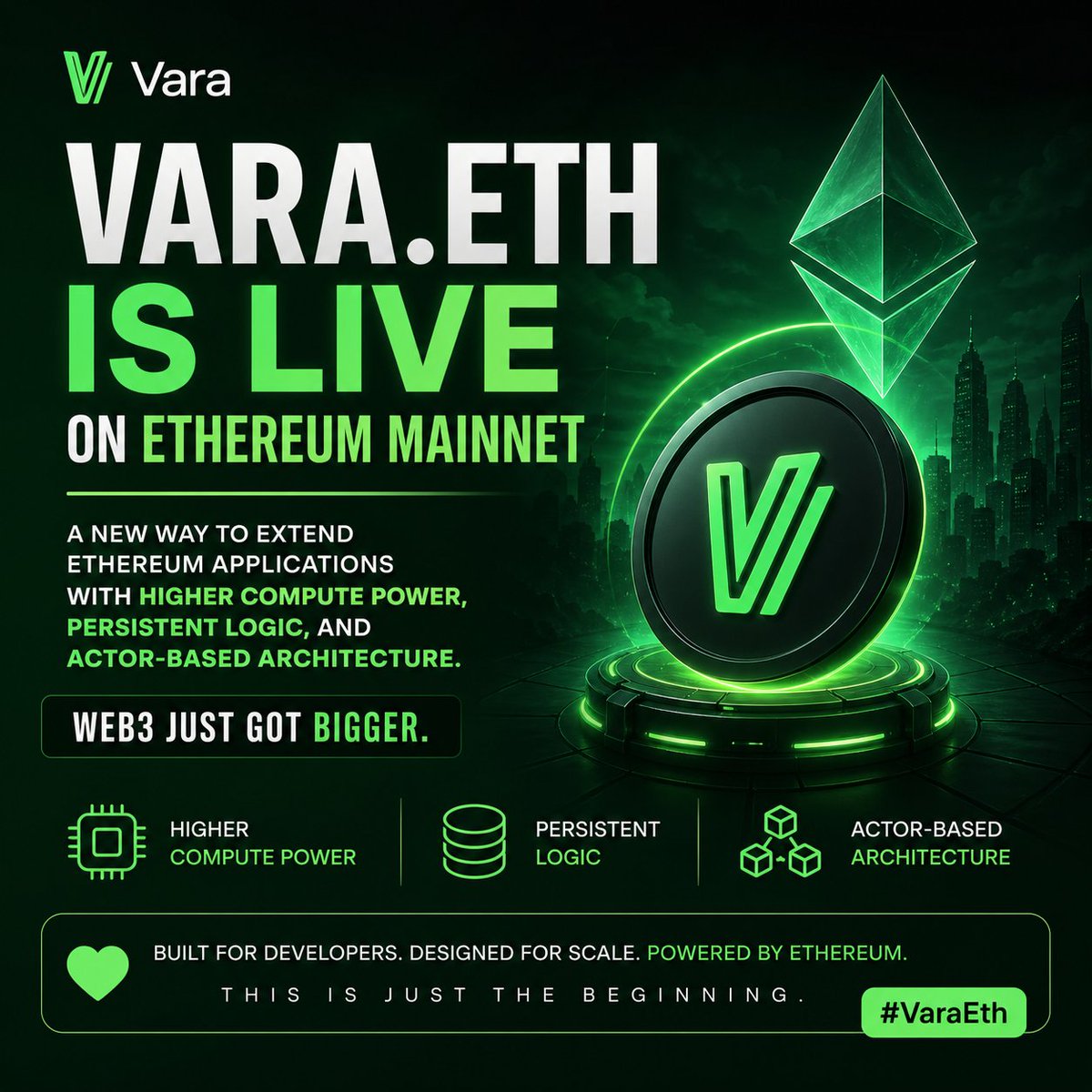
What if Ethereum could do everything it was always meant to do, without limits? Today, that question feels closer to reality. Vara.eth is now live on Ethereum Mainnet, and this isn’t just another launch to scroll past, it’s a defining moment in the evolution of Web3 infrastructure. For a long time, developers building on Ethereum have had to make tough trade-offs: performance vs decentralization, complexity vs cost, speed vs scalability. Innovation has always been there, but often constrained by execution limits. Vara.eth changes that narrative. By introducing higher compute power, persistent on-chain logic, and an actor-based architecture, Vara is not just improving Ethereum, it’s extending what Ethereum is capable of becoming. This unlocks something much deeper than technical upgrades. It opens the door to a new class of decentralized applications: • Systems that can run continuously without breaking state • Applications that think, respond, and evolve in real time • Complex infrastructures that mirror real-world processes, without sacrificing decentralization For builders, this means fewer compromises. For users, this means better experiences. For the ecosystem, this means growth that isn’t limited by yesterday’s constraints. But beyond the architecture and performance, there’s something even more important here, belief. Every milestone like this is powered by a community that chose to see the bigger picture early. People who understood that Web3 is not just about where we are now, but where we are going. Vara.eth going live is proof that the future of Ethereum isn’t static, it’s expanding. We are moving from simple smart contracts to intelligent, persistent, and scalable systems. We are moving from limitations to possibilities. And we are just getting started. #VaraEth
Vara Network@VaraNetwork

1/ Vara.eth is live on Ethereum mainnet. 👉 eth.vara.network This thread isn't about the architecture - it's about what it actually means for users and why it matters now. 🧵

English
16
44
137
753
Dean Sunday
Dean Sunday@DeanRex1293·
Ethereum’s Compute Ceiling just got shattered. With Vara.eth officially live on Mainnet, @VaraNetwork is bringing the Actor Model & parallel processing directly to the $ETH ecosystem. This isn't just scaling, it’s an evolution in logic. #VaraEth 1/3
Vara Network@VaraNetwork

1/ Vara.eth is live on Ethereum mainnet. 👉 eth.vara.network This thread isn't about the architecture - it's about what it actually means for users and why it matters now. 🧵

English
13
36
54
481
Emmanuel Godwin
Emmanuel Godwin@imjustnuel·
Vara.eth might not look loud from the outside. But for builders paying attention, this is a meaningful shift. The kind that compounds over time. eth.vara.network #VaraEth
English
0
0
3
77
Emmanuel Godwin
Emmanuel Godwin@imjustnuel·
It also lowers friction for innovation. Developers don’t have to simplify ideas just to fit limitations. They can actually build closer to their original vision. 5/5
English
0
0
4
71
Emmanuel Godwin
Emmanuel Godwin@imjustnuel·
And that matters more than people realize. Because when constraints reduce, creativity increases. That’s how new categories in Web3 are born. We’ve seen waves before: DeFi, NFTs and Gaming The next wave won’t just be new ideas… It will be better-built systems. 4/5
English
0
0
4
74
Emmanuel Godwin
Emmanuel Godwin@imjustnuel·
This changes how you think about building: Because you don't just deploy a contract but design a system that lives and evolves over time. That’s a different mindset entirely. 3/5
English
0
0
4
75
Emmanuel Godwin
Emmanuel Godwin@imjustnuel·
What’s interesting about Vara.eth is not the performance. It’s the idea that applications on Ethereum don’t have to stay static anymore. They can become more dynamic, responsive, and continuous than ever before. 2/5
English
0
0
3
91
Emmanuel Godwin
Emmanuel Godwin@imjustnuel·
A lot of people focus on tokens, trends, and short-term moves. But the real shifts in Web3 happen at the infrastructure level. Where builders get new tools… and new freedom. 1/5
English
0
0
3
124
Emmanuel Godwin
Emmanuel Godwin@imjustnuel·
@Kiwi_Nod @pharos_network @Kiwi_Nod Pharos is essentially a high-performance Layer-1 blockchain designed to be the backbone for AI and decentralized hardware. If most blockchains are single-lane roads, Pharos is a 100-lane superhighway.
English
1
0
0
18
KiwiNod
KiwiNod@Kiwi_Nod·
The signal is green. The real show has begun. I am officially managing a special 100,000 $PROS prize pool for my Layer1 friend @Pharos_Network. Pitch me (tag @Kiwi_Nod) or on Telegram: Tell me EXACTLY what you bring to the Pharos ecosystem. You have exactly three attempts to convince me you deserve a share. Impress me, or get rejected. The vault is open. topnod.onelink.me/k0YC/kiwinod
English
23.3K
3.2K
7.4K
526.3K