locha

1.6K posts

locha banner
locha

locha

@imlocha

⚡️ cofounder @fuul_xyz (@a16zcrypto CSX) | Loyalty & Affiliate Marketing for crypto enabled businesses | 🎓 @MIT | 🇦🇷

Miami, FL Katılım Haziran 2012
367 Takip Edilen2K Takipçiler
Sabitlenmiş Tweet
locha
locha@imlocha·
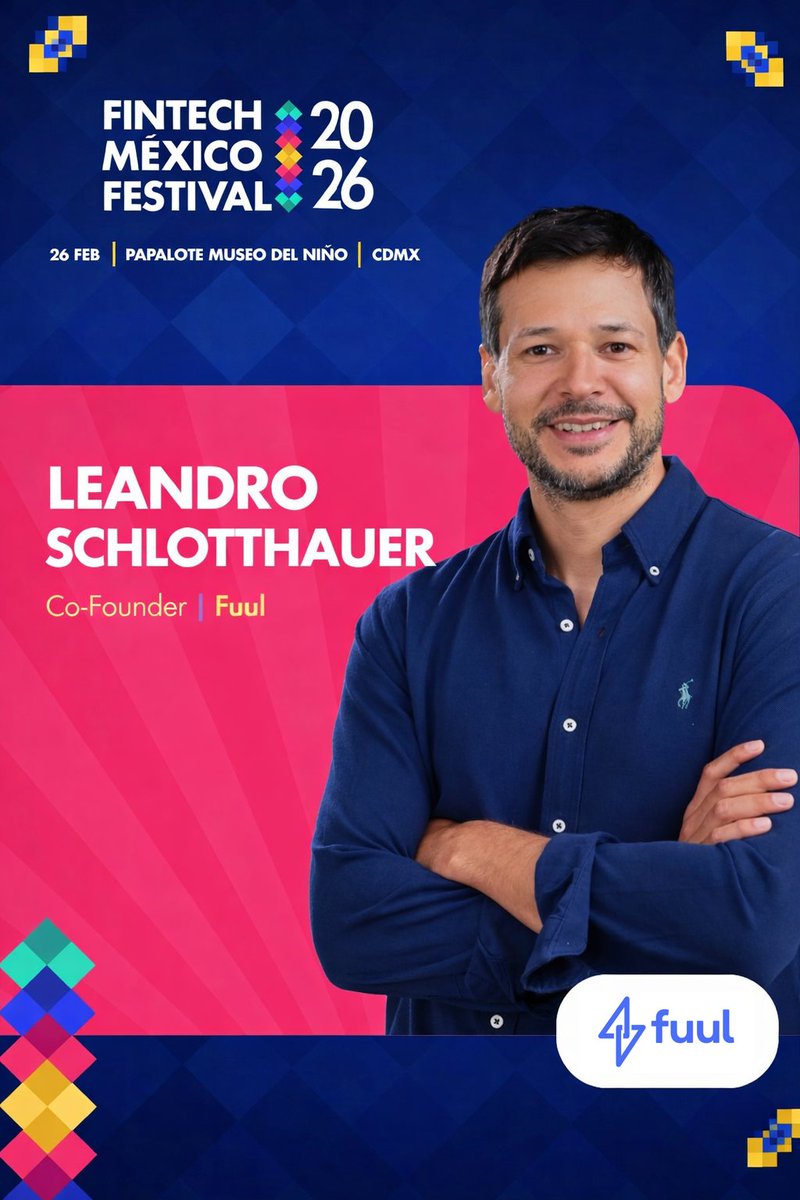
Mexico Fintech Festival 2026 was amazing. It was a great opportunity to connect with partners and clients who are building and growing financial products for the future of Latin America. The financial stack is evolving rapidly as players integrate SPEI, stablecoins, and even AI. But when infrastructure becomes commoditized across most players, what are the competitive advantages that might make people switch from their traditional bank to a neobank or fintech? I hope you guessed it right: it's rewards. We all know UX is better at fintechs, but rewards are what's keeping users tied to their traditional banks. Think cashback, airline miles, buy now pay later, and many other reward mechanisms that have barely touched ground in fintech until now. At Fuul, we're helping fintechs build competitive moats across user acquisition and retention. We help these companies unlock three key use cases: 1) Affiliate and Influencer Management: onboard, track, and pay affiliates and influencers for referred users, all from a single platform. 2) Loyalty Points: design and run points based loyalty programs that drive retention. 3) Stablecoin Cashback: deliver cashback directly to users' embedded wallets in stablecoins. If you're building in this space, whether in LATAM or beyond, and would like to understand how Fuul can help grow your business, please reach out!
locha tweet media
English
1
3
8
525
Luke Xiao
Luke Xiao@Lukexiao0·
I’ve joined @BNBChain as Head of BD! BNB was one of the first blockchains I interacted with when I started in crypto. Today, it powers the most active global community of users who transfer stablecoins, use DeFi, invest in tokenized assets, and launch AI agents. The work is just getting started and I'm excited to continue build on the momentum. We will continue to make BNB the best home for builders and institutions! DMs are open. If you’re a builder considering BNB Chain, let’s chat. We've got an incredible team here that is ready to help!
English
274
15
878
85.8K
locha
locha@imlocha·
@Mariandipietra Muy bueno Marian, alguna limitación por ahora para conectar a esos servicios ? Todo enchufado vía Claude code ?
Español
1
0
0
258
Mariano
Mariano@Mariandipietra·
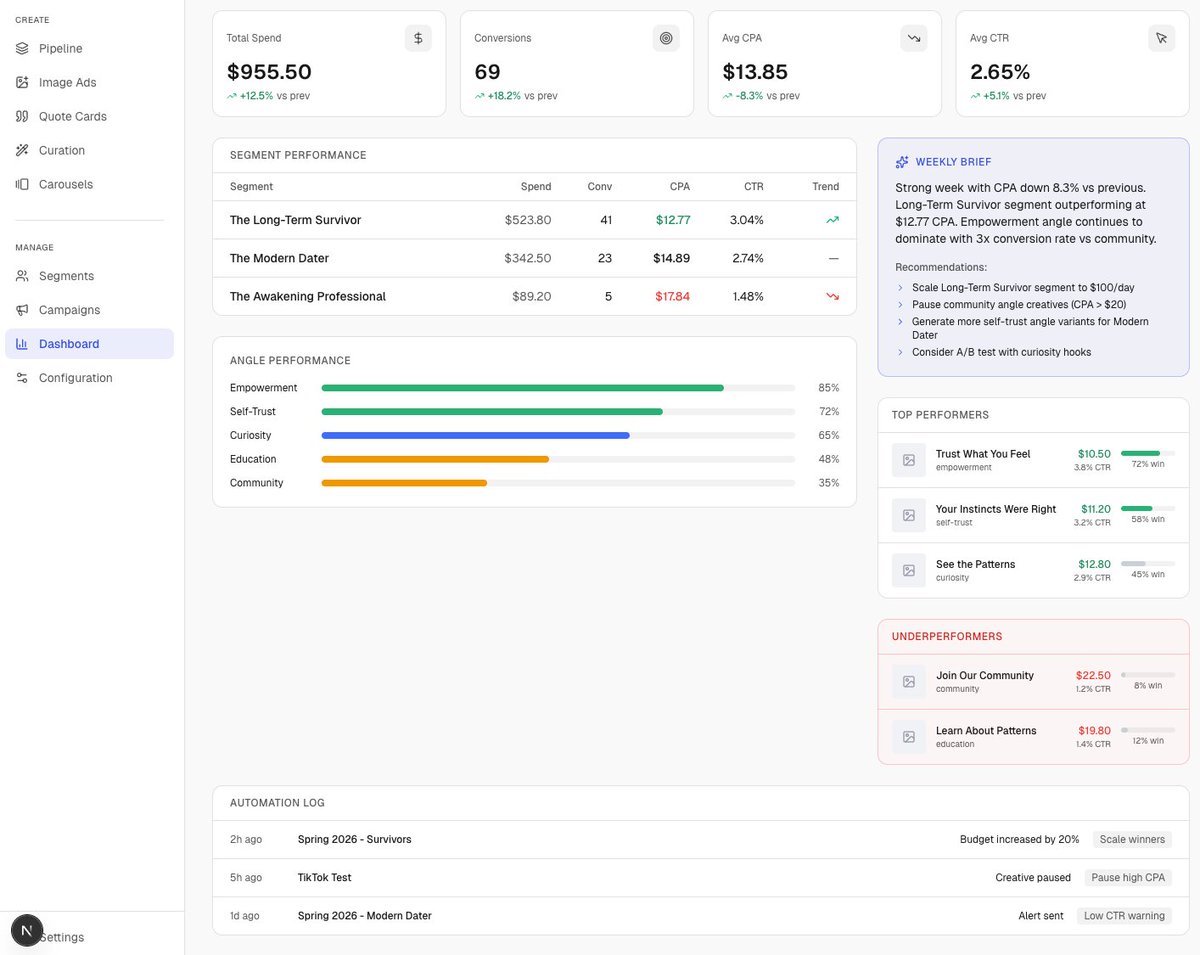
hace 4 semanas que vengo trabajando en algo similar para una app que estamos haciendo, pero que todo se va a manejar por AI, desde la curacion de Ads de la categoria para analisis, creacion, edicion, publicacion, management. Tanto para Meta, Google y Tiktok.
Mariano tweet media
Renato Piermarini@renapiermarini

Conecte Claude a mis cuentas de Meta y Google Analytics y ahora puede: - Ver campañas, audiencias y métricas en tiempo real - Crear y editar anuncios, ad sets y audiencias lookalike - Analizar tráfico, fuentes y top pages de Analytics Qué lindo momento para emprender!

Español
14
4
167
41.2K
EsteFi | LATAM/ACC
EsteFi | LATAM/ACC@NFTMami·
This weekend we hiked to watch a volcano spew lava, here are a few things it taught me about building startups…
EsteFi | LATAM/ACC tweet media
English
9
1
37
889
Ivan Zhao
Ivan Zhao@ivanhzhao·
Visiting Miami next week with @akothari and looking forward to meet local founders. Who’s free on Tuesday night?
English
124
20
292
68.8K
locha
locha@imlocha·
@andyyy Let’s go congrats Andy!
English
0
0
1
41
Andy
Andy@andyyy·
After 6 years of building this brand, the best is still yet to come. We are now just days away from unveiling what we've been building behind the scenes for the last few months. A new home for our show, at the center of finance. See you Monday 🫡
English
40
2
215
13.9K
locha retweetledi
Pacifica
Pacifica@pacifica_fi·
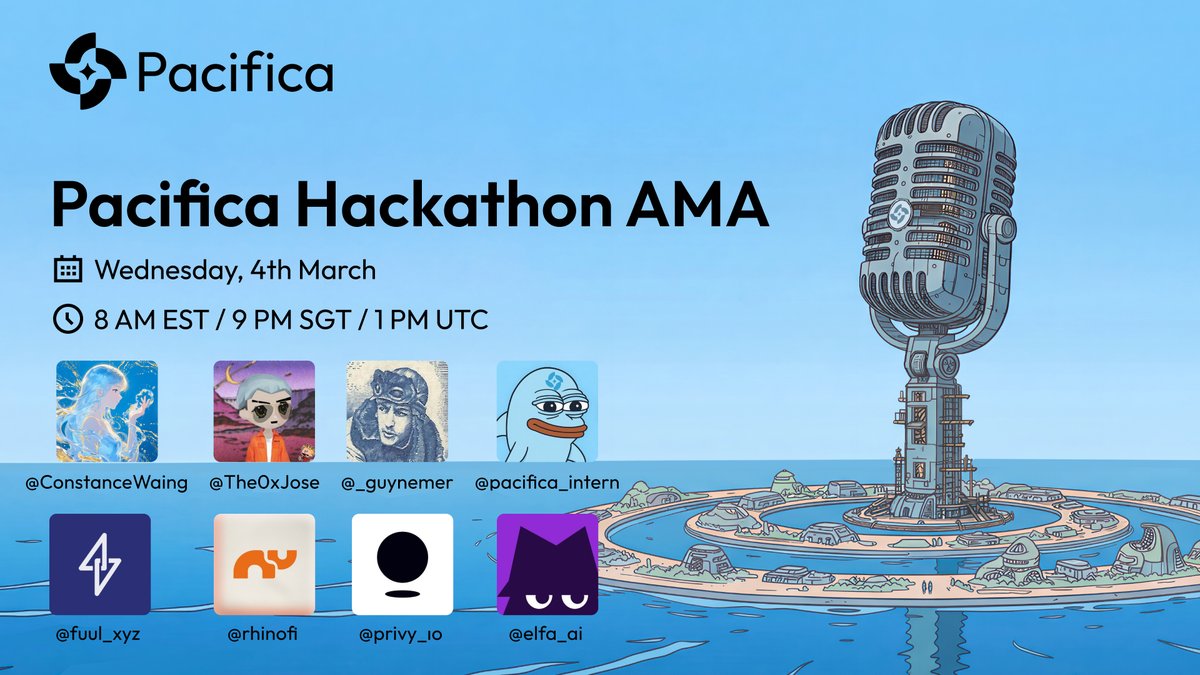
Pacifica Hackathon AMA is here! Join our Spaces on March 4th at 9PM SGT / 2PM CET / 8AM EST 🗣 This week’s guest are Pacifica's Hackathon partners! 🎙️ @fuul_xyz 🎙️ @rhinofi 🎙️ @privy_io 🎙️ @elfa_ai Set your reminders, you won’t want to miss this! 🌊 x.com/i/spaces/1qxoN…
Pacifica tweet media
English
9
11
53
5.4K
locha
locha@imlocha·
Mexico Fintech Festival 2026 was amazing. It was a great opportunity to connect with partners and clients who are building and growing financial products for the future of Latin America. The financial stack is evolving rapidly as players integrate SPEI, stablecoins, and even AI. But when infrastructure becomes commoditized across most players, what are the competitive advantages that might make people switch from their traditional bank to a neobank or fintech? I hope you guessed it right: it's rewards. We all know UX is better at fintechs, but rewards are what's keeping users tied to their traditional banks. Think cashback, airline miles, buy now pay later, and many other reward mechanisms that have barely touched ground in fintech until now. At Fuul, we're helping fintechs build competitive moats across user acquisition and retention. We help these companies unlock three key use cases: 1) Affiliate and Influencer Management: onboard, track, and pay affiliates and influencers for referred users, all from a single platform. 2) Loyalty Points: design and run points based loyalty programs that drive retention. 3) Stablecoin Cashback: deliver cashback directly to users' embedded wallets in stablecoins. If you're building in this space, whether in LATAM or beyond, and would like to understand how Fuul can help grow your business, please reach out!
locha tweet media
English
1
3
8
525
locha
locha@imlocha·
Amazing first time in Mexico City for Fintech Week Meeting with partners and clients powering Affiliates & Rewards programs for fintechs across LATAM. What use cases can they unlock with Fuul? 1) Onboard, track, and pay influencers and affiliates for referred users. 2) Loyalty points 3) Cashback in stables to users embedded wallets
locha tweet media
English
1
1
9
406
Basgan
Basgan@BasganBey·
@imlocha @pacifica_fi I hope you brought your hard hats. seems like a lot of actual building.
English
1
0
1
22
locha
locha@imlocha·
weird flexes and vanity metrics that sound even lamer in the age of AI - headcount (# of employees) - funding raised
English
0
0
0
62
locha retweetledi
Haseeb >|<
Haseeb >|<@hosseeb·
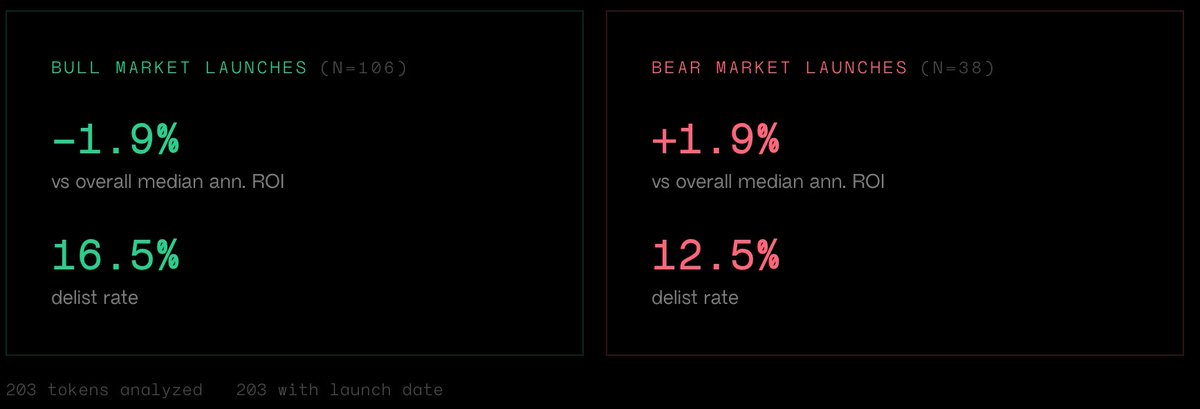
Every crypto founder thinks they need to time their token launch around bull markets. I always tell them they're wrong, launch timing doesn't matter. They never believe me. Well, I built a tool with Claude Code to analyze every token listing announced on the Binance blog to settle this once and for all. Here's what I found: Headline result: there is no statistically significant difference between tokens launched in bull vs bear markets (Mann-Whitney p = 0.81), meaning differences between bull and bear market tokens are indistinguishable from noise. It doesn't matter when you launch your token. How can I be sure of that? First, you have to be careful how you answer this question: people believe that it's better to launch tokens in bull markets, and there's more funding in bull markets, so there are many more tokens launched in bull markets. Because of this sample bias, you can't naively look at the proportion of top 100 tokens that were launched in bull markets. To correct for this, you need a clean selection criterion to compare the populations. The best dataset I found was looking at the Binance listings blog. Take every announced listing, tag them as during bull markets, bear markets, or neutral markets, and benchmark the relative performance of the bull vs bear populations. Filter out tokens that aren't independently priced (RWAs, stablecoins, LSTs etc.), and this gets you a total of ~200 tokens to benchmark. See the website below to explore the data & methodology in more detail. This finding is robust to almost any way you slice and dice the data. Now, if you're a founder, this analysis might not be the end of the story. Even if launching in a bear market doesn't predict long-term token performance, there are other advantages to launching in a bear market: less competition for talent, service providers are cheaper, exchange listings are less competitive. On the flipside, if you're doing a simultaneous token sale, you're likely to get more demand in a bull market. But on the whole, these things are probably a wash. The main thing is to just get your product out there and build something valuable. The example I always bring up to founders is that Solana launched 4 days after the COVID crash in 2020, when Bitcoin wicked down to $4K. It doesn't matter that much when you launch. Just launch.
Haseeb >|< tweet mediaHaseeb >|< tweet media
English
169
66
731
148K
locha retweetledi
⚡️ Fuul
⚡️ Fuul@fuul_xyz·
Trading competitions are one of the best growth plays for perp DEXs In practice, they usually come down to two decisions What counts, and who gets paid Let’s dive in 👇
English
1
2
9
500
Jai Toor
Jai Toor@jai__toor·
Most GTM tools are UI-first. Deepline is the opposite. Run your entire go-to-market from Claude Code. Waterfall enrichment. Email validation. Lead scoring. Campaign analytics. In minutes, from your terminal. Only UI is terminal and a playground tracks results in real-time. The real unlock: skills that compound. Every workflow makes the next one faster. APIs aren't a feature anymore. They're the primary interface.
English
6
0
7
470
locha
locha@imlocha·
We’ve been working in the space for over 3 years now with @fuul_xyz Some teams continue to prioritize vanity metrics over real network effects or fees for their projects. Many won’t recognize that the hard work is not building a large following or doing a an airdrop… the hard part is building a sustainable token and app model that users choose because it provides value to them. Incentives don’t replace PMF, we need more builders incentivizing their way into PMF
English
1
0
0
330
vitalik.eth
vitalik.eth@VitalikButerin·
My first reaction to this was: "And that's why I just got my $2,725 check of fileverse tokens now that fileverse has grown to the point where my dad regularly writes docs in fileverse that he sends to me" My second reaction to this was: "I see how this makes total sense from a crypto perspective, but it makes zero sense from an outside-of-crypto perspective ... hmm, what does this say about crypto?" My more detailed reaction: There are many distinct activities that you can refer to as "incentivizing users". First of all, paying some of your users with coins that your app gets by charging other users is totally fine: that's just a sustainable economic loop, there is nothing wrong with this. The activity that I think people are thinking about more is, paying all your users while the app is early, with the hope of "building network effect" and then making that money back (and much more) later when the app is mature. My general view, if you _really_ have to simplify it and sacrifice some nuances for the sake of brevity, is: * Incentives that compensate for unavoidable temporary costs that come from your thing being immature are good * Incentives that bring in totally new classes of users that would not use even a mature version of your thing without those incentives are bad For example, I have no problem with many types of defi liquidity rewards, because to me they compensate for per-year risk of the project being hacked or the team turning out to be scammers, a risk that is inherently higher for new projects and much lower once a project becomes more mature. Paying people to make tweets that get attention, might be the most "pure" example of the wrong thing to do, because you are going to get people who come to your platform to make tweets, with every incentive to game any mechanisms you have to judge quality and optimize for maximum laziness on their part, and then immediately disappear as soon as the incentives go away. In principle, content incentivization is a valuable and important problem, but it should be done with care, with an eye to quality over quantity, which are not natural goals that designers of "bootstrapping incentives" have by default. If fact, even if users do not disappear after incentives go away, there is a further problem: you succeed from the perspective of growing *quantity of community*, but you fail from the perspective of growing *quality of community*. In the case of defi protocols, you can argue: 1 ETH in an LP pool is 1 ETH doing useful work, regardless of whether it's put there by a cypherpunk or an amoral money maximizer. But, (i) this argument can only be made for defi, not for other areas like social, where esp. in the 2020s, quality matters more than quantity, and (ii) there are always subtle ways in which higher-quality community members help your protocol more in the long term (eg. by writing open-source tools, answering people's questions in online or offline forums, being potential developers on your team). The ideal incentive is an incentive that exactly compensates for temporary downsides of your protocol, those downsides that will disappear once the protocol has more maturity, and attracts zero users who would not be there organically once the protocol is mature. Charging users fees, but paying them back in protocol tokens, I think is also reasonable: it's effectively turning your users into your investors by default, which seems like a good thing to do. A further more cynical take I have is that in the 2021-24 era, the "real product" was creating a speculative bubble, and so the real function of many incentives was to pump up narratives to justify the narrative for the bubble. So any argument that incentives are good for bootstrapping acquisition should be not judged on the question of whether it's plausible, but on the question of whether it's more plausible than the alternative claim that it's all galaxy brain justification ( vitalik.eth.limo/general/2025/1… ) for a "pump and dump wearing a suit". TLDR: the bulk of the effort should be on making an actually-useful app. This was historically ignored, because it's not necessary for narrative engineering to create a speculative bubble. But now it is necessary. And we do see that the successful apps now, the apps that we actually most appreciate and respect, do the bulk of their user acquisition work in that way, not by paying users to come in indiscriminately.
Squiggly Hair Shanks@redhairshanks86

you either incentivise users or you won't have any let me be ABUNDANTLY clear: no normal person regularly tests new apps. it is a very small group of early adopters that do that, but 99% of people won't waste their time trying random apps by random startups in crypto, the ONLY reason - and i really mean ONLY reason - for anyone to try your ramshackle app is for personal financial gain, e.g. via an airdrop or rewards for providing liquidity. this behaviour was heavily encouraged during the airdrop meta to the point where projects needed to airdrop 10 - 20% of their total supply or they feared getting cancelled infinex is a great example. founder kain was speaking out against predatory airdrop farmers, he decided to not give them incentives and as a result infinex is DEAD now even though it's a top 10 app this cycle. he didn't understand the game, he only saw one side of the argument, the founder's perspective. his argument was:"why should we incentivise users who are predatory? we are going to not reward anyone, focus on delivering a great app and just hope that organic users will come." nigga there are hardly ANY organic users. people don't want to try new crypto apps in their free time, they want to hang out with friends, scroll social media, do sports, or literally anything BUT try out crypto apps now that the airdrop meta is significantly diminished, i see founders crawling out of their holes and thinking that they can get users without incentivization again. to those founders i say: FORGET IT you either reward users or you won't have any

English
337
142
1.3K
270.6K
locha
locha@imlocha·
@fedeogue Muy bueno Fede, creo que loyalty & rewards es un vector de diferenciación muy grande para bancos que todavía no se exploró en fintech
Español
1
0
0
71