
Inderjeet
157 posts

Inderjeet
@inder777
Staff Engineer | Tech culture and career growth | Decoding what engineers experience daily ↓ https://t.co/WiBkAL6Kqi
Bengaluru, India Katılım Temmuz 2016
166 Takip Edilen22 Takipçiler
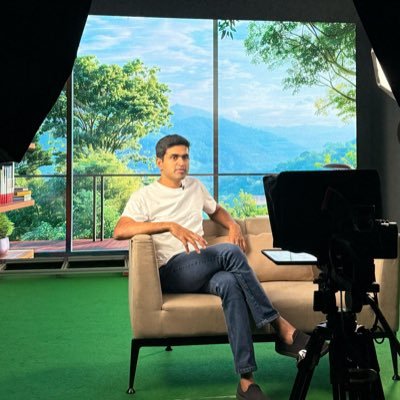
Computer systems design wages are up 16.7% since ChatGPT launched.
That includes roles like software developers, systems analysts, security analysts, database architects, and network architects.
The market is not paying less for technical skills; it's paying more for people with strong fundamentals.
This is why CS still matters.
English
@NoahKingJr Because someone still has to explain to AI why the production database should not be dropped for optimization. 😀
English

@system_monarch Likely event streams + identity graph + embedding similarity + real-time feature store. The “8 sec dwell time” itself became a strong intent signal.
English

SD round at Amazon for SDE-III (AI/ML):
You browsed a laptop on Amazon for 8 seconds. Did not click. Did not search. Closed the app.
6 hours later you open Amazon on a different device. The laptop is the first thing you see.
Your session expired. Your search history is empty. You are on a different device with a different IP.
How does Amazon know what you want before you do, and how do you design a real time recommendation system that connects behaviour across devices, sessions, and silences without the user ever telling you what they are looking for?
English
@akshaymarch7 Earlier engineers feared not learning enough.
Now they fear learning the wrong thing.
That uncertainty is exhausting in a completely different way.
English

I think software engineering is becoming mentally exhausting in a very different way now.
Earlier the struggle was:
“How do I learn all this?”
Now the struggle is:
“What should I even focus on anymore?”
Every week there’s:
a new AI tool
a new framework
a new coding agent
a new workflow
a new prediction about developers becoming obsolete
And I think many students are silently overwhelmed.
They are not lazy,
it's because the industry feels totally unstable.
I’ve spoken to students who genuinely feel guilty for taking even a small break now.
They think:
“If I stop learning for 2 weeks, I’ll fall behind forever.”
That’s a horrible feeling to live with constantly.
The strange part is:
the more tools we get to improve productivity…
the more anxious people seem to become.
I think one of the most valuable skills in the next few years will simply be:
0. the ability to stay calm.
1. To ignore noise.
2. To focus deeply.
3. To build patiently.
Because the people who survive long-term in tech are usually not the fastest learners.
They are the most consistent thinkers.
That's why I always ask my students in my courses to "be curious" about everyting!
English
@Akintola_steve Most startups don’t fail from lack of scale.
They fail from scaling complexity before finding product market fit.
Simple systems survive longer.
English

One mistake I see many early startups make is trying to build like they already raised Series A funding.
You’re 5 people.
No PMs.
No SRE team.
No infra engineers.
No proper observability setup.
But your architecture already looks very complicated, more like one trying to build a complex system like Netflix.
English
If you’re currently building a startup behind the scenes with a lean team, low funding, shared responsibilities, and pure faith carrying everybody…
Please hear this early:
Your startup will most likely not fail because the idea was bad.
It’ll fail because of:
poor structure,
bad engineering decisions,
and operational chaos.
If you're a start-up please do read this thread.
English
Engineers don’t burn out from hard work. They burn out from hard work that feels pointless. Purpose is infrastructure too. #EngineerBurnout #EngineeringPsychology #TechCulture
#softwareengineering
English
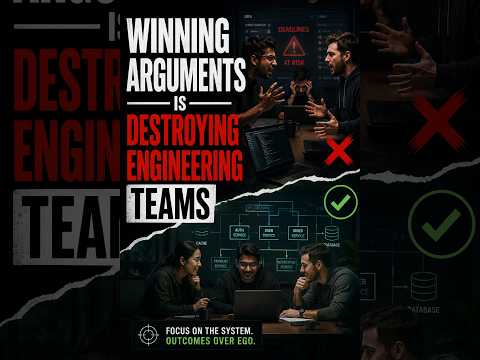
Most software engineering conflicts are not technical.
They are communication, ego, ownership and alignment problems disguised as architecture debates.
Made a short video on this:
youtu.be/cZzryc1HlZ8?si…
YouTube
English
Technical discussions fail the moment ego enters the room.
Strong engineers optimize for product outcomes, not argument wins.
That’s real software engineering maturity. #SoftwareEngineering
#EngineeringProductivity #TechCareer
English

Emotional societies react to stressors in extremes.
Often swinging from apathy to panic.
We saw this during Covid and we will probably see this with AI.
English
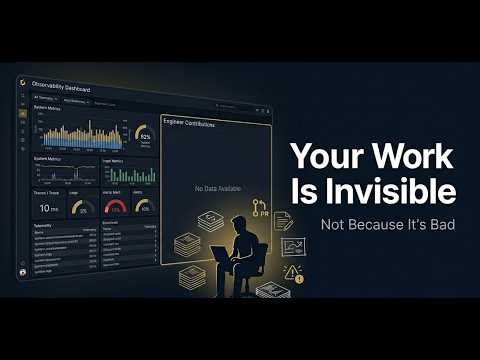
Every engineer can relate this in their workplace scenario :
youtu.be/CoXA7hjY8sg?si…
YouTube
English
Nobody tracks the cost of unclear requirements. But every engineer knows the tax which is rework, frustration, late nights. Bad specs are a productivity debt nobody accounts for. #EngineeringProductivity #TechLeadership #SoftwareDevelopment
English
@HarveenChadha AI can amplify execution. It still struggles to replace engineers who reduce risk, navigate ambiguity and make sound decisions under pressure.
English

was talking to a friend who is a senior leader
top management had given him a target: reduce staff by 15% and show equivalent gains through AI agents
since company attrition was 14-18%, it was an achievable target as he assumed they would not hire backfills
but attrition was only 2% as the job market is bad and very few are finding good offers outside..
he now has to fire people and asked me: on what parameters should I judge the AI-ability of a person ? Is it LOC ? token consumption? turnaround time ?
I had no answer
English
@Akintola_steve The scariest part? Most “stable” systems are actually held together by operational muscle memory and a few exhausted engineers.
English
There’s something in this Fintech space no one is talking about yet.
Some of the biggest Fintechs you all praise every day are surviving mainly because humans are secretly fixing things behind the scenes daily.
Not because the systems are perfect.
Remove manual reconciliation, support teams, engineers running scripts by 2AM and ops people doing “small adjustments” for just 48 hours and you’ll see real madness.
A lot of “fully automated systems” are actually:
Excel sheets,
Manual reversals,
Support escalation groups,
Cron jobs nobody dares touch,
And one senior engineer praying nothing breaks at midnight.
Fintech is far more fragile than people think.
English

“Just a small change” is the most expensive sentence in engineering.
Small changes carry full cognitive load. They just hide it better.
#SoftwareEngineering #EngineeringProductivity #TechCulture
English
@dharmeshba Once you get used to speed, automation, and keyboard-only flow… GUI starts feeling slow 😄
English

@Akintola_steve Well said.
AI can generate code.
But systems still need engineers who understand scale, tradeoffs, failures, and architecture. That’s the real moat.
English
Everybody can code now.
But not everybody can think in systems.
In this new AI wave, focus more on system design, architecture, scalability, distributed systems and understanding how real-world systems behave.
That’s what will keep you relevant.
English
@smartnakamoura Well said. Totally underrated.
Engineers know how to switch, but rarely knows how to survive in the team.
Well covered here as well:
youtu.be/CoXA7hjY8sg?si…
YouTube
English

Most developers don’t have a skill problem.
They have a visibility problem.
You can be the best engineer in your city and still be broke if nobody knows you exist.
Building is not enough. You have to be seen building.
English
I broke down all 6 fixes in the below video.
If your work has ever gone unnoticed this one's for you. 👇
youtu.be/CoXA7hjY8sg
Has your work ever gone unnoticed when it deserved credit? Drop it below 👇
#SoftwareEngineering #CareerGrowth #DecodedEngineer
YouTube
English