Omkar Deshmukh

33 posts

Omkar Deshmukh

Omkar Deshmukh

@indieom

Solo builder shipping safety net for Agentic IDEs | Daily breakdowns on Cursor, local LLMs, dev tools | Building in public

Katılım Mayıs 2025
8 Takip Edilen1 Takipçiler
Sabitlenmiş Tweet
Omkar Deshmukh
Omkar Deshmukh@indieom·
Google just dropped Gemma 4 (April 2, 2026) — their most capable open models yet. Four sizes: E2B & E4B (edge/mobile), 26B MoE, and 31B dense. All under Apache 2.0 (fully commercial use). You can replace you coding agent with it, even for large projects, here is how...
Google@Google

We just released Gemma 4 — our most intelligent open models to date. Built from the same world-class research as Gemini 3, Gemma 4 brings breakthrough intelligence directly to your own hardware for advanced reasoning and agentic workflows. Released under a commercially permissive Apache 2.0 license so anyone can build powerful AI tools. 🧵↓

English
1
0
0
1.1K
Omkar Deshmukh
Omkar Deshmukh@indieom·
@Amank1412 Google by all means, openai and anthropic do not own data. Google owns it on scale. GPT is google's own research. And they are most serious to push AI to breakthroughs in science n medicine.
English
1
0
3
368
Aman
Aman@Amank1412·
who's gonna win this AI race? > anthropic > openai
English
249
0
163
16K
Omkar Deshmukh
Omkar Deshmukh@indieom·
@YouJiacheng If chinese system focuses on learning by doing and India system gives theory knowledge, we should merge those approaches and get to a middle path. Indian student also have practicles where they learn by doing, but most of excercises are real world.
English
1
0
6
1.8K
You Jiacheng
You Jiacheng@YouJiacheng·
Holyshit, India's high school textbooks are crazily good. It makes China's high school textbooks look like trash. It is clearer and contains deeper and broader knowledge. ebooks.ebalbharati.in/pdfs/120303041…
English
58
72
935
132.1K
Omkar Deshmukh
Omkar Deshmukh@indieom·
@omarsar0 Isn't NotebookLLM one of best example of what andrej spoke about? It even goes one step further to create podcast n QnA for better understanding.
English
0
0
1
170
elvis
elvis@omarsar0·
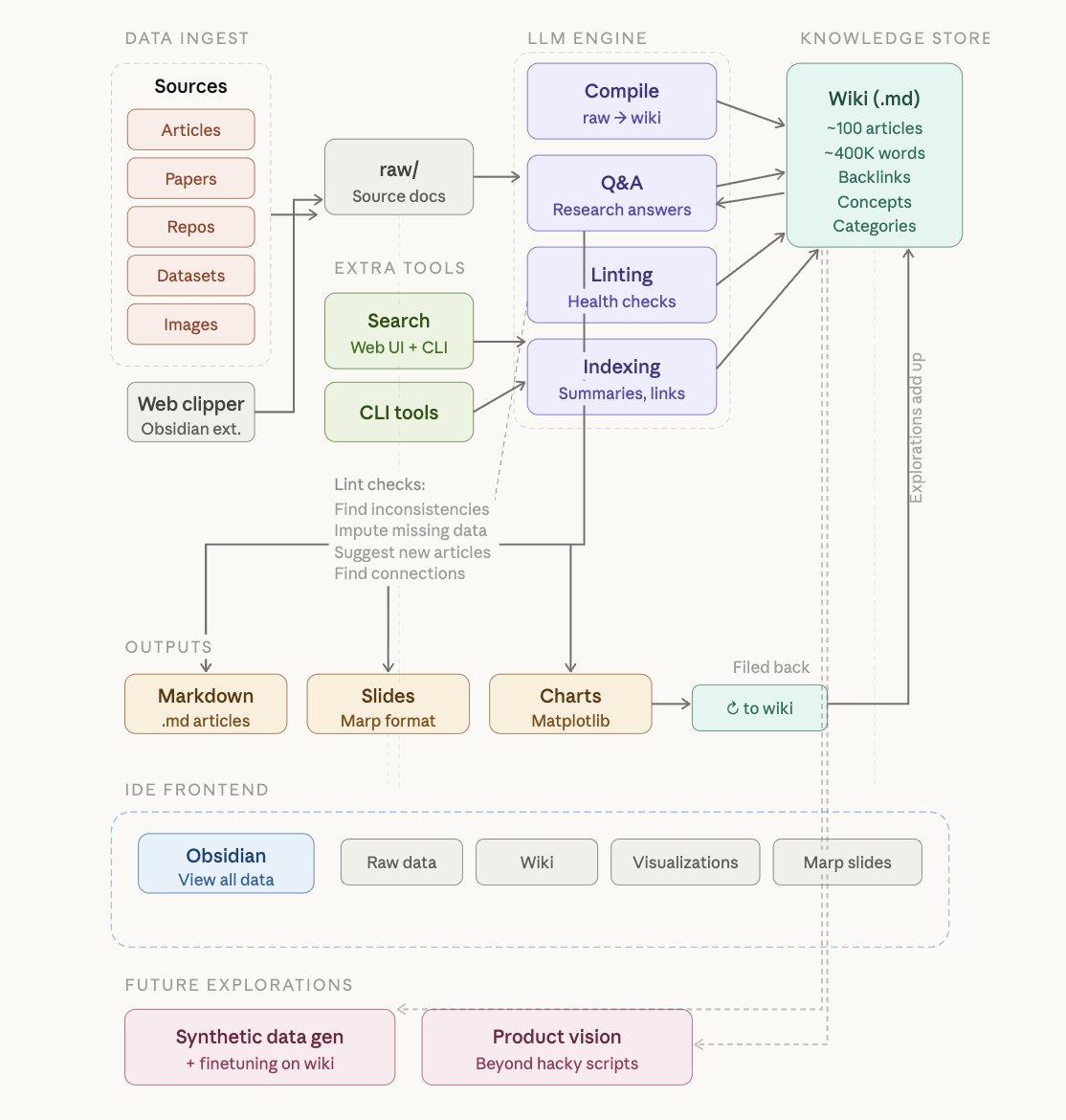
Diagram of the LLM Knowledge Base system. Feed this to your favorite agent and get your own LLM knowledge base going.
elvis tweet media
Andrej Karpathy@karpathy

LLM Knowledge Bases Something I'm finding very useful recently: using LLMs to build personal knowledge bases for various topics of research interest. In this way, a large fraction of my recent token throughput is going less into manipulating code, and more into manipulating knowledge (stored as markdown and images). The latest LLMs are quite good at it. So: Data ingest: I index source documents (articles, papers, repos, datasets, images, etc.) into a raw/ directory, then I use an LLM to incrementally "compile" a wiki, which is just a collection of .md files in a directory structure. The wiki includes summaries of all the data in raw/, backlinks, and then it categorizes data into concepts, writes articles for them, and links them all. To convert web articles into .md files I like to use the Obsidian Web Clipper extension, and then I also use a hotkey to download all the related images to local so that my LLM can easily reference them. IDE: I use Obsidian as the IDE "frontend" where I can view the raw data, the the compiled wiki, and the derived visualizations. Important to note that the LLM writes and maintains all of the data of the wiki, I rarely touch it directly. I've played with a few Obsidian plugins to render and view data in other ways (e.g. Marp for slides). Q&A: Where things get interesting is that once your wiki is big enough (e.g. mine on some recent research is ~100 articles and ~400K words), you can ask your LLM agent all kinds of complex questions against the wiki, and it will go off, research the answers, etc. I thought I had to reach for fancy RAG, but the LLM has been pretty good about auto-maintaining index files and brief summaries of all the documents and it reads all the important related data fairly easily at this ~small scale. Output: Instead of getting answers in text/terminal, I like to have it render markdown files for me, or slide shows (Marp format), or matplotlib images, all of which I then view again in Obsidian. You can imagine many other visual output formats depending on the query. Often, I end up "filing" the outputs back into the wiki to enhance it for further queries. So my own explorations and queries always "add up" in the knowledge base. Linting: I've run some LLM "health checks" over the wiki to e.g. find inconsistent data, impute missing data (with web searchers), find interesting connections for new article candidates, etc., to incrementally clean up the wiki and enhance its overall data integrity. The LLMs are quite good at suggesting further questions to ask and look into. Extra tools: I find myself developing additional tools to process the data, e.g. I vibe coded a small and naive search engine over the wiki, which I both use directly (in a web ui), but more often I want to hand it off to an LLM via CLI as a tool for larger queries. Further explorations: As the repo grows, the natural desire is to also think about synthetic data generation + finetuning to have your LLM "know" the data in its weights instead of just context windows. TLDR: raw data from a given number of sources is collected, then compiled by an LLM into a .md wiki, then operated on by various CLIs by the LLM to do Q&A and to incrementally enhance the wiki, and all of it viewable in Obsidian. You rarely ever write or edit the wiki manually, it's the domain of the LLM. I think there is room here for an incredible new product instead of a hacky collection of scripts.

English
38
153
1.3K
100.2K
Omkar Deshmukh
Omkar Deshmukh@indieom·
@karpathy Isn't this a super power for a researcher, to go deep, have snapshot of whole knowledge offloads so much of cognitive pressure. It gives you freedom to be creative on one side and have data backed answers engine on other hand.
English
0
0
0
1.1K
Andrej Karpathy
Andrej Karpathy@karpathy·
LLM Knowledge Bases Something I'm finding very useful recently: using LLMs to build personal knowledge bases for various topics of research interest. In this way, a large fraction of my recent token throughput is going less into manipulating code, and more into manipulating knowledge (stored as markdown and images). The latest LLMs are quite good at it. So: Data ingest: I index source documents (articles, papers, repos, datasets, images, etc.) into a raw/ directory, then I use an LLM to incrementally "compile" a wiki, which is just a collection of .md files in a directory structure. The wiki includes summaries of all the data in raw/, backlinks, and then it categorizes data into concepts, writes articles for them, and links them all. To convert web articles into .md files I like to use the Obsidian Web Clipper extension, and then I also use a hotkey to download all the related images to local so that my LLM can easily reference them. IDE: I use Obsidian as the IDE "frontend" where I can view the raw data, the the compiled wiki, and the derived visualizations. Important to note that the LLM writes and maintains all of the data of the wiki, I rarely touch it directly. I've played with a few Obsidian plugins to render and view data in other ways (e.g. Marp for slides). Q&A: Where things get interesting is that once your wiki is big enough (e.g. mine on some recent research is ~100 articles and ~400K words), you can ask your LLM agent all kinds of complex questions against the wiki, and it will go off, research the answers, etc. I thought I had to reach for fancy RAG, but the LLM has been pretty good about auto-maintaining index files and brief summaries of all the documents and it reads all the important related data fairly easily at this ~small scale. Output: Instead of getting answers in text/terminal, I like to have it render markdown files for me, or slide shows (Marp format), or matplotlib images, all of which I then view again in Obsidian. You can imagine many other visual output formats depending on the query. Often, I end up "filing" the outputs back into the wiki to enhance it for further queries. So my own explorations and queries always "add up" in the knowledge base. Linting: I've run some LLM "health checks" over the wiki to e.g. find inconsistent data, impute missing data (with web searchers), find interesting connections for new article candidates, etc., to incrementally clean up the wiki and enhance its overall data integrity. The LLMs are quite good at suggesting further questions to ask and look into. Extra tools: I find myself developing additional tools to process the data, e.g. I vibe coded a small and naive search engine over the wiki, which I both use directly (in a web ui), but more often I want to hand it off to an LLM via CLI as a tool for larger queries. Further explorations: As the repo grows, the natural desire is to also think about synthetic data generation + finetuning to have your LLM "know" the data in its weights instead of just context windows. TLDR: raw data from a given number of sources is collected, then compiled by an LLM into a .md wiki, then operated on by various CLIs by the LLM to do Q&A and to incrementally enhance the wiki, and all of it viewable in Obsidian. You rarely ever write or edit the wiki manually, it's the domain of the LLM. I think there is room here for an incredible new product instead of a hacky collection of scripts.
English
1.9K
4.2K
38.6K
9.9M
Omkar Deshmukh
Omkar Deshmukh@indieom·
@himanshustwts Isn't this a super power for a researcher, to go deep, have snapshot of whole knowledge offloads so much of cognitive pressure. It gives you freedom to be creative on one side and have data backed answers engine on other hand.
English
0
0
0
842
himanshu
himanshu@himanshustwts·
and here is the full architecture of the LLM Knowledge Base system covering every stage from ingest to future explorations.
himanshu tweet media
Andrej Karpathy@karpathy

LLM Knowledge Bases Something I'm finding very useful recently: using LLMs to build personal knowledge bases for various topics of research interest. In this way, a large fraction of my recent token throughput is going less into manipulating code, and more into manipulating knowledge (stored as markdown and images). The latest LLMs are quite good at it. So: Data ingest: I index source documents (articles, papers, repos, datasets, images, etc.) into a raw/ directory, then I use an LLM to incrementally "compile" a wiki, which is just a collection of .md files in a directory structure. The wiki includes summaries of all the data in raw/, backlinks, and then it categorizes data into concepts, writes articles for them, and links them all. To convert web articles into .md files I like to use the Obsidian Web Clipper extension, and then I also use a hotkey to download all the related images to local so that my LLM can easily reference them. IDE: I use Obsidian as the IDE "frontend" where I can view the raw data, the the compiled wiki, and the derived visualizations. Important to note that the LLM writes and maintains all of the data of the wiki, I rarely touch it directly. I've played with a few Obsidian plugins to render and view data in other ways (e.g. Marp for slides). Q&A: Where things get interesting is that once your wiki is big enough (e.g. mine on some recent research is ~100 articles and ~400K words), you can ask your LLM agent all kinds of complex questions against the wiki, and it will go off, research the answers, etc. I thought I had to reach for fancy RAG, but the LLM has been pretty good about auto-maintaining index files and brief summaries of all the documents and it reads all the important related data fairly easily at this ~small scale. Output: Instead of getting answers in text/terminal, I like to have it render markdown files for me, or slide shows (Marp format), or matplotlib images, all of which I then view again in Obsidian. You can imagine many other visual output formats depending on the query. Often, I end up "filing" the outputs back into the wiki to enhance it for further queries. So my own explorations and queries always "add up" in the knowledge base. Linting: I've run some LLM "health checks" over the wiki to e.g. find inconsistent data, impute missing data (with web searchers), find interesting connections for new article candidates, etc., to incrementally clean up the wiki and enhance its overall data integrity. The LLMs are quite good at suggesting further questions to ask and look into. Extra tools: I find myself developing additional tools to process the data, e.g. I vibe coded a small and naive search engine over the wiki, which I both use directly (in a web ui), but more often I want to hand it off to an LLM via CLI as a tool for larger queries. Further explorations: As the repo grows, the natural desire is to also think about synthetic data generation + finetuning to have your LLM "know" the data in its weights instead of just context windows. TLDR: raw data from a given number of sources is collected, then compiled by an LLM into a .md wiki, then operated on by various CLIs by the LLM to do Q&A and to incrementally enhance the wiki, and all of it viewable in Obsidian. You rarely ever write or edit the wiki manually, it's the domain of the LLM. I think there is room here for an incredible new product instead of a hacky collection of scripts.

English
84
506
5.2K
545.2K
Google
Google@Google·
We just released Gemma 4 — our most intelligent open models to date. Built from the same world-class research as Gemini 3, Gemma 4 brings breakthrough intelligence directly to your own hardware for advanced reasoning and agentic workflows. Released under a commercially permissive Apache 2.0 license so anyone can build powerful AI tools. 🧵↓
English
584
3K
19.6K
6.7M
Omkar Deshmukh
Omkar Deshmukh@indieom·
@Rishikesh04code Vibe coding is good vibe if you understand big picture of you system. Architectural depth is what is needed.
English
1
0
0
72
r1shi
r1shi@Rishikesh04code·
got my first client. a private institute needed a full test platform built from scratch. I said yes. Backend MVP is done. Frontend starts now. Documenting everything publicly Here's the full architecture 👇
r1shi tweet media
English
83
19
967
35.8K
Omkar Deshmukh
Omkar Deshmukh@indieom·
@amasad @galligator Best thing is Matthew is a guy having tattoos, not a nerd. This is how AI is democratizing software development and business.
English
0
0
0
71
Peter H. Diamandis, MD
Peter H. Diamandis, MD@PeterDiamandis·
The human brain processes visual information 60,000x faster than text. Humans are visual processors, not text processors. Images hit the brain instantly. Words take work. That's why a single SpaceX launch video communicates more than a thousand-word essay—and why your slide decks hit harder than paragraphs. We're wired for pictures, not prose.
English
1K
931
9K
23.1M
Omkar Deshmukh
Omkar Deshmukh@indieom·
This is what local-first coding looks like in 2026. Have you tried combining Gemma 4 with any graph/RAG tools yet? What’s working (or not) for you on big codebases?
English
0
0
0
45
Omkar Deshmukh
Omkar Deshmukh@indieom·
Put it all together locally (Ollama + LM Studio + LangGraph or similar) and you get something close to an ultimate private coding setup: Full repo awareness No cloud dependency Agentic workflows that actually remember and reason across files
English
1
0
0
50
Omkar Deshmukh
Omkar Deshmukh@indieom·
Google just dropped Gemma 4 (April 2, 2026) — their most capable open models yet. Four sizes: E2B & E4B (edge/mobile), 26B MoE, and 31B dense. All under Apache 2.0 (fully commercial use). You can replace you coding agent with it, even for large projects, here is how...
Google@Google

We just released Gemma 4 — our most intelligent open models to date. Built from the same world-class research as Gemini 3, Gemma 4 brings breakthrough intelligence directly to your own hardware for advanced reasoning and agentic workflows. Released under a commercially permissive Apache 2.0 license so anyone can build powerful AI tools. 🧵↓

English
1
0
0
1.1K
Omkar Deshmukh
Omkar Deshmukh@indieom·
need to go? Or do you still prefer the classic editor-first experience? Drop your take below 👇
English
0
0
1
31
Omkar Deshmukh
Omkar Deshmukh@indieom·
Early reactions say the flow feels “sublime” and changes how you think about orchestration. Cursor 3 is one of the clearest signals yet that AI coding UIs are moving away from “smart editor” toward “agent operating system.” What do you think — is this the direction all code tools
English
1
0
1
31
Omkar Deshmukh
Omkar Deshmukh@indieom·
Cursor 3 just dropped (April 2, 2026) — and it’s not just another update. They rebuilt the entire interface from the ground up. No longer a VS Code fork with AI sprinkled on top. It’s now an agent-first workspace. Here’s the real breakdown most people are missing:
English
1
0
0
32