
Michael Ashton

9.6K posts

Michael Ashton banner
Michael Ashton

Michael Ashton

@inflation_guy

Check out the Inflation Guy podcast at https://t.co/IkrlMfK1oI . Visit our website at https://t.co/cEgFwkXfwQ!

Morristown, NJ Katılım Temmuz 2009
201 Takip Edilen16.8K Takipçiler
Michael Ashton retweetledi

James E. Thorne
James E. Thorne@DrJStrategy·
Food for thought. Trump, Hormuz and the End of the Free Ride For half a century, Western strategists have known that the Strait of Hormuz is the acute point where energy, sea power and political will intersect. That knowledge is not in dispute. What is new in this war with Iran is that the United States, under Donald Trump, has chosen not to rush to “solve” the problem. In Hegelian terms, he is refusing an easy synthesis in order to force the underlying contradiction to the surface. The old thesis was simple: the US guarantees open sea lanes in the Gulf, and everyone else structures their economies and politics around that free insurance. Europe and the UK embraced ambitious green policies, ran down hard‑power capabilities and lectured Washington on multilateral virtue, secure in the assumption that American carriers would always appear off Hormuz. The political class behaved as if the American security guarantee were a law of nature, not a contingent choice. Their conduct today is closer to Chamberlain than Churchill: temporising, issuing statements, hoping the storm will pass without a fundamental reordering of their responsibilities. Trump’s antithesis is to withhold the automatic guarantee at the moment of maximum stress. Militarily, the US can break Iran’s residual ability to contest the Strait; that is not the binding constraint. The point is to delay that act. By allowing a closure or semi‑closure to bite, Trump ensures that the immediate pain is concentrated in exactly the jurisdictions that have most conspicuously free‑ridden on US power: the EU and the UK. Their industries, consumers and energy‑transition assumptions are exposed. In that context, his reported blunt message to European and British leaders, you need the oil out of the Strait more than we do; why don’t you go and take it? Is not a throwaway line. It is the verbalisation of the antithesis. It openly reverses the traditional presumption that America will carry the burden while its allies emote from the sidelines. In this dialectic, the prize is not simply the reopening of a chokepoint. The prize is a reordered system in which the United States effectively arbitrages and controls the global flow of oil. A world in which US‑aligned production in the Americas plus a discretionary capability to secure,or not secure, Hormuz places Washington at the centre of the hydrocarbon chessboard. For that strategic end, a rapid restoration of the old status quo would be counterproductive. A quick, surgical “fix” of Hormuz would short‑circuit the dialectic. If Trump rapidly crushed Iran’s remaining coastal capabilities, swept the mines and escorted tankers back through the Strait, Europe and the UK would heave a sigh of relief and return to business as usual: underfunded militaries, maximalist green posturing and performative disdain for US power, all underwritten by that same power. The contradiction between their dependence and their posture would remain latent. By declining to supply the synthesis on demand, and by explicitly telling London and Brussels to “go and take it” themselves, Trump forces a reckoning. European and British leaders must confront the fact that their energy systems, their industrial bases and their geopolitical sermons all rest on an American hard‑power foundation they neither finance nor politically respect. The longer the contradiction is allowed to unfold, the stronger the eventual synthesis can be: a new order in which access to secure flows, Hormuz, Venezuela and beyond, is explicitly conditional on real contributions, not assumed as a right. In that sense, the delay in “taking” the Strait, and the challenge issued to US allies to do it themselves, is not indecision. It is the negative moment Hegel insisted was necessary for history to move. Only by withholding the old guarantee, and by saying so out loud to those who depended on it, can Trump hope to end the free ride.
James E. Thorne tweet media
English
2.2K
7.3K
24.8K
4M
Lobster
Lobster@BowTiedLobster·
Here’s what this will look like. The market will be off 4% and he’ll sell his usual soft put. It will keep going down. People will buy expecting him to sell puts in size like the 3-month delay in April. He’ll sell more tiny puts. The light bulb goes on, and the bottom drops out.
Lobster@BowTiedLobster

Another way of saying this is Trump has a “show biz soft put” struck at a 3-5% drawdown to convince you he has a “real deal hard put” not too far below it. In reality, when the soft put breaks, he’ll be nowhere to be seen. He might not act before 2800.

English
2
4
21
15K
Michael Ashton
Michael Ashton@inflation_guy·
@blueprintsmb22 There's a PGP futures market and other ways as well. I helped a manufacturer of FIBC hedge that exposure through the Texas winter spike and COVID. Reach out to me if you need a hand!
English
0
0
2
175
Blueprintsmb
Blueprintsmb@blueprintsmb22·
As a manufacturer of plastic bags I wish I had thought more creatively on how to hedge my resin raw material exposure as chatter of Trump bombing Iran picked up pace in February…
Blueprintsmb tweet media
English
3
3
60
5.3K
Michael Ashton retweetledi
Vanessa Pestritto ⌘🛠️
Vanessa Pestritto ⌘🛠️@vanessadice·
If you’re thinking about inflation, portfolio construction, DeFi, or what a better onchain dollar should look like, come find us. I’ll be at DAS with the @inflation_guy The @fx_poet will be at the EY Global Blockchain Summit. Let’s talk
English
0
2
2
1.1K
Michael Ashton retweetledi
Andy Fately
Andy Fately@fx_poet·
@rexsalisbury We already have one. We call it USDi and it has been operating since April 2025. Mint it at usdicoin.com. Would love to connect and speak further on the issue
English
0
1
2
1.1K
Michael Ashton retweetledi
Andy Fately
Andy Fately@fx_poet·
We have already done this. USDi. Mint it at usdicoin.com
Rex Salisbury@rexsalisbury

Stablecoins are not stable. we need something better. Robert Shiller has the answer, invented by the chilean gov't in the 1960s. First, Why? Stables reference the dollar. but inflation erodes value of the dollar. There is a solution. Instead of a "Unit of Account" for a currency we need a "Unit of Price". It exists. Robert Shiller calls it his favorite underrated financial innovation. 60 years later, crypto independently rediscovered the need for this product — and getting it half right w/ stables. Right b/c the US dollar is relatively stable. Wrong b/c we need "relatively" as a qualifier. The historical context of the first "Unit of Price". In 1960s, Chile was drowning in inflation. Nobody would sign a long-term contract. Mortgages were impossible. Landlords wouldn't commit to rent for more than a month. On Jan 20, 1967, the government created something radical: the Unidad de Fomento (UF) — a non-circulating unit of account. The UF didn't reference a currency, it referenced the price level. the UF was the world's first "Unit of Price". The UF exists today and is pervasive in chili. The UF solved the cold start problem by referencing it in their own development loans -> then requiring adoption by banks. The biggest switch came from the 1981 AFP pension privatization — which created mandatory institutional demand for UF-denominated assets at scale. Once a critical mass of contracts referenced the UF, more contract types followed suit. The UF exchange rate against the peso is constantly adjusted for inflation so that its purchasing power remains nearly constant on a daily basis. it is NOT a currency (it's not in circulation). You can't spend it. It's a purely abstract unit of account — goods quoted in UFs can only be purchased with pesos. The UF has now replaced currency for most long-term contracts in Chile, and for purchases and sales of large items. - Pension payments - alimony, and child support payments are - offices for sale are often quoted in UFs Shiller's a bit frustrated. The UF was adopted 58 years go. It has been copied in Colombia, Ecuador, Mexico, and Uruguay. He tried to design a "Unit of Price" for the US...but it never took off! Ironically, the US's relatively low inflation environment historically means we are more exposed than some high inflation countries. We've never had to invent something that was inflation proof, so we didn't. Instead we choose to trust the dollars value wouldn't get inflated away. Without the pain of extreme inflationary periods, there was no way to build a political coalition to solve a problem we hadn't truly experienced (yes, we've had bouts of inflation, but ppl still had mortgages and long term leases). Now fast-forward to 2025. The stablecoin market is $250B+ and growing. But 99% of that market is pegged to the dollar. USDC. USDT. DAI. They're stable-ish — but silently depreciate with the inflation. A handful of projects are explicitly reinventing the UF on-chain. - Flatcoin designs like Nuon Frax Price Index (FPI) already use Truflation US CPI indices as an underlying source of truth, effectively upgrading "official" inflation to a censorship-resistant oracle — once the decentralized oracles exist, you can finally peg money to purchasing power, not politics (presuming oracles don't get compromised in their own politics or the governments gathering the data don't screw with it or stop *ahem* china or in the US cuts to various federal statistical agencies and economic data collection by POTUS) - Reflexer's RAI tried a different path (since wound down): a non-pegged stablecoin whose exchange rate is determined by supply and demand while the protocol tries to stabilize its price by constantly devaluing or revaluing it Reflexer — essentially a crypto-native unit of account (hard in practice!). But here's what most flatcoin builders are missing, and what Shiller understood deeply: the killer app isn't the token itself. *It's the contracts denominated in it.* Chile's UF worked because it became the standard unit for writing obligations — mortgages, rents, pensions. The token is just a vessel. The durable innovation is the unit of account layer that sits above it, embedded in legal and commercial agreements. So the success of Flatcoins is not their supply (which is likely to be eclipsed by stables), but the extent to which they are referenced. Similar to a LIBOR or SOFR used to credit contracts. That's what took the UF ~20 years to achieve (again big tipping point in 1981 w/ the pension adoption requirement) — but no flatcoin project has cracked yet (and certainly no flatcoin has gotten a government mandate!). The meta-point: Most of crypto's monetary experiments are rediscovering problems that economists solved decades ago — inflation indexation, seigniorage, reserve requirements — but with programmable, permissionless rails and without central banks as the single point of failure. And some of crypto's biggest "innovations" reflect not fundamental "invention" so much as outflanking an sclerotic regulatory state that should be doing these things independently. h/t @RobertJShiller:

English
0
1
5
1.7K
Michael Ashton
Michael Ashton@inflation_guy·
When I was an options trader, this was the time I always wanted to sell 3week vol. Not sure if it will matter with the war but normally once the NCAA tourney goes on, the televisions in the trading room turned away from CNBC.
English
0
0
5
1.4K
Michael Ashton
Michael Ashton@inflation_guy·
@budvandoor Bottom line? Monetary policy can only solve those problems that are due to money. Like...maintaining incomes with printed money while output of goods and services is restricted by locking people in their homes. 2021-2022 was a classic monetary inflation.
English
0
0
1
27
Michael Ashton
Michael Ashton@inflation_guy·
If the Fed doesn't consider an ease when we are undergoing an oil shock on top of already weak-ish payrolls, I don't really want to be very long equities here into a growth shock.
English
2
2
20
1.9K
Michael Ashton
Michael Ashton@inflation_guy·
@budvandoor I mean, you kinda do. Monetary policy can't do anything to lower those prices.
English
0
0
1
39
Michael Ashton
Michael Ashton@inflation_guy·
Really astonishing that Powell is equating the inflation jump after COVID to the oil price spike. This is sort of macro 101. The first was an inflationary spike induced by financing current incomes with printed money while output declined; the second is an oil spike that directly impacts growth but only has temporary direct effects on prices (some pass-through, but typically that's related to the length of the spike and tends also to be temporary). These are completely dissimilar and any competent monetary policymaker ought to see the difference?
English
2
1
15
2.3K
Michael Ashton
Michael Ashton@inflation_guy·
@dandolfa Standard monetary prescription was that if you have a huge gap between personal incomes and productive output, you are fine as long as you don't finance that gap with printed money. Which is exactly what happened. And we (monetarists) complained about it in real time.
English
1
0
0
161
David Andolfatto
David Andolfatto@dandolfa·
It's one thing to "blame" CARES/ARP and loose monetary policy for the COVID-19 inflation. But it's another thing to suggest (usually implicitly) that the inflation could have been prevented w/o economic damage along other dimensions (like unemployment).
English
5
1
29
2.3K
David Andolfatto
David Andolfatto@dandolfa·
Many recent papers reporting the importance of fiscal policy in shaping the COVID-19 inflation dynamic. However, as far as I know, none of them appear to investigate the welfare consequences of monetary-fiscal policy over this episode.
David Beckworth@DavidBeckworth

This adds to a growing number of papers that point to excess aggregate demand pressures—created by macroeconomic policy choices—playing a key role in the inflation surge. (1/3)

English
4
8
41
20.1K
Michael Ashton retweetledi
Omair Sharif
Omair Sharif@fcastofthemonth·
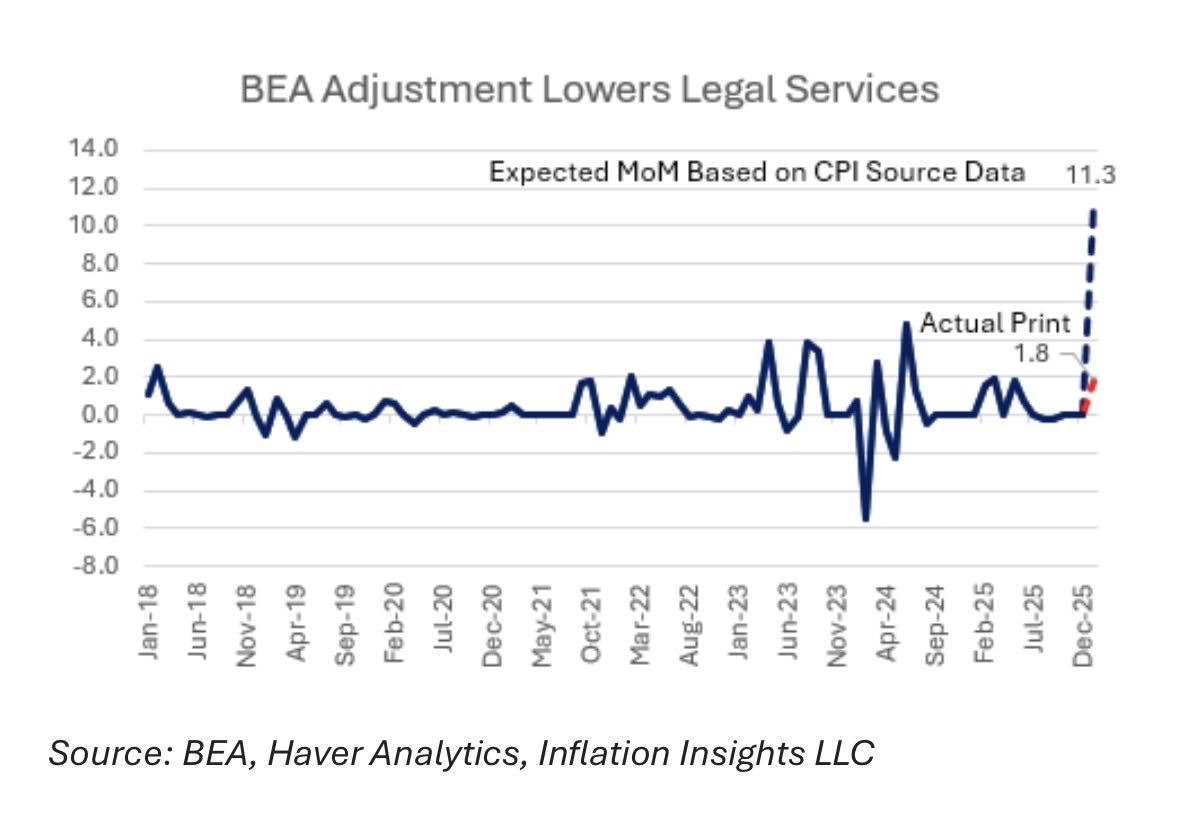
The BEA’s decision to change legal services source data in the PCE from CPI (around 11.3% in Jan) to PPI (1.8% in Jan) cut the core PCE MoM chg by 8bps (would have been 0.44% vs 0.36%). Could defend move on the merits (not political) but timing & lack of heads up were troubling.
Omair Sharif tweet media
English
7
42
135
24.4K
Michael Ashton
Michael Ashton@inflation_guy·
Remember, you can't spell Iran without AI. Which is literally true but probably not relevant.
English
0
0
5
1.1K