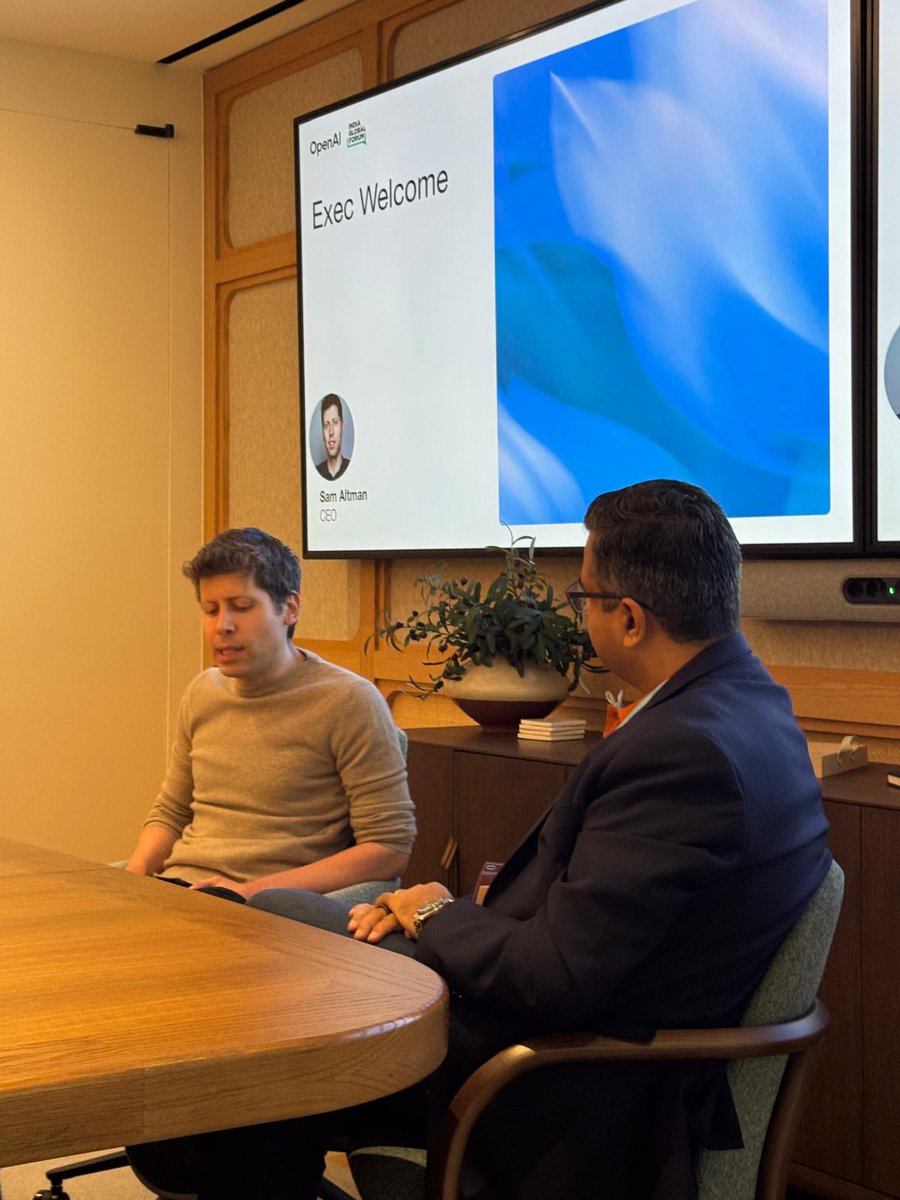
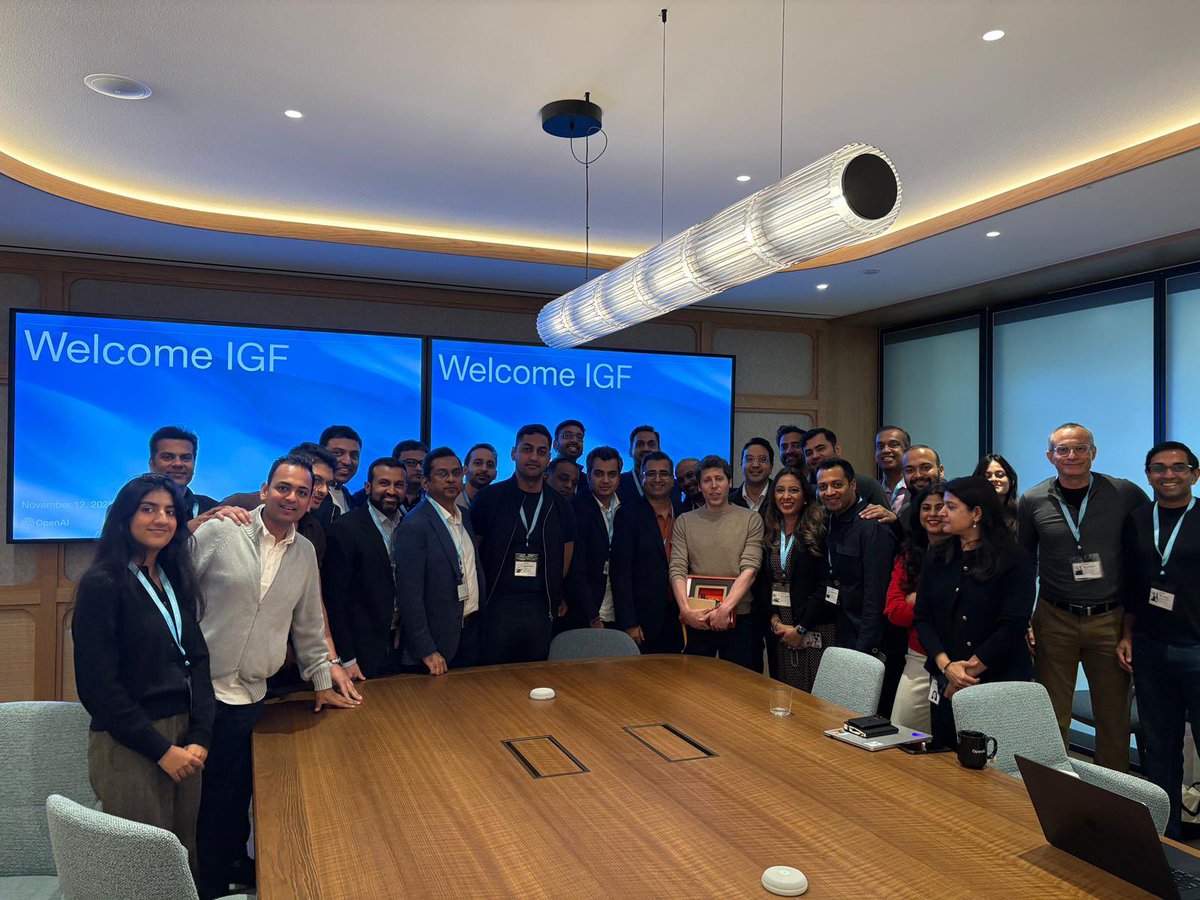
A deeply insightful interaction with Sam Altman at OpenAI HQ today as part of our #IGFUSA 2025 delegation.
Sam spoke powerfully about India’s scale, talent and digital infrastructure — and why India is set to become one of OpenAI’s most important partners in the years ahead.
Our conversation ranged from AI governance and safety to global innovation, skilling, and the next frontiers of productivity.
Proud that India Global Forum continues to build meaningful bridges between India and the world’s leading technology ecosystems.
@IGFupdates
Longevity Economy Sunday Superstar : Piyush Pandey, his life teaches us not to get obsessed with LifeSpan & WealthSpan, we want to be know for impact we had created & generations we inspired and not the position and wealth. Wwww.allagetech.comallagetech.com/2025/10/26/lon…
@harshmadhusudan It's not a skill but a will issue. Either policymakers are worried about slowing of US tech investment into India and it's impact on jobs or we are happy just being a the most important consumer market. Reality is it's a geo political and geo economic risk. Time to act is Now!
"Amazon outage shows EU heads are still in the cloud."
ft.com/content/9e2891…
'Europe and others must insulate their economies from Trump weaponising US tech.'
Applies to India too. Just no a priori tech reason why India cannot have its own cloud giants. This is a policy issue.
@GabbbarSingh Glad Mumbai managed to pull it off, a much-needed infrastructure for the Financial Capital, on a lighter note, at heart we are still a middle class! (which I am very proud of) Despite the opening, plastic wrap has not yet been peeled off the wall just like we do at our home!.
@AsYouNotWish UR missing out on the China & Iran angle, both r already upset, will not give it a free pass. For Pak, it's Army vs Political, China vs the US, Baloch vs Punjab, Pro-Israel vs Anti-Israel, a balancing act may give short-term gains will take a toll in the long run.
If Saudi Arabia formally joins the Abraham Accords, Pakistan will face its most defining diplomatic choice since its creation in 1947. To refuse would be to stand apart from a new Muslim regional order shaped by Washington’s design and Riyadh’s ambition. To accept would overturn decades of rhetoric, reverse long-held ideological positions, and betray what generations of Pakistanis have been taught to regard as an article of faith.
The dilemma is not new, but it has now become unavoidable. Every major foreign policy decision in Pakistan is shaped by the army, the intelligence apparatus, and the civilian elite that survives under their patronage. Public opinion rarely alters the course of these decisions. The current outrage over Pakistan’s endorsement of the US-backed Gaza plan is loud and visible, yet carefully contained. In Pakistan, anger may find a voice but never a veto.
The costs of recognising Israel would be severe. For a country founded in the name of Islam and driven by pan-Islamic narratives, the optics alone would shake its domestic consensus. It would inflame the religious right, embarrass the clerical establishment, and provide Islamist parties a ready cause. For decades, Pakistan has framed the Palestinian struggle as a moral extension of its hostility towards India. Reversing course now would demand not just a policy shift but a cultural unlearning.
Within the corridors of power, the debate is about survival. A normalisation with Israel would grant Pakistan the favour of Washington, easy access to Western financial institutions, and open, discreet channels to Israeli technology, particularly in agriculture and cybersecurity. For an economy perpetually on the brink, such incentives are tempting.
Riyadh’s trajectory is decisive. Pakistan’s foreign policy has long mirrored Saudi choices. From recognising the Taliban in the 1990s to joining the Islamic Military Alliance and maintaining strategic ambiguity on Iran, Islamabad has rarely deviated from Riyadh’s line. If the Kingdom signs the Abraham Accords, Pakistan will face irresistible pressure to follow.
The Saudi-Pakistan security pact further institutionalises this alignment. Pakistan has now officially tied its security calculus to Saudi strategic choices. If Riyadh embraces Israel, Islamabad’s autonomy will be constrained.
Signals are already visible. Shehbaz Sharif’s picture with Daniel Rosen of the American Jewish Congress and the controversy around Shama Junejo, spotted behind the Defence Minister at the United Nations despite her pro-Israel views, suggest the taboo is being tested. Islamabad is quietly preparing its domestic audience for an eventual shift.
Pakistan’s foreign policy is rarely driven by conviction. It is steered by compulsion. The military sees strategic flexibility as survival. If Washington demands a moderated stance on Israel, the establishment will likely oblige, provided the economic lifeline is visible.
Public resistance will not vanish. Decades of propaganda cannot be undone by a few gestures. The street still venerates Palestine as a sacred cause, and even the elite find it politically perilous to appear sympathetic to Israel. For now, Islamabad may attempt symbolic engagement, cultural, humanitarian, or multilateral, without full recognition. Such measures could gauge public tolerance before irreversible steps.
The transformation, if it comes, will be gradual. Pakistan’s policy towards Israel has shifted through unofficial contacts, back-channel dialogues, and selective silence. What was once unthinkable is now inconvenient. The country is entering a phase of cautious testing where ideology yields to necessity.
In the end, when debt, dependency, and diplomatic isolation converge, even the most sacred principles can be repackaged as pragmatism. Recognition of Israel may still appear distant, but its outlines are already visible. The taboo has not yet been broken, but it is no longer unbreakable.
@Ravisutanjani We need an increase in usage otherwise it will end with downloads. We need an inflexion point and an idea that will trigger an increase in usage.
🚨 Arattai is Seeing 100x Increase in Signups
Daily New Signup is Around 3.5 Lakh Users
Cabinet Ministers are Endorsing The App
What Can Increase The Adoption Even Further?
@TheNavroopSingh Look at ISRO & Defence Institutions now, they have none of the layering u talked about, they have PM backing, funding, & government projects and they are delivering. The groups you talked about come with either a trader or a protector mindset not a disruptor mindset which we need
The Government of India should form a Tech Fund for AI, Automation, Robotics, Cloud etc in various fields just like Stargate in USA. The Government should begin the fund with initial contribution, nudge the big corporates to contribute & commit sums to development of technology, products & vertical integration in various sectors from Telecom to Defence to IT sector.
The fund must chaired by the PMO, with big corporate representatives in attendance along with ministers and secretaries, officio members of Niti Ayog. Every corporate must spell out what Tech R&D, Product Development are they initiating, the time line & the policy support they need from Government.
Part of this corpus should be put in funding education/scholarships in premier Engineering, Technology institutes in country & a commitment of that talent to be absorbed by these companies to make sure best talent is absorbed and promoted.
Mandate CSR by companies & a portion of tech fund to be used for startups, setup one window clearances for such startups and amend the IP rules to give them fast track patents. Hold regular stock taking of the progress made by these companies.
As Niti Ayog to form a panel of domain specialists to give a report of future technologies, R&D & raw materials that may be required for vertical integration. Map out the availability of the same in India & do joint ventures globally to source that if not available in India.
The work on establishing this Tech Fund should begin ASAP without bureaucratic delay of first a report, then meeting, then implementing. The Fund must get running and regular meeting the these corporate honchos.
@UpdatesChennai Only if it were written the way you had mentioned - AraTai makes it so easy its not the name the issue is difficulty in pronouncing it. The double tt creates so much difficulty. The fact we have to explain it defeat the purpose.
Arattai : Ara (As in ara from arakku) and ti (As in tie). As simple as that. Wonder why so much fuss about the name. We have names like Meesho, Zomato, Swiggy, Xiaomi etc which has faced no issues... 🤷♂️ #Arattai
@vaitheek@Arattai@svembu Two Reasons for the move. One, it's new so can fill WhatsApp product gaps like Meeting Schedule is a great feature and I hope they add other productivity tools to it. Geopolitical reasons. On name, not good as we want the last mile user to easily pronounce it.
Arattai's problem isn't the brand name, it's quite cool.
I downloaded the app and there's no one from my contacts on Arattai to message. That's also fine as the network will grow.
@Arattai's only problem: What is the ONE strong reason to use it instead of Whatsapp? @svembu
@TheNavroopSingh@narendramodi Interesting to know which are the top IT companies? The reality is we need fresh minds as established minds come with a safe and protective mindset. China made strides it had fresh minds. In the US also its new age who pushed the boundaries not the established one.
India needs massive push on Defence, Renewable energy & Technology. The PM Office (@narendramodi )needs to make a working group on three critical sectors where regular meetings can be held with corporate India to nudge them towards it.
Firstly, We need mega defence capital outlays over next few years given hostile neighbourhood, growing American presence in our backyard & the geo-military alliances that are building up. India needs to be ready with offensive defence systems in bulk from Drones to Missiles to Defence Shields to Airforce jets.
Secondly, We need Renewable energy power generation shift even more focused to free up power grid in urban clusters for Industrial Use,
manufacturing to semi conductor plants to large Data Center farms. Policy incentives, subsidies needs to be doled out for Solar Modules, Battery Storage (BESS), Green Hydrogen & Grid Transmission.
Thirdly, we need dedicated focus on Technology specially AI & Automation. A working group with top Indian IT, Telecom & Data Companies to develop indigenous AI Modules, Domestic Tech alternatives. A dedicated focus on Automation specially in Auto Sector into EVs & Hybrids to spur more adoption of same to reduce dependence on Combustion vehicles & thus Oil imports.
The strategies in these critical sectors can be huge leg up for Indian economy its Infra Capex & Digital Transformation. The focus now has to shift towards new Industry in 21st Century aka Industrial Revolution 4.0.
The private capex has been woefully lagging in last decade to public capex thus it may need that nudge from top & regular consultation on progress on target’s. If India has to get self reliant & grow fast, it needs to pivot & sometimes crisis like the tariffs & trade war serves as perfect catalyst for it.
The Retirement Paradox is one of the most important blind spots ignored by all stakeholders. What it is, why we are here, and what we should do: My Take linkedin.com/posts/nitin-ja…
@SandeepParekh Sandeep, we need reforms in the mindset. Our collective mindsets have not changed with the change in our economic status. Non-compliance with the law is still accepted -breaking lines, traffic rules, bad roads, and unhygienic conditions of a restaurant we are happy to go.
What I say may sound absurd (maybe it is): but most of the reforms of the government of India are now DONE. Direct tax rationalisation, GST reduction, UPI, Jan Dhan on the financial side.
I see the only major reforms pending as bureaucracy reforms (and connected corruption).
@harshmadhusudan We need to learn from Indonesia and China on how they managed data localisation, very firm and we have been at best ambiguous, giving in to the pressure from time to time. The US tech giant needs the Indian market size and we need to leverage that, no free pass and access
Trump-led US is going ahead with 50% tariffs on India. Ukraine and Russia have not announced any summit so far. Trump is threatening more tariffs on anyone with digital taxes or regulations. Clearly an area of concern for him.
Now is the time for India to usher in digital taxes and strict data localisation wrt Foreign Big Tech. You cannot have extra-territorial laws applied and spying done on and in India. And economic opportunity of building our own software/net/AI product giants is huge.
I will repeat for the umpteenth time - you cannot reason with a bully. You have to hit back otherwise he will only bully more. Either we bend the knee (which is unacceptable), or gain some leverage. India’s strength in IT/GCC services is just that - a strength, not a liability. Let’s move ahead.
@CoderUday@CoderUday it is not a one-way street, India has also given tremendous access to American Tech Companies. After the US India has the highest number of subscribers. Chian blocked them, EU out Regulatory restrictions India has not. Sam Altman said India is their biggest market
It might be controversial but....
India should not anger America... Our entire IT is dependent on USA... If USA wants they can crush our entire IT.
"We neither create jobs nor supports merit, but when USA comes to give jobs based on merit... we fight with USA !!"
@tushar15@tushar15 The story gained a lot of currency among the younger generation who may not see the clarification because it will not be distributed as widely. The so called error achieved the desired impact.
Sanjay Kumar's data error is no innocent mistake. It appears to be a part of a planned strategy to cast aspersions against the Election Commission of India. The leftist ecosystem was quick to latch on to that data, also shared by a few Congress fellows. Warrants investigation.
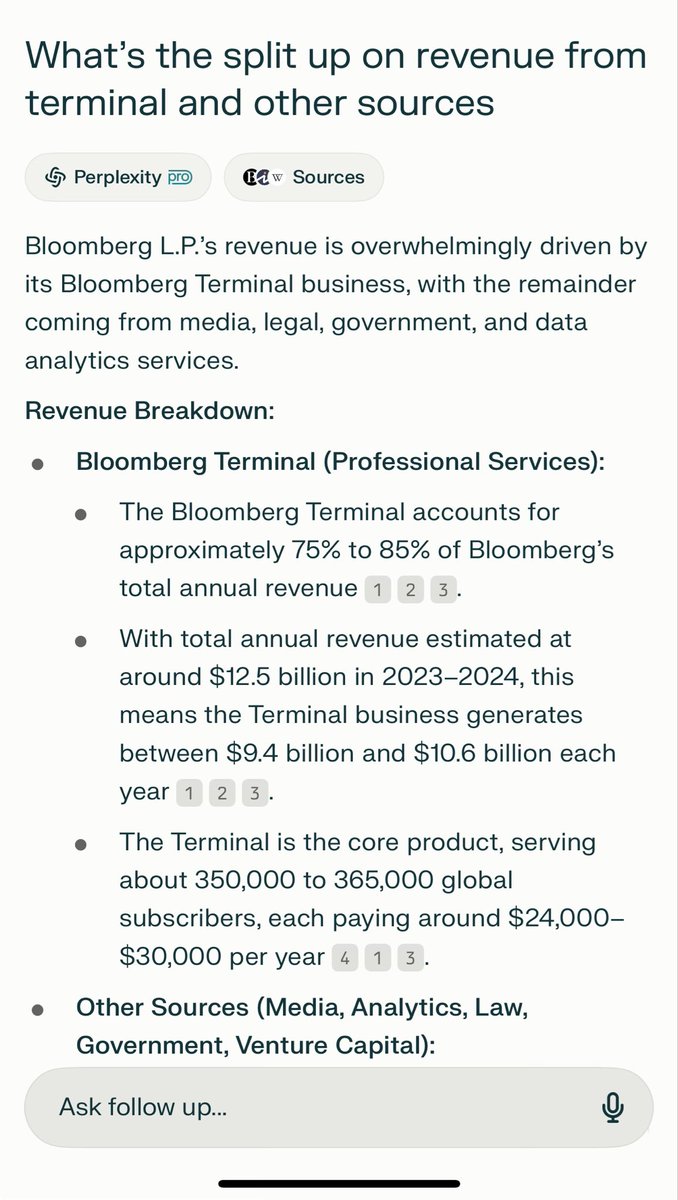
@AravSrinivas Hi @AravSrinivas while the data and analytics can be replicable, its community function - the message and chat which connect the entire global capital markets is Bloomberg biggest strength and an entry barrier.
@harshmadhusudan Spot on, agree with you as these are issues of national security importance & cannot be outsourced. We will be at their mercy all the time. China & Indonesia all have strong data localization policies. The only issue I see here is GCC, how do we manage data localization for them.
The US 'wants India to.. relax rules on data localisation policy, which mandates storage of data on local servers'
economictimes.indiatimes.com/news/economy/f…
India must not give in on data localisation at all.
To become subservient to US Big Tech will be an extremely counter-productive decision.
@AdvMananAgrawal In Singapore, each Building has its own Pincode and it is so easy to navigate. So I see the merit but 10 characters may not make it easy to use. Its not only abiut systems but also about ease of use.
Goodbye PINCODE, Welcome DIGIPIN!
India has officially transitioned into a new era of addressing!
The traditional 6-digit PINCODE is making way for the DIGIPIN — a 10-character alphanumeric digital code that pinpoints your exact geographic location.
(1/2)
@VishalBhargava5 The Location, DLF name and blank canvas are the main draw. One can reach the airport without any traffic lights bypassing Golf Course Road completely. Golf Link, and M3M Golf Estate are good examples of what large canvas with good builders can create. Price is a subjective topic
DLF’s Launch Price of Privana at the undeveloped but blank canvas location of Southern Peripheral Road, Gurgaon
Price of ₹42k/sqft in 50 storey towers.
Not an investors’ price but NCR buyers psyche is different from Mumbai. And DLF aura is overwhelming in Gurgaon.