insight.eth

27.6K posts

insight.eth banner
insight.eth

insight.eth

@insightens

Onchain Strategist | RWA Infrastructure | Capital Flows. Steward of foundational ENS : money.eth | fund.eth | tax.eth | legal.eth | forex.eth | perp.eth

𝕏 Katılım Aralık 2015
1K Takip Edilen1.7K Takipçiler
Sabitlenmiş Tweet
insight.eth
insight.eth@insightens·
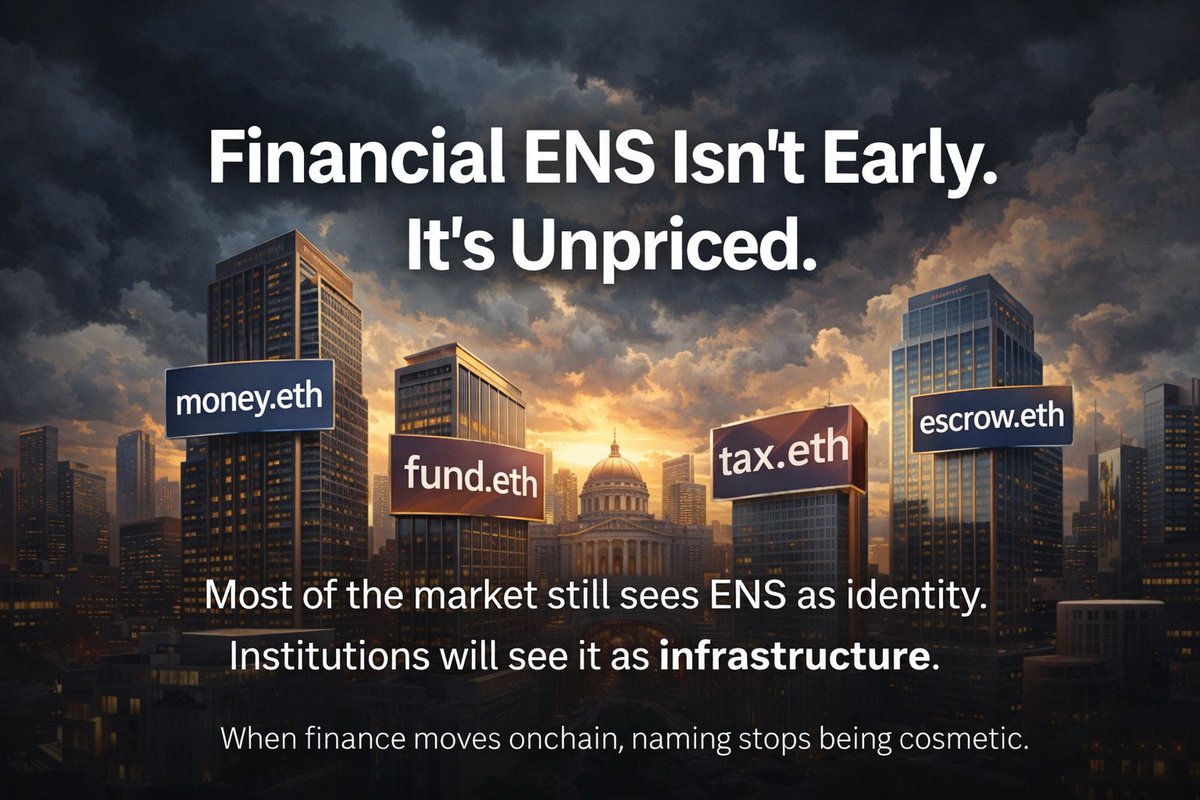
Today, ENS is discussed as usernames, profiles, and culture. That’s not how institutions adopt systems. Capital doesn’t care about identity it cares about clarity, settlement, trust boundaries, and jurisdiction. When those functions move onchain, a small set of financial root words stop being optional and start becoming load-bearing. The future of institutional ENS won’t be loud. It will be structural.
insight.eth tweet media
English
2
4
20
766
insight.eth
insight.eth@insightens·
Onchain finance has a naming problem it hasn’t articulated yet. Circle builds on money but doesn’t control money.eth.BlackRock tokenizes funds but doesn’t control fund.eth.Custody providers offer escrow but don’t control escrow.eth. Every institution is building on vocabulary they don’t own at the infrastructure layer. That’s a coordination failure waiting to be solved.
English
0
0
1
34
insight.eth
insight.eth@insightens·
BlackRock tokenized a money market fund and called it BUIDL. They needed a brand name for the product. They didn’t need money.eth the namespace entry for the category itself. Yet. I steward money.eth | fund.eth | escrow.eth | legal.eth | tax.eth | kyc.eth | charge.eth…. Not as collectibles. As the categorical vocabulary layer institutions will eventually need to coordinate around. The gap between “building products” and “controlling the namespace” is closing. Most institutions haven’t noticed.
English
0
0
1
47
insight.eth
insight.eth@insightens·
money.eth isn’t a brand name. It’s a namespace entry for the foundational concept of institutional finance — registered on public, persistent, programmable infrastructure. Circle has $40B in stablecoin issuance.Tether processes more volume than Visa.PayPal, Stripe, and Revolut are all building on stablecoins. None of them own the word “money” at the protocol naming layer. At some point, that’s not a branding decision. It’s a strategic oversight. The window where this domain is available to the entities that would benefit most is not indefinite.
English
0
0
2
48
insight.eth
insight.eth@insightens·
I represent S-tier single word ENS domains that represent the core operational vocabulary of institutional finance… money.eth, fund.eth, escrow.eth, legal.eth, tax.eth, kyc.eth…and others These aren’t collectibles. They’re namespace positions in the coordination layer of on-chain finance. The institutions building that infrastructure are already here. They have the capital. They have the operational need. They don’t yet own the words they’ll eventually need to name what they’re building. That’s a timing question, not a valuation question.
English
5
0
19
572
insight.eth retweetledi
insight.eth
insight.eth@insightens·
Today, ENS is discussed as usernames, profiles, and culture. That’s not how institutions adopt systems. Capital doesn’t care about identity it cares about clarity, settlement, trust boundaries, and jurisdiction. When those functions move onchain, a small set of financial root words stop being optional and start becoming load-bearing. The future of institutional ENS won’t be loud. It will be structural.
insight.eth tweet media
English
2
4
20
766
insight.eth
insight.eth@insightens·
@OndoFinance Five institutional moves in one week. Barclays, Coinbase, Revolut, Meta, Binance. The tokenized era is here. The question is whether identity infrastructure will be ready when institutions deploy at scale.
English
0
0
2
168
Ondo Finance
Ondo Finance@OndoFinance·
Finance is entering its tokenized era. Leading institutions across legacy finance, fintech, tech, and crypto all made major moves over the past week. Weekly tokenization roundup ↓ 1️⃣ Barclays accelerates push into stablecoins and tokenized deposits According to Bloomberg, the firm is “exploring the use of digital asset technology for various banking services.” pymnts.com/blockchain/202… 2️⃣ Coinbase adds stock trading for U.S. customers Coinbase has launched 24/5 stock and ETF trading. The company also plans to offer tokenized stocks in the future via Coinbase Tokenize. finextra.com/newsarticle/47… 3️⃣ Revolut among cohort testing stablecoin plans with the FCA The UK’s Financial Conduct Authority (FCA) is allowing firms to test stablecoin products in real-world conditions within a regulatory sandbox. finextra.com/newsarticle/47… 4️⃣ Meta plans to support stablecoins Meta is planning to launch stablecoin-backed payments and a new crypto wallet in the second half of 2026. coindesk.com/business/2026/… 5️⃣ Ondo and Binance bring tokenized stocks to hundreds of millions AAPLon, AMZNon, CRCLon, GOOGLon, METAon, MSFTon, NVDAon, QQQon, TSLAon are now accessible on Binance Alpha. x.com/OndoFinance/st…
English
64
93
612
26.5K
insight.eth
insight.eth@insightens·
@Grayscale @LowBeta @Cointelegraph The institutional era is here. The institutional-grade identity infrastructure isn’t…yet. Public blockchains are integrating into finance. But counterparty verification still routes offchain.
English
5
0
0
71
Grayscale
Grayscale@Grayscale·
“There’s no going back.” Public blockchains are being integrated into the global financial system — full stop. Stablecoins, tokenized assets, prediction markets; the institutional era of crypto is here. Grayscale Head of Research Zach Pandl @LowBeta on @Cointelegraph.
English
15
23
140
16.5K
insight.eth
insight.eth@insightens·
@AriannaSimpson Onchain identity is permanent infrastructure…agreed. The question is whether it gets built as fragmented, platform specific solutions or as a canonical layer that works everywhere.
English
0
0
0
48
AriannaSimpson.eth
AriannaSimpson.eth@AriannaSimpson·
"Is crypto dead?" is now a boring question. It's survived enough cycles. The real question: which parts are becoming permanent infrastructure? Stablecoins. On-chain identity. Programmable finance. The speculation layer was always the means, not the end.
English
21
6
104
7.2K
insight.eth
insight.eth@insightens·
@HHorsley Allocators drive capital at scale. But capital at scale requires verified counterparties. Morgan Stanley custodying crypto is step one. Verifying who they’re allocating to onchain is step two.
English
0
0
0
60
insight.eth
insight.eth@insightens·
@circle The highways for value movement are here. The highways for identity resolution aren’t yet. Cross chain interoperability works for assets. It breaks for counterparties.
English
0
0
0
190
Circle
Circle@circle·
Interoperability is becoming core Internet infrastructure. We’re building capabilities like CCTP that allow tokenized stocks, funds, bank deposits, and stablecoins to travel seamlessly cross-chain. The highways for value movement are here.
English
16
44
228
38.5K
insight.eth
insight.eth@insightens·
@circle @jerallaire The velocity of money increases when friction disappears. Circle’s removing friction from value transfer. The remaining friction is counterparty verification and that’s still offchain.
English
0
0
0
15
Jeremy Allaire - jda.eth / jdallaire.sol
Increasing the velocity of money will increase global economic prosperity, especially alongside the radically increasing velocity of work performed by software agents.
Circle@circle

“The velocity of money is about to increase by orders of magnitude.” - @jerallaire As AI agents transact autonomously, we need new economic infrastructure. We’re building the Internet financial system at the intersection of AI, stablecoins, and blockchains.

English
7
11
106
9K
insight.eth
insight.eth@insightens·
@circle @jerallaire AI, internet native money, and programmable infrastructure converging into the greatest economic acceleration in history. The missing variable…who are all these agents transacting with? Identity infrastructure is the fourth pillar.
English
0
0
0
211
Circle
Circle@circle·
We’re entering a new economic era, where AI, internet-native money, and programmable infrastructure converge. This may drive the greatest acceleration of economic activity in human history. And from @jerallaire, we’re just getting started.
English
23
59
297
38.8K
insight.eth
insight.eth@insightens·
@jerallaire Agents will need programmable dollars. They’ll also need verifiable identities. Circle is building the value transfer layer. The missing piece is who agents are transferring value to.
English
1
0
1
764
Jeremy Allaire - jda.eth / jdallaire.sol
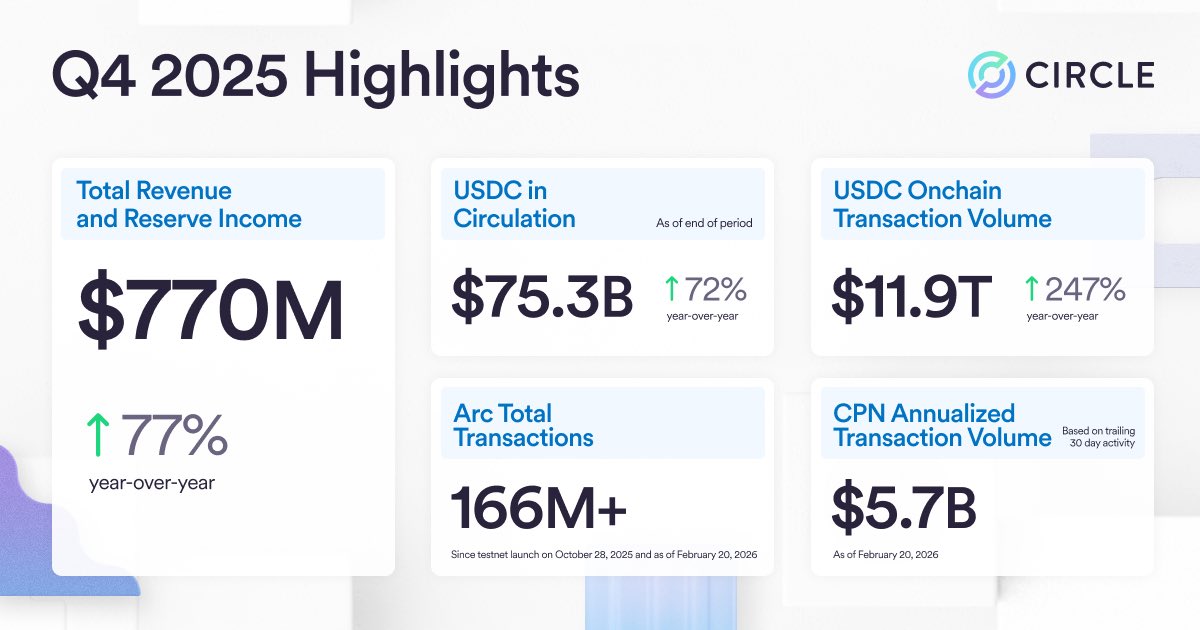
We're at an inflection point. The internet is evolving from moving information to moving value. Blockchain, stablecoins, and AI aren't separate trends — they're converging into something much bigger: a reimagined global economic system, built natively on the internet. We are entering a world where, in my view, tens or even hundreds of billions of AI agents will interact and perform economic functions over the internet. They'll need programmable digital dollars and open infrastructure to do it. That's exactly what we've been building at Circle. Circle’s Q4 showed this isn't just a vision anymore — it's happening. USDC expansion continued, our share of stablecoin transaction volume approached 50%, and our broader platform expanded well beyond issuance into the infrastructure layer of onchain finance. Arc. CCTP. Circle Payments Network. StableFX. Each one a building block for what comes next. The opportunity ahead has never been greater. And we're just getting started. Full results at investor.circle.com
Jeremy Allaire - jda.eth / jdallaire.sol tweet media
English
113
218
1.2K
283.9K
insight.eth
insight.eth@insightens·
@circle Agents need programmable money. They also need verifiable identity. USDC lets agents move value. But who are they moving it to? That’s the missing layer.
English
0
0
0
141
Circle
Circle@circle·
Circle has joined the Agentic AI Foundation. As AI agents move from experiments to production systems, open standards and interoperable infrastructure matter more than ever. Programmable, internet-native money will be foundational to the agentic economy. Agents need a trusted way to move value globally, in real time. We’re building for that future: aaif.io/press/agentic-…
Circle tweet media
English
47
86
561
42.3K
insight.eth
insight.eth@insightens·
@OndoFinance Five major institutional moves in one week. The tokenization era is underway. But every one of these announcements has the same unresolved dependency: verified counterparty identity at the settlement layer.
English
0
0
0
215
Ondo Finance
Ondo Finance@OndoFinance·
The tokenization era is underway. This week: the SEC set new stablecoin rules, U.S. banks launched a deposit token network, and two of the world's largest asset managers went onchain. Latest tokenization news ↓ 1️⃣ SEC clears the way for broker-dealers to hold stablecoins as working capital New SEC staff guidance sets a 2% haircut on stablecoin positions for broker-dealers, clearing a path for their use in securities settlement. ledgerinsights.com/sec-sets-2-hai… 2️⃣ U.S. banks to test deposit token network Five U.S. regional banks are testing Cari, a deposit token network designed to enable 24/7 instant payments using FDIC-insured tokenized deposits. bloomberg.com/news/articles/… 3️⃣ State Street launches Digital Asset Platform State Street is building out a full digital asset suite, including tokenized Money Market Funds, ETFs, tokenized deposits, and stablecoins. bloomberg.com/news/articles/… 4️⃣ BNP Paribas taps Ethereum for new money market fund tokenization pilot BNP Paribas Asset Management is piloting a tokenized money market fund on Ethereum, marking one of the first blockchain-based fund issuances out of France. theblock.co/post/390686/bn… 5️⃣ Ondo is the first to adopt Fidelity Center for Applied Technology's DVN The Ondo Bridge now leverages FCAT’s DVN on LayerZero, bringing institutional-grade verification to cross-chain transfers. x.com/OndoFinance/st…
English
52
109
564
25.7K
insight.eth
insight.eth@insightens·
Zeus nails the RWA reality check…tokenization doesn’t fix bad incentives, and retail needs to ask harder questions about risk positioning. But there’s a layer underneath this that makes the transparency he’s calling for possible — or impossible. “Real time reporting. Onchain waterfalls. Visible collateral tracking. Public performance history.” All of this depends on knowing who you’re looking at. Who’s the borrower? Who’s the servicer? Who takes first loss? Where do I sit in the capital stack? Right now, those questions get answered offchain — if they get answered at all. Investor decks, legal docs, trust-me disclosures. Even when the asset is onchain, identity verification routes through the same opaque intermediaries Zeus is warning about. The missing infrastructure isn’t just transparent reporting. It’s verified counterparty identity at the protocol level something that lets investors trustlessly answer: who is this issuer? What’s their track record? Are they who they claim to be? Without that, “onchain transparency” is just better UX on the same trust model. Institutional-grade packaging with a wallet address. Zeus is right. We get to decide if the rails are built for transparency or just distribution. Identity infrastructure is how we make transparency real.
Zeus@ZeusRWA

everyone gets excited when we see blackrock, franklin, wisdom tree, whoever, launching tokenized products. it feels like validation. “institutions are here.” “billions coming onchain.” but are we just relying on the same institutions that built the old system to now decide what gets brought into the new one? and if so, what exactly are they going to sell us? institutions don’t tokenize assets out of kindness. most of them probably don’t give a shit about you. they tokenize for distribution. lower funding costs. wider investor base. more liquidity. balance sheet relief. so ask yourself this: if they have a pristine, oversubscribed, low risk, cash flowing asset… why would they need us? most prime assets already get funded. family offices, pension funds, private credit desks aren’t short of capital for high quality deals. so when something needs alternative rails, you at least have to consider why. this isn’t me saying everything onchain is bad. it’s me saying incentives matter. and incentives don’t magically disappear because something is on a blockchain. we’ve seen this movie before. mortgage tranches sold to investors who didn’t understand the underlying risk. real estate syndications marketed with fancy ass brochures and optimistic projections. private credit structures where retail doesn’t actually know where they sit in the waterfall. tokenization doesn’t automatically fix that. it can improve transparency, but only if the transparency is real. only if you can see who’s borrowing, what’s the collateral, who takes first loss, where you sit in the capital stack, and what happens if cash flow slows. otherwise it’s just the same product with a wallet address. real estate is the perfect example. a developer who can’t raise capital traditionally might look at tokenization and think, cool, global retail liquidity. that doesn’t mean they’re evil. it just means distribution has expanded. and when distribution expands, standards can slip if investors don’t ask questions. most retail don’t read the facility agreement. they read the projected irR. they see “20% target.” they see “institutional grade.” but institutional grade doesn’t mean risk free. it means professionally packaged. big difference. some lower quality assets will absolutely find their way onchain. We all know that’s not a blockchain problem. that’s a capital markets problem. every market has good actors, opportunists, and outright bad actors. the difference with rwas is this. we actually have the chance to build something better. real time reporting. onchain waterfalls. visible collateral tracking. public performance history. the space won’t mature because institutions show up. it will mature because investors become wiser. so the real question isn’t “are institutions coming?” it’s “where do i sit in the risk?” am i senior? am i mezz? am i junior equity in a speculative development? who absorbs losses before me? what happens if rates stay high? what happens if the exit doesn’t happen? because if you don’t know that, you’re not investing. you’re hoping. i’m not anti rwa. i’m not anti institution. i’m not anti real estate tokenization. i’m anti blind allocation. neo finance doesn’t mean we switch our brains off because the asset is in a wallet instead of a booklet. if anything, we need to be more aware. because this time, we can actually see the rails being built. and we get to decide whether they’re built for transparency or just better distribution.


English
0
0
0
128
insight.eth
insight.eth@insightens·
EIP-8004 and attestation frameworks are foundational agreed. The gap I see is canonical resolution at the settlement layer. Three concrete cases… Cross-L2 institutional flows: Institution on Optimism verifying counterparty on Arbitrum — no standardized resolver. Routes back to offchain custodian APIs. Agent commerce: Circle’s robot dog demo works, but who’s the accountable principal when an agent initiates a USDC payment? Attestations exist but no canonical way to resolve it trustlessly. Tokenized assets: BNP exploring MMFs on public blockchain, Ondo bringing stocks to DeFi. Both hit the same wall: “How do we verify this counterparty?” Answer today: offchain KYC, reintroducing gatekeepers. The gap isn’t attestations existing — it’s ubiquitous resolution infrastructure where every chain, protocol, and agent can answer “who is this?” as trustlessly as Ethereum answers “did this execute?”
English
0
0
0
26
William Mougayar
William Mougayar@wmougayar·
@insightens They exist, eg 8004. What did you have in mind specifically, and for which use cases?
English
1
0
0
394
William Mougayar
William Mougayar@wmougayar·
We need to reframe how we value Ethereum. Not as a blockchain competing with others on some metric, but as a public-goods infrastructure, unlike any other in this space.  My talk presented a valuation model for viewing Ethereum in this important perspective, because if we use the wrong framework, we misprice Ethereum, and that mispricing is happening right now.
YAP Global@YAPGlobalTeam

Zooming out, @wmougayar framed Ethereum as trust infrastructure, not just an asset. @ethereumJoseph (@Consensys) called this the dawn of a decentralised trust supercycle. 🔄 Big picture thinking, with real regulatory movement happening in parallel.

English
8
10
92
6K
insight.eth
insight.eth@insightens·
@TheEtherMachine Neutral infrastructure expands participation. But participation at institutional scale requires knowing who’s participating. Mathematical certainty for execution. Identity uncertainty for counterparties. That’s what’s missing.
English
0
0
0
18
Ether Machine (ETHM)
Ether Machine (ETHM)@TheEtherMachine·
When infrastructure is neutral, it becomes a public good. Ethereum runs code with mathematical certainty for everyone, replacing the human discretion of legacy systems with a clear, programmable path that expands participation.
English
3
6
38
1.1K
insight.eth
insight.eth@insightens·
@TheEtherMachine Ethereum replaces gatekeepers with protocol. But settlement finality only works if you know who you settled with. Cryptographic finality for execution. Identity uncertainty for counterparties. That’s the gap.
English
0
0
0
92
Ether Machine (ETHM)
Ether Machine (ETHM)@TheEtherMachine·
Traditional finance relies on gatekeepers; Ethereum relies on protocol. By replacing intermediaries with cryptographic finality, Ethereum settles billions in stablecoins with the same rules for every user, ensuring a truly neutral and global financial foundation. (Featuring @AK_EtherMachine)
English
6
10
50
1.7K