Ian Marvin
4.8K posts

Ian Marvin
@inthelight_ian
Product designer and lighting person, occasional potter, even more occasional bass player. Personal account, some crossover into business!

London Katılım Ocak 2011
1.4K Takip Edilen748 Takipçiler

@mixoparthenos1 @joerichlaw @thetimes The deselected councillors weren't in the previous Labour administration.
English

@joerichlaw @thetimes Croydon is on record as the worst run council in the UK. Wasting tens of millions £. Corruption has plagued it for years. Maybe that’s the real reason Labour has deselected these individuals.
English

BREAKING: Anger in Croydon Labour as two longstanding popular black Councillors with impeccable records are deselected and Keir Starmer’s niece is imposed by London Party HQ on their safe Labour seat (via @TheTimes) thetimes.com/uk/politics/ar…
English

@AncientGleek @Gengi43 @joerichlaw @japanonmymind @thetimes @jeremycorbyn @zarahsultana @thisisyourparty I don't think there's a deposit needed but both of them have been loyal to the Labour Party over the years and served their community well. It's a travesty really.
English

@Gengi43 @joerichlaw @japanonmymind @thetimes @jeremycorbyn @zarahsultana @thisisyourparty It's too late now - nominations closed on 9th April so unless they were able to raise the deposit and get enough voters to nominate them as independent candidates before then they won't be able to stand.
English

@massdeportsquad @AaronBastani @rj_abel Sent back where? Do we get to choose where we are sent back to?
English

@PeterDClack @Various93891835 The Left lies. It is how they roll. And the cost of retooling these filthy machines would be astronomical in terms of energy used and money spent. Not to mention the birds, whales, and other wildlife that they slaughter.
English

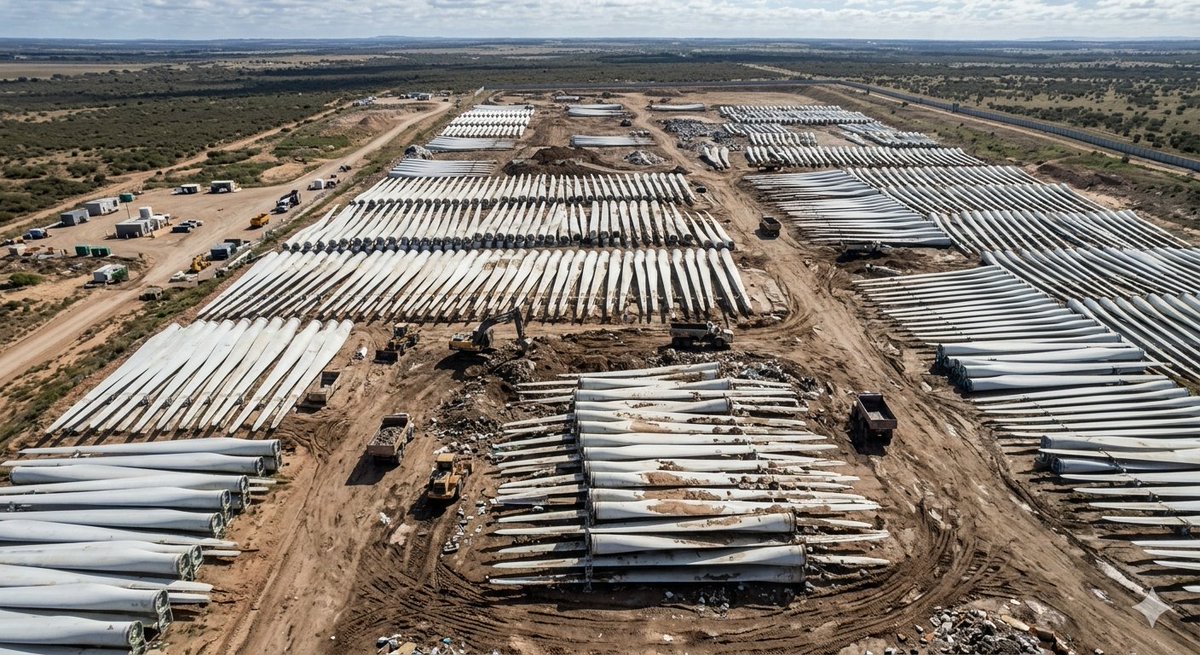
The world will have to deal with 43 million tons of decommissioned wind turbine blades by Net Zero in 2050.
To put that in perspective, it’s the equivalent weight of 215,000 locomotives. These blades are made of high-strength composites designed to survive decades of brutal weather, and they are notoriously difficult to recycle. They were built to last, but they weren't built to disappear.
Every turbine standing today will likely be decommissioned and replaced at least once before 2050. Without a cost-effective way to recycle fibre-reinforced polymers, the majority of these massive blades are destined for eternity - buried forever in turbine graveyards.
China, Europe, and the US will account for the vast majority of this waste, creating a mountainous industrial heartache that many Net Zero models simply haven't priced in.
But 43 million tons of purely composite blade waste every 20 years is a colossal physical reality.

Bega, New South Wales 🇦🇺 English

@Timoldland @lesley22061 As I'd like to charge from a handful of solar panels the fact that it seems to get the same range from 27kWh as others get from 50 odd is appealing too.
English

Great choice of small £25k EVs now covering traditional, modern, retro cool and more. And there are path more being launched in the next year.


Tim Oldland@Timoldland
Interestingly different proposition to the Renault 5 e-Tech. VW very much making ‘just a Polo’, bland safe looks that doesn’t offend. Im sure it’ll sell very well and will convert a lot of Polo buyers to EV especially at the same price point.
English

@rakishanis @willsolfiac Didn't the Turks bring it with them from Mongolia? But Feta is fine to make börek with.
English

@willsolfiac I heard a Bulgarian complain about how Greece imports the vast majority of their feta cheese from them and labels it as Greek before exporting it.
English

@Timoldland @lesley22061 I think the Twingo Is the nicest looking of the lot.
English

@lesley22061 They’re the size and price point above the Twingo.
English

@OdysseusRex @BrilliantMaps That takes me back to a holiday years ago. I remember adverts for lawnmower repairs over a soundtrack of a lawnmower starting and a woman with a van who collected your laundry and returned it ironed. Plus a phone in about whether inbreeding was a bad thing.
English

@gregdraws1 @ZoeJardiniere Closely related to voting Reform for Totally Landlocked District Council to Stop the Boats.
English

@ZoeJardiniere DO NOT ALLOW THE GREEN PARTY TO TAKE CONTROL OF YOUR (checks notes) BIN COLLECTION
English

@inthelight_ian @SamaHoole Thin strips rolled in flour, herbs and 🌶. Flash fried for a few minutes. Leave it still a little pink.
English

Liver and onions was on the kitchen table of roughly every British household in the country, at least once a fortnight, from approximately 1850 to approximately 1985.
A Tuesday meal. Whatever day the butcher had lamb's liver in, or pig's liver if you were further down the week, or ox liver if the household was stretching the budget.
Your mother bought it that afternoon. Still warm, or nearly. Deep burgundy, slick and glossy on the butcher's paper. Half a pound. Tuppence. Change from a shilling.
She sliced it quarter of an inch thick, dusted it in seasoned flour, and laid it in a pan where a pound of onions had been going soft in bacon fat for twenty minutes. Two minutes one side. Two minutes the other. The middle still faintly pink. Overcooked liver was a mortal sin in a British kitchen, spoken of by grandmothers with genuine sadness, the way a priest might discuss a lapsed parishioner.
Pan juices deglazed with water and Worcestershire, poured over. Mashed potato. A pile of cabbage. A rasher of bacon laid across the top if it was a good week.
The whole thing cost, in 1962, approximately 8p per serving. It delivered, in a single plate, the highest concentration of bioavailable vitamin A in any food on earth, more B12 than any supplement will ever contain, haem iron at absorption rates a plant source cannot match, copper, zinc, choline, folate, and selenium.
Nobody called it a superfood. Nobody called anything a superfood. It was called Tuesday.
Then, between 1985 and 2005, liver quietly disappeared. Mothers stopped buying it. The butcher stopped ordering it. The supermarket stopped stocking it. By 2010, most British adults under thirty had never knowingly eaten it.
The word now carries a faint cultural embarrassment. A food your nan ate. Something to move past.
Meanwhile, 20% of British women of childbearing age are anaemic. The NHS prescribes them ferrous sulphate tablets that cause nausea and take six months to address a deficiency one plate of liver a fortnight would correct in weeks.
The women taking the tablets are, in many cases, the granddaughters of the women who ate the liver.
The deficiency is cultural amnesia with a prescription attached.
Your butcher still has lamb's liver in the counter. Ask him. He will be delighted. He might throw in the kidneys.
Flour. Bacon fat. Onions. Four minutes total. Worcestershire. Mashed potato underneath.
The grandmother is gone, but the dish remembers her, and so do you, whether you knew her or not.
Eat it. Pass it on.

English

@LlyrPowell That's a line of parked cars . . . I guess they are all under the speed limit at least.
English

@grantbuttenshaw @paullewismoney That's the broader point being made which is missed by a simplistic headline. If you don't provide support to address the underlying cause of the rough sleeping as well as housing what you say is true. Typically mental and physical health and addictions.
English

@paullewismoney This is ridiculous.
Homeless is a choice most of the time. Give them a house and it will be abandoned in months
English

As I’ve said for more than 50 years the answer to homelessness is to give homeless people a home!
BladeoftheSun@BladeoftheS
Finland gave every homeless person a house and within 6 months 85% had a job and were financially independent. Less crime, less hospital visits, less suffering and even including the cost of the house, LESS COST than the UK/USA method of abandoning them on the streets.
English

@AmrutamBrahmani @WUTangKids I can't work out how his hand is in that position. Maybe it belongs to the guy who left his head on the table.
English

@helensclegel As with the scorpion and the frog, it's in their narure.
English

@secretcardrivre @NotHoodlum That and the plane being drawn into a wind turbine.
English

@BIGmisu @dufitalexis1 I nibbled at them raw, turns out they contain cyanide. Didn't do me a lot of good!
English

You planted this bamboo yourself. With enthusiasm. For a screen. Within two years you regretted it — and within five you understood you could not go back.
Running bamboo (Phyllostachys and related genera) is one of the most frequently self-inflicted garden disasters in Britain. The gardener plants it voluntarily, pays for it, and then pays considerably more to try to remove it.
What the garden centre tells you: fast-growing, evergreen, architectural, forms a screen in two seasons. All true.
What the garden centre does not tell you
The rhizomes of running bamboo (Phyllostachys, Pseudosasa, Sasa, Pleioblastus) spread laterally through the soil at one to two metres per year. They do not grow downward like normal roots — they run horizontally at 15-30cm depth, in every direction, under the lawn, under the border, under the patio, under the neighbour's fence. Every rhizome node produces a new culm that emerges without warning — in the middle of the lawn, between paving stones, through a neighbour's garden.
In three to five years, a bamboo planted as a three-metre screen has rhizomes occupying 50-80 square metres — the entire garden. In ten years they reach neighbouring gardens, irrigation pipes, house foundations, and drainage systems.
Cutting the canes does nothing
Bamboo cut to the ground regrows with more vigour than the year before. Every cut stimulates the rhizomes to produce emergency culms. Cutting weekly for an entire season does not weaken the root system — it causes it to expand faster in search of undisturbed ground.
Digging it out is a serious undertaking
Phyllostachys rhizomes are as hard as beech wood, interlaced in an underground network extending in every direction. Hand digging requires days of work per square metre. Mechanical excavation must reach 50-60cm depth across the entire colonised area — and every rhizome fragment left in the soil starts again. A single forgotten node restarts the problem from zero.
The root barrier
The only reliable way to contain running bamboo is a root barrier — a sheet of HDPE (high-density polyethylene) at least 1.5mm thick, installed at minimum 60cm depth, surrounding the entire planting area before the bamboo goes in. The barrier must be continuous with no joins or weak points. It costs more than the bamboo itself. If it was not installed at planting time — which covers the vast majority of cases — it cannot be retrofitted without excavating everything.
The distinction nobody explains at the garden centre
Running bamboo (Phyllostachys, Pseudosasa, Sasa): rhizomes that travel metres from the original plant. INVASIVE. Never plant without a root barrier.
Clump-forming bamboo (Fargesia, Borinda): rhizomes that grow as a compact clump without running. NOT INVASIVE. Fargesia is the correct choice for a British garden screen — it forms a dense hedge, stays where it is planted, and will not colonise neighbouring gardens.
Eradication protocol
For running bamboo already established, the method with the highest documented success rate is:
Year 1: cut all canes to ground level in June — when the plant has spent its stored energy on new growth and rhizome reserves are at their lowest. Cover the entire colonised area with thick black weed-suppressing membrane, edges weighted or buried. Leave covered for the full season.
Year 2: remove covering in spring. Cut every shoot that emerges immediately. Re-cover. Repeat through the season.
Years 3-4: monitor weekly. Cut every shoot within 24 hours of emergence — a bamboo shoot left for a week is already a metre tall and has re-stocked the rhizomes. Consistency is everything.
Alternative: systemic herbicide (glyphosate) injected into hollow cut stems immediately after cutting in late summer. The same protocol used for Japanese knotweed — to which this problem is closely comparable in persistence and difficulty.
The most architectural screen in the street is also the most expensive to remove. Consider it before planting, not after.

English

@MorssJames @dufitalexis1 We have it splitting 5m marble boulders that came down during the last ice age!
English

@dufitalexis1 Root barrier? lol.
I've seen that push through tarmac, concrete, foundations. anything. About as stupid as planting Leylandi
English