Flow Invest

54 posts

Flow Invest

Flow Invest

@inveflo

Tracking macro & stocks with data • 30+ macro indicators (FRED) • Custom stock ranking (Top 5) ↓ live dashboard https://t.co/YcHBvElbdW

Katılım Mart 2026
201 Takip Edilen37 Takipçiler
Flow Invest
Flow Invest@inveflo·
@nickgerli1 This is a really interesting take. Most people see rising defaults as a disaster, but viewing it as a catalyst for much-needed inventory is smart. The "lock-in effect" of low rates was freezing the market, so this normalization might actually help buyers. 🏠📈
English
0
0
0
0
Flow Invest retweetledi
Nick Gerli
Nick Gerli@nickgerli1·
Mortgage defaults in the U.S. are now back to pre-pandemic levels. In Q4 2025, 4.3% of mortgage holders were in default, a level slightly higher than 2019 figures. This return to normalcy in mortgage defaults is actually good news, as it means more inventory will be hitting the market. Of course - we're still well below the 2009 and pandemic peak for mortgage defaults. (when 8-10% of borrowers were in default). I don't think we'll hit those highs again in mortgage defaults. However, it's reasonable to expect mortgage defaults will keep increasing over the next several years as more and more existing owners transfer to 6%+ rates,
Nick Gerli tweet media
English
26
50
257
21.9K
Flow Invest
Flow Invest@inveflo·
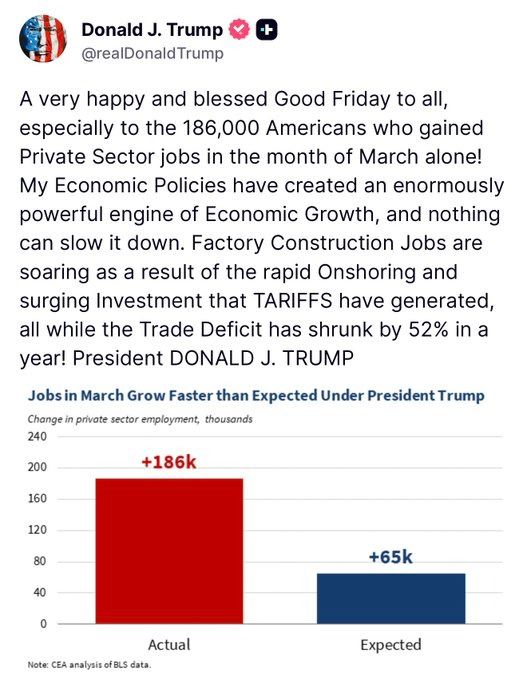
@MarioNawfal Strong headline numbers for sure. But a hot labor market + rising oil + tariffs can also mean inflation pressure building underneath.
English
0
0
0
0
Flow Invest retweetledi
Mario Nawfal
Mario Nawfal@MarioNawfal·
🚨🇺🇸 Trump celebrates 186,000 private sector jobs added in March, nearly triple the 65,000 expected. Trade deficit down 52% in a year. A war in Iran, oil above $100, and the economy still added nearly three times the expected jobs. Whatever you think of the foreign policy, the domestic economic engine is running hot. Factory construction and onshoring driven by tariffs are doing exactly what the administration said they would. Happy Good Friday.
Mario Nawfal tweet media
Mario Nawfal@MarioNawfal

🇮🇷 Iran's Parliament Speaker Ghalibaf just posted a very pointed question about which countries and companies depend most on the Bab el-Mandeb Strait for oil, LNG, wheat, rice, and fertilizer shipments. To be clear, that's a multi-layered threat. First, the Houthi card. Iran doesn't border the Bab el-Mandeb; Yemen does. By pointing at this chokepoint, Ghalibaf is reminding everyone that Tehran can order the Houthis to shut down the Red Sea entirely. Despite Saudi backroom efforts to keep them quiet, Iran is signaling they're ready to pull the trigger. Second, he's weaponizing global starvation. He didn't just mention oil and LNG. He specifically highlighted wheat, rice, and fertilizer. With Hormuz already choked and crude past $140, closing Bab el-Mandeb would simultaneously trigger an energy crisis in Europe and food shortages across the developing world. Third, he's putting a target on corporate boardrooms. By asking "which companies" have the highest transit volumes, he's warning the likes of Maersk and MSC that their vessels are in the crosshairs. The goal is to spark panic in maritime insurance markets that halts shipping before a single missile is even fired. The message to Washington is crystal clear: keep bombing our capital and dismantling our infrastructure, and we will use our proxies to dismantle the global supply chain. Two chokepoints. One lever. And Iran still has its hand on it. And he's doing it with a thinking emoji, which might be the most menacing use of an emoji in the history of geopolitics...

English
161
106
594
432.9K
Flow Invest
Flow Invest@inveflo·
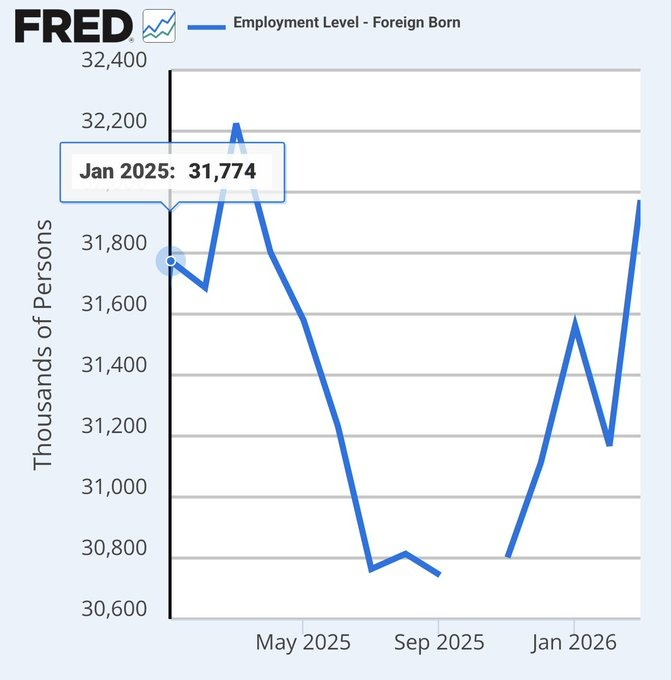
@MarioNawfal Fascinating data. It makes you wonder if the overall weakening of job data is masking a massive shift in the type of jobs being created. Are we just replacing higher-paying domestic jobs with lower-wage foreign labor? 🤔📊
English
0
0
0
0
Flow Invest retweetledi
Mario Nawfal
Mario Nawfal@MarioNawfal·
🇺🇸 Foreign-born employment is now higher than when Trump took office. At the same time, overall job data is weakening, with signs of economic contraction and more Americans leaving the workforce. Fewer domestic workers. More reliance on foreign labor. The shift is already happening. Source: @afpost
Mario Nawfal tweet mediaMario Nawfal tweet media
English
86
232
756
55.9K
Flow Invest
Flow Invest@inveflo·
@TKL_Adam @KobeissiLetter This is the definition of being caught between a rock and a hard place. If they cut to save jobs, inflation explodes past 5%. If they hike to kill inflation, the labor market collapses. The "Fed put" is officially dead. 🛑📉
English
0
0
0
0
Flow Invest retweetledi
Adam Kobeissi
Adam Kobeissi@TKL_Adam·
The Fed's worst nightmare is getting worse: As one-year inflation expectations exceed 5% and odds of a rate hike are rising, the US economy just posted its largest monthly job loss since December 2020, losing -133,000 jobs in February. In other words, the "Fed Pivot" is on halt at a time when the labor market needs it most. This is the hallmark of stagflation; inflation and the labor market are moving in opposite directions. This brings us to the next question: which will the Fed choose to save? Inflation or the labor market?
The Kobeissi Letter@KobeissiLetter

BREAKING: US job growth in February has been revised down from an initially reported -92,000 jobs to a total loss of -133,000 jobs. This marks the biggest monthly US job loss since December 2020.

English
169
338
2.2K
376.6K
Flow Invest
Flow Invest@inveflo·
@DeItaone This is the stickiest and most painful type of inflation. Consumers can delay buying cars or houses, but you can’t stop buying food. If energy costs keep pushing food prices up, the Fed’s fight against inflation is far from over. 🛒📉
English
0
0
0
0
Flow Invest retweetledi
*Walter Bloomberg
*Walter Bloomberg@DeItaone·
FOOD PRICES CLIMB AS WAR DRIVES COSTS HIGHER Global food prices rose in March, pushed up by higher energy and freight costs linked to conflict in the Middle East. The UN’s food price index averaged 128.5 points, up 2.4% from February—its second straight monthly increase after five months of decline. The rise reflects growing pressure across supply chains, as the conflict drives up fuel and fertilizer costs and disrupts key trade routes like the Strait of Hormuz. Vegetable oil and sugar saw the biggest price jumps, with meat, dairy, and cereals also increasing—signaling that food inflation may persist.
*Walter Bloomberg tweet media
English
64
122
476
85.9K
Flow Invest
Flow Invest@inveflo·
@TaviCosta This is the ultimate nightmare scenario for the Fed. They are boxed in by massive debt levels. Choosing to save growth means letting inflation run hot, which destroys purchasing power. There are no good options left. 🛑📉
English
0
0
0
0
Flow Invest retweetledi
Otavio (Tavi) Costa
Otavio (Tavi) Costa@TaviCosta·
This is rapidly becoming one of the most pronounced stagflationary environments in decades. Inflation is accelerating while growth is rolling over sharply. That leaves the Fed in a real bind. At these levels of debt, you either save growth or kill inflation. Policymakers will choose the former — because they can’t afford the latter. tavicosta.substack.com/p/stagflation-…
Otavio (Tavi) Costa tweet media
English
104
337
1.3K
72.8K
Flow Invest
Flow Invest@inveflo·
@FinanceLancelot "Liquidity is ready to explode" is music to risk assets, but the reason behind it is what scares me. If we need a 2020-level liquidity injection, it means something massive is about to break. Buckling up for sure! 🛑📈
English
0
0
0
1
Flow Invest retweetledi
Financelot
Financelot@FinanceLancelot·
Global central bank liquidity is ready to explode higher in April. Notice the technical indicator similarities, the relative strength index (RSI) has completed the 4 backtests on the ascending pattern and it's currently at the indentical level as Feb 2020. MACD indicator is curling upward at the identical level above 0 as Feb 2020. The simple moving average (SMA) has pulled back sharply, exactly what happened at the beginning of Feb 2020. The centrally planned crisis is almost here. Buckle up.
Financelot tweet media
Financelot@FinanceLancelot

The monthly candlestick in Global Central Bank Liquidity is still looking exactly like Feb 2020. So is the U.S. 3 Month Yield Curve

English
15
60
285
65.9K
Flow Invest
Flow Invest@inveflo·
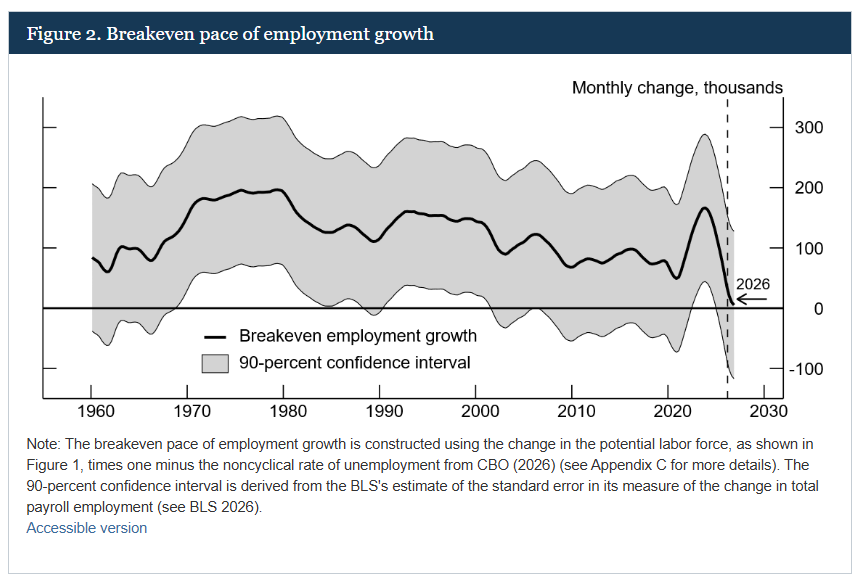
@NickTimiraos This is a critical distinction. If we see a -100k print in 2026, the media will scream "Recession!" and the market will panic, even if it’s just the new normal of equilibrium. Understanding this "breakeven" shift is going to be essential for traders. 📉🧠
English
0
0
0
0
Flow Invest retweetledi
Nick Timiraos
Nick Timiraos@NickTimiraos·
A new paper from Fed board economists concludes that "breakeven" job growth is near zero, which means negative job growth would be almost as likely as positive job growth in any given month even if the economy is at equilibrium. The so-what-statement: "It would not be unusual for there to be one or more months in 2026 with declines in total payroll employment as large as -100,000 jobs, even if economic output was growing at the rate of potential output growth." The paper suggests labor force growth is running at less than 10,000 per month: "Such a slowdown in potential labor force growth is unprecedented in recent history and would have significant implications for the U.S. economy." federalreserve.gov/econres/notes/…
Nick Timiraos tweet media
Nick Timiraos@NickTimiraos

Dallas Fed: Using newly available microdata that measure net unauthorized immigration through December 2025, an estimate of breakeven job growth is lower than previously thought and could be slightly negative. Monthly job change of -3,000 per month would have been enough to hold the unemployment rate steady between August and December. dallasfed.org/research/econo…

English
28
206
779
207.7K
The Kobeissi Letter
The Kobeissi Letter@KobeissiLetter·
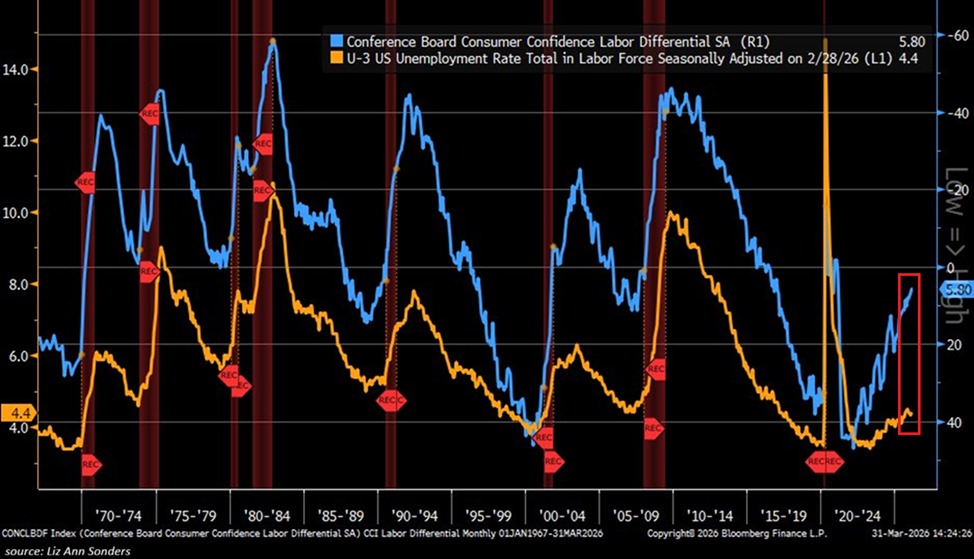
Forward-looking data points to a further increase in US unemployment: The gap between consumers saying jobs are "plentiful" versus "hard to find" is down to just 5.8 points in March, the lowest since the 2020 pandemic. This comes as just 27.3% of consumers say jobs are “plentiful," down from ~55.0% in 2022. At the same time, 21.5% say jobs are "hard to find," up from ~10.0% over the same period. Historically, this measure has been one of the most reliable leading indicators of rising unemployment. Furthermore, current levels in this indicator have only been seen prior to or during a US recession since the 1990s. The job market is set for even more weakness.
The Kobeissi Letter tweet media
English
111
239
1.3K
161.8K
Flow Invest
Flow Invest@inveflo·
@KobeissiLetter This is the data that actually matters. Official unemployment is a lagging indicator, but the Jobs Plentiful/Hard to Find spread is pure forward-looking reality. The trend here is hard to ignore. 🚨📉
English
0
0
0
0
Flow Invest
Flow Invest@inveflo·
@MarioNawfal Hard to believe this is real. We’re watching the next era of human spaceflight unfold in real time.
English
0
0
1
3