Jeff Smith
2.8K posts

Jeff Smith
@j_smith
Building something new. Led Design & Research @Coinbase, design systems @Airbnb, and teams @Facebook
NYC Katılım Mart 2011
1.1K Takip Edilen7K Takipçiler

Stoked to join @ghost team as Head of Brand.
It's a special org and team that can pull me from working for myself. Ghost is that.
The world needs a healthy, independent, information ecosystem. We get to build the best software for that.
John O'Nolan@JohnONolan
Today @Ghost crossed $10M ARR, as a bootstrapped non-profit foundation building open source software. Indie publisher revenue earned with Ghost now ~$130M, and accelerating. The world of technology is shifting rapidly, and so is the world of media, creators and journalism. It's hard to keep up with, and even harder to predict. My strong belief, though, is that open software that you own and control is going to be even more important and relevant in the future than it is now. So we're going to keep building it.
English
@gabrielvaldivia Open weight models on par with proprietary models from Fall ‘25—may not be as gated in the future
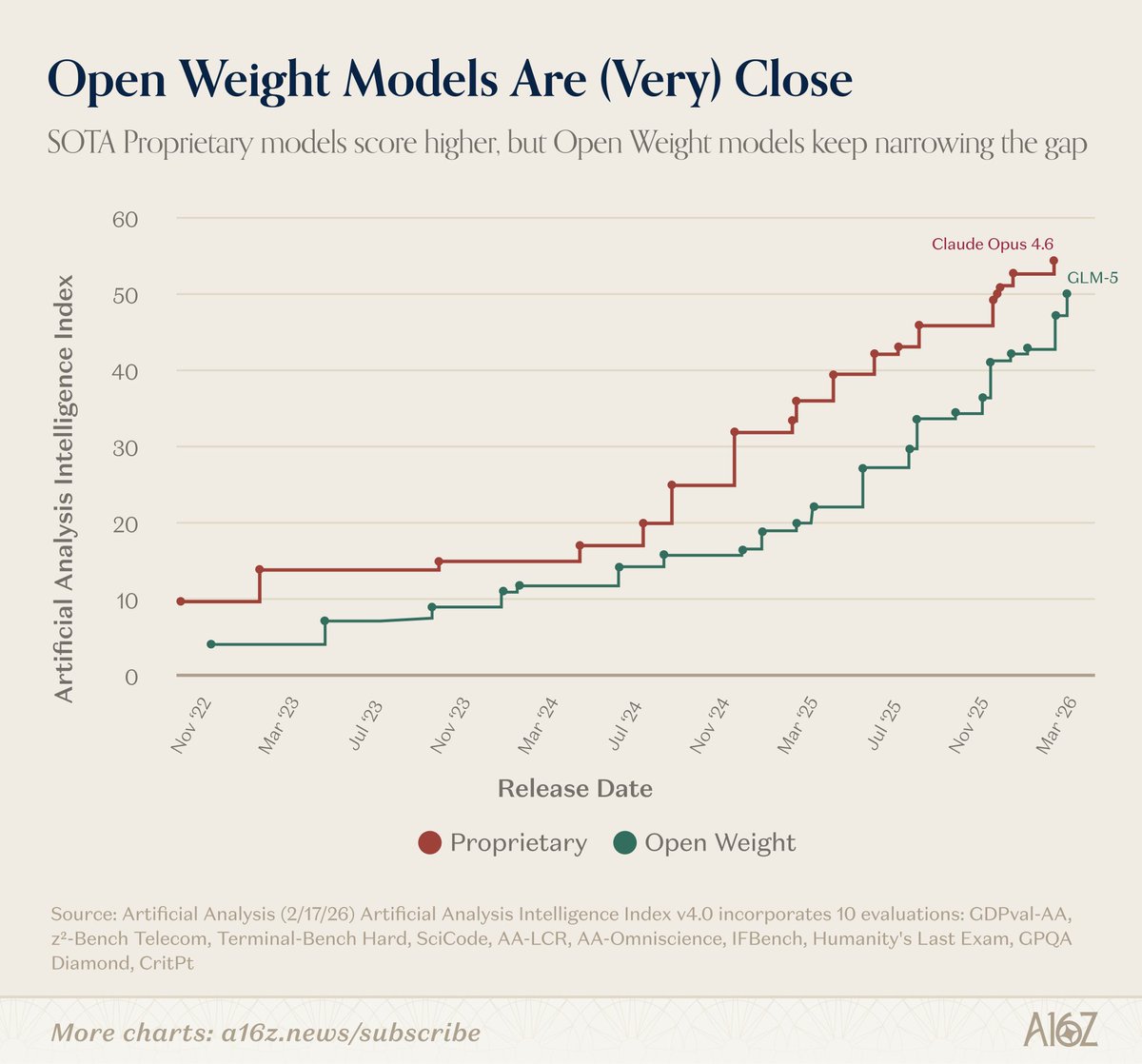
English

We went from $10/month for SaSS, to $20/month for AI, to now $200/month for Claude MAX. And we all know this is the cheapest it'll ever be. Seems like becoming a competitive knowledge worker is becoming increasingly gated by your ability to afford it.
English
Jeff Smith retweetledi

I will argue that the culprit is timing and substrate instability more than design or anything else.
We have simply not had successful consumer AI companies (besides OpenAI and maybe Claude - not Claude Code).
- Inference cost
- Jagged intelligence
- Rapidly changing frontier
- Free ChatGPT good enough for most normies
Intelligence is a new medium. Even there memory, personality, persistence, agent agency, long term planning are not really solved.
I have yet to see an agent harness/scaffolding that survives 6 months. Every new model makes half the bells and whistles unnecessary.
New model capabilities gave a shelf life of a few months before Open Source catches up. You can’t design great consumer UX on a platform that’s still being invented underneath you.
The tech has not settled yet for masses. Even early adopters can’t keep up. Things that have won are those that we had priors for - Chatbots, Coding.
Also don’t think designing for pixels is dead. We are very visual creatures. The shape of what we call “UI” needs to evolve along with a few computing constructs.
The shape of the container of intelligence will be varied and hyper personal.
We are in very very early innings. This is not the iPhone moment. This is pre-Macintosh moment.
alexey@sekachov
i have one upsetting observation: all the beautifully designed AI tools we’ve seen so far (dot, humane, cobot) were basically dead on arrival, while complex, highly technical products (claude code, openclaw) gain mass adoption in seconds. we're definitely missing something.
English
@tommyghung @samdblond Congrats on this milestone! exciting journey ahead
English

I'm a designer who loves simplifying complex systems. Sales is one of the messiest. I joined Monaco as founding designer to build something better with @samdblond and team
One platform that runs sales end-to-end. Automates the busywork, surfaces what matters.
Launching today 👇
English
All resonates.
What doesn't seem clear to me is how companies can compete with the frontier labs and Google.
Tuning an open weight model seems like a reasonable starting point but for all the reasons @jasoncwarner noted has it's limits.
However, training their own models on niche use cases (ex: legal) seems equally unlikely to work against the ever increasing capability of frontier models and corpus of training data Google and to a lesser extent the frontier labs already have.
English
@pistachiomatt @jasoncwarner Relationship is the output imo.
You don’t get to have it without the right inputs in the first place - the model itself.
At the risk of oversimplifying- it’s an execution detail unless the model playing field is somehow leveled/becomes boring infrastructure.
English
Everything collapses into the model.
Really. It’s that simple.
Extremely well articulated post from @jasoncwarner about where is the real moat in tech going forward.
Jason Warner@jasoncwarner
:taps the sign: x.com/jasoncwarner/s… This isn't about Cursor, so forget the name used. This is about what is happening in the world. Cursor, as I understand it, is finetuning chinese models so at least they realize what I'm about to say. Let's walk through this so we fully understand it. In the '90s a bunch of tech companies built out the internet. Those tech companies became critical infrastructure and were massively rewarded for it and became new tech giants. That infrastructure allowed a whole new type of company to exist, companies like Amazon and Google and eventually Facebook. And for companies like Microsoft to make a transition if they could see the future (folks like IBM and Oracle didn't see the future). In the '00s, those same companies built out new critical infrastructure called hyperscaler clouds which enabled a whole new generation of company to exist. Those hyperscalers became the most valuable companies in the world bc they controlled the most valuable commoditized asset on the planet at the time. And the new companies they enabled, the likes of AirBnB, Uber, GitHub, Shopify etc, became great companies in their own right...but nothing like the scale of AWS, Azure, GCP etc. Now it's happening again. Intelligence is becoming the new critical infrastructure upon which every company on the planet will build. It is enabling new types of companies to exist that couldn't before. And like the previous transitions, companies that see this transition can create and capture value in bold new ways. Right now it's down to a handful of companies. Google is the only full stack player: They have dirt, datacenters campuses, TPUs, GCP, and Gemini. By default, they lap the Amazon and Microsoft (don't get me started on Microsoft's continued fumbles here). They are 100% fully vertically integrated. When they got good at building Gemini, it all fell together for them for the next two decades. OpenAI, Anthropic (best independent lab on the planet and only investable frontier lab IMO), and perhaps xAI round out the frontier capable players. Poolside, Chinese labs (with Poolside, the most efficient labs in the world...see notes at bottom), and (perhaps) SSI will eventually become frontier capable. Those round out the list. Three things matter for the next decade: 1. Energy Infrastructure 2. Compute Infrastructure 3. Intelligence Infrastructure Most things after those are rounding errors. 1+2 = powered datacenter campuses 3 = frontier model providers or domain specific model providers 1+2+3 = full vertical integration At Poolside we have a saying which is "Everything collapses into the model" which means that eventually all things we think of as valuable become part of the models (and agents*) that get produced. *Note: first party agents from model providers will *always* be better than third party agents that come from non-model providers. This is simply a reality that modern agents and models are trained together. This really really means a large company producing an agent without backing of it's own model is especially vulnerable. Another way to think of it is that the surface area available to applications is exactly equal to the current capability gaps of this generation models. Each time models become more capable, they eat up more surface area available to third party applications *that are simply arbitraging the current model generation capability gap*. This doesn't mean third party apps aren't valuable, but it does mean if the only value third party apps have is the current capability gaps of models, those third party apps have diminishing value. This is not debatable in 2026. It arguably wasn't debatable when I wrote the post a full two years ago either, except people are really bad at living in an exponential. You know who isn't bad at living in an exponential? Jensen. Nvidia gets exactly what is happening while wall street futzes around with "capex buildout costs", Jensen knows exactly where every gigawatt in the world is going because he knows the future. Do you think you are smarter than Jensen? I know I'm not. How should non-model companies (and companies who are incapable of building models) behave in this moment? It's simple but not easy: Get good at building smaller but still capable models that push *your value prop*. Do not cede your ground to third party model providers hoping you can hold on and survive, you won't be able to with the fullness of time. The tech is just too powerful. If you are a company with a mid double digit billions market cap and above and you are not making models, you are default long-tail dying right now. It is your job to figure out how you don't die. "But Jason, what about data as a moat?" Data is valuable but if your *only* valuable asset is data, you are fighting a multi-pronged war. And if this is true it is even more paramount that you get good at training your own models. My god, this makes the whole thing more existential for you! "But Jason, it costs so much to build models! How can one compete with how much money the model providers raised?" Here's real dirty little secret of the AI industry. That's not real. epoch.ai/data-insights/… OpenAI 2024 compute spend above ^^. It cost them roughly $500m to build frontier model in 2024. But they spend $4.5b on RnD, which means, clusters for their researchers. The dirty little secret of the AI industry is there is no such thing as a gigawatt training cluster, there is no such thing as networking a million GPUs to train a model. The cost to train frontier AI is people with knowledge, a system capable of experimenting to find and iterate on model recipes, and $500m to train the final recipe. The first two are the hard part. The third one is just cost of doing business. And we wrote extensively about Poolside's way of building models which allows Poolside to do things that frontier labs do but at a fraction of the cost and fraction of the time. We call it the Model Factory and it's part of our secret weapons (along with our proprietary RL research): poolside.ai/blog/introduci… Every single company worth double digit billions not getting good at training their own model is the modern equivalent of saying "I can't possibly run a database as good as Oracle therefore I shouldn't try and just pay Oracle to do it" or "It costs too much for me to have engineers build and maintain our software, I'll just pay Accenture and Microsoft to do it". How many of us would build our forever homes (our companies) on two year leased back land (api call to model provider where we pass all our data to them)? I prefer to own the ground my home is built on. Get good at building your company specific models or look back in 10 years and realize you IBMed yourself.
English
@signulll not crazy. if you’ve used @conductor_build, it works well in practice (as long as you have an editor open to make tweaks
English

@tuhin Here’s to the journey! Excited to see what’s (work notwithstanding)
English
Some personal news – Friday was my last day at Luma . I will miss the team dearly.
For now there is no “next”. For the first time in my career, I get to simply take a break.
“I must dream myself back into my own world”
I’m spending the next few months exploring and meandering before dreaming up my next act — focusing on fitness, meditation, creative passions, and conversations with new people and unfamiliar ideas, alongside the people (and pups) closest to me.
It’s a rare moment when so much is changing — how we build, what we can build. But most dear to me is why we build.
And I need to find my own why again.

English


Great to see the final project I worked on at Linear ship. Rearrange the tab bar, create new tabs, make Linear yours.
Excited for the team to keep pushing the app further.
Linear@linear
New for Linear Mobile: Customizable navbar Rearrange and pin tabs, or add specific projects, initiatives, and documents for quick access.
English
@rish_neynar @neynarxyz @farcaster_xyz Congrats, @rish_neynar! Didn’t have this on my bingo card for January
English

Excited to share that @neynarxyz is acquiring @farcaster_xyz.
This means we will now maintain the Farcaster protocol, run the Farcaster client and operate Clanker.
Our vision is to enable builders to go from idea to recurring revenue, supported by a builder-first network.
See more of our thinking in the link in reply
Dan Romero@dwr
Neynar is acquiring Farcaster. Over the next few weeks, we’ll transfer ownership of the protocol contracts and code repositories, the Farcaster app, and Clanker to Neynar. They will run and maintain everything going forward. Some members of the Merkle team, Varun, and I will step back from day-to-day work on Farcaster and move on to something new. Rish, Manan, and the rest of the Neynar team have been building on Farcaster from the start. Neynar was one of the first Farcaster clients, and its infrastructure now powers much of the developer ecosystem. We think they are the right people to take over leadership of Farcaster and they’ll share their new builder-focused vision soon. This wasn’t an easy decision. Farcaster and the people building on it mean a lot to us. We’re proud of what our team built, and what the community built alongside us. But after five years, it’s clear Farcaster needs a new approach and leadership to reach its full potential. We’re excited to see what Farcaster becomes under Neynar, and we’re looking forward to this next chapter.
English

This is an ~average day:
Figma 5%*
Cursor + Claude Code 15%
Ghostty 20%
Conductor 60%
* Figma spikes depending on the stage of the project — I still love a solid canvas for going very wide as fast as possible
Frank@frank_
i've fully converted to @conductor_build — feels like going from typing with two fingers to having eight arms.
English

In a wild turn of events, I’m so stoked to start at @stripe this week.
Being part of one of the most legendary design teams is a dream come true.

English

Tried out the Figma MCP after seeing @j_smith's post (x.com/j_smith/status…) and oh boy.
Figma Make to design file > Figma MCP > Opencode > Opus 4.5 > XCode > iOS Swift app in one shot.
I mean, it's absolutely bonkers at this point. The code is clean, the animations are smooth, the process is effortless. I'm genuinely having an existential crisis over here.
If anyone needs me I'll be eating candy.

Jeff Smith@j_smith
Built an iOS app to track my 2026 daily goals. Used it as an excuse to switch up my workflow (Claude CLI + Figma MCP + Conductor instead of Cursor) and play around with some novel interaction patterns and sound design. Some learnings:
English

The age of personal tool building is upon us. Dream it, you can build it. Designers have a unique role in this future because we understand the important roles craft, beauty, function, usability, originality, and personality, all play in the process of tool building.
Jeff Smith@j_smith
Built an iOS app to track my 2026 daily goals. Used it as an excuse to switch up my workflow (Claude CLI + Figma MCP + Conductor instead of Cursor) and play around with some novel interaction patterns and sound design. Some learnings:
English
@brian_lovin Couldn't imagine you anywhere else. Here's to the next year!
English
One year at Notion! So far: fast, exciting, and deeply interesting...certainly beyond my expectations when we joined. The people here are wonderful, and I'm learning a lot + get to work on futuristic problems with AI every day. Very lucky ❤️
Brian Lovin@brian_lovin
✅ First day at @NotionHQ
English
Fun design detail: @conductor_build's "cities" (workspaces) you've visited.
A lot to like about this product.

Jeff Smith@j_smith
Two tools that I’ve come to love: @usemonologue. More whimsy, less UI, and great dictation. @conductor_build — the team is cooking! Tried it months ago, came back, and barely recognized its thoughtful git worktree integration and opinionated UI. Paired with @linear, each ticket becomes context for a fresh agent in a new worktree. Suggestions on how to set up for Ralph, lmk
English

Built an iOS app to track my 2026 daily goals.
Used it as an excuse to switch up my workflow (Claude CLI + Figma MCP + Conductor instead of Cursor) and play around with some novel interaction patterns and sound design.
Some learnings:
English